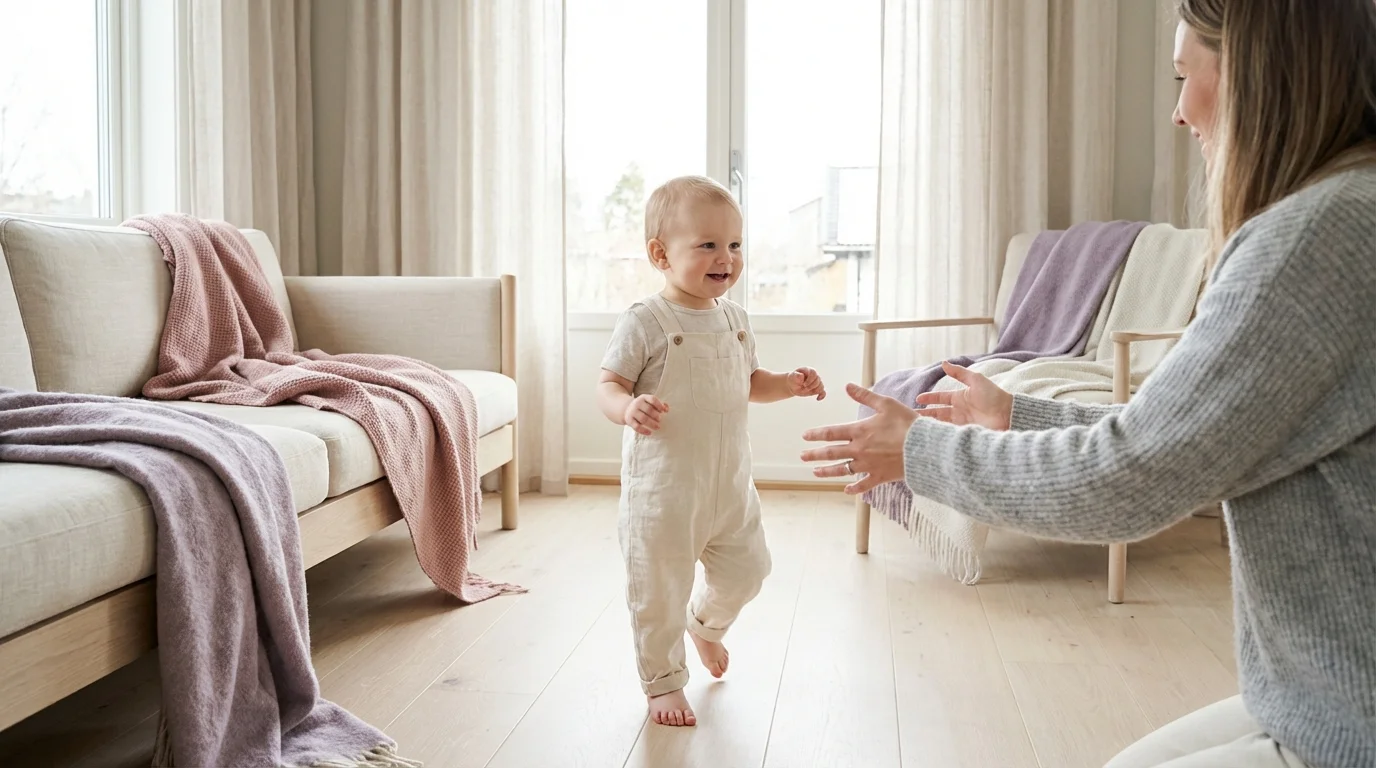
Your baby is turning one, congratulations. The CDC and AAP track 12 month old milestones across four domains: motor, language, social-emotional, and cognitive. Most one-year-olds hit them in a 6-month window (9–15 months), and "early" or "late" within that window is normal. Use the Milestone Tracker to log exactly which ones your child has reached and which to bring up at their 12-month well-child visit.
Developmental Milestones at 12 Months (CDC/AAP)
Most 12 month olds can:
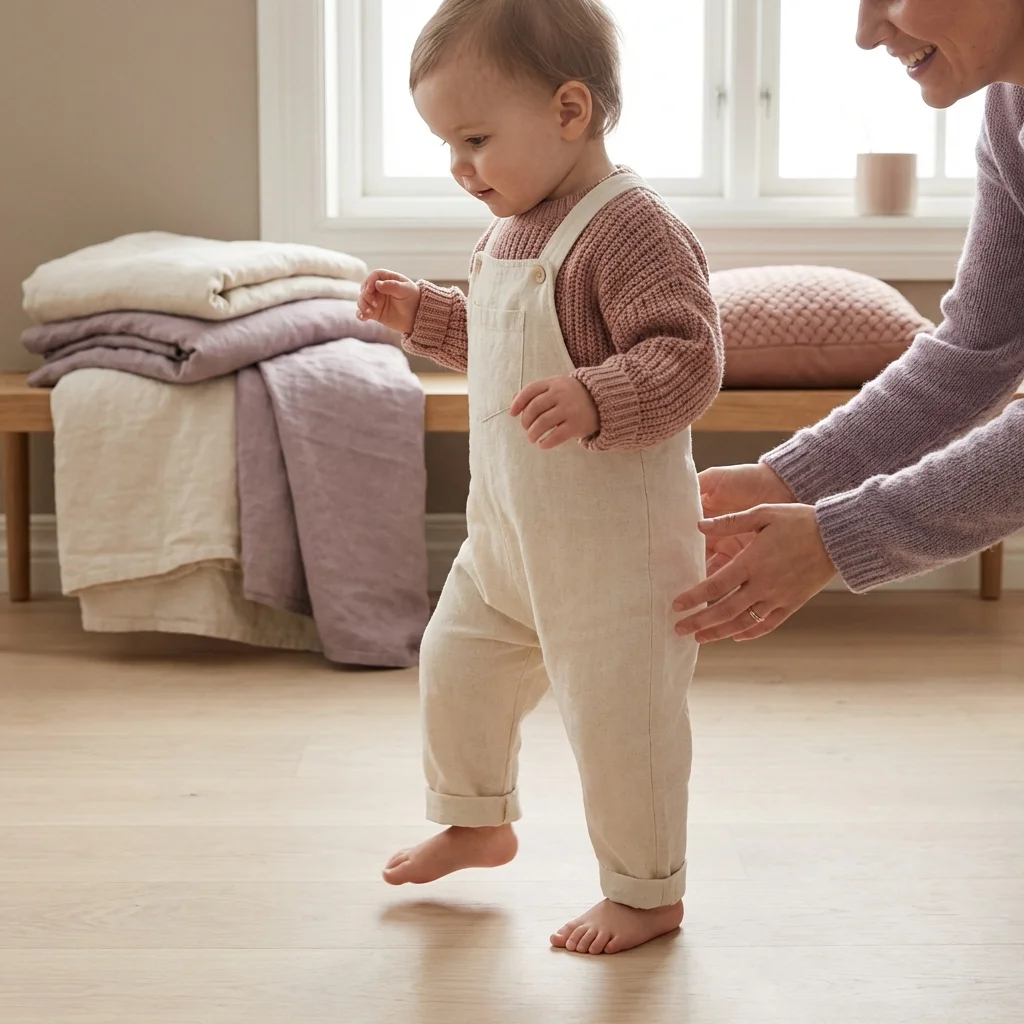
- Pull to stand and cruise along furniture; some take first independent steps (full range is 9–18 months per WHO)
- Use a precise pincer grasp to pick up small foods like a Cheerio
- Say 1–2 words besides "mama" and "dada" with meaning
- Wave bye-bye, clap, and point to ask for something or show interest
- Look for objects they see you hide (object permanence)
- Drink from an open cup with help and feed themselves finger foods
- Understand simple requests like "give me the ball"
Skills the AAP suggests discussing with a pediatrician if missing at 12 months:
- Does not crawl, pull to stand, or move forward in some way
- Does not babble with consonant-vowel sounds (ba-ba, da-da)
- Does not gesture (pointing, waving, reaching)
- Loses skills they previously had
If any of those apply, request a developmental screen, the CDC "Learn the Signs. Act Early." program is the U.S. standard.
Key Takeaways
- First steps vary widely: the normal range is 9–18 months, babies who walk later often develop better coordination from prolonged crawling.
- At 12 months, most children understand 50–100 words, far more than they can say; typical spoken vocabulary is 1–5 meaningful words.
- The AAP recommends zero screen time (except video calls) for children under 18 months, quality face-to-face interaction matters most at this age.
- One-year-olds need 11–14 hours of total sleep per day (including 1–2 naps), according to AAP guidelines.
- At 12 months, babies transition from formula or breast milk to whole cow's milk, the AAP recommends whole milk until age 2 to support brain development.
Motor Development
Gross Motor Skills
Most one-year-olds are in constant motion. Typical for 12 months:
- Crawls confidently and quickly
- Pulls to stand by holding onto furniture
- Cruises along furniture (side-stepping)
- Can stand alone for a few seconds
- Some take first steps, but many wait until 14–18 months
First steps vary enormously. Some children walk at 9 months, others at 18 months. Both are completely normal. Children who crawl for a long time often develop better coordination. Read more about when babies crawl, walk, and talk.
Fine Motor Skills
Hands are becoming increasingly precise:
- Pincer grasp, picks up small things between thumb and index finger
- Points at things that interest them
- Places objects in and takes them out of containers
- Turns pages in board books (often several at a time)
- Feeds themselves finger foods
Language and Communication
Language explodes around the first birthday, even though comprehension is far ahead of what the child can say.
What Most One-Year-Olds Can Do
- Understands 50–100 words (far more than they can say)
- Says 1–5 words with meaning (mama, dada, ball, no)
- Babbling with variation and melody, sounds like conversation
- Understands simple requests such as "give me the ball" or "come here"
- Uses gestures, points, waves, shakes head
How to Stimulate Language
- Talk a lot and describe what you are doing: "Now we're putting on your shoe"
- Read books with pointable pictures
- Sing songs and rhymes
- Allow time for a response, don't answer for your child
Read more about language development and baby sign language.
Sleep at 12 Months
Most one-year-olds need 11–14 hours of sleep per day.
Typical Sleep Pattern
- Night sleep: 10–12 hours
- Daytime naps: 1–2 naps (many transition from two to one nap around 12–15 months)
- Wake windows: 3–4 hours between sleep periods
Common Challenges
- Sleep regression around 12 months is common
- Separation anxiety can make bedtime difficult
- New motor skills (walking) mean your baby wants to practice instead of sleep
Stick with your bedtime routines. Even when your baby protests, consistent routines provide security. Use a sleep tracker to follow your baby's sleep pattern and find what works.
Food and Nutrition
At 12 months, your baby is ready to eat more or less what the rest of the family eats, with some adjustments.
Big Changes at 1 Year
- Whole cow's milk can be introduced as a drink, use whole milk, no more than 16–20 oz (500 ml) per day
- Breast milk or formula can continue in addition, but is no longer nutritionally essential
- Three main meals plus 1–2 snacks
- Family food with adjustments, cut into small pieces, lower sodium
Foods to Focus On
- Iron-rich foods are important, meat, beans, lentils, whole grains. Read about iron-rich foods for babies
- Fatty fish 2–3 times a week for omega-3
- Fruits and vegetables in varied colors
- Bread and grains, choose whole grain varieties
Still avoid: Whole nuts (choking hazard), honey (botulism risk in the first year), rice milk/rice crackers (arsenic), foods high in salt and sugar. Read more about food for one-year-olds.
Social and Emotional Development
Your one-year-old is a little personality with strong opinions.
Typical at 12 Months
- Separation anxiety, protests when you leave the room
- Stranger anxiety, cautious around unfamiliar people
- Shows affection, gives hugs, kisses their stuffed animal
- Imitates parents and older siblings
- Tests limits, does things again after being stopped
- Has a sense of humor, laughs at funny things, does things to see your reaction
How to Support Development
- Be predictable and available
- Provide a secure framework with clear, simple boundaries
- Acknowledge their feelings: "I understand you are sad"
- Play together, pointing games, peek-a-boo, stacking blocks
Read about attachment and interaction and emotional development.
Play and Stimulation
Your one-year-old learns through play. Here are activities that are perfect for this age.
- Stack and knock down, blocks, cups, boxes
- Shape sorter, trains fine motor skills and problem-solving
- Music and dancing, musical play with your baby
- Books, picture books with clear images and simple words
- Sandbox and water play, sensory play
- Ball, roll, throw (and fetch!)
The best toys are simple. Kitchen utensils, cardboard boxes, and balls provide more play value than advanced electronic toys.
Well-Baby Visit at 12 Months
Your pediatrician will schedule a checkup around 12 months. Here they check:
- Height, weight, and head circumference
- Vision and hearing
- Motor development
- Language and communication
- Vaccinations (MMR vaccine is typically given at 12–15 months)
Read more about well-baby checkups.
When Should You Talk to Your Pediatrician?
Contact your pediatrician if your baby at 12 months:
- Does not crawl or move forward in any way
- Does not use gestures (pointing, waving)
- Does not respond to their own name
- Does not bear weight on their legs
- Has lost skills they had previously
Remember that all children develop at their own pace. These points are guidelines, not absolute rules.
Frequently Asked Questions
Is it normal for my baby not to walk at 12 months?
Yes, completely normal. Many children start walking between 12 and 18 months. Some wait until nearly 18 months. As long as your baby moves forward in some way and pulls to stand, there is no reason to worry.
How many words should a one-year-old say?
Most one-year-olds say 1–5 words with meaning. Some say more, some say none yet but communicate with gestures. Comprehension is more important than number of words.
Should I stop breastfeeding at 1 year?
No, there is no reason to stop nursing at 1 year. The WHO recommends breastfeeding until 2 years and beyond. Breastfeeding can continue for as long as mother and baby find it mutually desirable.
Does my baby still need night feeds?
Most one-year-olds do not need nutrition at night if they eat well during the day. Night nursing can continue for closeness and comfort, but is not nutritionally necessary.
How much sleep does a one-year-old need?
11–14 hours per day, including daytime naps. Most have 10–12 hours at night and 1–2 naps during the day.
Summary
Your one-year-old is in a wonderful period of development. Make room for exploration, stick to your routines, and enjoy this exciting time.
Sources: WHO. Child Development, AAP. Developmental Milestones
Sources
- AAP. Developmental milestones for children
- CDC. Learn the Signs. Act Early., milestone tracking
- WHO. Child health and development
🔧 Helpful Tools
- Milestone Tracker. Log which 12-month CDC/AAP milestones your child has reached and which to flag at the well-child visit.
- Development Leaps. Understand the cognitive "leap" weeks that overlap the first birthday and the sleep regressions they cause.
- Sleep Tracker. Log nap counts and night sleep to check the 11–14 hour daily total against AAP recommendations as your baby transitions from 2 naps to 1.
- Food Guide for Toddlers. Help picking finger foods and first cup options for a 12-month-old transitioning off formula or to cow's milk.
📖 Related Articles
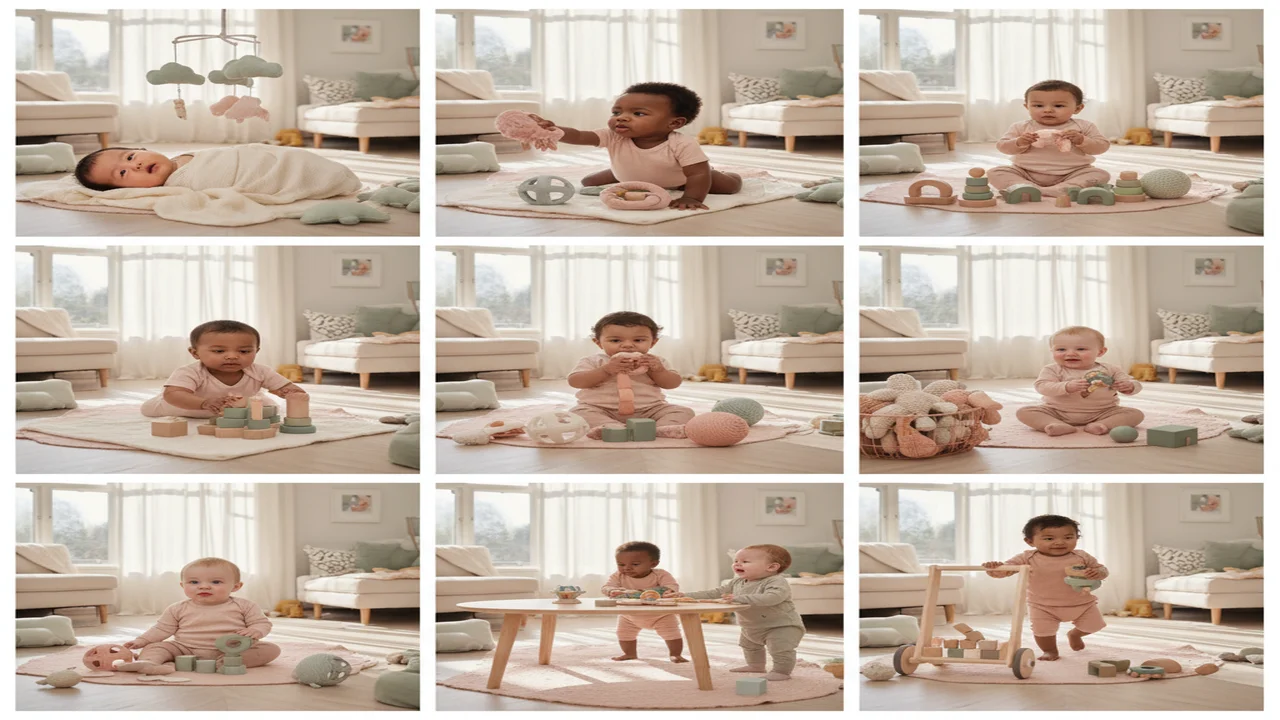
- Baby Development Milestones by Month (0–12 Months). A complete guide to baby developmental milestones from birth to 12 months, including motor, language, social, and cognitive skills, with red flags to watch for.
- When Baby Gets Stuck: How to Help With Motor Development. Baby who rolls but can't roll back? Pulls to stand but can't get down? How to help your child through motor frustration without taking over.
- Baby Motor Development: Milestones from 0 to 12 Months. Follow your baby's motor development month by month. From the first head lift to first steps, what's normal and how to support development?