Your baby understands more than you think. From birth, your child actively listens to your voice, and their brain works at full speed sorting sounds, rhythms, and intonation. Speech development begins long before the first word arrives.
In this guide you will find an overview of speech development from 0 to 3 years, concrete tips for supporting your child, and information about when it may be time to seek help.
Speech Development Happens Faster Than You Think
Children learn language at a pace that surprises most parents. From the first cooing sounds to full sentences takes only a couple of years. According to health authorities, there is wide variation in when children reach different speech milestones, but the sequence is quite similar for everyone.
The most important thing you can do as a parent is to talk with your child, a lot and often. Research shows that children who hear many words throughout the day develop a larger vocabulary and better language comprehension.
Speech Development Milestones by Age
0–3 Months: Cooing and Vowels
Newborns recognize your voice from birth. In the first months, the baby begins with soft cooing and vowel sounds like "aaah" and "oooh." The child reacts to voices by going quiet, turning their head, or smiling.
- Cries to signal needs
- Calms at familiar voices
- Makes cooing and small vowel sounds
- Smiles in response to faces (from around 6 weeks)
4–6 Months: Babbling Begins
Now come the classic babbling stages. The baby tries consonant-vowel combinations like "ba-ba" and "da-da." Laughter bursts out, and the baby experiments with volume and pitch.
- Babbles with consonant-vowel combinations
- Laughs out loud for the first time
- Responds to their own name
- Changes tone, can "shout" and "whisper"
7–9 Months: Varied Babbling
Babbling becomes more varied and starts to resemble real conversation. The baby imitates tone of voice and rhythm, and it can sound like the baby is speaking their own "language." The child understands more and more words, even if they cannot yet say them.
10–12 Months: First Words
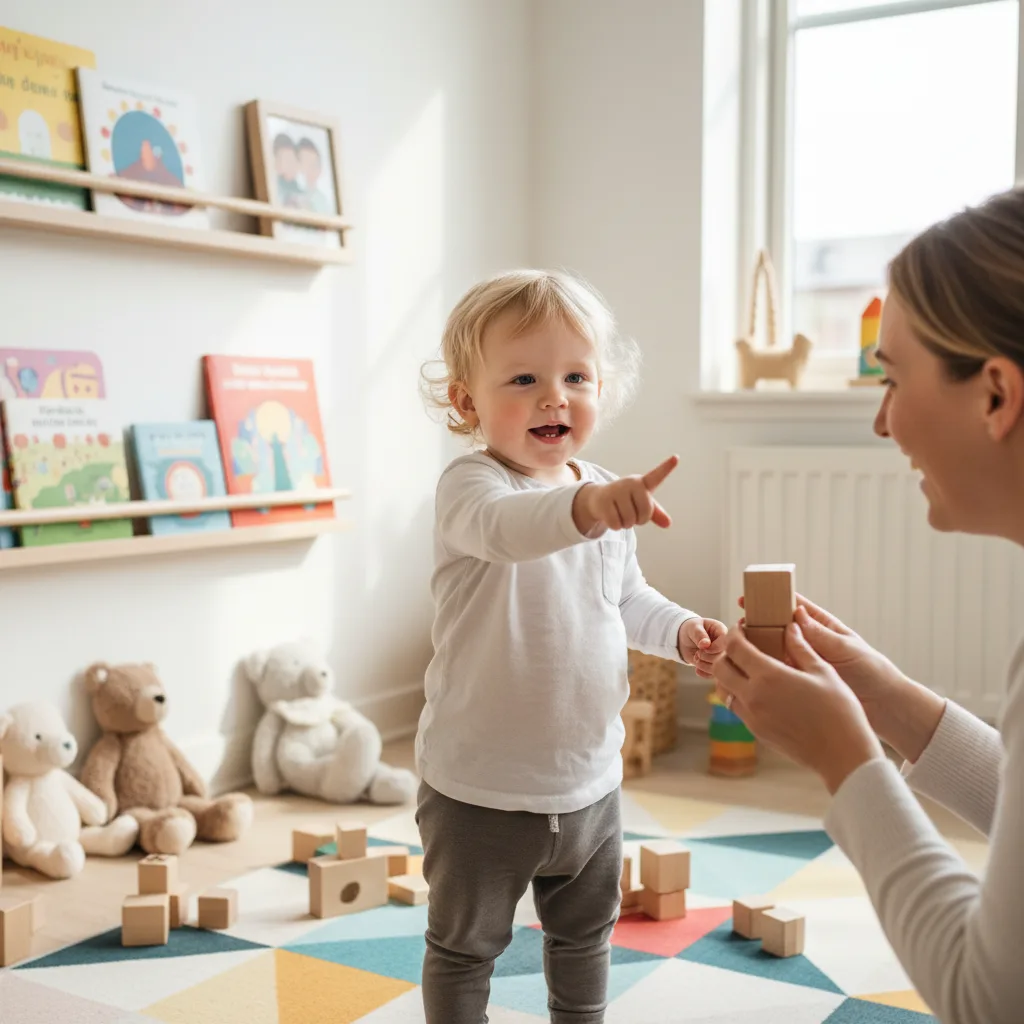
The first recognizable words appear, typically "mama" or "dada." The child understands "no" and simple commands like "come here." Pointing with a finger becomes an important communication tool.
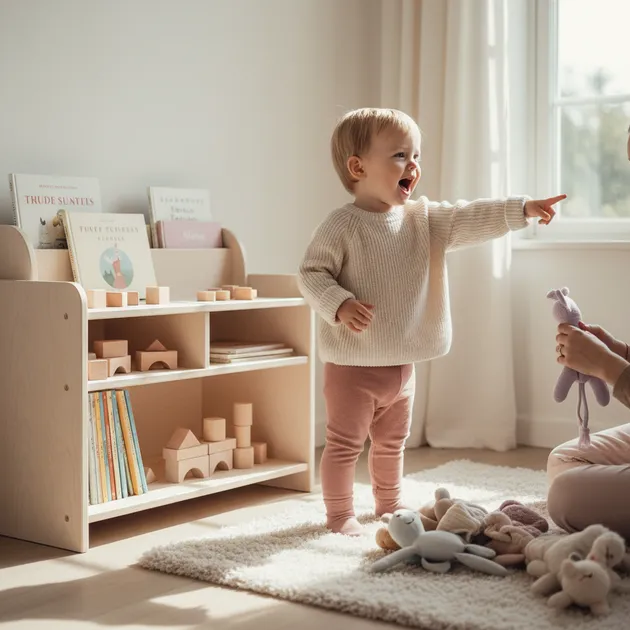
Pointing is an important language milestone. When the baby points, put words to what they are pointing at: "Yes, that's a dog!" This builds vocabulary and shows the child that communication works.
12–18 Months: 5–20 Words
The child now typically has 5–20 words and understands far more. They point actively, follow simple instructions like "give me the ball," and use gestures together with sounds to make themselves understood.
18–24 Months: The Word Explosion
Around 18 months many children experience a word explosion. Vocabulary can grow from 50 to over 200 words in a matter of months. The child begins to combine two-word sentences like "mama ball" and "more milk."
2–3 Years: Sentences and Questions
The child now has 200 or more words and speaks in short sentences of 3–5 words. Questions like "what's that?" and "why?" become a regular part of daily life. Strangers understand 50–75% of what the child says.
Context note: Pediatricians track speech development at routine well-child visits. The 2-year visit specifically assesses language, and the 4-year visit uses standardized tools to evaluate early language skills.
How to Support Your Child's Speech Development
Talk to Your Baby A Lot
It doesn't have to be sophisticated. Tell your baby what you are doing: "Now we're changing your diaper. First we lift your legs up. There, now you're clean!" This running commentary gives the child rich language input throughout the day.
Read Aloud Every Day
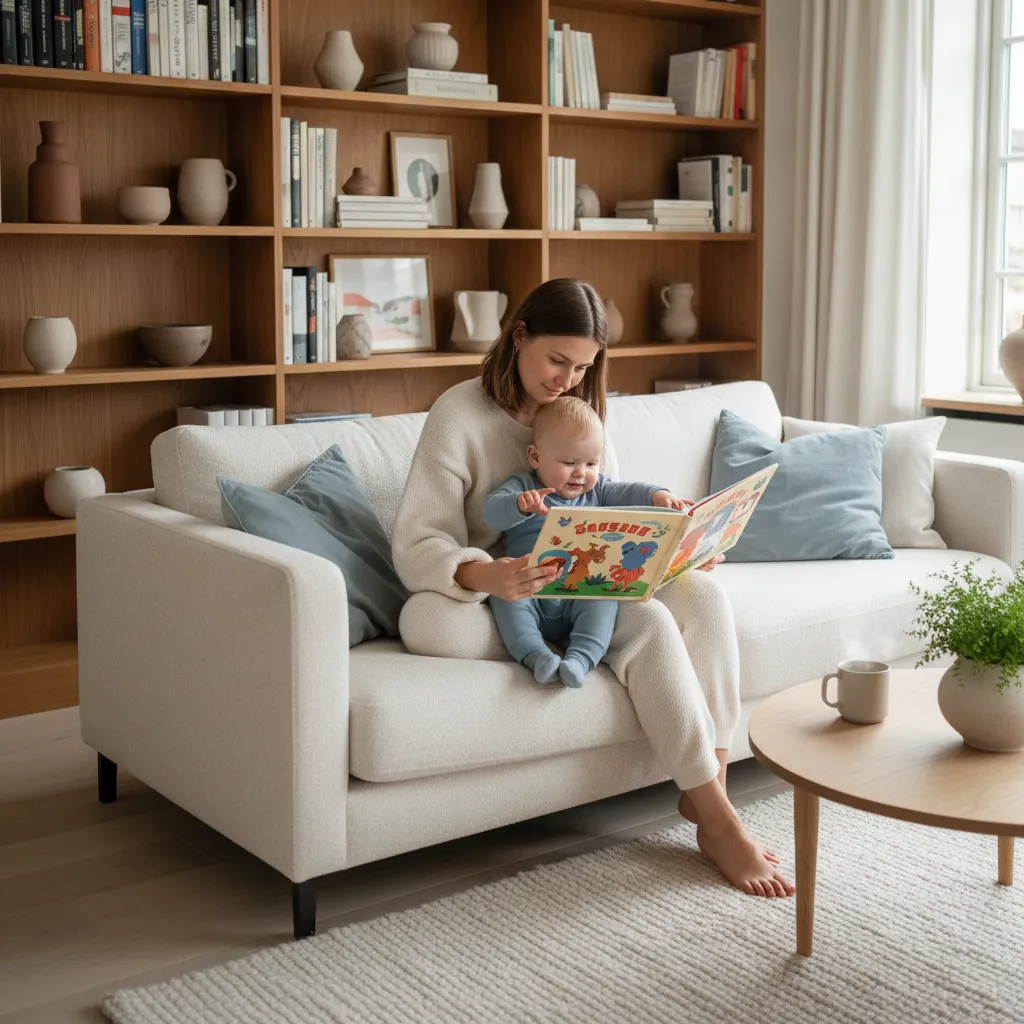
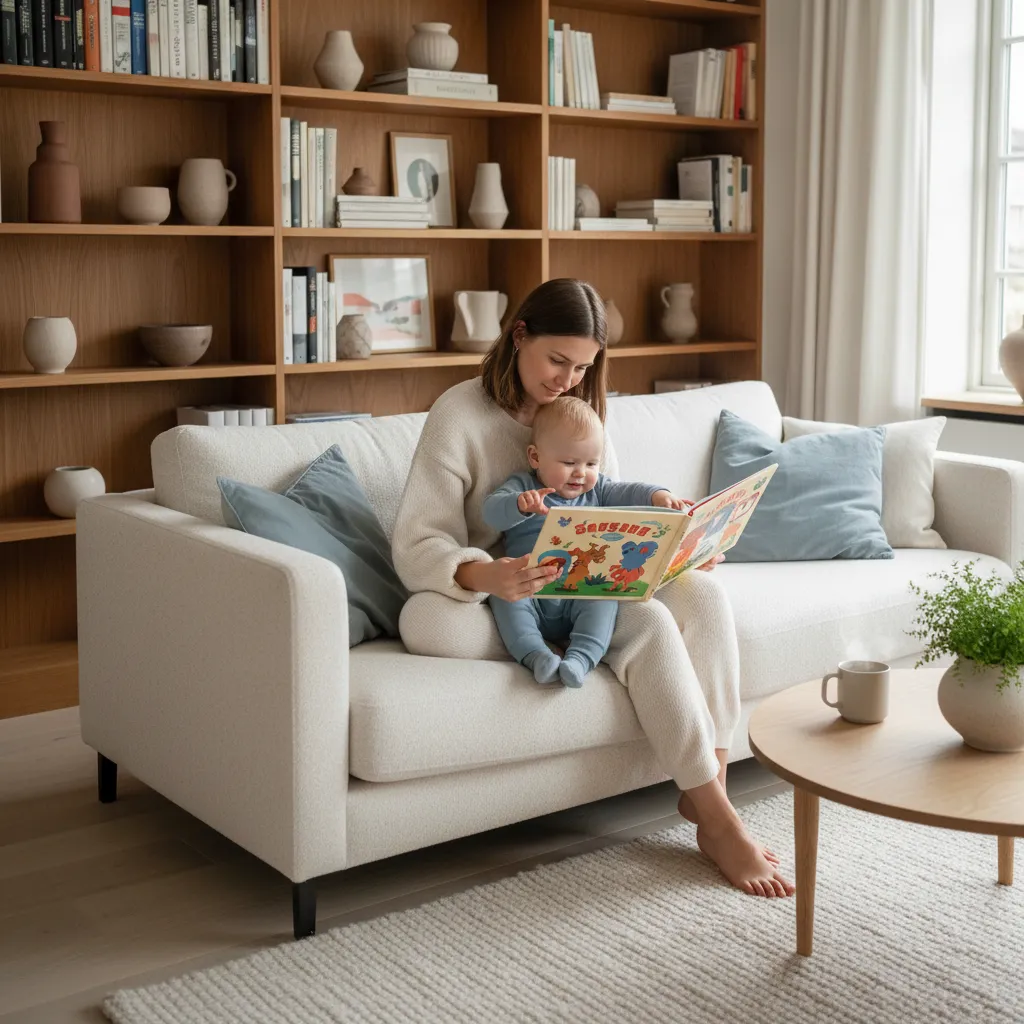
Reading is one of the most effective things you can do for speech development. Start with picture books from around 4–5 months of age. According to health authorities, reading aloud strengthens vocabulary, language comprehension, and attachment. Even 10–15 minutes a day makes a big difference over time. Read more in our guide to reading with your baby.
Describe What Your Child Sees and Does
Put words to what the child is focused on. If the child is looking at a cat, say "Look, a cat! The cat is black. It says meow." Words linked to something the child is already paying attention to are more easily remembered.
Respond to Babbling
When the baby babbles, respond as if it is a real conversation. "Oh really? Is that so? Tell me more!" This teaches the child that communication is mutual, that saying something leads to a response.
Use Real Words
Avoid oversimplifying. Say "bottle" instead of "ba-ba" and "car" instead of "vroom-vroom." Children learn the words they hear. It is perfectly fine to use a warm and exaggerated tone, but use the right words.
Songs and rhymes are wonderful for speech development. Children's songs with movements, like "The Wheels on the Bus" and "Head Shoulders Knees and Toes", combine rhythm, repetition, and movement. That makes them especially effective for language learning.
Bilingualism. An Advantage for Your Child
Many families are multilingual, and it is well documented that bilingualism is a strength. Health authorities and special education services recommend that parents speak their own native language with the child.
Bilingual children may mix languages during some periods, and that is completely normal. It is not a sign of confusion, but shows that the child is keeping two language systems active at the same time. Bilingual children may have slightly fewer words in each individual language, but the combined vocabulary is usually just as large or larger.
For multilingual families: Speak your native language with your child. The child will learn English at daycare and from the environment. A strong first language is the best foundation for learning a second language well. Daycare will support English development.
Signs of Delayed Speech Development
There is wide normal variation in speech development, but some signs should lead you to contact your pediatrician:
Contact your pediatrician if the child: - Is not babbling (ba-ba, da-da) by 12 months - Is not using any recognizable words by 18 months - Has under 50 words at age 2, or is not combining two-word sentences - Loses language skills they previously had - Shows little eye contact and does not point to communicate
Some children are "late starters" who catch up with peers on their own. But it is always better to check too early than too late. Early intervention yields the best results if it turns out the child needs extra support.
What to Do If You Are Concerned
Your Pediatrician Is the First Step
Contact your pediatrician. Child health nurses and doctors have experience with child development and can assess whether further evaluation is warranted. You do not need a referral to make contact.
Early Intervention Services
If your pediatrician recommends further follow-up, the child can be referred to early intervention services. They assess the child's language skills and can recommend support in daycare or at home.
Speech Therapist
A speech therapist can provide specialized help with speech difficulties. Many areas offer publicly funded speech therapy services. Your pediatrician can guide you to the right provider.
Track language milestones as the child develops. It gives you a good overview and makes it easier to provide concrete information to your pediatrician if needed.
Track development digitally: With Milestones on Babysential you can log new words and language progress. You get a clear overview of your child's development that you can also share with your pediatrician.
Frequently Asked Questions About Speech Development
When does the baby say their first word?
Most babies say their first recognizable word between 10 and 14 months. "Mama" and "dada" are common first words. The child understands many more words than they can say, receptive language always runs ahead of expressive language.
Is it normal for the child to point instead of talking?
Yes, pointing is an important part of speech development. Children use gestures as a stepping stone between comprehension and speech. Pointing shows that the child has communicative intent, which is the foundation of spoken language.
Should we use baby sign language?
Baby sign language can be a nice supplement to spoken language development. Research shows that signing does not delay speech, and can reduce frustration because the child can express themselves before words arrive.
Does screen time affect speech development?
Health authorities recommend no screen time for children under 2 years. Research shows that children learn language best through direct interaction with people, not through screens. A conversation with you is more valuable than any educational app.
Can bilingualism delay development?
No. Multilingualism does not delay speech development. The child may take a little longer before speaking, but the total vocabulary is just as large. Continue speaking both languages, it is a gift to your child.
Want to track your child's milestones and development? See our complete milestone guide for an overview of all language and motor milestones by age, or log milestones in My Baby to keep track of what your child can do. See also the development timeline for a week-by-week overview.
Read More
- Baby sign language: Communicate before your baby talks
- Reading with your baby: How to read with children of all ages
- Daycare: Preparation and settling in
- Track your baby's milestones
- See development on the timeline
Sources
Last updated: March 2026
🔧 Helpful Tools
- Baby Milestones Tracker. Track your baby's developmental milestones
- Development Leaps. Understand your baby's developmental leaps
- All Baby Tools. Browse all free tools for pregnancy and baby care
📖 Related Articles
- Child Speech Development: From Babbling to Sentences. Everything about speech development in children from 0–3 years. Milestones, tips for supporting language, bilingualism, and signs of delayed development.