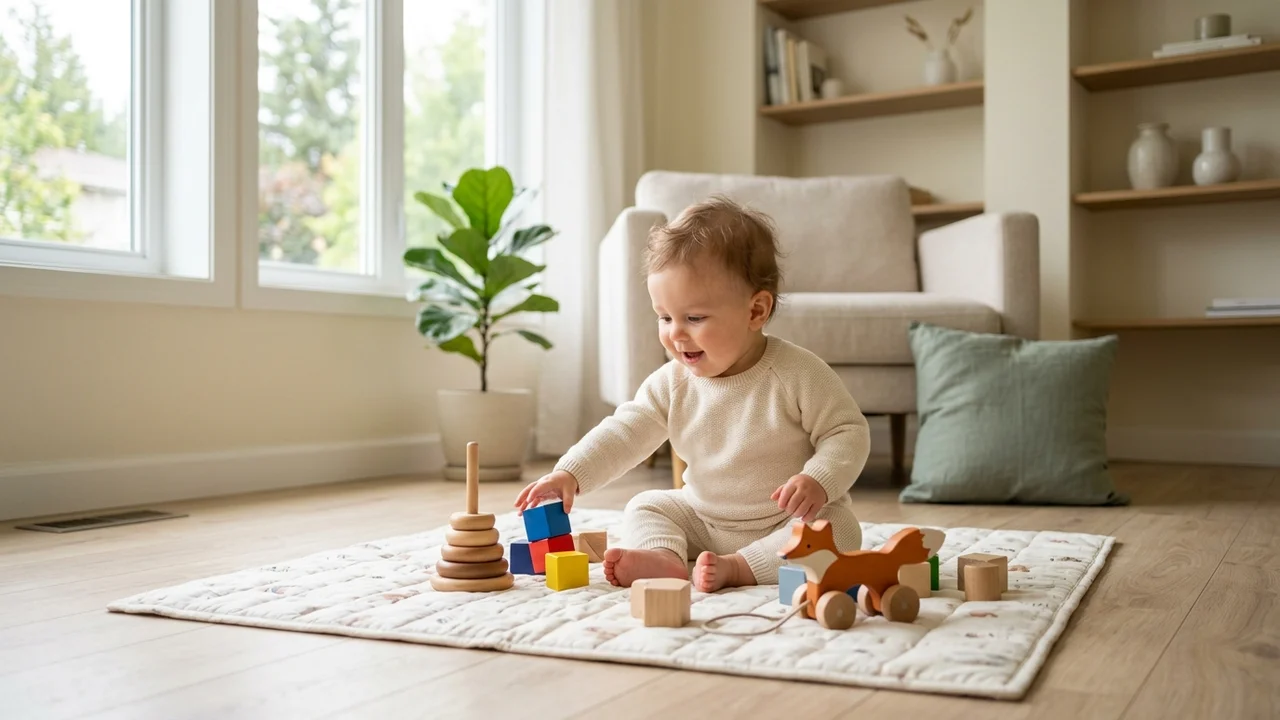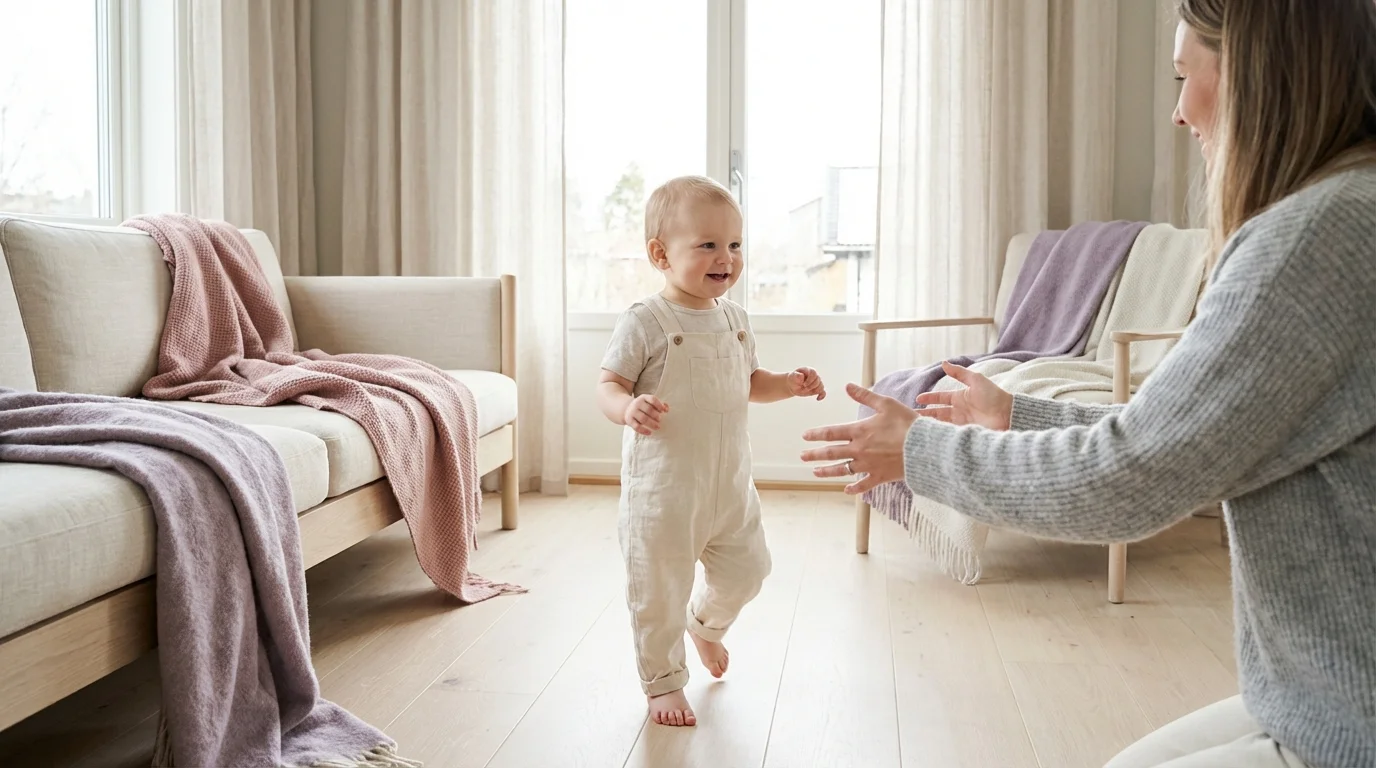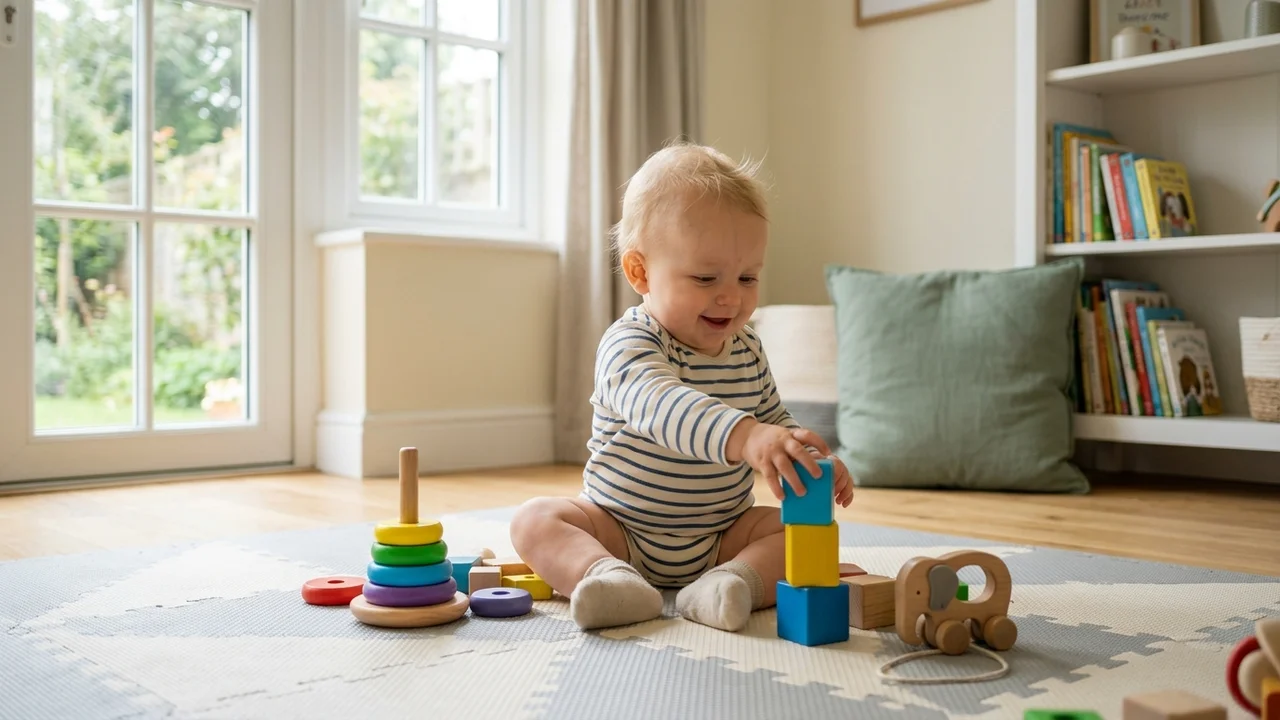
Most babies take their first independent steps between 9 and 12 months and are walking confidently by 14–15 months, according to the American Academy of Pediatrics (AAP). The normal range is 9–18 months, all of which is considered developmentally typical. Walking late within this range is not a cause for concern.
Key Takeaways
- 50% of babies walk by 12 months and 90% by 14 months, according to the WHO Multicentre Growth Reference Study (2006)
- The normal range is 9–18 months, any baby walking by 18 months is within the expected developmental window (AAP)
- Walking is preceded by a sequence: tummy time → rolling → sitting → pulling to stand → cruising → first steps
- Barefoot time indoors develops better balance than shoes, the AAP and NHS both recommend bare feet for new walkers
- Talk to your pediatrician if baby is not pulling to stand by 12 months or not walking by 18 months
Baby Walking Milestones: Month-by-Month Timeline
The path to independent walking unfolds across several months of motor development. The following timeline reflects median ages from the WHO Multicentre Growth Reference Study (2006) and AAP developmental guidance:
| Age | Motor milestone | Notes |
|---|---|---|
| 2–4 months | Pushes up during tummy time | Builds neck and shoulder strength |
| 4–6 months | Rolls, sits with support | Core and trunk stability develops |
| 6–8 months | Sits independently | Hands free for exploration and balance |
| 7–9 months | Pulls to stand | Uses furniture for support |
| 8–10 months | Cruises along furniture | Side-steps while holding surfaces |
| 9–12 months | Stands briefly unsupported | Balance and leg strength consolidate |
| 9–12 months | First independent steps | Median: ~12 months |
| 12–15 months | Walks independently | Most babies by 14–15 months |
| 15–18 months | Walks confidently, changes direction | Full independent mobility established |
What Is the Average Age for a Baby's First Steps?
The WHO Multicentre Growth Reference Study, the largest cross-cultural study of infant motor development, found that 50% of babies walk independently by 12 months, and 90% walk by 14 months. The AAP defines 18 months as the upper limit of the typical range.
This means:
- Walking at 9 months: early, but normal
- Walking at 12 months: right at the median
- Walking at 15 months: completely normal
- Walking at 18 months: still within the normal range, no intervention is typically required unless other developmental concerns are present
There is no meaningful developmental benefit to walking early. Babies who walk at 9 months and babies who walk at 17 months reach the same motor milestones by age 2–3.
Pre-Walking Milestones: What Happens Before First Steps
Independent walking is the outcome of a sequence of physical achievements. Each stage builds the strength, balance, and coordination needed for the next.
Tummy Time
From birth, tummy time, placing baby on their stomach while awake and supervised, develops the neck, shoulder, and core muscles that underlie all motor development. The AAP recommends starting tummy time from day one, building to 30 minutes per day by 3 months. Babies who get adequate tummy time tend to reach motor milestones slightly earlier.
Rolling and Sitting
Rolling (typically 4–6 months) develops core rotation and spatial awareness. Sitting independently (typically 6–8 months) is the first major milestone requiring full trunk control and balance, the same balance systems needed for standing and walking.
Pulling to Stand
Between 7 and 9 months, most babies begin pulling themselves to a standing position using furniture, a parent's leg, or any available support. This is the first time the legs bear full body weight and is a critical muscle-strengthening phase. Let babies pull up freely, it is safe and essential for development.
Cruising
Cruising, stepping sideways while holding onto furniture, follows pulling to stand, typically between 8 and 10 months. Cruising is the closest approximation of walking: it requires alternating leg movement, weight shifting, and balance adjustment. Some babies cruise for weeks or months before taking independent steps; this is entirely normal.
Standing Independently
Before taking steps, most babies stand unsupported for several seconds or more. This usually appears at 9–12 months. It represents the moment when balance has developed sufficiently to maintain an upright posture without external support.
First Steps
First independent steps are typically wobbly and short, often 2–4 steps before sitting down or grabbing support. Many babies take first steps and then revert to crawling for weeks before walking becomes their default mode of travel. This is normal. Crawling is faster and more reliable until walking is fully consolidated.
How to Support Baby's Walking Development
What helps:
- Tummy time from birth, the foundation of all gross motor development
- Barefoot time indoors, bare feet give better proprioceptive feedback (awareness of foot position) than shoes, helping balance develop faster
- Push toys and stable furniture, walkers without wheels that the baby can push provide walking practice with support
- Floor time, maximize time on the floor where the baby can practise pulling, cruising, and stepping freely
- Encouragement without rushing, standing a short distance away and encouraging the baby to walk toward you
What to avoid:
- Baby bouncers and seated containers, extended time in bouncers, exersaucers, or baby seats reduces floor time and delays motor milestones
- Holding baby's hands constantly, allowing the baby to attempt balance independently is more useful than walking while holding both hands
- Pressure or rushing, there is no evidence that any intervention causes babies to walk earlier; the timeline is largely biologically determined
Shoes
Babies learning to walk indoors do not need shoes. The AAP and NHS both recommend bare feet or non-slip socks indoors, as shoes restrict the natural movement of foot muscles and reduce sensory feedback. When shoes are needed for outdoor use, choose flexible soles, a wide toe box, and a secure fit. Hard, rigid soles are not recommended for new walkers.
When to Talk to Your Pediatrician About Walking
Raise walking development with your pediatrician if:
- Baby is not pulling to stand by 12 months
- Baby is not walking by 18 months
- Baby loses walking ability they previously had at any age
- Baby walks exclusively on tip-toes past 18–24 months (occasional tip-toe walking in new walkers is normal; persistent tip-toeing can be associated with tight Achilles tendons or neurological differences)
- Baby shows significant asymmetry, using one side of the body much more than the other
- Any other developmental concerns are present alongside delayed walking (speech, social engagement, fine motor)
Walking delay in isolation, with all other development on track, is often constitutional (familial late walking) and resolves without intervention.
Walking Milestone Comparison Table
| Milestone | Typical age range | When to discuss with pediatrician |
|---|---|---|
| Pulls to stand | 7–10 months | If not achieved by 12 months |
| Cruises along furniture | 8–11 months | If not achieved by 13 months |
| Stands independently | 9–12 months | If not achieved by 14 months |
| First steps | 9–12 months | – |
| Walking independently | 9–15 months | If not achieved by 18 months |
| Walking confidently | 12–18 months | If not achieved by 20 months |
Baby Walking Safety Checklist
Once a baby starts walking, the home environment needs to be reassessed:
- Stair gates at top and bottom of all staircases
- Corner and edge protectors on sharp furniture
- Non-slip rugs or remove rugs that slide
- Remove unstable furniture baby might use for support and pull over
- Cabinet locks on low cabinets containing hazardous items
- Secure heavy furniture (bookshelves, TV units) to the wall
- Check floor-level hazards, cables, small objects, anything within reach from standing height
Frequently Asked Questions
When do babies start walking?
Most babies take their first independent steps between 9 and 12 months, according to the AAP and WHO. The typical age to be walking confidently is 12–15 months. The full normal range extends to 18 months, any baby walking by 18 months is developing within the expected range.
Is my baby late if they aren't walking at 12 months?
No. Twelve months is the median age for first steps, meaning half of all babies are not yet walking at that point. Walking anywhere between 9 and 18 months is considered developmentally typical. If your baby is not walking by 18 months, discuss it with your pediatrician, but a baby at 13–15 months who is cruising and pulling to stand is progressing normally.
What comes before walking?
The typical sequence is: rolling → sitting independently → pulling to stand → cruising along furniture → standing independently → first steps. Each stage builds the strength and balance needed for the next. Babies who skip stages, for example, going directly from sitting to walking without crawling, still fall within normal development.
Should I use a baby walker to teach my baby to walk?
No. The AAP advises against wheeled baby walkers. They do not accelerate walking development and are associated with a significant number of injuries, primarily from falls down stairs. They also reduce floor time and tummy time, which can actually delay motor development. Push toys (where the baby pushes rather than sits inside) are a safer and more effective alternative.
When do babies need shoes?
Babies do not need shoes until they are walking outdoors regularly. Indoor walking is best done barefoot or in non-slip socks, bare feet provide the best sensory feedback for balance development. When outdoor shoes are needed, choose flexible soles, a wide toe box, and no rigid heel support.
Do all babies crawl before they walk?
No. Crawling is not a developmental requirement. Roughly 10% of babies skip crawling entirely, some bottom-shuffle, some roll to move, some go directly from pulling to stand to walking. The AAP does not list crawling as a milestone that requires medical follow-up if absent. Walking ability is not affected by whether a baby crawled.
When do babies start running?
Most babies begin running, a gait where both feet briefly leave the ground, between 18 and 24 months. Early running is typically more of a fast, unsteady walk. Well-coordinated running with arm swing develops closer to 2–2.5 years.
What if my baby always walks on tip-toes?
Occasional tip-toe walking is very common in new walkers and is not a concern in itself. If a baby is consistently walking on tip-toes past 18–24 months, or if the heels cannot be brought flat to the ground passively, discuss this with your pediatrician. Persistent tip-toeing can sometimes be associated with tight Achilles tendons, sensory processing differences, or neurological conditions, though it is often idiopathic and resolves with time or physiotherapy.
Can I help my baby walk faster?
No intervention has been shown to cause babies to walk earlier than their biological timeline allows. Tummy time from birth and maximising floor time support motor development broadly, but cannot accelerate the timing of independent walking. Babies walk when their nervous system, muscles, and balance system are ready, not on a schedule.
What is the difference between cruising and walking?
Cruising refers to stepping sideways or forward while holding onto a surface for support, furniture, a wall, or a parent. Walking refers to independent stepping without any external support. Most babies cruise for several weeks or months before they have sufficient balance to walk independently. Cruising is an active, important stage of motor development, not simply a "waiting phase."
Sources
- American Academy of Pediatrics (AAP). Developmental Milestones: 12 Months. 2023.
- World Health Organization (WHO). WHO Multicentre Growth Reference Study Group: WHO Motor Development Study. 2006.
- NHS. Your baby's developmental milestones. 2024.
- Centers for Disease Control and Prevention (CDC). Learn the Signs. Act Early.. 2024.
🔧 Helpful Tools
- Milestone Tracker. Track your baby's developmental milestones by age
- Baby Sleep Tracker. Log sleep windows and understand your baby's patterns