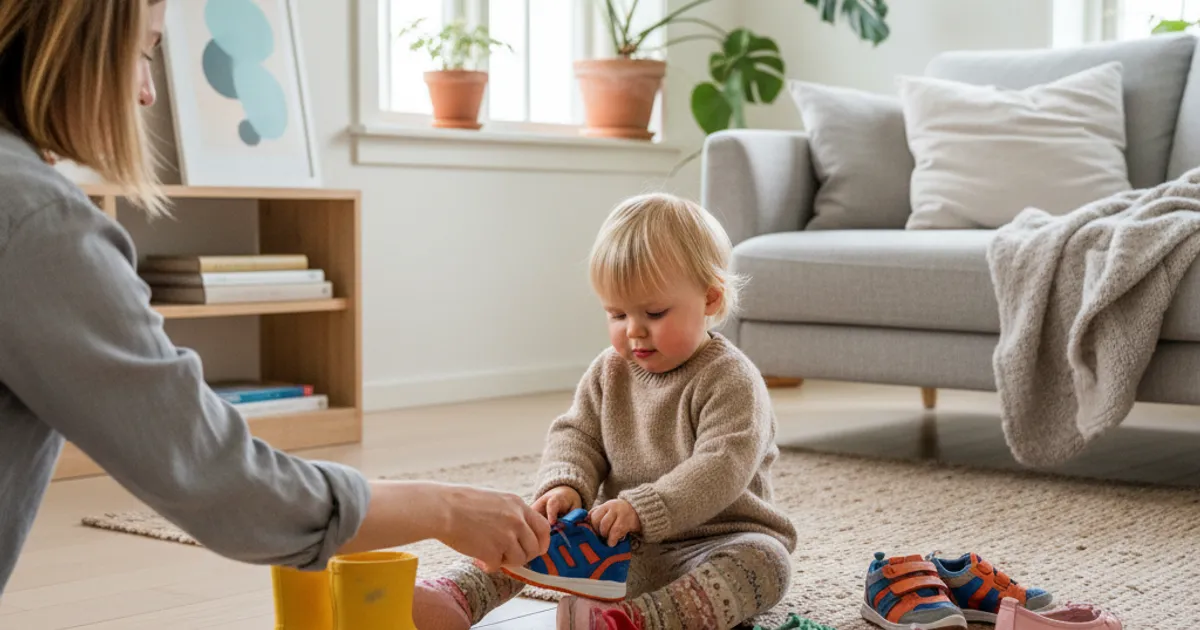
Getting children's shoes in the right size matters more than most parents realize. Children's feet are soft and shaped by cartilage, the wrong size can affect foot development without the child ever complaining. For children under 3 who cannot tell you when a shoe is pinching, you as a parent need to check regularly.
This guide gives you a complete size chart, shows you how to measure your child's foot at home, and helps you choose the right shoes.
Size Chart: Children's Shoes Ages 0–3
The table shows the relationship between foot length, EU shoe size, US shoe size, and typical age. Remember that age is only a rough guide, foot length is the only reliable measurement.
Complete Chart. Foot Length to Shoe Size
| Foot Length (cm / inches) | EU Size | US Size | Typical Age |
|---|---|---|---|
| 9.5 cm / 3.7" | 16 | 1 | 0–3 months |
| 10.0 cm / 3.9" | 17 | 1.5 | 3–6 months |
| 10.7 cm / 4.2" | 18 | 2.5 | 6–9 months |
| 11.3 cm / 4.4" | 19 | 3 | 9–12 months |
| 12.0 cm / 4.7" | 20 | 4 | 10–14 months |
| 12.7 cm / 5.0" | 21 | 5 | 12–18 months |
| 13.3 cm / 5.2" | 22 | 6 | 14–20 months |
| 14.0 cm / 5.5" | 23 | 7 | 18–24 months |
| 14.7 cm / 5.8" | 24 | 8 | 20–26 months |
| 15.3 cm / 6.0" | 25 | 8.5 | 2–2.5 years |
| 16.0 cm / 6.3" | 26 | 9.5 | 2.5–3 years |
| 16.7 cm / 6.6" | 27 | 10 | 3–3.5 years |
Age ranges are averages and vary greatly from child to child. A 12-month-old can wear anything from a size 18 to a 22 EU. Always measure the foot, don't choose shoes by age alone.
Important: Growing Room
The numbers in the table show foot length. The shoe you buy should have an extra 0.4–0.6 inches (1–1.5 cm) beyond this. That means:
- A child with a foot length of 4.7 inches (12 cm) needs a shoe with an interior length of about 5.1–5.3 inches (13–13.5 cm)
- Most shoe models already have some built-in allowance
- Ask the store about the shoe's interior length in centimeters, it is not the same as the EU or US size
How to Measure Your Child's Foot at Home
You need: a sheet of paper (letter size works), a pencil, and a ruler or measuring tape.
Step by Step
- Measure in the afternoon. Feet are largest then, after a day of activity.
- Place the paper on a hard floor (not carpet). Tape it down if needed.
- The child should stand with full weight on the foot. Don't measure while seated, the foot is shorter without weight on it.
- Trace around the foot with the pencil held vertically. Keep the pencil right against the foot.
- Measure from heel to longest toe. Use a ruler. The longest toe is not always the big toe, some children have a longer second toe.
- Measure both feet. They are rarely exactly the same length. Use the longer foot as your reference.
- Add 0.4–0.6 inches (1–1.5 cm) to the length you measured. That is the growing room.
Alternative Method: Remove the Insole
Many children's shoes have a removable insole. Take it out, place your child's foot on top, and check that there is 0.4–0.6 inches (1–1.5 cm) between the toes and the edge. This is the quickest way to check whether existing shoes still fit.
Create a "measuring station" on the inside of a closet door. Mark foot length with date every other month, so you can easily see growth over time.
How Fast Do Children's Feet Grow?
Children's feet grow surprisingly fast, and unevenly. There can be months with no change, followed by a full size gained in just a few weeks.
Average Growth by Age
| Age | Growth per year | Check size |
|---|---|---|
| 0–12 months | Up to 1 inch (25 mm) | Every 6–8 weeks |
| 1–2 years | About 0.6–0.7 inches (15–18 mm) | Every 2–3 months |
| 2–3 years | About 0.5–0.6 inches (12–15 mm) | Every 3–4 months |
| 3–6 years | About 0.3–0.5 inches (8–12 mm) | Every 4–6 months |
One EU size corresponds to about 0.26 inches (6.7 mm) of foot length difference. That means a child between 1 and 2 years old can grow through 2–3 shoe sizes in a single year.
Children rarely complain when their shoes are too small. Children's feet are soft and adapt, and the nervous system is not developed enough to register pressure the same way as adults. Check size actively and regularly.
Signs That Shoes Are Too Small
Even if your child doesn't say anything, there are signs you can look for:
Physical Signs
- Red marks on the toes, heel, or top of the foot after wearing
- Blisters or hard skin (less common in younger children)
- Toes that bend or lie on top of each other inside the shoe
- Wear on the inside of the toe cap, a sign that toes are being pressed against the end
Behavioral Signs
- The child refuses to wear shoes or pulls them off
- Reluctant to walk or wants to be carried more than usual
- Sits down frequently outdoors after short periods of walking
- The child walks differently or walks on tiptoe
If you notice any of these signs, measure the foot and check the shoes using the insole method.
When Does Your Child Need Their First Shoes?
Many parents buy shoes too early. The truth is that children need shoes only when they are walking independently outdoors on hard or cold surfaces.
Timeline for Shoe Needs
| Stage | Shoe Need |
|---|---|
| Crawling (7–12 months) | None. Barefoot or non-slip socks |
| Standing with support (8–14 months) | None. Soft pre-walkers indoors if desired |
| First steps (10–18 months) | Barefoot indoors, soft shoes outdoors when needed |
| Walking independently (12–20 months) | Proper first shoes for outdoor use |
| Stable walking (18+ months) | Shoes suited to activity and weather |
Barefoot Is Best for Development
Physical therapists and orthopedic specialists agree: children should go barefoot as much as possible. When children walk without shoes, they use their toes to grip the surface. This trains the muscles in the foot, strengthens the arch, and develops balance.
Indoors at home, your child rarely needs shoes, non-slip socks or bare feet are best.
What Makes Good Children's Shoes?
The 6 Most Important Features
-
Flexible sole, the sole should bend easily at the ball of the foot (where the foot bends at push-off). Hold the heel and toe and bend, it should give.
-
Firm heel counter, the back of the shoe should support the ankle. Squeeze the back, it should feel firm, not floppy.
-
Wide toe box, children's feet are naturally widest at the front. Toes should have room to spread. A too-narrow shoe can cause foot problems over time.
-
Adjustable closure. Velcro or laces so the shoe fits securely. Slip-on shoes provide poor support.
-
Breathable material, children's feet sweat a lot. Leather is best. Synthetic materials can lead to damp, cold feet.
-
Lightweight, heavy shoes inhibit natural walking, especially in children who have recently learned to walk.
Shoes to Avoid for Young Children
- Completely flat shoes without a heel counter (like ballet flats), provide no support
- Stiff, heavy shoes, inhibit natural movement
- Hand-me-down shoes from other children, the shape is molded to another foot
- Oversized shoes, the child trips and compensates with an unnatural gait
- Shoes with any heel rise, even a centimeter changes the walking pattern
It is tempting to buy shoes the child "can grow into" to save money. But oversized shoes cause tripping, compensatory gait patterns, and can cause blisters as the foot slides around. 0.4–0.6 inches (1–1.5 cm) of growing room is enough.
Seasonal Shoe Guide
Your child needs different shoes for different seasons. Here is an overview:
Spring and Summer
- Sandals with a heel strap, open but with a closed toe for protection. The heel strap is important for keeping the foot in place.
- Light sneakers, for days with lots of walking
- Barefoot on grass and sand is still the best option
Fall and Winter
- Lined rubber boots, for rain and slush. Choose ones with Velcro or laces for better fit.
- Winter boots, waterproof, warm, with good grip. Should have room for thick socks.
- Indoor shoes for daycare, with a firm heel counter and non-slip sole.
How Many Shoes Does Your Child Need?
For toddlers, this is a good minimum:
| Shoes | Purpose |
|---|---|
| Everyday shoes / sneakers | Daily use, daycare outdoors |
| Indoor shoes | Daycare indoors |
| Rain / rubber boots | Wet weather |
| Winter boots | Cold weather (below freezing) |
| Sandals | Summer (from about 1 year) |
Tips for Saving Money on Children's Shoes
Children's shoes are one of the biggest recurring expenses. Here are some smart strategies:
- Buy the right size, oversized shoes wear out faster and need replacing anyway
- Wait to buy until your child actually needs them (don't buy "just in case")
- Season shopping: The last pair of the season can be used as a start for next year (buy one size up)
- Look for gently used shoes online, but measure the insole yourself, don't trust that the size is correct
- Avoid used shoes as everyday shoes: Shoes mold to the previous owner's foot. A few turns in used rubber boots is fine, but everyday shoes should be new.
- Quality pays off: Cheap shoes with stiff soles and poor fit wear out faster and are worse for the foot
Many shoe stores with a children's section offer free foot measuring. It is worth using this service, especially for the first pairs. The experts can also assess whether your child needs shoes with extra support.
Common Foot Issues in Toddlers
Flat Feet. Is It Normal?
Yes, completely normal. All children have flat feet in their early years. The arch develops gradually up to age 5–7. You generally don't need special shoes or orthotics.
Talk to your pediatrician if:
- Your child has pain in their feet
- The flat foot is only on one side
- Your child is over 6 and still has a completely flat foot
In-Toeing (Pigeon-Toed Walking)
Many toddlers walk with their toes pointing inward. This is common and almost always corrects itself by age 3–4. Special shoes don't help, barefoot walking is better.
Toe Walking
Some children walk on their toes. Sometimes it's just a habit, but persistent toe walking after age 2 should be assessed by your pediatrician. It can be caused by a tight Achilles tendon or other conditions that need follow-up.
Measuring Foot Length: Store vs. Home
| Method | Advantage | Disadvantage |
|---|---|---|
| Home with pencil/paper | Free, do it when convenient | Requires child to stand still |
| Insole check | Quick, visual | Only shows if current shoes fit |
| Measuring device in store | Professional, accurate | Child may be restless in store |
| Digital foot scanner | Very accurate | Few stores have this |
The best approach is to measure at home first, note the foot length, and have it ready when you shop. Then you can check the shoe's interior length directly against your own measurement.
Frequently Asked Questions
Do EU Sizes Match Between Different Shoe Brands?
Unfortunately not always. There is no exact standard, and a size 22 from one brand may correspond to a 21 or 23 from another. Always measure the shoe's insole in centimeters and compare it to your child's foot length plus growing room.
Can I Buy Used Shoes for My Child?
For everyday use, it is not recommended. Shoes mold to the previous owner's foot, gait pattern, and wear. For barely-used specialty shoes (rubber boots, dress shoes worn 2–3 times) it can be fine, but check that the sole isn't worn unevenly and that the heel counter is still firm.
My Child Has Very Wide Feet. What Should I Do?
Some brands make shoes in extra widths (W or wide). European brands like Superfit, Ricosta, and Bisgaard often offer wider lasts. Sandals with adjustable straps also fit wide feet well. Avoid narrow brands and models with a narrow toe box.
How Many Pairs of Shoes Does a 1-Year-Old Need?
A 1-year-old who has just started walking really only needs one pair of good everyday shoes for outdoor use, plus non-slip socks for indoors. When they start daycare, they will also need indoor shoes and possibly rain or winter boots depending on the season.
Should My Child Wear Socks in Shoes?
Yes, always. Socks absorb sweat, protect against blisters, and provide a little extra warmth. Choose cotton or wool socks without tight elastic bands. Measure the foot with the type of sock your child normally wears, thick winter socks take up more space than thin summer socks.
See Also
- Baby's First Shoes. Guide to Choosing and Fitting
- Baby Clothes Size Guide
- Motor Development in Babies
- When Baby Crawls, Walks, and Talks
Sources
- American Academy of Pediatrics (AAP). "Shoes for Babies and Toddlers." healthychildren.org
- American Orthopaedic Foot & Ankle Society. "Children's Foot Health." aofas.org
- Canadian Paediatric Society. "Healthy feet for your child." cps.ca
- Journal of Foot and Ankle Research. "Footwear and foot health in children." 2016.
🔧 Helpful Tools
- Baby Milestones Tracker. Track your baby's developmental milestones
- Development Leaps. Understand your baby's developmental leaps
- All Baby Tools. Browse all free tools for pregnancy and baby care
📖 Related Articles
- Baby's First Shoes: When and What to Choose. When does your baby actually need shoes? Learn about the right timing, sizing, fit, and what to look for when buying your baby's first shoes.