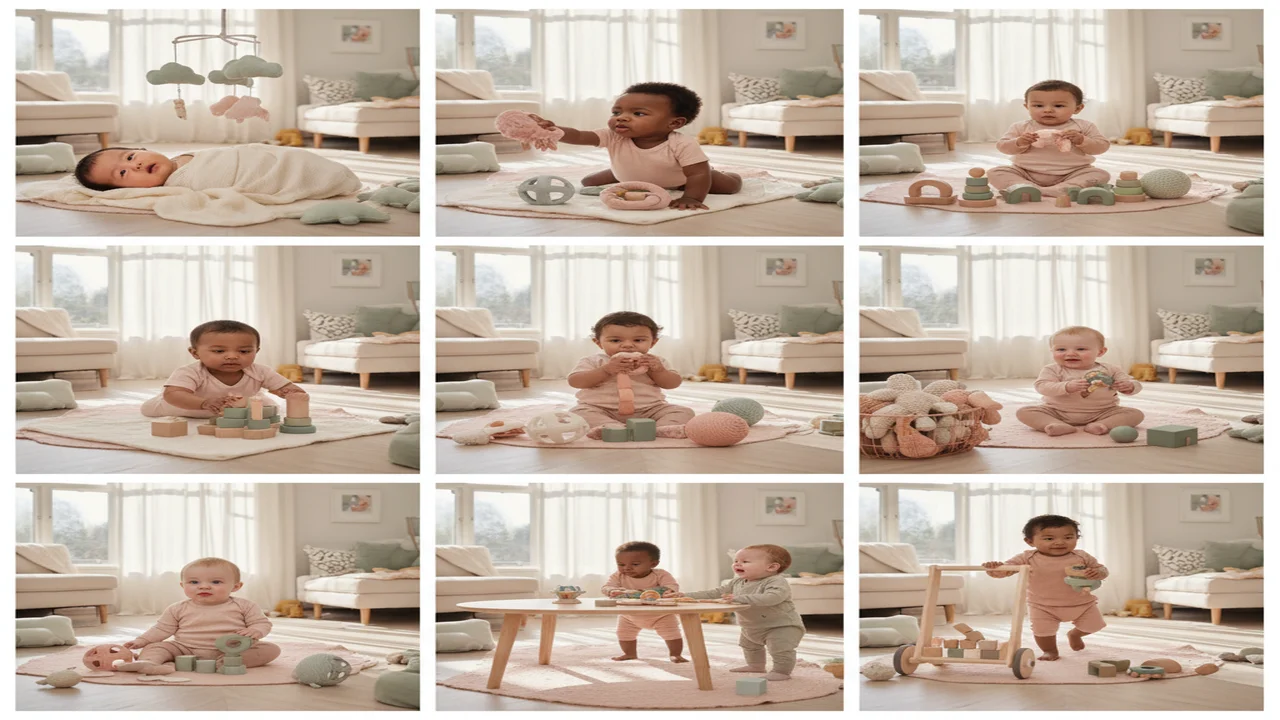
Baby Development Milestones by Month (0–12 Months)
Developmental milestones are skills most babies achieve by a certain age, but there is a wide range of normal. The CDC's "Learn the Signs. Act Early." program and AAP use age ranges, not exact months. What matters is overall trajectory, not hitting each milestone on a specific day.
Key Takeaways
- Milestones are ranges, not deadlines, the CDC and AAP both publish age ranges, not fixed dates.
- Key benchmarks: social smile at 2 months, rolling at 4–5 months, sitting independently at 6–8 months, first words at 10–14 months.
- Most babies start crawling between 7–10 months, some skip crawling entirely and go straight to standing, which is also normal.
- Losing a previously acquired skill is always a red flag and warrants immediate pediatrician contact, regardless of age.
- Early intervention is most effective when started early, if you're concerned, contact your pediatrician rather than waiting.
Complete Milestone Chart: 0–12 Months
| Age | Motor | Language | Social | Cognitive |
|---|---|---|---|---|
| 1 month | Turns head toward sound | Makes small throaty sounds | Brief eye contact | Follows faces briefly |
| 2 months | Lifts head 45° on tummy | Cooing | Social smile | Recognizes familiar faces |
| 3 months | Holds head steady, bats at objects | Laughs, different cries for different needs | Smiles spontaneously | Follows moving objects |
| 4 months | Rolls front to back, pushes up on arms | Babbles, squeals | Enjoys social play | Reaches for objects |
| 5 months | Rolls both ways, sits with support | Responds to name | Recognizes caregivers | Explores objects with mouth |
| 6 months | Sits momentarily without support | Babbles consonants (ba, da, ma) | Distinguishes familiar/strangers | Object permanence begins |
| 7–8 months | Sits independently, may crawl/scoot | "Dada/mama" (non-specific) | Stranger anxiety begins | Searches for hidden objects |
| 9–10 months | Pulls to stand, cruises furniture | "Dada/mama" with meaning | Waves bye-bye, plays peek-a-boo | Points at objects |
| 11–12 months | Stands alone, takes first steps | 1–5 words, understands "no" | Separation anxiety | Uses objects correctly (cups, spoons) |
Milestones by Domain
Motor Development
- 0–2 months: Newborn reflexes (rooting, grasp, Moro)
- 2–4 months: Tummy time progress, brings hands to mouth
- 4–6 months: Rolling, sits with support, reaches accurately
- 6–9 months: Sits alone, crawling (some skip this)
- 9–12 months: Pulls to stand, cruises, some walk by 12 months
Language Development
- 0–3 months: Cries, coos, responds to voice
- 3–6 months: Laughs, babbles vowels
- 6–9 months: Babbles consonants, responds to name
- 9–12 months: First words, 2–6 words by 12 months, understands 50+ words
Social-Emotional Development
- 2 months: First social smile
- 4 months: Laughs, enjoys interaction
- 6–8 months: Stranger anxiety (normal, not a problem)
- 9–12 months: Separation anxiety peaks, shows affection
Red Flags: When to Talk to Your Pediatrician
Contact your doctor if by these ages your baby:
By 2 months:
- Doesn't respond to loud sounds
- Doesn't watch things as they move
- Doesn't smile at people
By 4 months:
- Doesn't hold head steady
- Doesn't coo or make sounds
- Doesn't follow moving objects with eyes
By 6 months:
- Doesn't roll in either direction
- Doesn't try to reach for objects
- Doesn't show affection for caregivers
By 12 months:
- No babbling or pointing
- No single words
- Loses previously acquired skills (always a red flag)
The Most Important Thing to Know
Milestones are ranges, not deadlines. Early intervention is available and effective when concerns are identified. Don't wait, if you're worried, talk to your pediatrician.
🔗 Track your baby's milestones with our Development Tracker, personalized for your baby's exact age.
Sources: CDC "Learn the Signs. Act Early." Milestone Checklist 2022; American Academy of Pediatrics (AAP) Developmental Surveillance Guidelines; WHO Child Growth Standards
Frequently Asked Questions
What are the most important baby milestones to watch for?
Key milestones across domains: social smile by 2 months, rolling both ways by 5–6 months, sitting independently by 6–8 months, babbling by 6 months, first words (1–5) by 12 months, and standing/first steps by 9–15 months. The CDC's "Learn the Signs. Act Early." checklist is the most widely used reference tool.
When should I be worried about my baby's development?
Contact your pediatrician if your baby loses a previously acquired skill at any age, doesn't smile by 2 months, doesn't babble by 6 months, has no words by 12 months, or doesn't point or wave by 12 months. These are recognized red flags. Early referral to early intervention services leads to significantly better outcomes.
Do all babies crawl before walking?
No, some babies skip crawling entirely and move directly from sitting to pulling up and walking. This is within the normal range and does not indicate a developmental problem. Tummy time from birth helps develop the upper body strength needed for both crawling and walking.
How do milestones differ between boys and girls?
Language development tends to be slightly ahead in girls on average, while boys may show marginally later language milestones. However, the differences are small and the ranges overlap significantly. Pediatricians assess all babies against the same developmental ranges regardless of sex.
Sources
- AAP. Developmental milestones for children
- CDC. Learn the Signs. Act Early., milestone tracking
- WHO. Child health and development
🔧 Helpful Tools
- Baby Milestones Tracker. Track your baby's developmental milestones
- Development Leaps. Understand your baby's developmental leaps
- All Baby Tools. Browse all free tools for pregnancy and baby care
📖 Related Articles
- Music Play with Baby: Songs, Rhythm and Development. Music stimulates your baby's brain, language, and motor development. Here are simple music activities you can do at home from day one.
- Baby at 12 Months: Development, Milestones, and Tips. Baby at 12 months, what is normal? Read about motor development, language, sleep, food, and milestones for your one-year-old.
- The Timeline: Follow Your Baby Week by Week. How to use Babysential's timeline to follow your baby's development week by week during pregnancy and the first year of life.