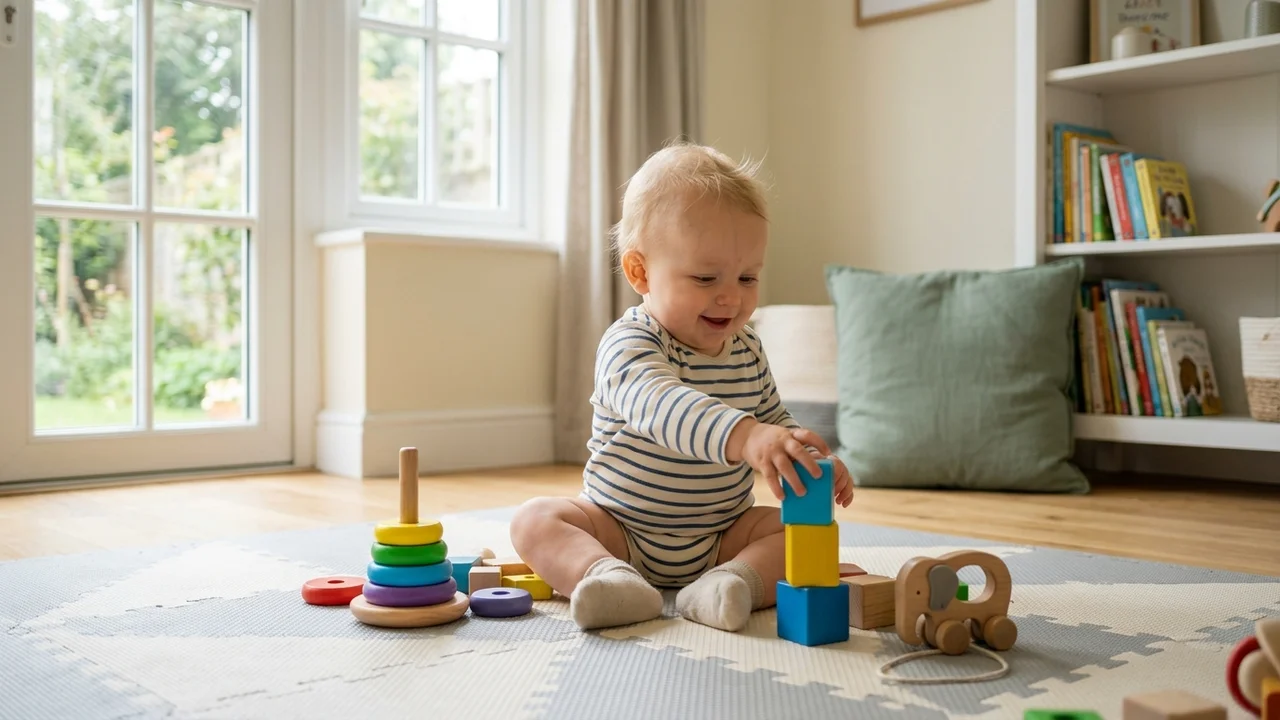
"Has your baby started walking yet?" It is probably the most common question parents hear as their child approaches their first birthday. But the truth is that normal variation is enormous, and that's completely fine.
Here you'll find an honest overview of when most babies crawl, walk, and talk, with clear guidelines for what is normal and when it makes sense to talk to your pediatrician.
The most important thing to remember: Children develop at their own pace. Some babies never crawl but go straight from scooting to walking. Others speak late but then catch up with a burst of words. Comparing with other children is rarely helpful.
When Do Babies Start Crawling?
Crawling is one of the most variable milestones. There is no single "right" age for when your baby should crawl, and some skip it entirely.
Typical Age Range
- Early: 5–6 months
- Most common: 7–10 months
- Later: 10–12 months
- Some never crawl, and that is completely normal
What Happens Before Crawling?
Crawling isn't the first step. Your baby builds up through a series of skills:
- Lifts head during tummy time (2–3 months)
- Rolls from tummy to back (4–6 months)
- Sits without support (7–8 months)
- Gets up on all fours and rocks (7–9 months)
- Starts crawling (7–10 months)
Many babies find their own creative ways to move forward. Some scoot on their belly, some push themselves backward, and some move sideways. All of these are normal variations.
How You Can Support Development
- Give your baby plenty of floor time on a safe surface.
- Tummy time from an early age strengthens the muscles your baby needs for crawling.
- Place toys just out of reach to motivate movement.
- Avoid baby walkers, they can delay natural development.
When Do Babies Start Walking?
First steps are one of the most anticipated milestones. But just like crawling, there is a lot of variation.
Typical Age Range
- Early: 8–9 months
- Most common: 10–14 months
- Later: 15–18 months
Pediatricians consider everything up to 18 months to be within the normal range for first independent steps. Most children take their first steps between 12 and 15 months.
The Steps Toward Walking
Walking is a gradual process that builds on many skills:
- Pulls to stand (8–10 months), pulls up using furniture
- Cruises along furniture (9–11 months), "surfs" along the sofa
- Stands without support (9–12 months), a few seconds at a time
- Takes steps with help (10–13 months), holds an adult's hand
- Walks independently (12–18 months), wide stance, arms up for balance
At first, your baby walks with arms raised for balance, with choppy steps and toes pointing in various directions. Over time, the arms come down, the steps become smoother, and your baby discovers the joy of carrying things from room to room.
You cannot teach your baby to walk, they will start when their body is ready. Avoid "training" your child to walk. Let development happen at your baby's own pace.
How You Can Support Development
- Create safe environments for practice. Baby-proofing your home becomes especially important now.
- Let your baby walk barefoot indoors, it strengthens foot muscles and improves balance.
- Stable furniture at the right height provides good support for a baby who is practicing.
- Push toys (like a sturdy toy cart) can motivate those first steps.
When Do Babies Start Talking?
Language development begins long before the first words. Babies communicate with sounds, eye contact, and movement from day one.
Typical Language Development
| Age | What to Expect |
|---|---|
| 0–2 months | Crying, cooing, vowel sounds (ah, oh) |
| 3–4 months | Laughing out loud, babbling, experimenting with voice |
| 5–7 months | Syllable babbling like "ba-ba," "da-da," "ma-ma" |
| 8–10 months | Responds to own name, understands "no," waves |
| 10–14 months | First words with meaning (mama, dada, no) |
| 12–18 months | 3–20 words, points, follows simple instructions |
| 18–24 months | Vocabulary explodes, begins using two-word phrases |
Receptive Language Comes First
It is important to distinguish between what your baby says (expressive language) and what they understand (receptive language). Babies understand far more words than they can say. A 12-month-old baby may understand 50–100 words, even if they only say 3–5.
According to the AAP, most children begin to understand simple words and phrases from 6–12 months of age, and use sounds, pointing, and movement to express themselves.
How You Can Support Language Development
- Talk to your baby often, describe what you are doing, seeing, and experiencing together.
- Read books, picture books with clear images are perfect from 6 months.
- Sing songs, children's songs with movements support language learning.
- Give your baby time to respond, pause after speaking and let your baby answer with sounds.
- Name emotions, "you're happy right now" or "that was a little scary."
- Use your native language, children can learn multiple languages at the same time.
The AAP does not recommend screen time for children under 2 years. The brain develops best through social interaction with trusted adults, through play, talking, reading, and singing.
Normal Variation. What Does It Mean?
It is easy to worry when the neighbor's baby walked at 10 months while yours is still crawling at 14 months. But remember:
- Early in one area doesn't mean early in all areas. A baby who crawls early won't necessarily walk early.
- Some skip stages. Not all babies crawl, some go straight from scooting to walking.
- Focus varies. Some babies put all their energy into motor skills, while others focus on language. It is rare for development to progress at the same pace across all areas simultaneously.
- Temperament matters. Cautious babies may take longer to let go, even when the body is ready.
When Should You Contact Your Pediatrician?
Even though variation is normal, there are some signs worth following up on. Contact your pediatrician if:
Motor Skills
- Your baby cannot hold their head steady at 4 months.
- Your baby cannot sit without support by 9–10 months.
- Your baby shows no signs of wanting to move forward by 12 months.
- Your baby is not walking by 18 months.
- Your baby uses only one side of the body (asymmetrical movement pattern).
Language
- Your baby is not babbling by 9 months.
- Your baby is saying no words by 15–18 months.
- Your baby does not appear to understand simple words and instructions by 12 months.
- Your child loses skills they previously had.
In General
- You have a gut feeling that something isn't right. Parents know their child best, always take your concerns seriously.
Your pediatrician will monitor development at regular well-baby visits and can refer you to a specialist if needed.
Frequently Asked Questions
Is it normal if my baby doesn't crawl?
Yes. Some babies skip the crawling phase entirely and find other ways to get around, scooting, rolling, or going straight from sitting to standing. As long as your baby shows interest in moving and exploring their surroundings, there is no reason for concern.
My baby is 14 months old and not walking yet, should I be worried?
No, probably not. Everything up to 18 months is within the normal range. As long as your baby is pulling to stand, cruising along furniture, and showing interest in moving around, just give it time. Talk to your pediatrician if you are unsure.
Is there anything I can do to help my baby start talking sooner?
You cannot speed up development, but you can create good conditions: talk to your baby often, read books, sing songs, and give your baby time to respond. The most important thing is daily, rich language stimulation through everyday interaction.
Does it mean something is wrong if my baby is "behind" on everything?
Not necessarily, but it may be worth getting an assessment. Some children are "late bloomers" who catch up on everything, while others may benefit from some extra support. Your pediatrician can help you evaluate whether there is reason for concern.
Read More
- Complete milestone guide. All motor, language, and social milestones in one place
- Baby development month by month. Complete overview 0–12 months
- Motor development in babies. Detailed guide to motor milestones
- Language development in children. From babbling to sentences
- Tummy time: why and how. Strengthen the muscles your baby needs
- Track your baby's milestones. Log and follow development in Babysential
- Baby timeline. See what is typical for your baby's age
Sources
🔧 Helpful Tools
- Baby Milestones Tracker. Track your baby's developmental milestones
- Development Leaps. Understand your baby's developmental leaps
- All Baby Tools. Browse all free tools for pregnancy and baby care
📖 Related Articles
- When Do Babies Start Walking? Milestones, Timeline & What to Expect. Most babies take first steps between 9–12 months, with normal range up to 18 months (AAP). Complete guide to walking milestones, pre-walking stages, and when to see a doctor.