Your baby learns something new almost every day. From the first tentative head lift to those unsteady steps across the living room floor, motor development is one of the most visible and exciting parts of the first year of life.
But it's also a topic that raises many questions. Is my baby behind? Should she be crawling by now? Why isn't he sitting up yet? Here you'll find a reassuring overview of what to expect, period by period, and what you can do to support your child.
Key Takeaways
- The normal range for first steps is 9–16 months, babies who walk at 10 months are not more advanced than those who walk at 15 months; individual variation is enormous.
- Not all babies crawl, some scoot on their bottom, roll, belly-crawl, or skip directly to pulling to stand and walking; all variations are within the normal range per the CDC and AAP.
- Tummy time from the first week of life is the single most effective thing you can do to support motor development, it strengthens the neck, shoulder, and back muscles needed for every subsequent gross motor milestone.
- Contact your pediatrician if your baby does not lift their head by 3–4 months, is not sitting by 9 months, or if you notice a clear difference between the right and left sides of the body.
- Baby walkers are not recommended, the AAP states they can delay motor development and pose a safety risk; barefoot time indoors gives babies better balance and sensory feedback for learning to walk.
Motor Development: What Is It?
Motor development is about how your baby learns to use their body. It divides into two main areas:
Gross motor skills are the large movements. They involve controlling the head, body, arms, and legs, like rolling, sitting, crawling, and walking.
Fine motor skills are the small, precise movements. They involve using the hands and fingers, like grasping, pointing, picking up small objects, and eventually holding a spoon.
Both develop in parallel throughout the first year, but gross motor skills are usually the ones you notice first. Your baby follows a natural developmental pattern where each skill builds on the previous one.
From the CDC: Children develop individually. Some are early walkers, others take more time. Both are normal. The most important thing is that your baby makes progress over time.
0–3 Months: The First Weeks
Your newborn can do more than you think. From birth, babies have reflexes that form the foundation for later motor skills.
What Happens in the Body?
- Head control develops gradually. At first, the baby needs full head support, but after a few weeks they begin to briefly lift their head when lying on their tummy
- The grasp reflex is strong. Place your finger in your baby's hand, and they'll squeeze. This reflex is innate and gradually gives way to intentional grasping
- Vision matures. Your baby sees best at 20–30 cm (8–12 inches), exactly the distance to your face during nursing. By six weeks, the baby can fix their gaze and follow objects with their eyes
What Can You Expect?
By 6 weeks, the baby smiles intentionally for the first time and begins making sounds. By 3 months, most babies can lift their head well when lying on their tummy, look around with interest, and show joy with their whole body, arms waving and legs kicking.
Tip: Place your baby on your chest or in your lap for a few minutes each day. This early tummy time strengthens the neck muscles and prepares your baby for everything that's coming.
3–6 Months: Grasping and Rolling
Now things start happening fast. Your baby becomes increasingly active and curious, and you can almost see the development from week to week.
Gross Motor Skills
- Rolling over. Most babies first learn to roll from tummy to back, then from back to tummy. It can happen suddenly, always keep a hand on your baby during diaper changes!
- Sitting with support. Your baby holds their head steady and can sit in your lap or in a bouncy seat. The back muscles grow stronger day by day.
- Pushing up. On their tummy, your baby lifts their upper body with their arms and looks around. Some begin to rock back and forth on all fours.
Fine Motor Skills
- Intentional grasping. Your baby reaches for toys and holds them. What was once reflex is now a deliberate action.
- Brings things to the mouth. Everything is explored with the mouth, it's your baby's most important sensory tool during this period.
- Transfers between hands. Toward the end of this period, many babies can move a toy from one hand to the other.
Did you know? Between 4 and 6 months, babies are motorically very active. According to the AAP, your baby is now exploring their surroundings with their whole body and constantly discovering new things they can do.

6–9 Months: Crawling and Sitting
This period is a milestone phase. Your baby becomes much more independent in their movements, and the world opens up in a whole new way.
Sitting Without Support
Most babies can sit on their own between 6 and 8 months. At first they sit a bit unsteadily and use their hands for balance, but eventually they sit securely and can play at the same time.
Crawling and Getting Around
Some babies crawl classically on hands and knees, others scoot on their bottom, roll forward, or do a commando crawl on their belly. All variations are completely normal.
- 7–8 months: Many begin to move forward in some way
- 8–9 months: Crawling becomes more coordinated and efficient
- Some babies skip the crawling phase entirely and go straight to pulling up to standing and walking, that's also normal
Fingers Become Precise
Your baby develops what we call the pincer grasp, the ability to pick up small objects between the thumb and index finger. This skill is important for much of what comes later, like self-feeding and drawing.
- Picks up small food pieces from the plate
- Points at things with the index finger
- Explores toys in more detail, presses buttons, pulls strings
Important: When your baby can crawl, it's time to childproof. Check the floor for small objects, cover electrical outlets, and set up gates at staircases.
9–12 Months: Toward First Steps
The last quarter of the first year is marked by a strong desire to stand upright and move. Your baby is working purposefully toward walking.
Pulling to Stand
From around 9–10 months, many babies pull themselves up to standing using furniture, the edge of the sofa, or your legs. At first they often stand without knowing how to get back down again.
Cruising Along Furniture
Your baby moves sideways along the sofa or a table while holding on. This is called cruising and is an important step toward independent walking.
First Steps
Some babies take their first steps around 10–11 months, while others wait until 15–16 months. Both are within the normal range. The average age for learning to walk is around 12 months, but there is significant variation.
Other Milestones in This Period
- Points at things and looks at you to share the experience
- Waves bye-bye and claps their hands
- Understands simple gestures and can give you things when you ask
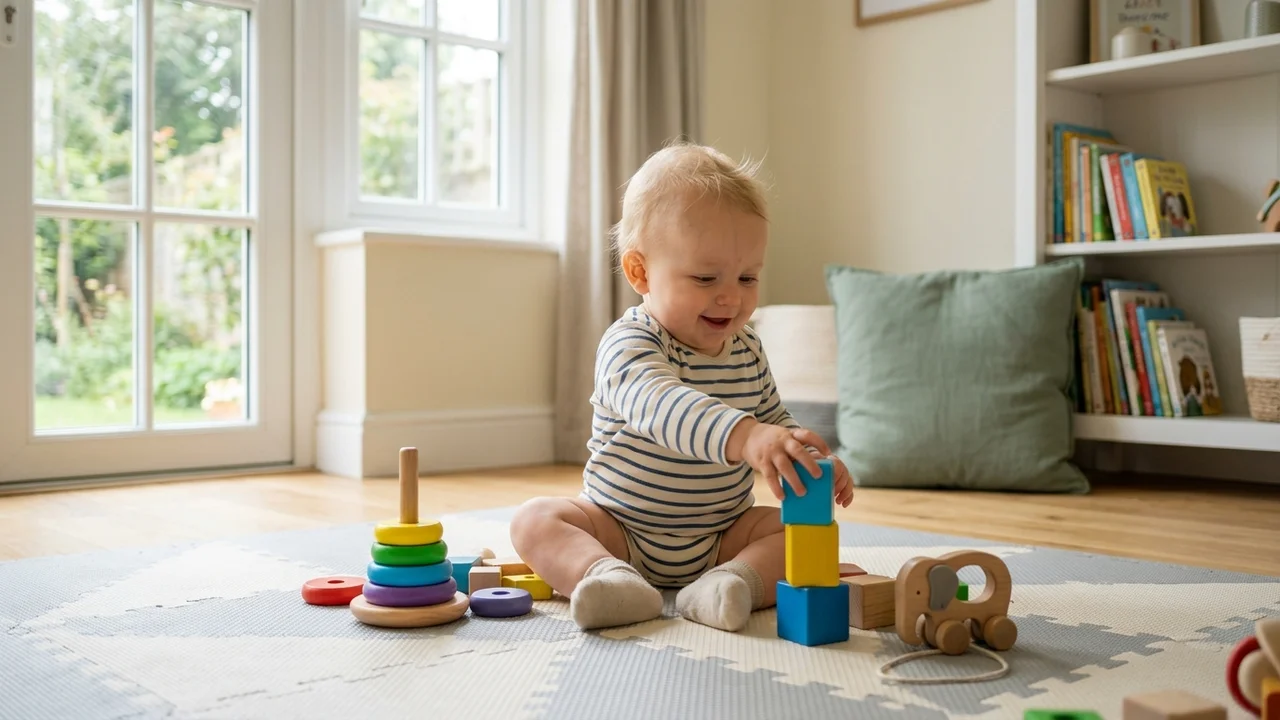
- Stacks blocks, two to three blocks on top of each other is a big achievement
Tip: Barefoot is best for learning to walk. When your baby feels the floor under their feet, they get better balance and grip. Shoes are only needed when the child goes outdoors.
Tummy Time: How to Stimulate Your Baby's Development
Tummy time is the simplest and most effective thing you can do for your baby's motor development. It strengthens the muscles in the neck, shoulders, back, and arms, everything your baby needs to reach the next milestones.
Why Is It So Important?
Since babies should sleep on their backs (to reduce the risk of SIDS), they need extra time on their tummy when they're awake. Without tummy time, muscle development can slow down, and your baby can develop a flattened back of the head.
How to Do It
- Start early. You can begin from the very first week at home
- Short and often. 1–2 minutes at a time for newborns, gradually building up to 30–60 minutes total per day by 3–4 months
- Use your chest. Lay your baby on your chest while you recline. The closeness and eye contact make it feel safer
- Make it fun. Lie on the floor in front of your baby, use colorful toys or a baby-safe mirror
When Your Baby Protests
It's common for babies not to like tummy time at first. Here are some strategies:
- Use your lap. Place your baby over your thighs, it's softer than the floor
- Roll a towel. Place a rolled-up towel under their chest for extra support
- Choose the right time. After a diaper change, when your baby is alert, is a good choice. Avoid right after feeding
- Keep it short. 30 seconds without crying is better than 5 minutes with tears
- Be consistent. Some babies need several weeks before they get used to it
For a more in-depth guide, read Tummy Time: A Complete Guide.
Wide Normal Variation: Don't Compare
One of the most important things you can take away from this article is: the normal range is enormous.
Every Baby Has Their Own Pace
Some babies crawl at 6 months, others never do. Some walk at 10 months, others at 16 months. Development charts show averages, not requirements.
That doesn't mean you shouldn't pay attention. It means you should look at the whole picture. Is your baby making progress? Are they showing interest in moving? Are they trying new things? Then everything is probably as it should be.
Some Skip Steps
Not all babies follow the textbook. Some skip the crawling phase and go straight to standing and walking. Others crawl for a long time and take their time before getting up. Both paths are completely normal.
When Should You Contact Your Pediatrician?
Your pediatrician monitors your baby's motor development at regular well-child visits. But between visits, you can reach out if:
- Your baby doesn't lift their head during tummy time by 3–4 months
- Your baby seems stiff or unusually floppy in the body
- You notice a clear difference between the right and left side of the body
- Your baby is not sitting by 9 months
- Your baby shows no interest in moving or exploring
- You have a gut feeling that something isn't right
Trust yourself. You know your baby best. Your pediatric nurse and pediatrician are there to help. It's always better to ask once too often than once too few.

Frequently Asked Questions
When do babies start crawling?
Most babies start crawling between 7 and 10 months. But some crawl as early as 6 months, while others skip the crawling phase entirely. All variations are within the normal range.
Should I be worried if my baby doesn't crawl?
No, not necessarily. Some babies move by scooting on their bottom, rolling, or belly-crawling. Others go straight to pulling up and walking. As long as your baby finds a way to get around and shows progress, there's no reason for concern.
When should babies start walking?
Most children take their first steps between 9 and 16 months. The average is around 12 months, but there is significant individual variation. Children who walk early are not necessarily more developed than those who take their time.
How much tummy time does my baby need?
Start with 1–2 minutes a few times a day for newborns and build gradually. By 3–4 months the goal is 30–60 minutes total per day, spread across several sessions. Remember that all awake tummy time counts, including time on your chest or in your lap.
Can I do anything to help my baby walk?
The best thing you can do is give your baby the opportunity to move freely and safely. Let your baby walk barefoot indoors, create a safe environment for exploring, and let your baby pull up along furniture. Baby walkers are not recommended, they can delay development and pose a safety risk.
Does early motor development mean my baby is especially gifted?
No. When a baby reaches motor milestones says little about their overall development or intelligence. A baby who walks at 10 months is not "more advanced" than one who walks at 15 months. Every baby has their own pace.
Read also: Motor development 12–18 months | Gross motor activities | Fine motor activities
Further Reading
- Complete milestone guide by age, see all milestones in one place
- Track your baby's milestones
- Tummy Time: A Complete Guide
- Checklist: Childproofing your home
- Your guide to the newborn stage
- Tips and tools for parents with a baby
Sources
🔧 Helpful Tools
- Baby Milestones Tracker. Track your baby's developmental milestones
- Development Leaps. Understand your baby's developmental leaps
- All Baby Tools. Browse all free tools for pregnancy and baby care
📖 Related Articles
- Baby at 12 Months: Development, Milestones, and Tips. Baby at 12 months, what is normal? Read about motor development, language, sleep, food, and milestones for your one-year-old.
- Your Baby's Five Senses: How Sight, Hearing, Touch, Taste, and Smell Develop. How your baby's five senses develop from birth to one year. Age-appropriate tips for stimulating sight, hearing, touch, taste, and smell.
- Baby Gym: Activities, Benefits, and Tips for Motor Development. Everything about baby gyms, activities for motor development, DIY baby gym vs store-bought, age-appropriate exercises from 0-12 months, and tips for stimulating your baby at home.