The Short Answer
A toddler learning tower is worth buying if your child walks steadily, you spend real time in the kitchen, and you pick a model with a wide, flared base and guardrails on all four sides. It puts your toddler safely at counter height so they can pour, stir, and rinse next to you instead of pulling at your legs.
Ready before the day comes.
Hospital bag, nursery and baby gear lists you can tick off as you go.
Start a checklistWhat to know:
- Most toddlers are ready around 18 months, once they walk without holding on and can climb a low step confidently.
- There is no mandatory US safety standard for learning towers yet, and CPSC recalled several models in 2025 and 2026 for tip-over and entrapment hazards.
- The checklist that matters: base wider than the platform, rails on all four sides, no gaps a child's body can slip through, a printed weight limit, and a clean recall history.
- A tower reduces fall risk. It does not remove it. Keep an adult within arm's reach, and park it away from the stove.
- On a tight budget with a child past 2.5, a sturdy step stool plus close supervision covers most of the same ground for a third of the price.
What a Learning Tower Is (and What It Is Not)
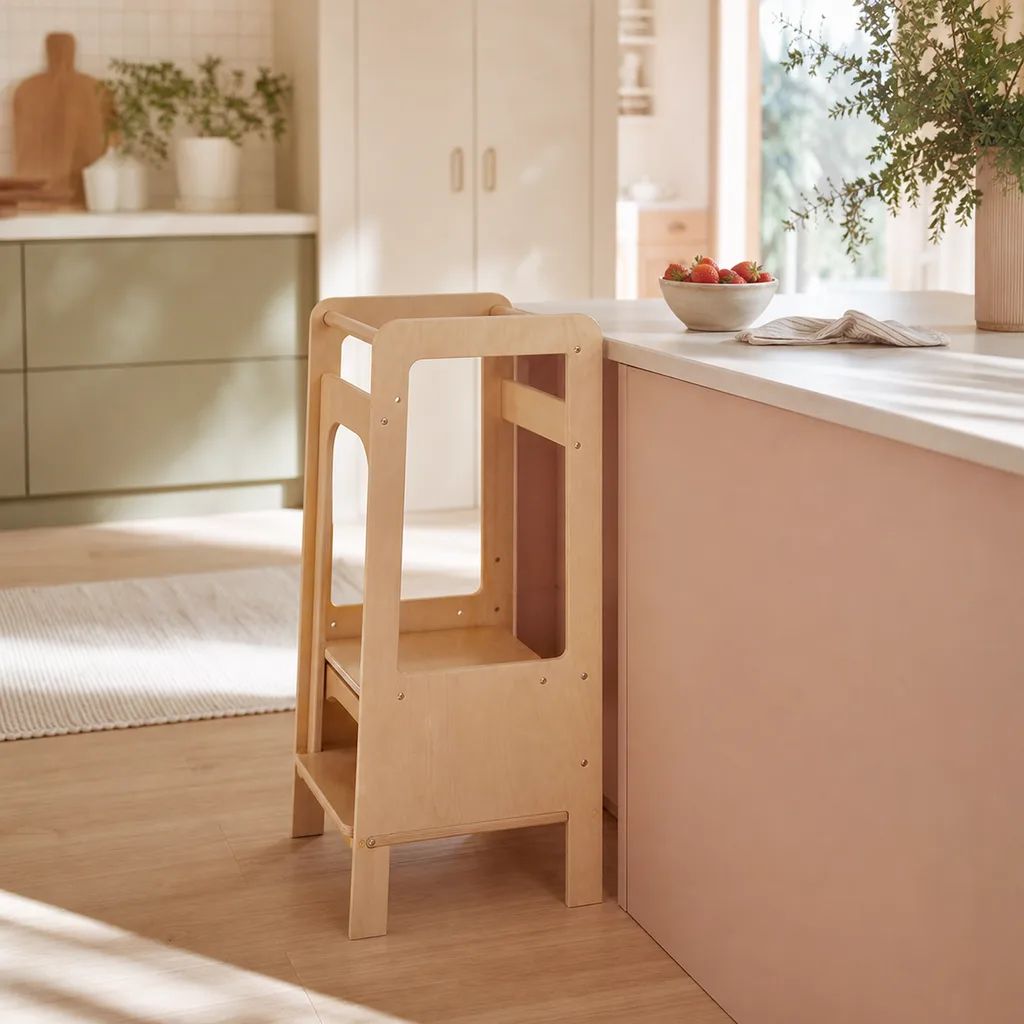
A learning tower, also sold as a kitchen helper stool or toddler tower, is a raised platform with an enclosed top: rails or panels on all four sides, an adjustable standing height, and steps the child can climb on their own. The idea comes from Montessori practice, where toddlers join real household work as early as possible. If that philosophy appeals to you, our guide to Montessori at home for babies and toddlers covers the bigger picture.
Here is how a tower compares to the cheaper options families usually consider:
| Option | Fall protection | Typical price | Best for |
|---|---|---|---|
| Learning tower | Rails on all four sides | $70–$250 | Daily kitchen time from about 18 months |
| Step stool | None (open on all sides) | $15–$40 | Short tasks with a steady child past 2.5 years |
| Kitchen chair | None, and it slides | Free | Nothing. Chairs tip and skid; skip this habit |
A tower is standing gear, not seating and not a jungle gym. If your child treats every raised surface as a climbing challenge, that is normal toddler behavior, but it changes the math on when to introduce one.
When Is a Toddler Ready for a Learning Tower?
Age matters less than movement skills. The CDC milestone checklists put walking without holding on to anyone or anything at 18 months, and climbing on and off a couch without help around age 2. A learning tower asks for something in between: steady independent walking, plus enough coordination to step up onto a low platform without swaying.
Signs your toddler is ready:
- Walks confidently across the room, including turns and stops, without grabbing furniture
- Can step up onto a curb or bottom stair while holding your hand, without lurching
- Follows a simple one-step direction like "hold the rail"
- Shows interest in what you are doing at the counter
Signs to wait a few more weeks:
- Still cruising along furniture rather than walking freely
- Falls frequently on flat ground during normal play
- Cannot yet climb onto a low couch cushion without help
Every child hits these points on their own schedule, and the normal range is wide. Our guide to motor development from 12 to 18 months walks through what typically develops when, and you can log what your child is doing now in our milestones tracker to see how their gross motor skills are trending before you spend the money.
The Safety Reality: No Federal Standard Yet
Here is the honest assessment: learning towers are one of the few popular toddler products with no mandatory federal safety standard. Cribs, high chairs, and play yards all have binding CPSC rules. Towers do not, as of mid-2026. ASTM International has a standard for children's standing towers in development, but until it is finalized and adopted, manufacturers are largely testing to their own specifications.
The recall record shows why that gap matters.
CPSC recalled multiple children's tower stools in 2025 and 2026 for tip-over, collapse, and head-entrapment hazards, with reported injuries ranging from bruises to a fractured arm and a brain injury.
Two recent examples, both sold on Amazon:
- Onasti toddler towers (March 2025): about 10,300 units recalled after four reports of the stool collapsing or tipping over, including a brain injury to a toddler, per the CPSC recall notice.
- Cosyland tower stools (2026): recalled for entrapment and fall hazards after 25 reports of stability issues and falls, with eight injuries ranging from scrapes to a fractured arm.
Consumer Reports ran popular towers through the draft ASTM test methods in 2025 and reported that nearly every model it tested raised at least one safety concern, most often stability under sideways force.
One more certification note: JPMA certifies baby gear against finalized ASTM standards, and since the tower standard is still a draft, genuine third-party certification is rare in this category. If a brand claims a certification, ask which specific standard it was tested against and request the documentation. A vague "safety tested" badge on a listing means nothing.
None of this makes towers a bad buy. It means the vetting burden sits on you, and cheap unbranded imports are exactly where the recalls have clustered.
The Safety Checklist Before You Buy
Run any tower, new or used, through this list:
| Check | Why it matters | What passing looks like |
|---|---|---|
| Base wider than the platform | Tip-over is the number one recall hazard | Legs flare outward; the footprint is clearly wider than the standing area |
| Rails on all four sides | Open backs are how toddlers fall out | Enclosure at least to the child's mid-torso on every side |
| Gap sizes | A gap that lets the torso through but traps the head is a strangulation risk, and it drove the 2026 recall | Openings too small for a child's torso to slip through, or large enough for the whole body, head included, to pass freely |
| Printed weight limit | No limit usually means no testing | A stated limit, typically 100–200 pounds, plus a stated age range |
| Solid hardware | Collapse caused the Onasti injuries | Metal bolts into threaded inserts, not screws into bare particleboard |
| Adjustable platform | The tower should grow with your child | At least two or three height settings that lock positively |
| Wobble test | Reveals weak joints before your child does | Push the top rail sideways in the store or on delivery; no rocking, no flex |
| Recall check | Recalled models keep circulating secondhand | Search the brand and model at cpsc.gov/Recalls before paying |
For a used tower, add two more steps: retighten every bolt, and reject anything with cracks, wood splits, or missing parts. If you cannot identify the brand and model, you cannot check the recall history, and that alone is a reason to pass.
Where to Put It (and Where Not To)
Placement decides most of a tower's real-world risk. The AAP warns that hot liquids, grease, and hot foods can cause serious burns when toddlers are underfoot in the kitchen, and a tower puts your toddler's reach two feet higher than you are used to.
- Never next to the stove or oven. Counter-height hands can reach pot handles, burners, and splatter. Set the tower at a prep counter or the sink instead.
- Out of reach of hazards you forgot were hazards. Knife blocks, the coffee maker, the toaster, cleaning sprays under the sink, and anything plugged in. Sweep the reachable zone before every session.
- On a level, hard floor. Rugs and uneven tile make even a well-built tower rock.
- Away from windows and shelving. The AAP notes children can be seriously hurt when they climb furniture that tips, and a tower can become a ladder to bigger trouble if you park it near something climbable.
- Stored out of the kitchen when you are not cooking together. An unattended tower is an open invitation to solo climbing.
If you have not done a full hazard sweep since your child started walking, our childproofing guide covers the whole house, room by room.
Should You Buy a Learning Tower or Skip It?
| If you are... | And you want... | The right choice is... |
|---|---|---|
| Cooking most days with an 18-month-old shadowing you | Real participation without carrying them | Buy a tower that passes the full checklist |
| Working with a small kitchen | Counter access without a permanent footprint | Buy a folding tower, and check its locked stability twice as hard |
| Parenting a steady 2.5- to 3-year-old | Occasional help with low-risk tasks | A sturdy step stool with you at their side |
| Waiting on a new walker under 18 months | A head start | Wait. Balance is not there yet, rails or not |
| Furnishing grandma's house for monthly visits | Something for rare use | Skip it. Bring simple table-height tasks instead |
Budget note: solid towers from established brands run roughly $70 to $250. Both of the recalled models above sold in the $70 to $100 range, so price alone tells you little. The checklist does the sorting, not the price tag.
If you are building a bigger gear list for the toddler year, our checklists tool helps you track what is actually worth buying and what you can skip.
Alternatives That Work
A tower is a convenience, and there are cheaper routes to the same developmental payoff:
- A step stool, later. From around 2.5 to 3 years, a steady child can use a wide, rubber-footed stool for hand washing and simple counter tasks while you stand beside them.
- Table-height work. Move the task to your toddler instead of moving your toddler to the counter. Tearing lettuce, stirring dry ingredients, and washing produce in a bowl all work at a low table from well before 18 months.
- A cleared low cabinet or drawer. One toddler-owned space in the kitchen, stocked with cups and wooden spoons, buys you cooking time at zero risk and zero dollars.
Plenty of toddler learning happens nowhere near a counter. Our roundup of play activities for 1-year-olds has ideas that build the same fine motor and imitation skills without any gear at all.
When to Call Your Pediatrician
Two situations deserve a professional opinion:
- After a fall from a tower or counter height. Call your pediatrician promptly if your child hit their head. Mayo Clinic's head trauma first-aid guidance lists repeated vomiting, unusual drowsiness, and any loss of consciousness among the signs that need emergency evaluation, and trust your gut on anything that just seems wrong. Falls onto hard kitchen floors from platform height can cause more than bruises, as the recall injury reports show.
- If walking is late. A child who is not walking independently by 18 months should be evaluated. That is a check-in, not a verdict; our guide on when babies start walking explains the normal range and what an evaluation looks like.
And report any tower failure, collapse, wobble, or near-miss at SaferProducts.gov. Recalls start with parent reports.
Frequently Asked Questions
What age can a toddler use a learning tower?
Most toddlers are ready around 18 months, once they walk steadily without holding on and can step up onto a low platform with confidence. CDC milestone checklists put independent walking at 18 months, which is a sensible floor. Before that, balance is too shaky for a raised platform, even one with rails on all four sides.
Are learning towers safe?
They can be, but there is no mandatory US safety standard yet, and CPSC recalled several models in 2025 and 2026 for tip-over and entrapment hazards. Choose a wide, flared base and four-sided rails, check the model against recall listings, and stay within arm's reach whenever your child is up in the tower.
Is there a safety certification for learning towers?
Not a finalized one. An ASTM standard for children's standing towers is still in development as of mid-2026, so most towers carry no third-party certification, and JPMA certification is rare in this category. Ask the manufacturer what stability and entrapment testing the tower has passed, and treat a vague "safety tested" claim as a no.
What is the difference between a learning tower and a step stool?
A learning tower is an enclosed platform with rails on all four sides, so a toddler can stand at counter height with fall protection. A step stool is open on all sides, cheaper, and fine for short supervised tasks with an older, steadier child, typically from around 2.5 to 3 years.
Should I buy a used learning tower?
Only after checking the exact brand and model against CPSC recall listings, tightening every bolt, and confirming it does not rock when pushed sideways at the top rail. Skip any secondhand tower with missing hardware, cracks, or no identifiable model name, because an unidentifiable tower cannot be checked against recalls.