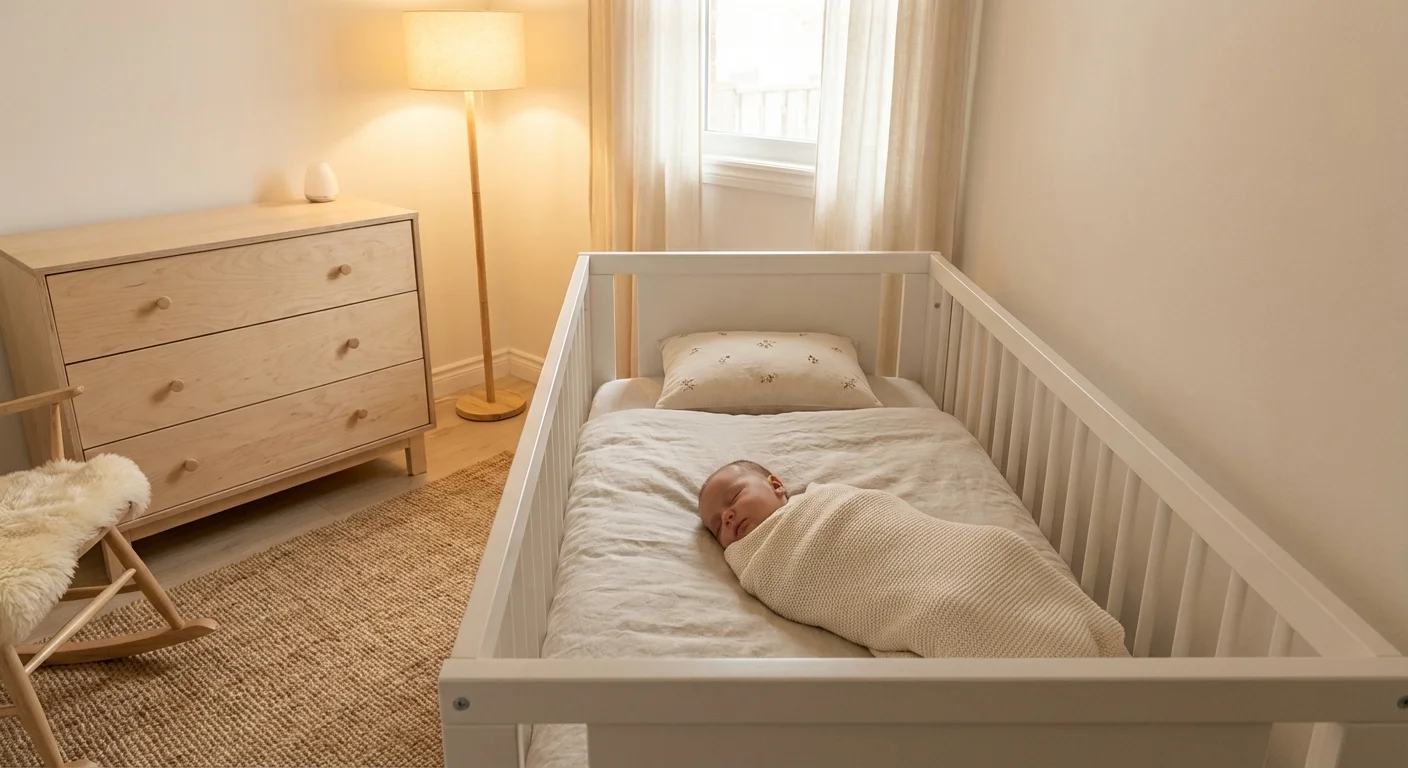
The nursery is half built, the registry lists both a bassinet and a crib, and you're wondering which one your baby will sleep in on the first night home.
The bassinet vs crib choice comes down to where your baby sleeps in the first months and how much floor space you have. This guide compares both, plus mini cribs and play yards, against the federal safety standards and the American Academy of Pediatrics (AAP) safe sleep advice. Once you've chosen, tick off the sleep space on your nursery checklist.
Your newborn needs one safe sleep surface, and a bassinet or a crib can each be used from birth if it meets the current federal standard and holds only its firm, flat mattress and a fitted sheet. Pick a bassinet to room-share in a small bedroom, or a crib for one bed that lasts until your child moves to a bed.
Key Takeaways
- One is enough. The AAP lists a crib, bassinet, portable crib or play yard as a place for your baby to sleep if it meets Consumer Product Safety Commission (CPSC) standards.
- Keep it bare. Use the firm mattress made for the product and a fitted sheet, and nothing else.
- Room-share for at least 6 months. The AAP recommends it, and a bassinet or a crib can do the job.
- Move by the label. Switch when your baby reaches a limit printed on the bassinet or can push up on hands and knees, whichever comes first.
- Skip banned products. Selling inclined sleepers and crib bumpers has been illegal in the US since November 12, 2022.
Bassinet vs Crib: The Differences at a Glance
A bassinet is a small bed for the newborn months, a full-size crib lasts until your child moves to a bed, a mini crib is a smaller crib with rigid sides, and a play yard (often called a pack and play) is a framed enclosure with a floor and mesh or fabric sides. Each has its own mandatory federal rule.
| Bassinet | Full-size crib | Mini crib | Play yard | |
|---|---|---|---|---|
| Federal rule | 16 CFR 1218 | 16 CFR 1219 | 16 CFR 1220 | 16 CFR 1221 |
| Mattress | Firm, flat pad made for it | Firm, flat, snug fit | Firm, flat pad made for it | Only the pad it came with |
| Sides | Varies by design | Fixed; no drop-sides | Rigid | Mesh or fabric |
| Limits | Printed limits, or pushing up on hands and knees | Until your child moves to a bed | Printed limits | Printed limits |
| Footprint | Smallest | About 28 × 52⅜ in inside | Under 49¾ in long inside | Varies by model |
| Portability | Moves room to room | Stays put | Some models fold | Folds for travel |
| Price band (our rough guide) | Lower | Higher | In between | Lower to middle |
What the Safety Standards Require
Every crib, bassinet and play yard sold in the US has to meet a mandatory CPSC rule built on an ASTM International standard. Look for the rule number on the label or in the manual.
Bassinets and Cradles
A bassinet has to meet a federal rule, and the label or manual names it. The rule is 16 CFR part 1218, based on ASTM F2194. It covers bassinets made or imported on or after April 23, 2014, and its newest version applies to those made or imported from February 21, 2026 (CPSC).
The rule also covers any product that converts into a bassinet, whenever it is in bassinet mode (16 CFR 1218). That includes the "3-in-1 bassinet crib" listings on many registries: each mode has to meet its own standard.
Full-Size and Non-Full-Size Cribs
A crib has to meet one of two federal rules, depending on its size. Full-size cribs fall under 16 CFR part 1219 and measure about 28 by 52⅜ inches inside (CPSC). Rigid-sided cribs shorter than 49¾ inches or longer than 55 inches inside, including mini cribs and folding portable cribs, fall under part 1220 (CPSC).
Both rules cover cribs made on or after June 28, 2011. The 2011 standards banned the manufacture and sale of drop-side cribs and required stronger slats, mattress supports and hardware (AAP).
The AAP adds that crib bars should be no more than 2⅜ inches apart and the mattress should fit snugly (AAP). Our guide to types of cribs covers convertible designs.
Play Yards
A play yard is held to its own rule, 16 CFR part 1221, based on ASTM F406, and the current version applies to those made or imported from April 5, 2025. A play yard with a bassinet attachment has to meet both the play yard and the bassinet requirements (CPSC).
Check what you're buying. Fill in the product registration form that manufacturers must provide with durable infant products under federal rules (CPSC). Then look up the model on CPSC's recall pages. The AAP says to check the CPSC website to make sure your crib hasn't been recalled, especially if it's not new (AAP, 2026).
Room-Sharing and Where Your Baby Sleeps
The AAP says to "share a room with your baby for at least the first 6 months of life," with your baby's sleep space close to your bed but not in it (AAP, 2026). Its 2022 policy update put the timeframe as "preferably for at least the first six months" (AAP, 2022).
The AAP says room-sharing can decrease the risk of SIDS by as much as 50% (AAP, 2026), and NICHD's Safe to Sleep campaign calls room-sharing without bed-sharing "the safest option" (NICHD). A bassinet makes that practical in a small bedroom. If a full-size crib fits beside your bed, it does the same job and saves a second purchase.
In any of these beds, your baby sleeps on their back. The AAP calls a surface firm if it "shouldn't indent when your baby is lying on it" and says anything inclined more than 10 degrees isn't safe for sleep, and NICHD adds that it should be "covered only with a fitted sheet."
Do You Need a Bassinet and a Crib?
For most families, no. A full-size crib that meets its standard can be used from the first night. You may want a second bed in a few cases (this list is our own reasoning, not AAP or CPSC advice):
- Bedroom space. If a crib fits beside your bed, room-share in it and skip the bassinet. If it doesn't, a bassinet or play yard in your room plus a crib for later is the usual pair.
- How long you'll room-share. A bassinet may reach its printed limits before you're ready to stop, so plan for a crib or play yard in your room afterward.
- Stairs. If naps happen on another floor, a play yard there saves carrying a sleeping baby up and down.
- Recovery after birth. After a c-section or a hard birth, a bassinet beside the bed may be easier to reach than a crib rail. Ask your care team about lifting and bending.
- Budget. One bed costs less than two, and a crib lasts until your child moves to a bed, which the AAP suggests once children are about 3 feet tall (AAP).
- A second baby. If your first child may still be in the crib when a sibling arrives, a bassinet can wait until then.
Otherwise, our rule of thumb is to buy one: a crib if it fits in your room, a bassinet or play yard if it doesn't.
"Crib or bassinet (safety-certified)" and "Firm mattress with fitted sheet" are the first two items on the Nursery Essentials list in our checklists. Tick off the one you chose.
Bassinet vs Mini Crib vs Pack and Play
For each pair below, compare the federal rule the product meets and the limits printed on it.
Bassinet vs Mini Crib
A mini crib is a smaller rigid-sided crib under 16 CFR part 1220, and a bassinet is a newborn bed under part 1218. The AAP lists a mini crib, like a bassinet, as a safe choice with a flat, firm mattress (AAP). Read the weight and height limits printed on each to see how long you'll use it.
Crib vs Pack and Play
A play yard that meets 16 CFR part 1221 is on the AAP's list of safe sleep spaces, folds for travel and takes less room than a crib. Use only the pad it came with: the AAP warns that mattresses sold separately "are usually not tight enough to keep infants from suffocating or getting trapped" (AAP).
Bassinet vs Pack and Play
Some play yards include a bassinet attachment for the newborn months. It has to meet both standards and has its own printed limits. For trips, see our guide to travel bassinets.
Bassinet vs Moses Basket
The AAP warns that many mini-bassinets and baskets don't meet infant sleep safety standards, and that their soft sides can let a baby tip out, a bigger risk on counters, tables and other high surfaces (AAP). Our suggestion: skip baskets. If you buy a bassinet, choose a rigid-sided model whose label or manual says it meets 16 CFR part 1218, and keep it on the floor, never on a counter or table.
British advice uses "cot" for what US parents call a crib; our crib vs cot guide sorts out the terms.
When Should You Move Your Baby From the Bassinet to the Crib?
Move your baby once they reach any limit printed on the bassinet or in its manual, or can push up on hands and knees, whichever comes first. CPSC named that developmental sign when it approved the bassinet standard in 2013, describing a bassinet as not intended for a child "able to push up on his hands and knees" (CPSC, 2013). The same release says a bassinet is not intended for use beyond about 5 months of age, so treat that as the outer edge and go by the printed limit or the first sign of pushing up, whichever comes first.
Limits differ between bassinets, so read yours before your baby arrives. If your baby outgrows it while you're still room-sharing, put the crib or a play yard in your bedroom, since the AAP's advice is about the room. The new bed follows the same rules: back to sleep, a firm, flat mattress and a fitted sheet only.
What to Skip: Products That Aren't Safe for Sleep
Leave these off your registry and turn them down second-hand:
- Inclined sleepers. The Safe Sleep for Babies Act bans selling sleepers inclined more than 10 degrees for infants up to 1 year old, effective November 12, 2022, whatever the manufacture date (CPSC).
- Crib bumpers and liners. The same law bans crib bumpers. Non-padded mesh liners fall outside it, but the AAP lists crib liners among items to avoid because they can work loose and trap a sleeping child.
- Loungers, nests and in-bed sleepers. The AAP says infants have suffocated while sleeping on loungers, and it lists inclined sleepers, often marketed as pods, wedges or nests, among the products the Safe Sleep for Babies Act bans (AAP). In-bed sleepers and compact nests are regulated by CPSC's infant sleep products rule, 16 CFR part 1236, which sits beside the crib, bassinet and play yard rules; those products must still meet the bassinet requirements (CPSC). We'd skip them: one crib, bassinet or play yard is all your baby needs.
- Sleep positioners. The AAP links them with multiple deaths and says there is no evidence they prevent SIDS (AAP).
- Soft and weighted extras. The AAP says no blankets, pillows, stuffed toys, bumper pads or plush add-on mattresses, and CPSC adds no weighted blankets or weighted swaddles (CPSC).
- Car seats and swings for sleep. If your baby falls asleep in a car seat, stroller, swing, carrier or sling, the AAP says to move them to a firm sleep surface on their back as soon as possible (AAP).
Buying a Crib or Bassinet Second-Hand
- Manufacture date. Find it on the tracking label or registration form. For child care settings, CPSC presumes cribs made on or after June 28, 2011 comply with the crib rules; for your home, treat that date as a minimum and still check recalls (CPSC).
- No drop-side. The AAP tells owners of older cribs to stop using the drop-side rail (AAP).
- Every part. The AAP says not to use a crib that doesn't have instructions, is missing hardware or is broken (AAP), and to check that all hardware is tight and no parts are loose, missing or broken (AAP).
- Recalls and mattress. Search the model on CPSC's recall pages, and use the firm mattress made for it, fitted tightly (AAP).
Sheets and Setup
Use only the mattress or pad made for your baby's bed, fitted tightly, with a fitted sheet as the only thing inside. For spares, see how many bassinet sheets to keep for your laundry routine.
Frequently Asked Questions
Is a bassinet or a crib better for a newborn?
The AAP lists both as safe places for a newborn to sleep when they meet CPSC standards and hold only a firm mattress and a fitted sheet. A bassinet fits beside your bed in a small room; a crib lasts until your child moves to a bed.
Do I need both a bassinet and a crib?
No. One safe sleep surface is enough, and a full-size crib that meets the federal standard can be used from the first night. A bassinet makes sense when a crib won't fit in your bedroom and you plan to room-share.
Crib vs bassinet: which is safer?
Both are safe sleep spaces when they meet their federal standard (16 CFR 1218 for bassinets, 1219 or 1220 for cribs) and stay bare, with only a firm mattress and a fitted sheet. The AAP lists both as places for your baby to sleep.
When should I move my baby from the bassinet to the crib?
Move your baby once they reach any limit printed on the bassinet or in its manual, or can push up on hands and knees, whichever comes first. CPSC describes a bassinet as not intended for a baby who can push up on hands and knees.
Can a newborn sleep in a pack and play instead?
Yes. The AAP lists a play yard as a safe sleep space when it meets the CPSC standard, 16 CFR 1221. Use only the firm pad that came with it and a fitted sheet, with nothing else inside.
What is the difference between a bassinet and a mini crib?
A bassinet is a small bed for the newborn months, regulated under 16 CFR 1218. A mini crib is a smaller crib with rigid sides, regulated as a non-full-size crib under 16 CFR 1220. Compare the limits printed on each to see how long it will last.
Before Your Baby Comes Home
Next, plan the supplies you'll use fastest: work out how many diapers to stock and how many bottles fit the way you plan to feed. Our nursery must-haves list covers the rest of the room, and when you're ready, finish your nursery list.
This article is for informational purposes only and does not replace professional medical advice. Follow the instructions and warnings for your specific product, and talk with your pediatrician about guidance for your baby.
How This Guide Was Made
The Babysential Team wrote this guide from the AAP, CPSC and NICHD documents below, checked on October 11, 2026. AI-assisted drafting helped organize the page. Each safety statement links to a named source, and our own suggestions are labeled as ours. Babysential sells and links none of the products compared here.
Sources
- How to Keep Your Sleeping Baby Safe: AAP Policy Explained, AAP (HealthyChildren.org), 2026
- American Academy of Pediatrics Updates Safe Sleep Recommendations: Back Is Best, AAP, 2022
- Baby Products to Avoid: Unsafe Registry Picks & Secondhand Gear, AAP (HealthyChildren.org), 2026
- New Crib Standards: What Parents Need to Know, AAP (HealthyChildren.org), 2014
- Choosing a Crib, AAP (HealthyChildren.org), 2021
- Safe Sleep Environment, NICHD Safe to Sleep, undated page, checked October 2026
- Bassinets and Cradles Business Guidance, CPSC, 2026
- CPSC Approves New Federal Safety Standard for Bassinets and Cradles, CPSC, 2013
- 16 CFR Part 1218: Safety Standard for Bassinets and Cradles, Code of Federal Regulations (CPSC), 2025
- Full-Size Baby Cribs Business Guidance, CPSC, 2019
- Non-Full-Size Baby Cribs Business Guidance, CPSC, 2025
- Play Yards Business Guidance, CPSC, 2025
- Enforcement Guidance for Child Care Providers (Cribs), CPSC, 2012
- Safe Sleep for Babies Act Business Guidance, CPSC, 2022
- Infant Sleep Products Business Guidance, CPSC, 2022
- Safe Sleep: Cribs and Infant Products, CPSC, 2026