You don't need expensive materials or a dedicated playroom to use Montessori at home. All you need is a little preparation, ordinary everyday objects, and a willingness to follow your child's lead.
Montessori is about letting your child explore at their own pace, in an environment adapted to their size and developmental stage. It's simpler than you might think.
What is Montessori, a brief overview
Maria Montessori was an Italian physician who, over a hundred years ago, made a revolutionary discovery: children learn best when they are free to explore on their own terms, in a thoughtfully prepared environment.
Five core principles guide Montessori pedagogy:
- Respect for the child, the child is competent and curious from birth
- The prepared environment, surroundings adapted to the child's size and developmental stage
- Freedom within limits, the child chooses their own activities, but within safe boundaries
- Follow the child, observe what your child is drawn to and create space for it
- Sensitive periods, children go through specific windows of time when they are especially receptive to certain kinds of learning
"Help me do it myself" is the most famous phrase in Montessori philosophy. It sums up the whole approach: don't do things for the child, set up the conditions for the child to master things independently.
How to create a Montessori-inspired home
You don't need to renovate your whole house. Start with one room or one zone, and ask: what can my child reach, see, and do entirely on their own here?
Child-height furniture
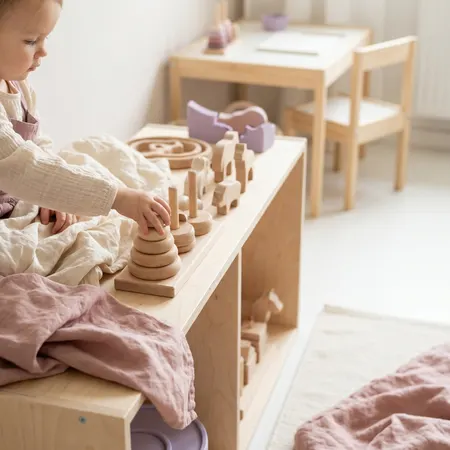
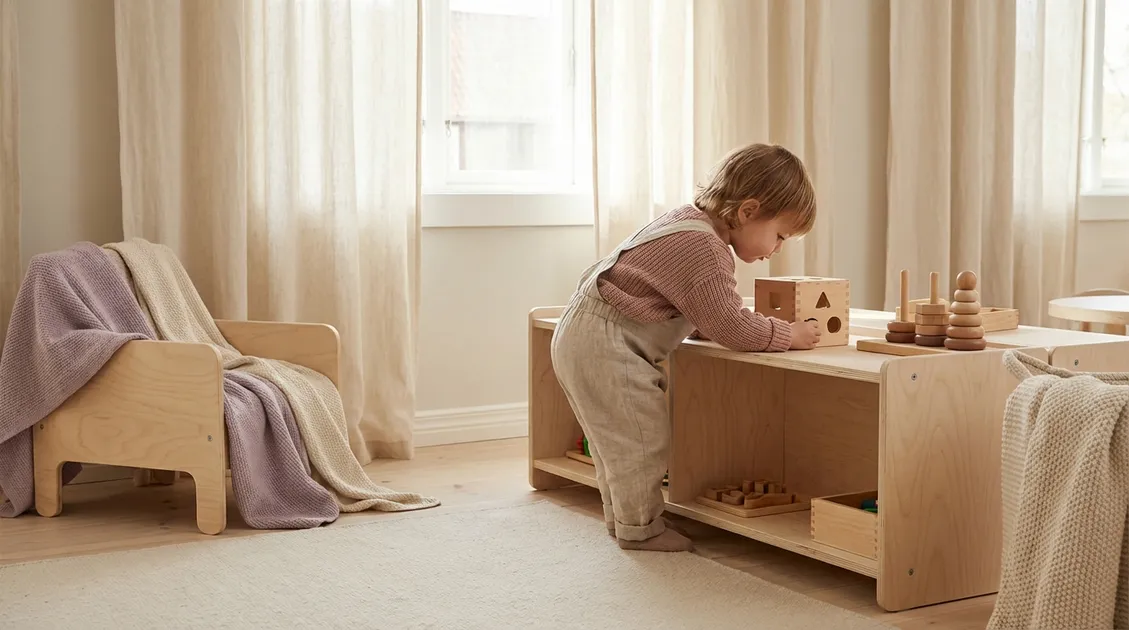
Put a low shelf out with a few toys on it. Hang hooks at your child's height for a coat and bag. Use a small step stool at the sink. When things are accessible, your child doesn't have to ask for help all the time.
Fewer toys, better quality
Montessori recommends having only a small number of toys out at a time. Too many choices overwhelm. Rotate the toys, swap out what's on display every week or two.
Choose natural materials like wood, fabric, and metal over plastic. Real objects over toy versions.
Order and system
Everything has a fixed place. Toys are sorted into baskets or on trays. Your child learns to take things out, and put them back. This outer order helps the child build inner structure.
You don't need to buy special Montessori shelving. A standard low bookcase at child height works perfectly. Use baskets and trays to organise activities.
Montessori activities: 0–6 months
In the first months, Montessori is about creating a calm, stimulating environment where your baby can observe and explore with their senses.
Activities for the youngest
- Mobile above the changing table, make a simple mobile with high-contrast colours (black and white in the first weeks, colours from around 3 months)
- Mirror at floor level, babies are fascinated by their own reflection and practice visual focusing
- Grasping rings and rattles, one at a time, in natural materials like wood or fabric
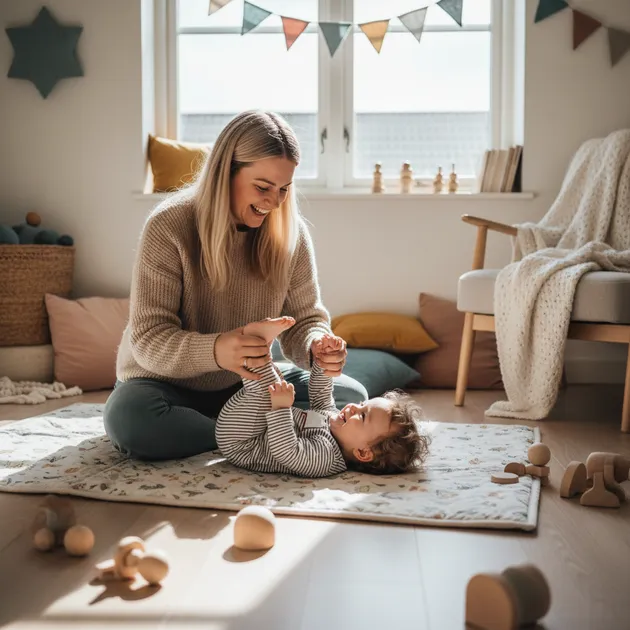
- Tummy time on a mat, lay your baby on a soft mat with 2–3 interesting objects within reach
- Contrast cards, simple black-and-white images stimulate vision in the first weeks
The most important thing now is to give your baby time to observe. Don't overwhelm with impressions. One thing at a time.
Montessori activities: 6–12 months
Your baby is starting to sit, crawl, and grasp with a pincer grip. Now curiosity explodes.
Practical activities
- Peek-a-boo with fabric, place a cloth over a toy and let your baby find it. Trains object permanence
- Stacking cups, stacking and knocking down is endlessly fun and develops fine motor skills
- Sensory baskets, fill a basket with 3–4 safe objects with different textures: a wooden stick, a silk scarf, soft fabric, a smooth stone
- Ball in a box, your child drops a ball through a hole and watches it roll out. Cause and effect in practice
- Simple food exploration, let your baby explore food with their hands. Mash banana, touch avocado
Observe your child: what catches their attention? What movements do they repeat? What you see is likely a sensitive period, a sign of what your child is ready to learn right now.
Environment tips for this age
A floor mattress instead of a crib lets your baby crawl out and explore the room independently (childproofing is essential). Place books in a low basket with the covers facing out. Have a low chair or cushion where your child can practise sitting.
Follow your child's milestones to adapt activities to their development.
Montessori activities: 1–2 years
The toddler wants to do everything themselves. This is not defiance, it is an intense developmental drive toward independence. Embrace it.
Everyday life activities
Montessori calls these "practical life activities," and they are the very heart of the pedagogy at this age:
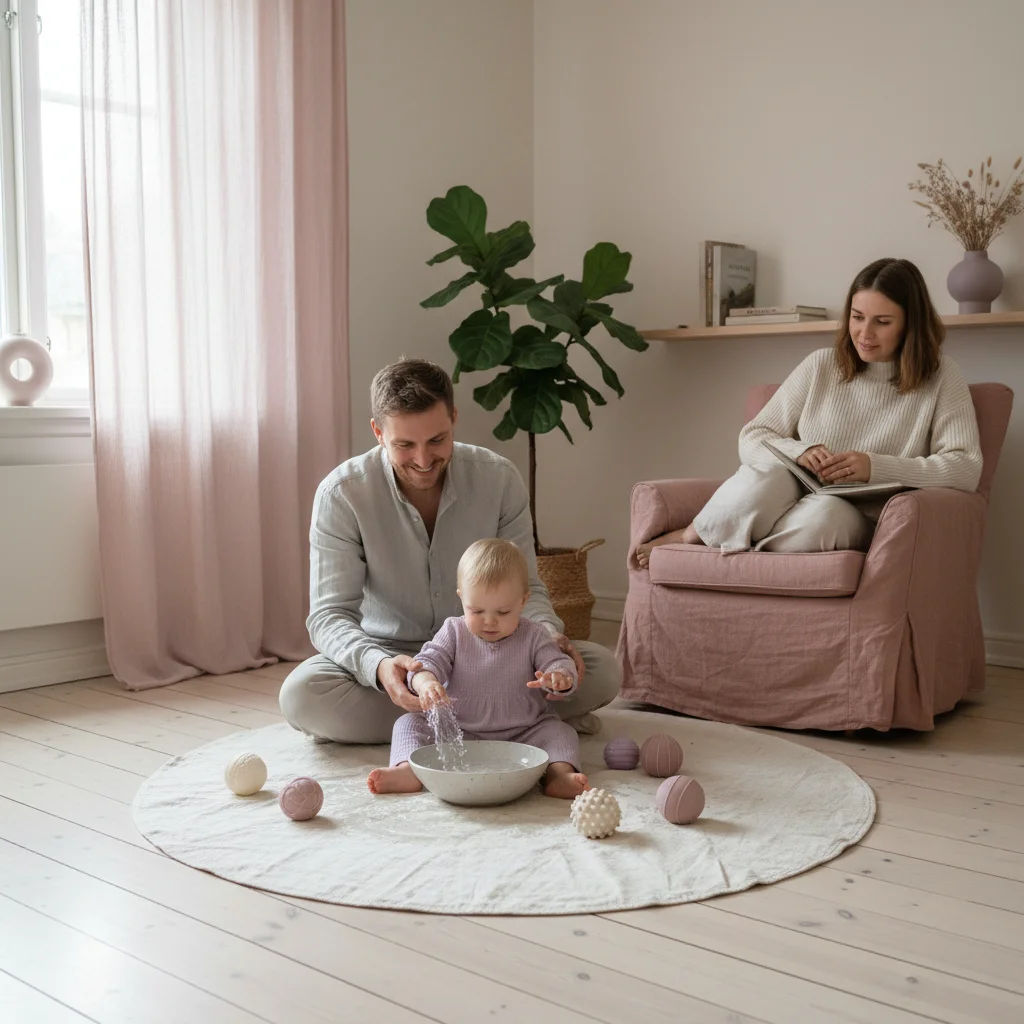
- Pouring water, from a small pitcher into a glass. Start with dry items (beans, rice) before moving on to water
- Sweeping the floor, a small child-sized broom and dustpan
- Washing fruit, set up a small basin of water and let your child wash apples and pears
- Getting dressed, lay out clothes in the order they go on. Choose clothes that are easy to take off and put on
- Brushing teeth, your child goes first, you "help" afterwards
Fine motor skills and concentration
- Threading large beads onto a cord
- Sorting, colours, shapes, or sizes using everyday objects
- Opening and closing, boxes with different types of lids, mailboxes, zippers
- Pushing sticks through holes in a lid
- Reading picture books, let your child turn the pages and point
In Montessori, we don't interrupt a child's concentration. If your toddler is absorbed in transferring beans from one bowl to another for the tenth time, let it happen. Repetition is how the brain learns.
Montessori activities: 2–3 years
Language is exploding, fine motor skills are becoming more precise, and imagination is growing. Now you can introduce more complex activities.
Practical life
- Spreading their own toast with a child-friendly butter knife
- Watering plants with a small watering can
- Setting the table, use a placemat with outlines drawn for the plate, glass, and cutlery
- Folding towels and washing cloths
- Baking together, your child can measure, pour, and stir
Creative and sensory
- Cutting, start with cutting thin strips of paper with child scissors
- Painting with a brush at an easel or on large paper
- Modelling with natural clay or homemade dough
- Nature collection, collect pinecones, stones, and leaves on a walk, sort them at home
- Matching cards, pairs of pictures with animals, fruit, or everyday objects
Language and concepts
Talk with your child about what you are doing together. "Now we're pouring the water into the cup. Can you see it running?" Name colours, shapes, quantities, and actions.
Find more age-appropriate activities for your child on Babysential.
The adult's role
In Montessori, you are not the teacher, you are the facilitator. That means:
Observe first. See what your child is drawn to. What are they trying to do? What are they almost able to do?
Show, don't explain. Demonstrate slowly and clearly how something is done. Use few words. Let your child try it themselves afterwards.
Wait. Give your child time to solve problems. Tolerate a little frustration. Offer help only when your child asks for it or clearly needs it.
Adapt the environment. When something isn't working, change the surroundings, not the child. Is the stacking cup too difficult? Switch to something with fewer pieces.
"Help me do it myself" also means: don't praise your child for everything they do. In Montessori, we say "You did it!" or "I can see you worked hard on that", rather than "Clever girl!" or "Good job!"
Montessori on a budget
You don't need to import expensive Montessori materials from abroad. Here are affordable alternatives:
| Montessori material | Homemade alternative |
|---|---|
| Threading beads | Large wooden blocks with holes + a shoelace |
| Sensory board | Board with different textures glued on (felt, sandpaper, rubber) |
| Spooning activity | Two bowls + a large spoon + dried beans |
| Colour sorting | Pom-poms in different colours + an egg carton |
| Puzzle | Homemade from cardboard with 2–4 pieces |
| Practical life board | Zipper, buttons, and Velcro sewn onto a piece of fabric |
Second-hand shops often have wooden toys, baskets, and trays at a fraction of the price. Nature is free, and the best Montessori materials are found outdoors.
Common mistakes parents make
Too many toys out at once. Start with 5–8 activities on the shelf. Rotate regularly.
Too much help. It's faster to dress your child yourself, but that takes away their opportunity to practise.
Too little time. A toddler pouring water may need ten minutes for something you can do in ten seconds. That is the whole point.
Perfectionism. The floor gets wet, beans end up on the ground, the toast looks like a battlefield. That is learning in action.
Frequently asked questions
Is Montessori the same as "free-range parenting"?
No. Montessori gives freedom within clear boundaries. The child chooses the activity, but the rules are fixed: we treat materials with care, we tidy up after ourselves, we don't hurt others. Structure and order are fundamental to Montessori philosophy.
When can I start with Montessori at home?
From birth. For newborns, it is about a calm, prepared environment with a mirror at floor level, a mobile, and a few quality objects. The principles scale with your child's age.
Do I need to buy special Montessori materials?
No. Everyday objects are the best materials. A real cup, a small broom, a basket of pinecones, all of these are Montessori. What matters is that the objects are real, the right size for your child, and accessible.
Can I use Montessori even if my child goes to a regular daycare?
Absolutely. Montessori at home is about attitude and environment, not about replicating a classroom. Many families apply Montessori principles in daily life regardless of their childcare setting.
What do I do if my child isn't interested in the activities?
Follow the child, not the plan. If your child ignores the stacking cups but loves pouring water, create more opportunities for pouring. Montessori is about observing what your child is ready for, not about pushing through an activity list.
Read more
- Sensory play for babies, 20 simple activities
- Motor development in babies
- Play and learning for babies
- The best toys for babies 0–6 months
Sources
- American Montessori Society, amshq.org
- Montessori, M. (1949). The Absorbent Mind. The Montessori-Pierson Publishing Company
- Lillard, A. S. (2017). Montessori: The Science Behind the Genius. Oxford University Press
- Association Montessori Internationale, montessori-ami.org
🔧 Helpful Tools
- Baby Milestones Tracker. Track your baby's developmental milestones
- Development Leaps. Understand your baby's developmental leaps
- All Baby Tools. Browse all free tools for pregnancy and baby care
📖 Related Articles
- Baby Gym: Activities, Benefits, and Tips for Motor Development. Everything about baby gyms, activities for motor development, DIY baby gym vs store-bought, age-appropriate exercises from 0-12 months, and tips for stimulating your baby at home.
- Sensory Play for Babies, 20 Simple Activities, 20 easy sensory activities for babies from 0 to 12 months. Stimulate all the senses with safe, homemade toys and everyday household items.