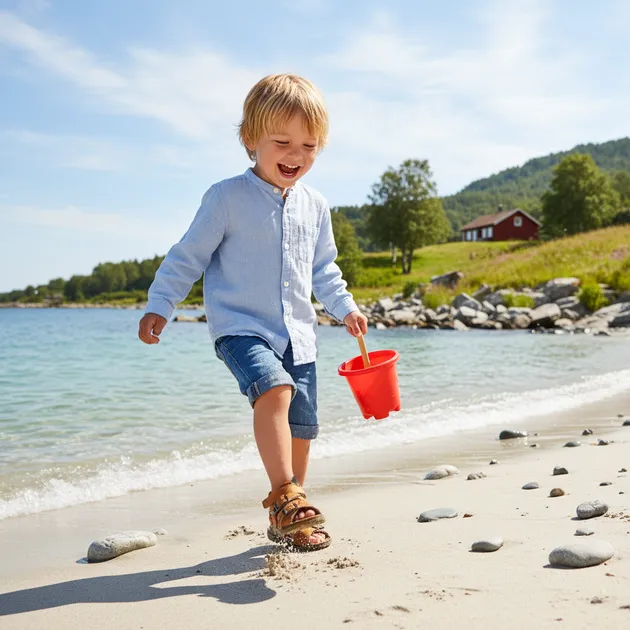
Summer is approaching, and your child needs good sandals. But a child's foot is completely different from an adult's, it's soft, shaped by cartilage, and grows rapidly. The wrong sandals can do more harm than good.
Here is a complete guide to choosing the right sandals for babies and toddlers, with tips on sizing, fit, and the best brands.
Prices in this article are approximate and may have changed. Check current prices with retailers.
When Does Your Child Need Sandals?
Barefoot Is Still Best
Just as with regular shoes, going barefoot is the very best thing for a child's foot development. When children go barefoot, they use their toes actively to grip the ground. This strengthens the foot muscles and develops balance.
Let your child go barefoot as much as possible, even in summer. Grass, sand, and soil are ideal surfaces for small bare feet.
Once the Child Is Walking Independently
Children need sandals when they are walking confidently outdoors and need protection from hot surfaces, sharp stones, or gravel. For most children, that means from around 9–12 months, depending on when they start walking.
Don't buy sandals before your child actually needs them. The cute miniature sandals in the store are tempting, but completely unnecessary for a child who isn't yet walking.
Children who have just learned to walk do best with closed sandals that have toe protection. Open sandals are better suited for children from age 2–3 who are more confident on their feet.
Open vs. Closed Sandals
Closed Sandals (With Toe Protection)
Closed sandals have a reinforced toe cap that protects toes from stones and roots. They are the safest choice for toddlers who are unsteady and prone to tripping.
Advantages:
- Protects toes from impact and scrapes
- Provides better support around the foot
- Suitable for all types of terrain
- Can serve as the only summer shoe
Disadvantages:
- Dry more slowly than open sandals
- Can get warm on very hot days
Open Sandals
Open sandals allow better airflow and dry faster. They are best suited for older children who are confident on their feet and moving on even surfaces.
Advantages:
- Lightweight and airy
- Dry quickly after water play
- Easier to put on and take off
Disadvantages:
- No toe protection
- Less support
- Not suitable for uneven terrain
What to Look for in Children's Sandals
1. Flexible Sole
The sole should bend where the foot naturally bends, at the ball of the foot. Hold the heel and toe and flex the sandal. It should give at the front, not in the middle.
Avoid sandals with a completely rigid sole. The child's foot needs to move freely in order to develop properly.
2. Toe Protection
For children under 3, we always recommend sandals with a closed toe or toe guard. Young children fall and trip often, and toes are especially vulnerable.
3. Adjustable Fastening
Choose sandals with Velcro straps or buckles that can be adjusted. Children's feet vary in width, and adjustable fastenings give a better fit than slip-on styles.
Avoid sandals that simply slide on with no adjustment. They fit poorly and fall off easily.
4. Firm Heel Counter
The heel counter (back panel) should provide stability for the ankle. It should feel firm when you squeeze it, not soft and pliable. Good heel support is especially important for children who have just learned to walk.
5. Non-Slip Sole
Check that the sole has good grip, especially on wet surfaces. Children play in water all summer, and slippery sandals can lead to nasty falls.
Test the grip by running your hand across the sole. It should feel rough and have a clear tread pattern. Smooth rubber soles without any pattern are not safe for children.
6. Breathable Materials
Children's feet sweat a lot. Choose sandals made from natural materials such as leather, or with mesh panels that allow air circulation. Synthetic sandals without ventilation can cause sweaty feet and blisters.
Sizing Guide for Children's Sandals
How to Measure Your Child's Foot
- Stand the child on a piece of paper with the foot flat on the floor (standing, not sitting)
- Trace around the foot with a pencil held close to the foot
- Measure from heel to longest toe in centimeters
- Add 1 cm for growing room
Always measure both feet. It is completely normal for one foot to be slightly larger. Use the larger foot as your reference.
Children's Sandal Size Chart
| EU Size | Foot Length (cm) | Approximate Age |
|---|---|---|
| 19 | 11.5 | 9–12 months |
| 20 | 12.3 | 12–15 months |
| 21 | 13.0 | 15–18 months |
| 22 | 13.7 | 18–21 months |
| 23 | 14.3 | 21–24 months |
| 24 | 15.0 | 2 years |
| 25 | 15.7 | 2.5 years |
| 26 | 16.3 | 3 years |
Age is a guide only. Always measure the foot, children of the same age can have very different foot sizes.
Children's feet grow in spurts. Check the size every two months in summer, and every three months in winter. A sandal that is too small restricts foot development.
Trying on Sandals
Bring your child to the store and try sandals on later in the day, when the foot is at its largest. Let the child walk around the store for a few minutes and observe:
- Does the child walk naturally, or do they shuffle?
- Does the heel slide up and down?
- Is there room in front of the toes (approx. 1 cm)?
- Is the skin turning red anywhere?
Materials. Leather vs. Synthetic
Leather
Leather is the traditional choice for children's sandals. It breathes well, molds to the foot, and is durable.
Advantages: Breathable, adapts to the foot, long-lasting, comfortable
Disadvantages: More expensive, doesn't handle water as well, requires maintenance
Synthetic
Modern synthetic materials like EVA foam and fabric are lightweight, affordable, and handle water well.
Advantages: Less expensive, water-resistant, easy to wash, lightweight
Disadvantages: Less breathable, can cause sweaty feet, doesn't mold to the foot
Hybrid
Many modern children's sandals combine leather on the inside (for comfort) with synthetic material on the outside (for durability). This gives the best of both worlds.
Popular Brands
Kavat
Swedish brand with a strong following. Known for durable children's shoes with a focus on fit.
- Kavat Glomma. Closed sandal with toe protection
- Kavat Ris. Open sandal for older children
Ecco
Danish brand with good fit and quality materials.
- Ecco SP.1 Lite Infant. Sporty sandal
- Ecco Crepetray Mini. Soft sandal for the youngest
Viking
Scandinavian brand that makes sturdy children's shoes for outdoor conditions.
- Viking Anchor. Waterproof sandal
- Viking Thrill. Sporty summer sandal
Superfit
Austrian brand known for wide fit and good sizing systems.
- Superfit Flow. Closed sandal
- Superfit Mike. Classic children's sandal
Reima
Finnish brand with good water sandals.
- Reima Bungee. Water sandal for active children
Price Guide for Children's Sandals
| Category | Price Range | Examples |
|---|---|---|
| Budget | $20–$40 | Chain stores, H&M, Zara |
| Mid-range | $40–$70 | Viking, Reima |
| Premium | $70–$110 | Kavat, Ecco, Superfit |
Invest in good sandals from a brand with proper sizing, especially for the first pair. Poor-quality sandals can affect your child's gait and foot development. Look for end-of-season sales for the following year.
Water Sandals vs. Everyday Sandals
Water Sandals
Designed for use in and around water, on the beach, at the pool, or in streams. They are lightweight, quick-drying, and have non-slip soles.
Water sandals are not suitable as the only summer shoe. They provide too little support for daily wear. Use them in addition to a proper pair of everyday sandals.
Everyday Sandals
Good everyday sandals are what your child will wear most. They need to handle playground activities, park walks, and everyday outings. Prioritize fit, support, and durability.
Care and Maintenance
Leather Sandals
- Wipe with a damp cloth after use
- Apply leather conditioner or shoe cream a couple of times per season
- Dry at room temperature, never on a radiator or in direct sun
- Store with newspaper inside to hold the shape
Synthetic Sandals
- Wash with lukewarm water and mild soap
- Can often be machine washed at 30°C (check the label)
- Dry in the shade
Tips for Longer Life
Keep two pairs of sandals in rotation so one pair can dry while the other is in use. This significantly extends their lifespan and prevents odor.
Where to Buy Children's Sandals
- Specialty shoe stores. Wide selection, quality brands, in-store foot measuring
- Sports and outdoor retailers. Sporty brands in various price ranges
- Department stores. Broad range of brands and price points
- Online children's retailers. Good selection, check return policies carefully
Many shoe stores offer professional foot measuring for children. Take advantage of this, especially for the first pair of sandals.
Summary
The most important advice for children's sandals:
- Barefoot is best, use sandals only when the child needs protection outdoors
- Closed toe for toddlers, open sandals from age 2–3
- Measure the foot, never rely solely on age or EU size
- Flexible sole, should bend at the ball of the foot
- Firm heel counter, provides stability for unsteady toddlers
- 1 cm growing room, check the size every two months
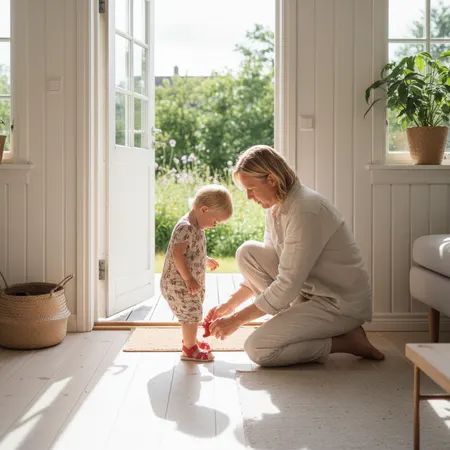
Add sandals and other summer gear to your shopping list to stay organized. See the baby clothing seasonal guide for a complete dressing guide throughout the year.
Read More
- Baby's First Shoes. When and what to choose
- Baby Clothes by Season. Dressing guide
- Baby Clothes Size Guide. Getting the right size
- Summer With Young Children. Activities and tips
- Checklists. Everything your child needs
Frequently Asked Questions About Children's Sandals
When does a baby need sandals?
The child needs sandals when they are walking independently outdoors and need protection from hot surfaces, sharp stones, or gravel. For most children, that means from around 9–12 months. Never buy sandals just for appearances, barefoot is best for foot development.
Should the child have open or closed sandals?
For children under 2–3 years, closed sandals with toe protection are recommended. Young children trip often, and toes are vulnerable to scrapes and impact. Open sandals are better suited for older children who are confident on their feet and moving on even surfaces.
How much growing room should sandals have?
Sandals should have approximately 1 cm of growing room in front of the longest toe. Measure your child's foot while standing on paper and add 1 cm. Check the size every two months in summer, as children's feet grow rapidly in spurts.
Can children use Crocs or clogs as sandals?
Crocs and clogs lack a heel counter and provide no ankle support, making them less suitable for daily use. They are fine as indoor shoes or beach shoes for short periods, but should not be your child's main shoe. Choose sandals with a firm heel counter and adjustable fastening for everyday use.
What do good children's sandals cost?
Good children's sandals typically range from $40 to $110. Brands such as Kavat, Ecco, Viking, and Superfit offer good fit and durability in this range. Budget models from chain stores ($20–$40) can work as a spare pair but should not be the only summer shoe.
Sources
- AAP (American Academy of Pediatrics). "Choosing the Right Shoes for Your Child." healthychildren.org
- American Podiatric Medical Association. "Children's Foot Health."
- Brand sizing guides: Kavat, Ecco, Viking, Superfit.
🔧 Helpful Tools
- All Baby Tools. Browse all free tools for pregnancy and baby care
📖 Related Articles
- Baby and Child Hats: A Complete Guide for All Seasons. Complete guide to hats for babies and children. Wool hats, balaclavas, sun hats, and UV hats. Sizes, materials, and tips for every season.
- Kids Swimwear Guide: Swimsuits, UV Suits, and Sun Protection. Everything about kids swimwear, UV suits, and sun protection clothing. UPF ratings, sizing, and tips for safe swimming. Find the right swimwear for baby and toddler.