A bike trailer opens up a whole new world of family outings. You can cycle to daycare, take the kids on a long ride along the river, or simply get around without a car. But with prices ranging from $350 to $1,500+ and many models to choose from, it can be difficult to know what you actually need.
Here's a complete overview of bike trailers, from types and safety to brands and what to prioritize for different conditions.
Prices in this article are approximate and may have changed. Check current prices with retailers.
What is a bike trailer?
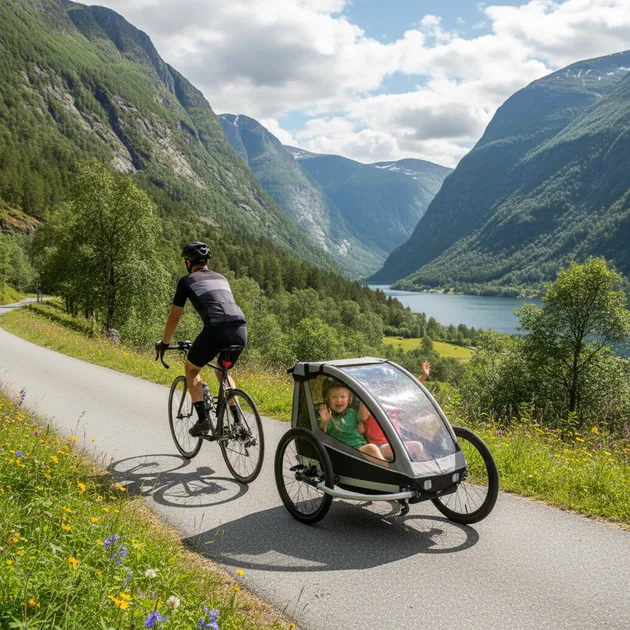
A bike trailer (also called a cycle trailer) is a trailer that attaches to the back of your bike with a hitch. Your child sits safely inside a cabin with safety harnesses, protected from the elements.
Most bike trailers today are multifunctional. You can use them as a bike trailer, jogging stroller, regular stroller, and in some cases as a ski trailer. This makes them an extremely versatile investment.
Who is a bike trailer for?
Bike trailers are great for families who cycle regularly and want to bring their children along. They're especially popular in cities with good bike infrastructure, but also work well on gravel and forest trails with the right model.
If you live in a city with good cycling infrastructure, a bike trailer can replace a second car for many families. You save money and get exercise in the process.
From what age can my child ride in a bike trailer?
10–12 months with infant insert
Most manufacturers recommend bike trailers from 10–12 months, provided the child can sit steadily and you use a dedicated infant sling. The infant insert provides extra neck support and cushioning.
Some brands like Thule offer infant inserts from 6 months, but this assumes you cycle carefully on smooth, even surfaces.
12 months and up without insert
From around 12 months, most children can sit in the trailer without extra support. The child must be able to sit upright without assistance and hold their head steadily.
Upper age limit
Most bike trailers have a weight limit of 48–50 lbs (22–23 kg) per seat. In practice, this means your child can use it until they're 5–6 years old, depending on size.
Types of bike trailers
Single trailer (1 child)
Suitable for families with one child or those who want a narrower, lighter option. Single trailers are typically 24–30 inches wide and weigh 22–29 lbs (10–13 kg).
Advantages:
- Narrower and lighter than double trailers
- Easier to maneuver
- Less expensive (from around $350)
- Fits through most doorways
Double trailer (2 children)
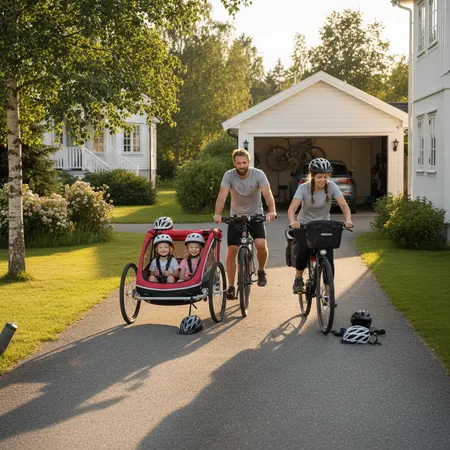
Has two seats side by side. Width is typically 32–36 inches and weight 29–40 lbs (13–18 kg). Perfect for twins or siblings close in age.
Advantages:
- Room for two children
- Often better overall value than two single trailers
- Children can sit together and entertain each other
Disadvantages:
- Wide, can be challenging in tight urban areas
- Heavier to pull
- Higher price (from around $550)
Sport models vs. comfort models
Sport models have better suspension, larger wheels, and are built for active families who jog and cycle frequently. They handle gravel, forest trails, and uneven terrain.
Comfort models are lighter, more compact, and better suited for daily transport in the city. They are easier to fold and take on public transport.
Important features to look for
Suspension
Good suspension is essential for your child's comfort and safety, especially on roads with bumps, cobblestones, and gravel paths. Look for models with adjustable suspension that can be adapted to your child's weight.
Budget models without suspension provide a hard, uncomfortable ride for your child. It's worth spending a little more on good suspension.
Safety harnesses
All bike trailers should have 5-point safety harnesses that keep your child securely in place. The harnesses should be easy to adjust and have padding at the shoulders.
Check that the harness is snug enough that your child can't slip out, but loose enough to be comfortable. You should be able to fit two fingers between the harness and your child's body.
Weather protection
Good weather protection is essential for year-round use. Look for models with:
- Rain cover that covers the entire front without restricting airflow
- Sun shade with UV protection
- Windows that can be opened for ventilation on warm days
- Mud flap that protects from water spray off the rear wheel
Cargo space
You need room for a diaper bag, groceries, or trip supplies. Most bike trailers have a cargo compartment at the back, but the size varies considerably.
Check that the cargo area is large enough for what you actually need. A bike trailer with 30–40 liters of cargo space covers most needs for daycare runs and grocery trips.
Reflectors and visibility
Traffic safety is important. All good bike trailers have built-in reflectors, but you should also use:
- Safety flag that makes the trailer visible to drivers
- LED lights at the rear and optionally the front
- Extra reflectors on the sides
Conversion options
One of the great advantages of bike trailers is that many models can be converted to other uses.
Jogging stroller
With an extra front wheel (usually sold separately) the bike trailer becomes a jogging stroller. The large front wheel provides good suspension on uneven ground.
Regular stroller
A small swivel wheel at the front turns the trailer into a regular stroller for shopping and city outings. Practical when you're not cycling.
Ski trailer
Some brands offer ski kits that replace the wheels. This lets you take your children cross-country skiing. A great winter alternative worth considering.
Popular brands
Thule Chariot
Thule is a market leader and offers several models at various price points.
- Thule Chariot Cross. All-rounder with great suspension, from approx. $1,000
- Thule Chariot Sport. Top model with adjustable suspension, from approx. $1,300
- Thule Chariot Lite. Budget model, from approx. $550
All Thule models can be converted to jogging stroller and regular stroller with additional kits.
Burley
American brand with a strong reputation for durability and value.
- Burley D'Lite. Premium with great suspension, from approx. $1,100
- Burley Cub. Good mid-range option, from approx. $650
- Burley Bee. Budget choice, from approx. $450
Hamax
Norwegian brand that also makes bike trailers.
- Hamax Outback. Solid all-rounder, from approx. $750
- Hamax Avenida. Compact city model, from approx. $550
Croozer
German quality brand focused on safety.
- Croozer Kid Vaaya. Top model with aerodynamic design, from approx. $1,400
- Croozer Kid Keeke. Good mid-range option, from approx. $850
Safety in a bike trailer
Hitch and attachment system
The connection between the bike and the trailer is the most important safety component. Look for:
- Safety leash that keeps the trailer attached even if the hitch detaches
- Universal hitch that fits most bikes
- Simple mounting so there's no room for error
Rollover protection
Good models have a built-in roll cage that protects your child if the trailer tips over. The roll cage is a steel frame that absorbs impact and prevents the cabin from collapsing.
5-point harness
Always use the 5-point harness, and tighten it correctly. Your child should never be able to stand up or get out of the harness while riding.
Helmet
The AAP recommends helmet use for children in bike trailers. If your child wears a helmet, choose one that doesn't push the head forward when the child leans back against the seat.
The AAP recommends helmets for all children in bike trailers, especially on roads with traffic. If your child wears a helmet, make sure it fits well and doesn't push the head into an uncomfortable position.
Price guide for bike trailers
| Category | Price range | Examples |
|---|---|---|
| Budget | $350–550 | Thule Chariot Lite, Burley Bee |
| Mid-range | $550–1,000 | Burley Cub, Hamax Outback |
| Premium | $1,000–1,500+ | Thule Chariot Sport, Croozer Vaaya |
Conversion kits (jogging stroller, regular stroller, ski) cost an extra $60–230 per kit.
Used vs. new bike trailer
A used bike trailer can save you hundreds of dollars. Trailers from brands like Thule and Burley hold up well, and there is a large secondhand market on Facebook Marketplace and Craigslist.
What to check when buying used
- Frame. Look for cracks, rust, or damage
- Fabric. Check for holes, wear, and mold
- Wheels. Check tires, bearings, and that the wheels spin freely
- Hitch. Test that it clicks securely and the safety leash is intact
- Harness. Check that the 5-point harness works and shows no wear
- Suspension. Test that the cushioning still works
Ask the seller for the receipt and how old the trailer is. Most manufacturers recommend replacing bike trailers after 8–10 years of use, regardless of condition.
When should you buy new?
Buy new if you plan to use the trailer for multiple children, can't find the exact model you want used, or want full warranty coverage. New models also often have improved safety technology.
How to choose the right bike trailer
- Number of children. Do you need a single or double trailer?
- Primary use. Daily transport, exercise, or longer trips?
- Terrain. Pavement, gravel, or forest trails?
- Conversion. Do you need a jogging stroller, regular stroller, or ski option?
- Budget. What can you afford? Remember conversion kits cost extra.
- Storage. How much space do you have at home?
Summary
A bike trailer is a fantastic investment for active families. It gives you the freedom to cycle with your children safely, and with conversion options you get great value for money.
The most important tips:
- Wait until your child is 10–12 months with an infant insert, or 12+ months without
- Prioritize suspension and safety over extras
- Choose the right size, single trailer for one child, double for two
- Always use a flag and reflectors in traffic
- Used is smart if you check the condition carefully
See also
- Stroller guide, how to choose the right one
- Car seat safety for children
- Baby's first shoes
- Dressing your baby by season
- Summer with toddlers, activities and tips
Frequently asked questions about bike trailers
From what age can my child sit in a bike trailer?
Most manufacturers recommend bike trailers from 10–12 months with an infant insert. Without the insert, your child should be able to sit up stably on their own, which most can do from around 12 months. Always check the manufacturer's age recommendation for your specific model.
Is a bike trailer safer than a bike seat?
Bike trailers generally offer better protection than bike seats. The child sits lower (lower center of gravity), is surrounded by a frame with a roll cage, and has a 5-point harness. In the event of a tip, the fall is shorter and the child is better protected.
Does my child need a helmet in a bike trailer?
The AAP recommends helmets for all children in bike trailers, especially in areas with traffic. If your child wears a helmet, choose one that doesn't push the head forward when leaning back.
Can I use a bike trailer in winter?
Yes, a bike trailer can be used on cleared winter roads. Be extra careful on slippery surfaces and use studded tires on your bike. Some brands offer ski kits that replace the wheels, letting you take your children cross-country skiing.
How long can my child use a bike trailer?
Most bike trailers have a weight limit of 48–50 lbs (22–23 kg) per seat. In practice, this means your child can use it until they are 5–6 years old, depending on size and model.
Sources
🔧 Helpful Tools
- All Baby Tools. Browse all free tools for pregnancy and baby care
📖 Related Articles
- Bike Seat for Kids - Safe Cycling with Little Ones. Complete guide to bike seats for children. Front or rear, safety tips, and best brands. Everything you need for safe cycling with your child.