Those first wobbly steps are one of the magical moments in a child's development. And with them comes the question: does my baby need shoes now?
The answer might surprise you: not yet. Baby feet are soft, shaped from cartilage rather than bone, and the best thing for their development is to go without shoes as much as possible. But when shoes are needed, a few things really matter for healthy foot development.
When Does Your Baby Actually Need Shoes?
Barefoot Is Best
Physical therapists and orthopedic specialists agree: children do best without shoes for as long as possible. Baby feet are soft and flexible, the skeleton is mostly cartilage and doesn't finish hardening until around age 20.
When babies walk barefoot, they use their toes actively to "grip" the ground. This trains the muscles of the foot, strengthens the arch, and develops balance. All of this is hindered by shoes that encase and restrict the foot.
Good alternatives to shoes indoors:
- Bare feet (best of all)
- Non-slip socks
- Soft pre-walker shoes with a thin sole
Shoes Are Needed When Baby Walks Outdoors Regularly
The first time your child genuinely needs proper shoes is when they're taking multiple independent steps outdoors and need protection from cold, wet weather, sharp objects, and hard surfaces.
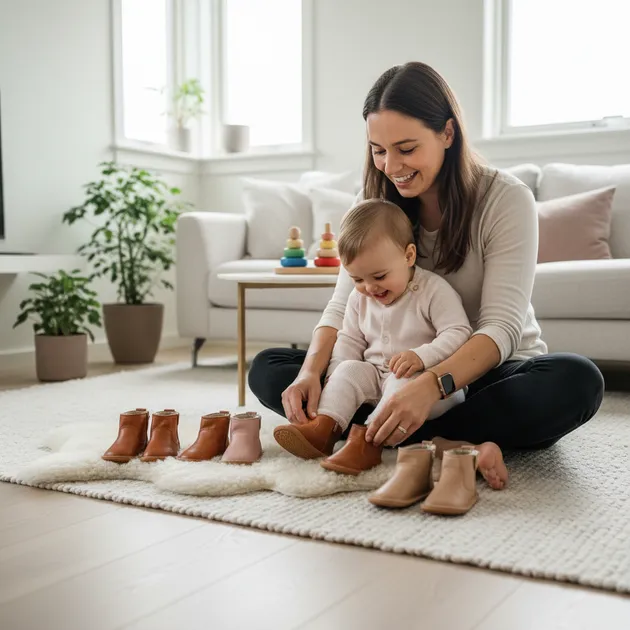
Buying shoes "too early" (before the child is actually walking) is unnecessary and can do more harm than good. The adorable miniature shoes in baby photos are fun, but the baby is better off without them.
Let your child go barefoot as much as possible, even after they've gotten shoes. Variety is the key. Barefoot on grass, sand, and uneven surfaces trains foot muscles and balance. At daycare and indoors, shoes with a firm heel counter are preferable to clogs or crocs.
What to Look for in a First Walker Shoe
Podiatrists and physical therapists recommend these features for a baby's first proper shoes:
1. Correct Size with Growing Room
Shoes should have 0.4–0.6 inches (1–1.5 cm) of growing room beyond the foot length. Remove the insole and place your child's foot on it, this makes it easy to check.
Baby feet grow fast and unevenly. Between ages 2–3, a foot can grow up to 0.6 inches (15 mm) in a year. Check the size every 6–8 weeks for the youngest children.
2. Flexible Sole
The sole should be soft enough that the foot can move naturally, especially at the ball of the foot (where the foot bends at push-off). Hold the heel and toe and bend the shoe, it should flex at the ball, not in the middle.
Also try twisting the shoe like a washcloth. A good children's shoe offers a little resistance, a completely rigid or completely limp shoe isn't ideal.
3. Firm Heel Counter
The back of the shoe should provide stability for the ankle. Children who have just learned to walk spend a lot of energy on balance, and a firm heel counter helps.
Press on the back of the shoe, it should feel firm and supportive, not soft and moldable.
4. Wide Toe Box
Baby feet are naturally wide at the front. The toes should have room to spread freely inside the shoe. A narrow toe box squeezes the toes together and can over time cause problems such as bunions.
Check that you can fit your little finger between the upper and the top of the foot when the shoe is fastened.
5. Adjustable Closure
Laces or velcro allow the shoe to be fitted to the child's foot. Slip-on shoes don't hold well enough and allow the foot to slide around inside.
For the youngest children, laces provide the most precise fit, but velcro is most practical for everyday use.
6. Breathable Material
Baby feet sweat surprisingly often, up to 2–3 tablespoons of moisture per day. Natural materials like leather breathe well. Synthetic materials can lead to damp, cold feet and in the worst case fungal infections.
Pre-Walker Shoes vs. First Walker Shoes
There's a difference between shoes for the crawling/cruising stage and shoes for a child who is walking:
| Feature | Pre-walkers | First walker shoes |
|---|---|---|
| Sole | Very thin, soft | Flexible but stable |
| Heel counter | Soft | Firm |
| Purpose | Warmth and protection | Support while walking |
| When to use | Crawling, pulling to stand | Taking independent steps outdoors |
| Indoor/outdoor | Indoors | Outdoors |
Pre-walker shoes are just a transitional stage. Your baby doesn't really need them, non-slip socks work just as well.
How to Measure Your Child's Foot
- Measure in the afternoon, feet are largest then
- Stand your child on a piece of paper and trace around their foot with a pencil (child should be standing and bearing their weight)
- Measure from heel to longest toe
- Add 0.4–0.6 inches (1–1.5 cm) of growing room
- Measure both feet, they're rarely exactly the same
- Use the longer foot as your reference
Size Guide (approximate)
| Foot length | EU size | US size | Approx. age |
|---|---|---|---|
| 4.3 in / 11 cm | 18 | 2.5 | 8–12 months |
| 4.7 in / 12 cm | 19–20 | 3–4 | 10–14 months |
| 5.1 in / 13 cm | 21 | 5 | 12–18 months |
| 5.5 in / 14 cm | 22–23 | 6–7 | 18–24 months |
| 5.9 in / 15 cm | 24 | 8 | 2 years |
| 6.3 in / 16 cm | 25–26 | 8.5–9 | 2.5–3 years |
Age is only a rough guide, variation is large. Always measure the foot.
Children rarely complain that their shoes are too tight. Baby feet are so soft they conform to the shoe without the child noticing discomfort. Check shoe size regularly, at minimum every 6–8 weeks for the youngest children.
Common Mistakes to Avoid
Shoes that are too big "to grow into": Shoes that are far too large provide poor footing and can cause tripping and uneven pressure. Stick to 0.4–0.6 inches (1–1.5 cm) of growing room.
Hand-me-down shoes from older siblings: Shoes conform to the foot that wore them. Used shoes may have worn down in ways that force a new wearer's foot into an incorrect pattern. New shoes are preferable for healthy foot development.
Stiff "orthopedic" shoes: Healthy baby feet don't need rigid shoes with arch supports. A normal foot develops best with flexible shoes and plenty of barefoot time.
Crocs and clogs for everyday use: Plastic shoes without a heel counter provide very little support. Use them as beach sandals, but not as everyday shoes, especially not at daycare.
Flat Feet and Other Concerns
All toddlers have a degree of flat feet until age 3–4. This is completely normal and generally needs no treatment. The arch develops gradually as muscles strengthen.
According to the American Academy of Pediatric Orthopaedics, flat feet are very common in young children, and as long as the feet are soft and flexible, no special follow-up is needed.
Intoeing (feet pointing inward) is also very common and generally resolves with growth. Treatment is rarely considered before ages 10–12.
See your pediatrician or a physical therapist if:
- Your child has pain in their feet
- Your child limps or avoids walking
- The feet are very stiff or asymmetrical
- You have any other concerns about foot development
Frequently Asked Questions
How many pairs of shoes does a toddler need?
Two pairs are plenty for the youngest children: one pair for everyday use and one backup (for drying after rain). As your child grows, you can add seasonal shoes (sandals in summer, winter boots in cold weather).
Should my child wear shoes at daycare?
Indoor shoes with a firm heel counter are better than crocs or just socks on hard floors. Choose lightweight, breathable shoes that the child can take on and off themselves.
How often should I check shoe size?
For children under 3: every 6–8 weeks. For children over 3: every 3–4 months. Remove the insole and place your child's foot on it, you can quickly see whether there's still enough growing room.
Are barefoot shoes good for children?
Barefoot-style shoes (with a thin, flexible sole and wide toe box) can be a good option for children with healthy feet. They allow more contact with the ground and train foot muscles. Introduce them gradually. Remember that all young children are naturally flat-footed until around age 6–7, this is normal, not a problem.
Read More
Sources
- AAP. Shoes for babies and toddlers
- American Orthopaedic Foot & Ankle Society. Children's foot care
- APMA. Children's foot health
🔧 Helpful Tools
- Baby Milestones Tracker. Track your baby's developmental milestones
- All Baby Tools. Browse all free tools for pregnancy and baby care
📖 Related Articles
- Children's Shoe Size Chart: Complete Guide for Ages 0–3. Children's shoe sizes by age with EU and US sizing. How to measure your child's foot at home, when to buy first shoes, and how often to check sizing.