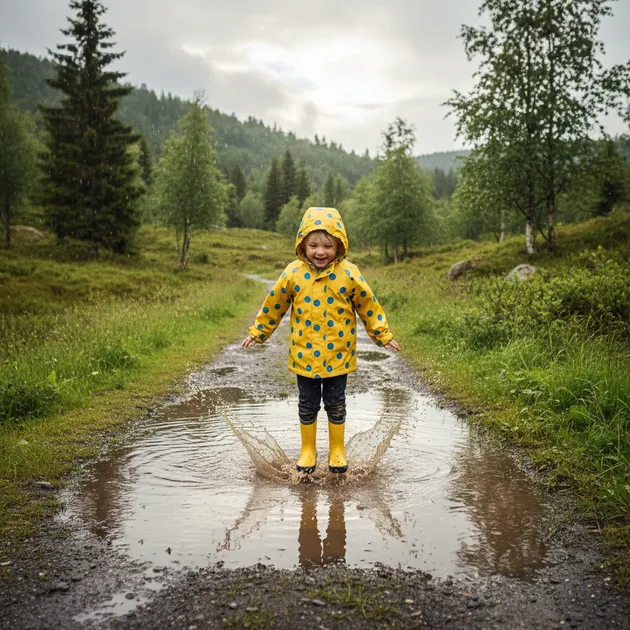
Children in daycare need good rain gear, in many parts of the world, especially in northern climates, kids play outside in all kinds of weather. With the right rainwear, your child can play outdoors regardless of conditions and come home dry and happy.
But what does a waterproof rating of 10,000 mm actually mean? Is PU better than PVC? And do you need lined or unlined rain gear? This guide gives you the answers.
Types of rain gear for children
Rain suit (all-in-one)
A rain suit is a single garment that covers the entire body. Best for the youngest children (0–3 years) because it cannot ride up or down. No gap between jacket and pants means the child stays dry everywhere.
Many styles have an integrated hood and fold-over cuffs on arms and legs. Perfect for strollers and early daycare age.
Rain set (jacket + pants)
A two-piece rain set is the most common choice for children from 2–3 years and up. The advantage is flexibility, you can use just the jacket on days with light drizzle, or just the pants if the child wants to play in puddles.
Bib pants are the best choice for younger children because they stay in place. For older children, regular rain pants with elastic waistband work fine.
Rain jacket alone
A good rain jacket is a versatile garment used from spring to fall. Choose a style long enough to cover the bottom and with an adjustable hood. A rain jacket can be paired with regular pants or rain pants as needed.
Materials, what should you choose?
PU (polyurethane)
PU is the most common material in children's rain gear. It is soft, flexible, and completely waterproof. PU rain gear does not have seams that can leak because the material is welded instead of sewn.
PU rain gear does not breathe, which means sweat can build up on the inside. For active children in warm rainy weather, this can feel clammy. The solution is to wear thin layers underneath.
PVC-free matters: PVC contains phthalates that can be harmful. Most quality brands have moved away from PVC, but always check the label. Look for PU or TPU instead.
Laminated fabric (hardshell)
Laminated rain gear uses a breathable membrane (like Gore-Tex or similar) on a woven textile. This provides both waterproofing and breathability. The material is stiffer than PU but more comfortable during high activity.
Laminated rain gear is more expensive but a good choice for very active children who sweat a lot.
TPU (thermoplastic polyurethane)
TPU is a newer material that combines the best of PU and laminate. It is as soft as PU but breathes better. Several brands are now switching to TPU for their children's rain gear.
Waterproof rating, what do the numbers mean?
The waterproof rating (water column) measures water pressure in millimeters. The higher the number, the more waterproof the fabric. For children's rain gear:
| Water column | Description | Suitable for |
|---|---|---|
| 3,000 mm | Light water repellency | Light drizzle and brief showers |
| 5,000 mm | Waterproof | Normal rain |
| 8,000 mm | Very waterproof | Heavy rain and prolonged use |
| 10,000+ mm | Fully waterproof | All rain, daycare-approved |
For daycare use, we recommend at least 5,000 mm water column. Children sit in puddles, crawl on wet surfaces, and press the fabric against wet objects, that requires a higher waterproof rating than normal rain.
Did you know? When a child sits on the ground in rain, the fabric is subjected to pressure equivalent to 5,000 mm water column. With a backpack the pressure increases further. That is why it makes sense to choose rain gear with a high waterproof rating for daycare.
Lined or unlined rain gear?
Unlined rain gear
Unlined (without lining) is the most versatile choice. You control the insulation by choosing what to wear underneath. Works from spring to fall, from mild to cold rainy days with fleece underneath.
Unlined rain gear dries quickly and takes up little space. Ideal to keep in the stroller basket or daycare bag as a spare set.
Fleece-lined rain gear
Fleece-lined rain gear combines rain protection and warmth in a single garment. Practical on cold spring days and mild fall days when you do not want to think about layering.
The downside is that lined rain gear dries more slowly and is too warm on mild rainy days. It is also less flexible than unlined rain gear with layers underneath.
Daycare strategy: Keep one set of unlined rain gear for daily use (dries faster between days) and one fleece-lined set as backup for cold days. Many daycares ask for two sets anyway.
Scandinavian and Nordic brands
Didriksons (Sweden)
Didriksons is perhaps the most popular brand for children's rain gear in Scandinavia. Known for high waterproof ratings (8,000–10,000 mm), good fit, and reasonable prices.
Polarn O. Pyret (Sweden)
PO.P offers a wear guarantee on their rain gear. High quality with a focus on durability and sustainability. A bit more expensive but often lasts for two children.
Reima (Finland)
Finnish Reima makes rain gear with very good fit and smart details like adjustable cuffs and reflectors.
Helly Hansen (Norway)
Norwegian outdoor brand with functional, durable rain gear at accessible price points. Good waterproof ratings and simple, long-lasting design.
CeLaVi (Denmark)
Danish brand known for colorful PU rain gear at a good price. Popular for the youngest children. Soft and flexible material.
Size and fit
Rain gear should fit a little loosely, there needs to be room for clothes underneath without pulling. But it should not be so big that the child trips or that rain collects in folds.
General guidelines:
- Order one size up from your child's normal clothing size
- Try it on with a fleece sweater underneath to make sure there is enough room
- Sleeves and pant legs should have fold-over cuffs or elastic
- Bib pants give the best fit for children under 3 years
Rain gear for the very youngest (0–12 months)
Babies sitting in a stroller do not necessarily need a full rain set. A good stroller rain cover protects against most weather. But for carrier walks and exploration, a rain suit is invaluable.
Choose a soft PU suit with an integrated hood and fold-over feet. It should be easy to put on and take off, babies rarely enjoy getting dressed.
From when the child starts to crawl and walk outdoors (8–12 months), rain gear becomes more important. You then need a garment that can withstand the child crawling on wet surfaces.
Washing and care
Rain gear needs different treatment than regular clothes:
- PU rain gear: Rinse off with a hose or wash in the washing machine at 30°C without detergent. Hang to dry, never tumble dry.
- Laminated rain gear: Wash with a specialist product for rain gear. Re-proof after washing with spray or wash-in product.
- Drying: Hang inside out. PU clothes dry best at room temperature. Avoid direct sunlight for extended periods.
- Waterproofing: PU clothes do not need re-proofing, they are waterproof on their own. Laminated clothes should be re-proofed every six months.
Daycare drying tip: Hang rain gear on the hook inside out. Put newspaper inside the pant legs , it absorbs moisture and helps the clothes dry faster for the next day.
Reflectors and visibility
Rain gear in light or bright colors makes your child visible, but reflectors are even more important. Look for:
- Reflective strips on arms and legs
- Reflector on the back
- Reflective details around the hood
Many brands have integrated reflectors, but you can always add extra reflective strips or stickers. For the very youngest, it is a good idea to choose rain gear in bright colors like yellow, red, or orange.
When to start with rain gear?
You can start with rain gear from when the baby is 3–4 months if you carry the baby in a carrier. A rain suit over the carrier protects the baby while you walk.
For active outdoor play, 8–12 months is a natural starting point. That is when most children start crawling outdoors and need protection from wet surfaces.
In daycare, rain gear is essential from day one. Daycare children are outside in all kinds of weather, and rain gear is typically on the list of required items.
Checklist for buying rain gear
- ✅ Waterproof rating of at least 5,000 mm for daycare
- ✅ PVC-free material (choose PU or TPU)
- ✅ Reflectors on arms, legs, and back
- ✅ Fold-over cuffs or elastic in arms and legs
- ✅ Bib pants for children under 3 years
- ✅ One size up from normal clothing size
- ✅ Seamless or welded (for PU rain gear)
Frequently asked questions about rain gear for kids
What is the best kids' rain gear?
Didriksons, Polarn O. Pyret, and Reima consistently score highly in Nordic tests. For daycare use, Didriksons is often recommended due to high waterproof ratings and good value. For the youngest children, CeLaVi and similar brands with soft PU material are popular choices.
What waterproof rating does rain gear need?
For daycare, at least 5,000 mm is recommended. Children sit on wet ground, crawl, and play in puddles, that demands more than normal rain. For light use in a stroller, 3,000 mm is sufficient. For rain gear that can handle everything, choose 10,000 mm or higher.
Is PU rain gear safe for children?
Yes, PU (polyurethane) is safe and the most widely used material in children's rain gear. The important thing is to choose PVC-free rain gear, since PVC can contain harmful phthalates. Most Nordic brands now use PU or TPU instead of PVC.
Should rain gear be lined or unlined?
Unlined is most versatile, you control warmth with layers underneath. Fleece-lined is practical for cold rainy days but dries more slowly. For daycare, one set of unlined for daily use and one lined set as backup for cold days is ideal.
How do you wash children's rain gear?
PU rain gear can be rinsed with water or washed at 30°C without detergent. Never use a tumble dryer. Hang inside out to dry at room temperature. Laminated rain gear should be washed with a specialist product and re-proofed after washing.
Sources
- AAP. Infant and toddler nutrition guidelines
- WHO. Global infant feeding recommendations
- CDC. Infant and toddler nutrition resources
🔧 Helpful Tools
- All Baby Tools. Browse all free tools for pregnancy and baby care