Summer is finally here, and your child wants to get in the water. But children's skin is much thinner than adult skin and burns faster in the sun. The right swimwear protects against both UV rays and cold.
Here's a complete guide to swimsuits, UV suits, and swimwear for babies and kids, from UPF ratings to sizing and maintenance.
Types of Kids Swimwear
There are several types of swimwear for children, and each garment has its use case. Let's look at the most common ones.
Swimsuit
The classic swimsuit covers the upper body and is popular for girls from around 1 year. It provides some sun protection on the belly and back, but the arms and legs are exposed.
Choose a swimsuit with a good fit that won't slip down in the water. Wide straps are more comfortable for children than thin spaghetti straps.
Swim Trunks and Board Shorts
Swim trunks or board shorts are the standard choice for boys. Tight swim briefs stay in place better in the water, while loose board shorts are more comfortable on land.
For babies under 1 year, there are special swim diapers. These contain solid waste (but not urine) and are required in most pools.
UV Suit
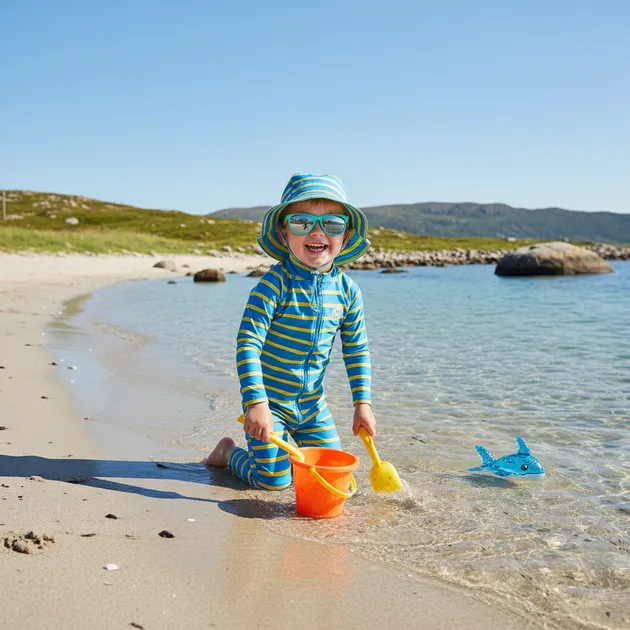
The UV suit is the best choice for young children. It covers large parts of the body and has built-in UV protection with UPF 50+. Many models have long sleeves and long legs, so the child is well covered.
UV suits come in two main types:
- One-piece, covers from neck to ankles, best for babies and toddlers
- Two-piece, top and bottom separate, easier to put on and take off
For babies under 1 year, the AAP recommends avoiding direct sun. A UV suit with UPF 50+ is the best protection when you're out in the summer heat.
Rashguard
A rashguard is a fitted top with UV protection. It's typically worn with swim trunks or board shorts. Rashguards are popular for older children who want more freedom of movement than a one-piece provides.
Most rashguards have UPF 40-50+ and dry quickly. They also protect against scrapes on slides and playground equipment near water.
UV Protection and UPF Ratings
What Is UPF?
UPF stands for Ultraviolet Protection Factor and measures how much UV radiation passes through the fabric. The higher the UPF value, the better the protection.
- UPF 15-24, good protection, blocks 93-96% of UV rays
- UPF 25-39, very good protection, blocks 96-97%
- UPF 40-50+, excellent protection, blocks 97.5% or more
For children, UPF 50+ is recommended as the standard. Many quality children's clothing items have this rating.
UPF vs. SPF
UPF is used for clothing, SPF is used for sunscreen. A UV suit with UPF 50+ is equivalent to a sunscreen with SPF 50, but the advantage is that the suit doesn't need to be reapplied.
Children's skin is especially vulnerable to UV rays. The AAP recommends protecting children under 1 year from direct sun. UV clothing provides reliable protection without chemicals on the skin.
Children under 6 months should not use sunscreen. Use shade, clothing, and UV suits for protection. From 6 months, you can use sunscreen with SPF 30-50 on skin areas not covered by clothing.
UV Suit vs. Sunscreen. What's Best?
Many parents wonder whether a UV suit or sunscreen is the better choice. The answer is that both have advantages, but for young children, UV clothing is the safest option.
Advantages of UV Suits
- Protects all the time without needing to reapply
- No chemicals on your child's skin
- Works in water without washing off
- Also protects against wind and cold
- More reliable than sunscreen, which can be applied too thinly
When You Need Sunscreen Too
A UV suit doesn't cover everything. The face, hands, and feet still need protection. Use sunscreen with at least SPF 30 on exposed areas, and reapply every two hours.
Don't forget a sun hat for the child, it protects the face, ears, and neck.
Choosing the Right Size
Sizing Guide for Swimwear
Kids swimwear should fit snugly but not tightly. A garment that's too big fills with water and pulls the child down. A garment that's too small chafes and is uncomfortable.
Rules of thumb:
- Choose the child's regular clothing size, or one size down for loose styles
- UV suits should fit snugly without squeezing
- Swim trunks with drawstrings provide better adjustment
- Try the garment wet, it fits differently than dry
Size by Age
| Age | Typical Size | Tips |
|---|---|---|
| 0-6 mo | Newborn-6M | Swim diaper + UV suit |
| 6-12 mo | 6-12M | One-piece UV suit is easiest |
| 1-2 yr | 12-24M | One-piece or two-piece UV suit |
| 2-3 yr | 2T-3T | Two-piece UV suit or rashguard + bottoms |
| 3-5 yr | 3T-5T | Rashguard + swim trunks/board shorts |
Don't buy swimwear in a larger size hoping it will last longer. Poor fit reduces UV protection because the fabric gets stretched out, and loose garments can be dangerous in the water.
Materials and Quality
Best Materials for Kids Swimwear
Not all materials provide equal UV protection. Dense, dark fabrics block more UV radiation than light, thin fabrics.
Good materials for swimwear:
- Polyester, dries quickly, holds its shape well, good UV protection
- Nylon/polyamide, soft, stretchy, dries quickly
- Elastane/spandex (as an additive), provides stretch and good fit
Avoid:
- Cotton in swimwear, absorbs water, dries slowly, loses UV protection when wet
- Very thin fabrics without UPF labeling
Chlorine Resistance
Chlorine in swimming pools breaks down elastane over time. Rinse swimwear in fresh water after each swim, and wash at low temperature. Avoid the dryer, it destroys elasticity.
Water Safety
The right swimwear is important, but water safety is about much more than clothing.
Basic Rules for Swimming with Children
- Never leave the child unattended, drowning can happen in seconds, without sound
- Stay within arm's reach of children under 4
- Use approved flotation devices, swimwear is NOT flotation equipment
- Teach the child to swim early, many swim clubs accept children from age 4-5
- Check the water temperature, babies cool down quickly
A UV suit or swimsuit is NOT a flotation device. Some UV suits have built-in float inserts, but these do not replace an approved swim vest or float ring. Always stay close to the child in the water.
Swim Diapers
For babies who are not yet potty trained, swim diapers are required in most pools. There are two types:
- Disposable swim diapers, practical for single visits
- Reusable swim diapers, more environmentally friendly, washed between uses
Swim diapers contain solid waste but not urine. Most reusable swim diapers fit better and leak less than disposable versions.
Swimwear for Different Situations
Swimming Pool
At the pool, it's usually warm, so a regular swimsuit or swim trunks will do. Remember a swim diaper for babies. Many pools require swim caps for children with long hair.
Beach and Outdoors
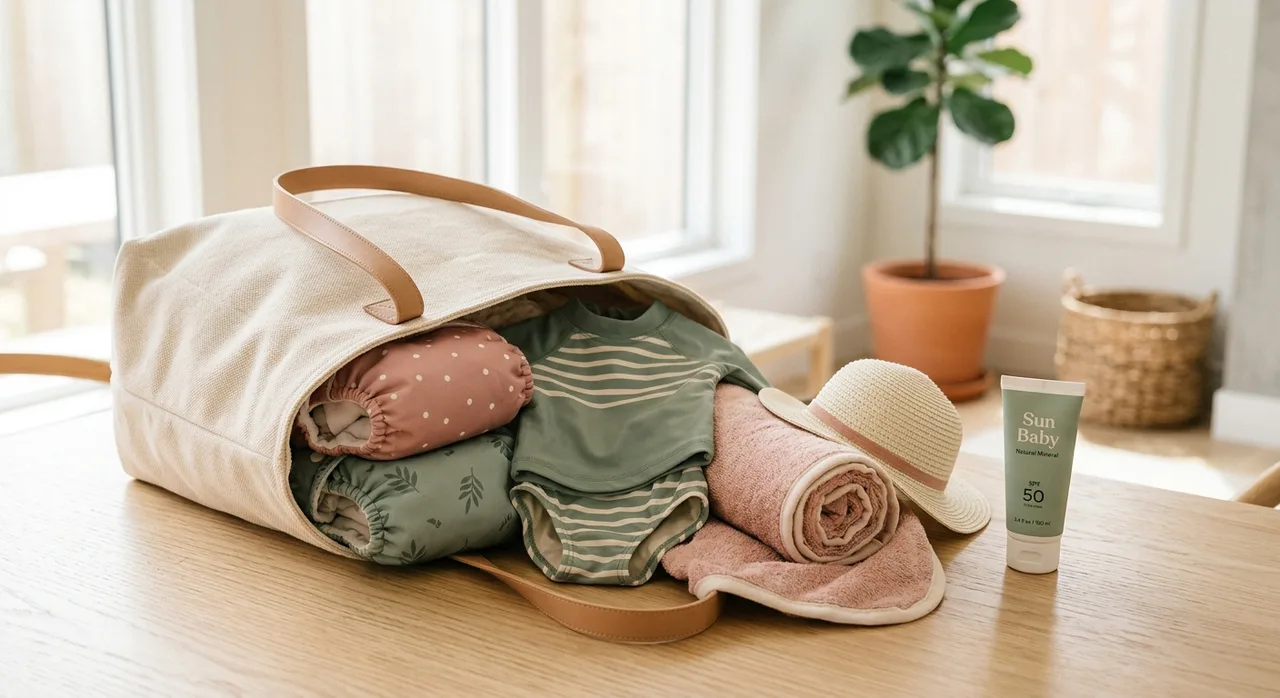
At the beach, the child needs UV protection. Combine a UV suit with a sun hat and sunscreen on exposed areas. Bring extra clothes for the child to change into when they're done swimming.
Daycare
Many daycares have water play in the summer. Check what your daycare recommends, some require UV suits, others accept regular swimwear. Label all swimwear with the child's name.
Swimwear Maintenance
Good care significantly extends the life of swimwear.
Washing Tips
- Rinse in fresh water after each swim (chlorine and saltwater break down the fabric)
- Wash at 86°F / 30°C with mild detergent
- Don't use a dryer, it destroys elastane
- Dry in the shade, direct sun bleaches colors and weakens UV protection
- Don't wring, gently press out the water
When Should You Replace Swimwear?
Replace swimwear that is faded, stretched out, or has lost its elasticity. UPF protection decreases over time, especially after many washes. As a rule of thumb, quality UV suits last 1-2 seasons with regular use.
Swimwear Shopping Checklist
Before buying swimwear for your child, go through this list:
- UPF 50+ for UV suits and rashguards
- Right size (snug but not tight)
- Good quality polyester or nylon
- Swim diaper for babies not yet potty trained
- Sun hat with a wide brim
- Sunscreen SPF 30-50 for exposed skin
- Extra clothes to change into afterward
Summary
Kids swimwear is about more than looks. UV protection, fit, and safety are what matters most.
For babies and toddlers, a UV suit with UPF 50+ is the safest choice. Combine with a swim diaper, sun hat, and sunscreen on exposed skin. Choose the right size and always rinse swimwear after use.
With the right gear, the whole family can enjoy summer by the water, safely and comfortably.
Frequently Asked Questions
Does my baby need a UV suit?
Yes. UV radiation can be strong in summer, especially between 10 AM and 3 PM. Babies under 1 year should be kept out of direct sun, and a UV suit with UPF 50+ provides the best protection. The AAP recommends protecting baby skin with clothing rather than sunscreen in the first year of life.
What's the difference between UPF and SPF?
UPF (Ultraviolet Protection Factor) is used for clothing and indicates how much UV radiation is blocked by the fabric. SPF (Sun Protection Factor) is used for sunscreen. A UV suit with UPF 50+ blocks over 97.5% of UV rays, equivalent to SPF 50 sunscreen, but without needing to reapply.
Can a child swim in a UV suit?
Yes, UV suits are designed for use in water. They dry quickly and maintain UV protection even when wet. Remember that a UV suit is not a flotation device, always stay close to the child in the water, and use an approved life vest when needed.
How long does a UV suit last?
A quality UV suit lasts 1-2 seasons with regular use. UV protection gradually decreases with washing and wear. Replace the suit if the fabric has become thin, faded, or has lost its elasticity. Always rinse in fresh water after swimming to extend its lifespan.
Should the child wear a swim diaper under the UV suit?
Yes, children who still wear diapers should wear a swim diaper under the UV suit in swimming pools. Most pools require this. Reusable swim diapers often fit better than disposable versions and are more environmentally friendly.
Read More
Sources: AAP. Sun Safety, WHO. UV Radiation, Skin Cancer Foundation
Last updated: March 2026
Sources
- AAP. Infant and toddler nutrition guidelines
- WHO. Global infant feeding recommendations
- CDC. Infant and toddler nutrition resources
🔧 Helpful Tools
- All Baby Tools. Browse all free tools for pregnancy and baby care
📖 Related Articles
- Baby and Child Hats: A Complete Guide for All Seasons. Complete guide to hats for babies and children. Wool hats, balaclavas, sun hats, and UV hats. Sizes, materials, and tips for every season.
- Children's Sandals. How to Find the Best Summer Shoes. Complete guide to sandals for babies and toddlers. Sizing, fit, and the best brands. Find the perfect summer sandals for small feet.
- Summer with Babies and Toddlers: Sun Safety and Fun. A safe and fun summer with your child. Sun protection, swimming, activities, and safety tips for babies and toddlers.