From the moment of birth, your baby's brain is working overtime to interpret the world through their senses. Their vision is blurry, but your voice is recognized immediately. The smell of your skin provides comfort. Touch is the first language your baby understands.
Sensory development is the foundation for everything your child learns later, language, motor skills, social abilities. And the best part is that you're already stimulating the senses just by being close to your child. Here's what happens with each sense and how you can support development in a natural way.
Sight: From Blurry to Full Color
Newborns see the world as if through a foggy window. They can focus on things that are 8-12 inches away, exactly the distance to your face when you're breastfeeding or bottle-feeding.
The First Weeks
Your baby prefers faces above all else. Strong contrasts like black and white catch their gaze. Colors are hard to distinguish at first.
2-4 Months
Vision becomes sharper. Your baby starts to follow movements with their eyes and shows interest in more colors, especially red and yellow. Hand-eye coordination starts gently.
6-12 Months
By around 6 months, most babies have near-normal vision. Depth perception develops, and your child can grasp objects with precision. By one year, your baby sees almost as well as an adult.
Hang a simple mobile over the changing table with black-and-white patterns for the first weeks. After 3 months, you can switch to colorful versions. The movement and contrasts give your baby's vision a great workout.
How to stimulate vision:
- Show your face up close and make funny expressions
- Use high-contrast images in the first weeks
- Roll a colorful ball along the floor from 4 months
- Point at things and name them from 6 months
Hearing: Recognizes Your Voice from Day One
Hearing is the most developed sense at birth. Your baby has actually been listening to your voice for months, sound filters through the amniotic fluid from around week 25 of pregnancy.
In the United States, all newborns are screened for hearing shortly after birth. This test detects hearing loss early so that your child can get help quickly.
How Hearing Develops
- Newborn: Startles at loud noises, calms to familiar voices. Prefers higher-pitched voices.
- 3 months: Turns head toward sounds. Begins to "respond" with their own sounds.
- 6 months: Recognizes their own name. Tries to imitate sounds.
- 9-12 months: Understands simple words and instructions. Babbling becomes more varied and melodic.
How to stimulate hearing:
- Talk to your baby throughout the day, narrate what you're doing
- Sing songs and nursery rhymes with repetition
- Let your baby hear different everyday sounds (water, birds, music)
- Read picture books with sound words from 6 months
The AAP recommends always speaking directly to your child, not through a screen. Young children learn language best from real people who respond to them.
Touch: The First and Most Fundamental Sense
Touch is the sense that develops first, already in the womb. For newborns, skin contact is as necessary as food and sleep. Skin-to-skin after birth regulates the baby's temperature, heart rate, and stress levels.
Touch and Bonding
Research shows that regular skin contact strengthens the bond between parents and child. Your baby learns through touch that the world is safe.
How to stimulate the sense of touch:
- Baby massage after bathing (use baby oil, stroke gently and evenly)
- Let your baby feel different textures: soft blanket, smooth wood, textured fabric
- Carry your baby in a wrap or on your arm
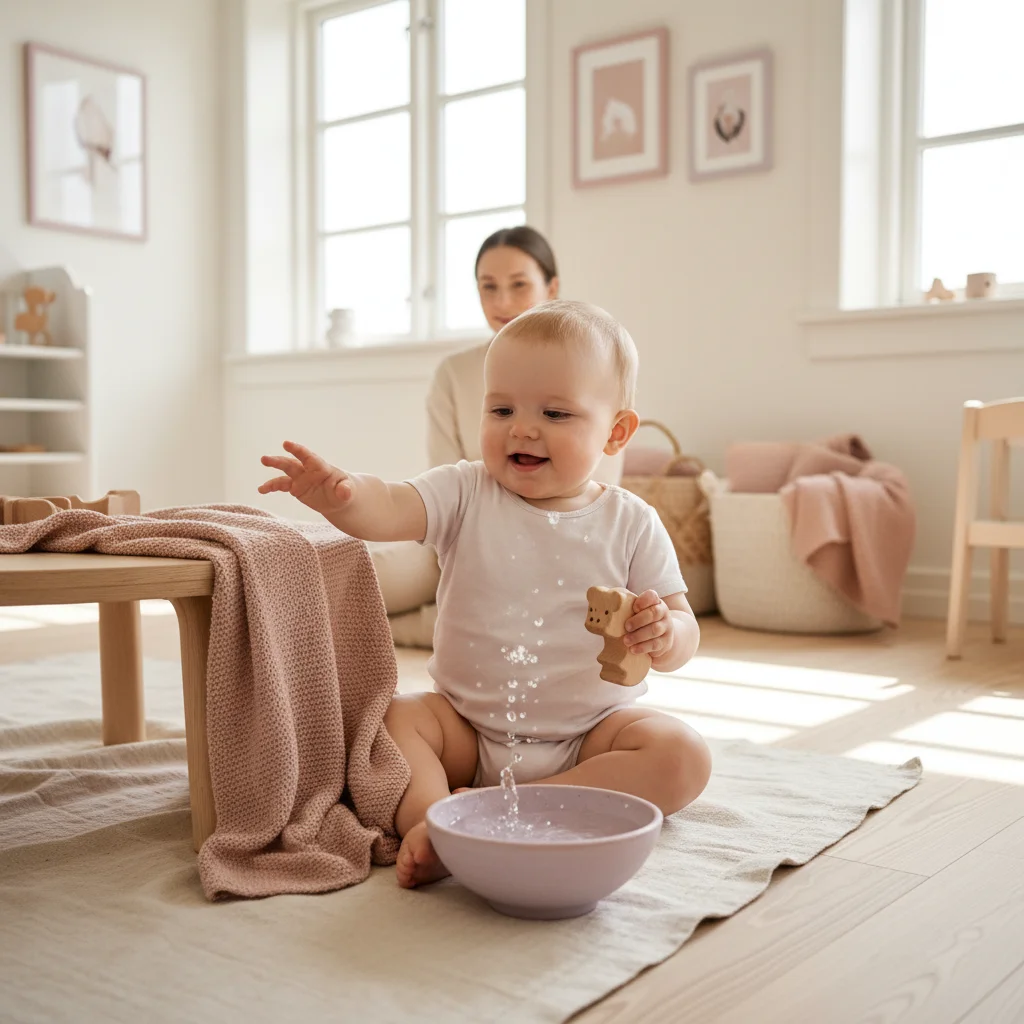
- Sensory play with water, sand, and dough from 6 months
- Let your child go barefoot on different surfaces indoors and outdoors
Make a "texture box" with different materials: silk, wool, cotton, cork, sandpaper. Let your baby explore with their hands. From 8-9 months, this is a big hit.
Taste and Smell: Closely Connected
Taste and smell are closely linked and surprisingly well-developed in newborns. Your baby can distinguish between sweet, sour, salty, and bitter from birth. Sweet is preferred, which makes biological sense, since breast milk is slightly sweet.
Taste Development
- Newborn: Prefers sweet. Grimaces at sour and bitter.
- 4-6 months: Sense of smell sharpens. Baby turns toward the smell of breast milk.
- 6-12 months: Introducing solid foods opens a world of flavors. The more flavors your child is exposed to early, the more varied their diet will be later.
Why Early Exposure Matters
Research supports that babies who taste many different vegetables and flavors between 6 and 12 months more often accept varied food as older children. Repeated exposure is the key, it can take 10-15 tries before a child accepts a new flavor.
How to stimulate taste and smell:
- Offer varied flavors when starting solids (vegetables first, then fruit)
- Let your baby smell food before eating it
- Don't give up after the first rejection, offer the same flavor again after a few days
- Use herbs and spices gently (parsley, dill, cinnamon) from 6 months
The Senses Work Together
Sensory development isn't about training one sense at a time. Most everyday activities stimulate multiple senses simultaneously. When your baby eats, they use taste, smell, touch, and sight. When you sing, your child uses hearing and sight.
The best stimulation is what happens naturally through play and interaction. A trip to the park provides visual impressions, sounds, smells, and the touch of grass and leaves. A meal is a complete sensory adventure.
Avoid overstimulation. Babies also need breaks from sensory input. Signs that your child has had enough: turning their head away, rubbing their eyes, crying without a clear reason, or seeming restless. Give your child calm in a quiet, dimly lit room.
Frequently Asked Questions
When should I worry about my baby's vision?
If your baby doesn't follow objects with their eyes by 3 months, doesn't react to your face, or has one eye that constantly crosses after 4 months, contact your pediatrician. The AAP recommends vision screening whenever there's suspicion of visual problems.
How do I know if my baby hears normally?
All newborns in the US are tested for hearing shortly after birth. Signs of good hearing after the test period: your baby startles at loud noises, turns toward voices, and begins to babble around 4-6 months. If you're concerned, contact your pediatrician.
Can I overstimulate my baby?
Yes. Too many impressions at once can make your baby stressed and fussy. Choose one or two activities at a time, follow your baby's signals, and give breaks. Quiet time is as valuable as stimulation.
Is sensory toys necessary?
No. Everyday objects provide at least as good sensory stimulation. A wooden spoon to bang with, a soft blanket to feel, or water to splash in. Expensive equipment isn't necessary for good sensory development.
Sources
Sources: AAP - Developmental Milestones, CDC - Child Development
Last updated: March 2026
🔧 Helpful Tools
- Baby Milestones Tracker. Track your baby's developmental milestones
- Development Leaps. Understand your baby's developmental leaps
- All Baby Tools. Browse all free tools for pregnancy and baby care
📖 Related Articles
- Play and Learning for Babies 0–6 Months. Simple play ideas and activities that stimulate your baby's development from birth to 6 months. Based on developmental research.
- When Baby Gets Stuck: How to Help With Motor Development. Baby who rolls but can't roll back? Pulls to stand but can't get down? How to help your child through motor frustration without taking over.
- Developmental Leaps in Babies: What Happens and What You Can Do. About developmental leaps and fussy periods in babies. What the research says, common signs, and tips for getting through them.