Most conversations about screen time focus on children. But emerging research and updated international guidelines are pointing at something parents didn't quite expect: your own phone use matters too.
The WHO, AAP, and leading child development researchers are now clear, adults should avoid screen use during feeding, limit their phone use when with young children, and recognize that babies notice when attention is divided.
This isn't an accusation. It's an invitation to awareness.
What Do the Guidelines Say?
Updated guidelines from major health organizations now explicitly address parents' own screen behavior:
- Limit your own screen use when spending time with your baby
- Avoid using screens during breastfeeding and bottle feeding
- No screens at mealtimes, for anyone in the family
- Don't use screens as a way to calm or distract the baby
- Reduce notifications and alerts on your phone
These recommendations come from major health authorities including the WHO, AAP (American Academy of Pediatrics), and national health agencies across multiple countries. The underlying research base is consistent: parental presence matters for early development.
Why Does This Matter Right Now?
Parents have always been distracted, by books, newspapers, conversations with adults. So what's different about phones?
The difference is frequency and compulsion. The average adult checks their phone over 100 times a day. Many of those moments happen with a baby in the room. And unlike reading a book, a smartphone is specifically designed to capture and hold your attention, through notifications, variable reward patterns, and infinite scroll.
The baby notices.
What Happens to Your Baby
The Still Face Effect
One of the most important findings in infant development research is the "still face" experiment. In this research setup, a parent engages with their baby fully, smiling, responding, playing. Then the parent suddenly stops reacting and holds a neutral, expressionless face.
What happens is striking. The baby immediately tries to re-engage: smiling, pointing, vocalizing. Without response, the baby shows signs of stress, looking away, becoming agitated, eventually crying.
When researchers replicated this with parents using phones instead of holding a still face, babies responded in the same way. They made fewer attempts at social engagement, smiled less frequently, and became distressed more quickly.
Research shows that parental phone use can temporarily produce the same reactions in infants as the classic "still face" experiment. Your baby looks for eye contact and response, and reacts to its absence, even when you're physically present.
Social Interaction Builds the Brain
In the first years of life, the brain develops faster than at any other point. This happens largely through social interaction with trusted caregivers.
A systematic review published in 2022 concluded that parental phone use reduces verbal and non-verbal communication, and makes parents less sensitive to their baby's signals.
This doesn't need to happen many times a day to have an effect. Frequent, brief breaks in attunement can, over time, affect a baby's developing ability to regulate their own emotions.
As child development researchers put it: screens cannot replace adults who see, hear, and engage.
During Feeding
This is perhaps the piece of guidance that hits hardest for many parents.
Feeding, whether by breast or bottle, can consume many hours per day, especially in the first weeks. It's the middle of the night, you're exhausted, and the phone is right there. That's completely understandable.
But the guidance is clear: feeding time is one of the most important early bonding opportunities. It's when your baby repeatedly seeks out your gaze. It's where you establish a shared rhythm and early communication.
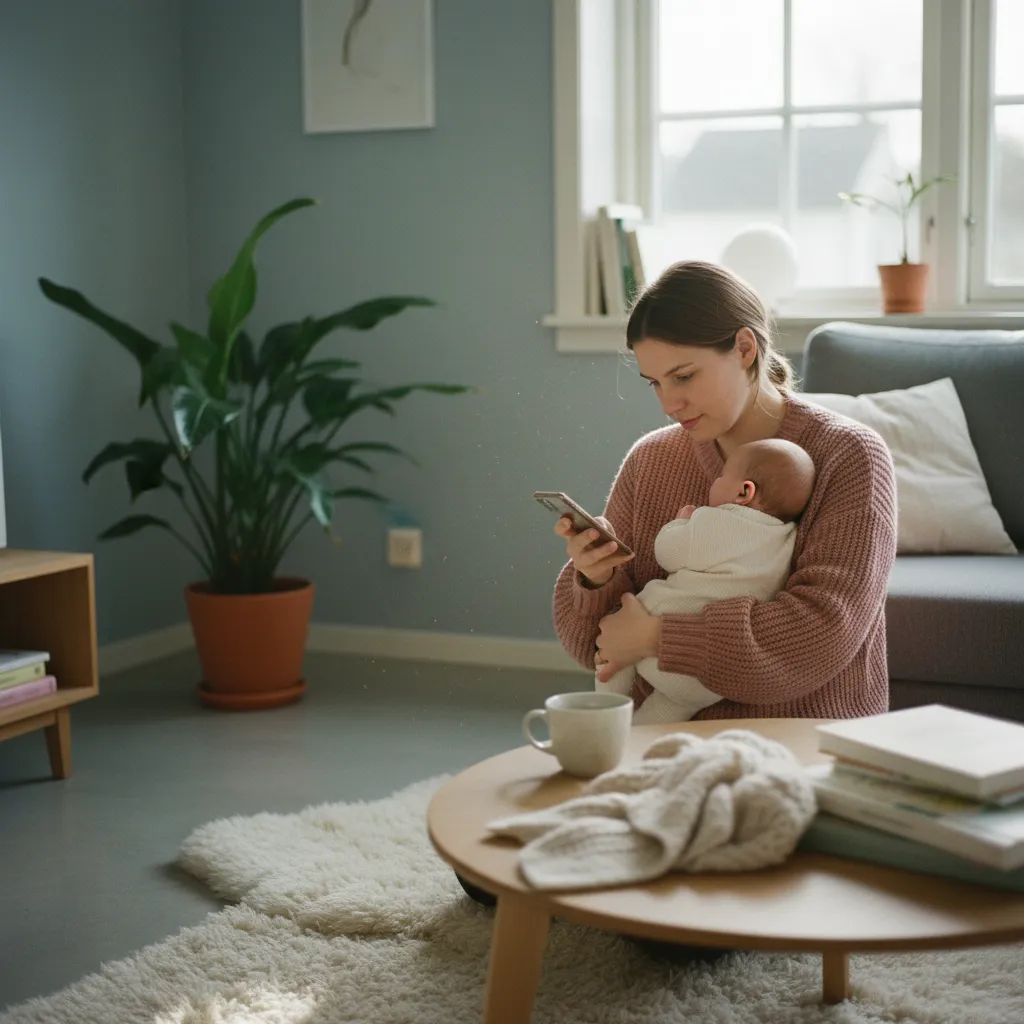
When you look down at your phone, your baby is still looking for you.
Try putting your phone out of reach for the first 10–15 minutes of a feeding. Look at your baby, feel their weight, notice their breathing pattern. You can always check your phone once they've finished and drifted off. A feeding log app used before the feed starts means less screen time during it.
Moments When Presence Matters Most
Bedtime and Night Feeds
Night feeds are exhausting. Many parents scroll to stay awake. That's human. But it's worth knowing that babies are tuned to your presence even in low light, and the quality of the interaction matters even when it's half-dark and 3am.
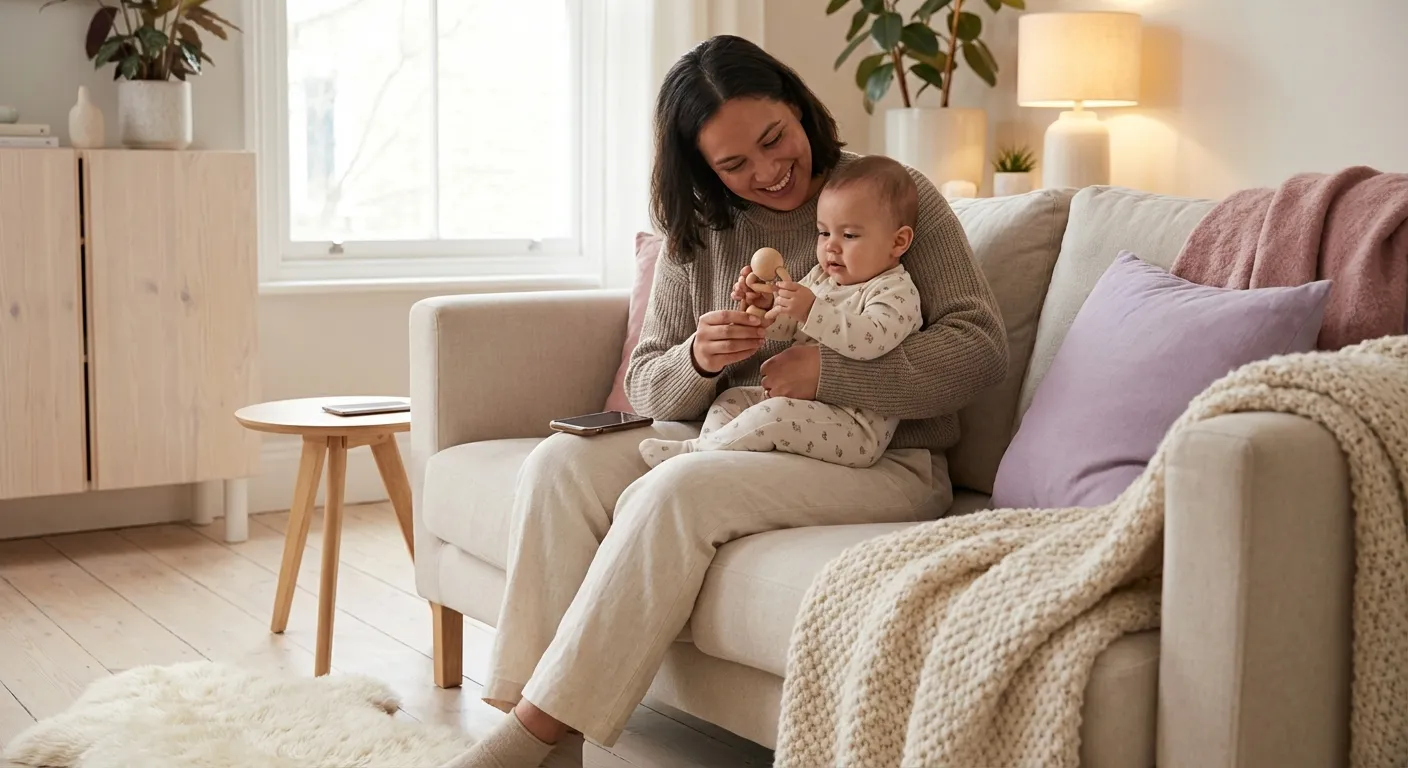
A middle-ground option: listening to an audiobook or podcast through earbuds keeps you stimulated while still allowing eye contact and physical presence with your baby.
Floor Play
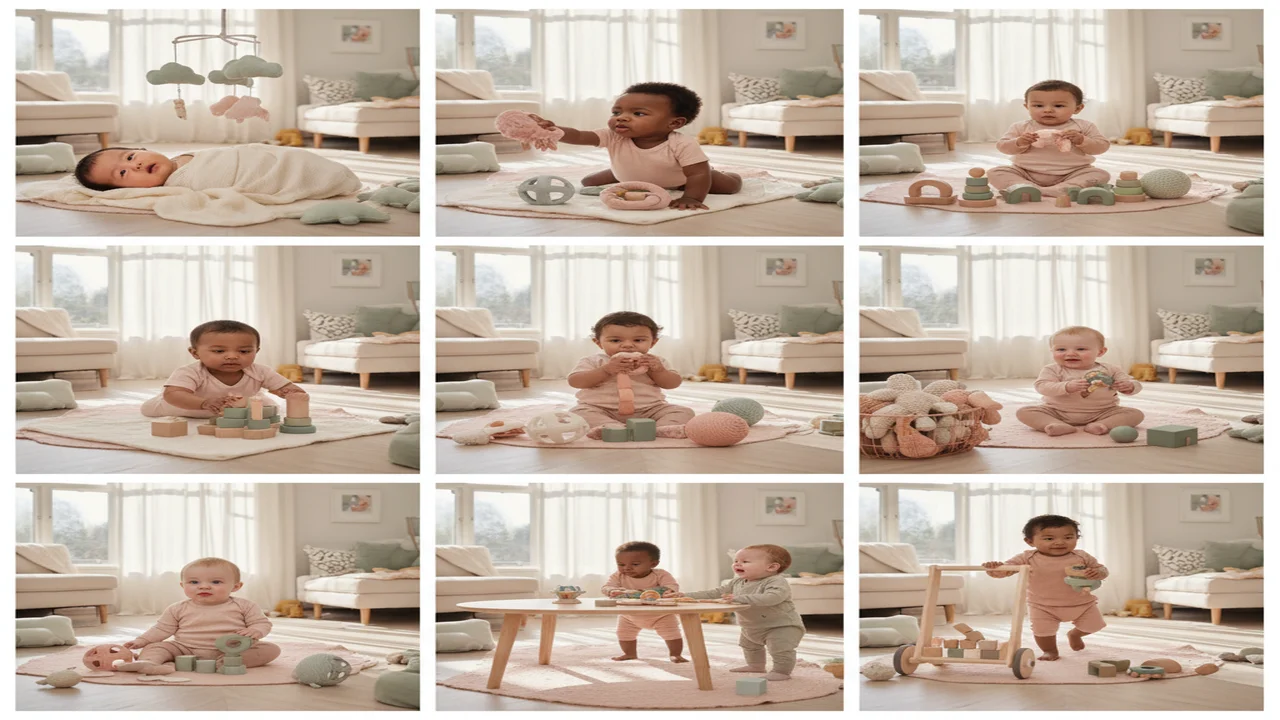
When babies explore and play, they look back at you for reassurance and shared excitement. Psychologists call this "social referencing", babies check your reaction to decide whether something is safe or exciting.
If you're sitting next to them scrolling through your phone, the baby looks over, but doesn't get that response. Over time, the urge to share experiences and achievements can diminish.
Mealtimes
No screens at the table, for anyone. This applies from the moment your baby starts joining family meals.
Mealtimes are a social arena. They're where children learn the rhythms of conversation, the pleasure of eating together, and that food is something positive you do as a family.
The evidence base underlying current screen recommendations comes from decades of infant development research, from the still face experiments of the 1970s to modern studies on parental phone use and child outcomes. The consistent finding is that responsive, attuned caregiving during early infancy has lasting developmental effects.
This Is Not About Guilt
It's important to say this directly: every parent checks their phone. That's normal, and occasional use is not harmful.
What health authorities are asking for is not perfection. It's awareness.
Sometimes you need to respond to a message. Sometimes you're exhausted and need a mental break. That's human. The goal is simply to be aware that some moments matter more than others, and that being present during those moments has real value for your baby.
Guilt is not a useful parenting tool. Awareness is.
Practical Changes That Help
You don't need a big plan. A few small adjustments can make a meaningful difference.
Put the phone in another room. When the phone is visible, we check it, even when we didn't intend to. Move it to a different room during feeding or floor play.
Turn off notifications for set periods. You won't miss anything important. Most apps allow calls from selected contacts to come through in emergencies.
Create screen-free anchor points in the day. Not the whole day, just a few predictable moments. The morning routine. Afternoon play. Bathtime. When it's consistent, it's easier to maintain.
Charge your phone outside the bedroom. Many parents say the phone is their alarm clock. Get a small clock instead. It reduces late-night scrolling and gives you better sleep.
Making it a joint decision with your partner is more effective than a unilateral rule. Talk openly about your phone habits as a family. What moments matter most? Where could you both be more present? Shared intentions are easier to keep.
Frequently Asked Questions
Is it harmful to check my phone during breastfeeding?
Checking your phone occasionally is not harmful. What matters is the pattern. If the baby repeatedly looks for your gaze and doesn't find it, this can affect interaction over time. The guidance is to avoid it, not because one instance is dangerous, but because being present during feeding has real value for bonding.
What about an audiobook or podcast during feeding?
Audio through earbuds is different from staring at a screen. You can still maintain eye contact and respond to your baby while listening. Many parents find this helpful for staying awake at night, and it allows a more conscious form of "mental rest" than scrolling.
Does this apply to both parents?
Yes. The guidance applies to all caregivers around the child, not just the parent who is feeding.
My baby doesn't seem bothered when I use my phone. Is that okay?
Babies don't always show stress visibly. Some adapt quickly by stopping their bids for attention, which is actually a concerning adaptation, not a sign that everything is fine. Absence of obvious protest doesn't mean the experience is neutral.
What if I'm alone and exhausted. I need a break too?
Breaks are important. You cannot give everything you have 24 hours a day. Take breaks consciously: put the baby safely down, go to another room with your coffee and your phone. That's better than being physically present but mentally elsewhere.
Read More
- Baby Sleep Tracker
- Breastfeeding Newborn Guide
- Emotional Development in Children
- Baby Development Month by Month
Sources
- WHO. Early Childhood Development
- AAP. Screen Time and Young Children
- Radesky J et al., "Patterns of Mobile Device Use by Caregivers and Children During Meals in Fast Food Restaurants", Pediatrics 2014
- Tronick E. The Still Face Experiment (original research)
- Kildare CA, Middlemiss W, "Impact of Parents Mobile Device Use on Parent-Child Interaction: A Literature Review", Computers in Human Behavior 2017
🔧 Helpful Tools
- Baby Milestones Tracker. Track your baby's developmental milestones
- Development Leaps. Understand your baby's developmental leaps
- All Baby Tools. Browse all free tools for pregnancy and baby care