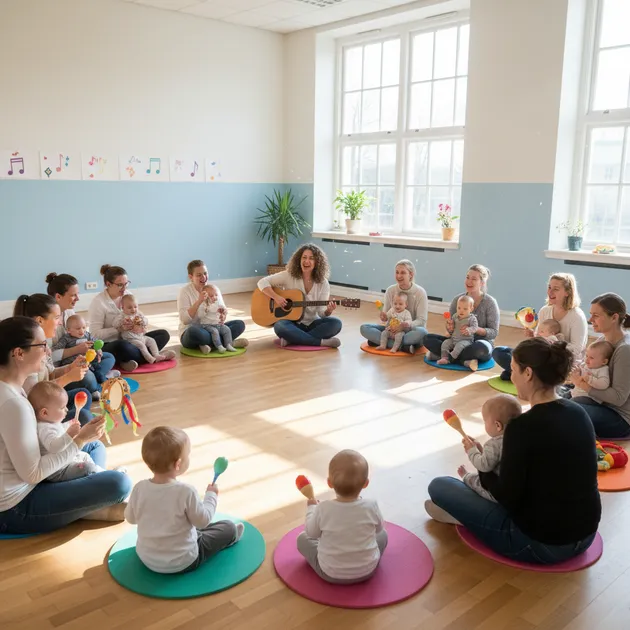
You're sitting in a circle on the floor with your baby in your lap. Around you sit other parents. Some sing loudly, others hum softly. Your baby stares, fascinated, at the person leading the song. Welcome to baby music class.
Singing with babies is one of the most popular activities for new parents. It's free or affordable, social, and, most importantly, fantastic for your baby's development. Here's everything you need to know about baby songs, whether you want to find a class or sing at home.
What Are Baby Music Classes?
Baby music classes are organized singing and musical play for babies and their parents. They usually take place in groups of 8–15 parents with babies, led by an instructor who knows children's songs, rhymes, and movement games.
A typical session lasts 30–45 minutes and includes a mix of:
- Welcome song where everyone greets each other
- Lullabies and calm songs with rocking movements
- Action songs with clapping, stomping, and arm movements
- Finger plays with small rhymes and movements
- Instrument play with maracas, bells, or rhythm eggs
Baby music class is not music instruction. Nobody expects you to sing in tune or know all the songs beforehand. It's about interaction, closeness, and joy.
Why Are Baby Songs Good for Your Baby?
Research on music and child development shows that singing and rhythm have surprisingly many positive effects. Baby songs aren't just fun, they're brain training.
Language Development
Singing enhances language development in babies. When you sing, you naturally exaggerate pitch, rhythm, and pronunciation. Your baby hears the words more clearly than in normal speech.
The repetition in children's songs helps baby recognize words and phrases. Songs like "Twinkle Twinkle Little Star" and "The Wheels on the Bus" have simple, repetitive lyrics that make it easier for the brain to pick up language patterns.
Bonding and Security
When you sing to your baby, something wonderful happens: eye contact, touch, and your voice create a strong bonding experience. Baby recognizes your voice and associates it with safety.
Babies who are sung to regularly often show more calm and better self-regulation. This also applies to babies who are fussy or have colic-like symptoms.
Motor Development
Action songs invite baby to use their body. Clapping, waving, stomping, and dancing strengthen both gross and fine motor skills. Baby watches you make the movements and gradually tries to imitate.
Social Development
In baby music groups, your baby encounters other children and adults. It's a safe arena for practicing social interaction, looking at others, smiling, showing interest.
For you as a parent, baby music class is also a great opportunity to meet others in the same situation. Many friendships between parents start in music groups.
When Can You Start?
You can start singing with your baby from when they are a few weeks old. Most organized classes accept babies from around 6 weeks.
0–3 Months
Newborns respond strongly to familiar voices. You can sing to your baby from day one. Calm, simple songs with repetition work best. Baby will listen, become calm, and perhaps fix their gaze on your face.
3–6 Months
Baby starts responding with sounds, smiles, and movements. Now you can add simple movements, rocking, gently clapping baby's hands, and using small props like fabric cloths.
6–12 Months
Baby participates more actively. They clap, hit instruments, try to dance, and may start to "sing along", often with their own sounds. Finger plays become especially popular at this age.
After 12 Months
Toddlers love action songs and can gradually learn simple lyrics. They dance, jump, and stomp. Many transition from baby songs to "music and play" or "toddler music" around this age.
Classic Children's Songs for Baby Music
You don't need to know many songs to get started. Here are some classics that work perfectly for baby music:
Calm Songs (rocking and cuddling)
- Twinkle Twinkle Little Star, perfect lullaby, slow movements
- Rock-a-Bye Baby, traditional lullaby
- Hush Little Baby, gentle, calm melody
- All the Pretty Little Horses, soothing and beautiful
Action Songs (clap, stomp, move)
- Baa Baa Black Sheep, clap hands, simple lyrics
- The Wheels on the Bus, many movements, very popular
- Head, Shoulders, Knees and Toes, point to body parts
- Pat-a-Cake, clapping song for the littlest ones
Finger Plays (fine coordination)
- This Little Piggy, finger/toe movements
- Itsy Bitsy Spider, finger play with a story
- Where Is Thumbkin?, movements with fingers
Songs with Tempo
- If You're Happy and You Know It, clapping and movement
- Old MacDonald Had a Farm, animal sounds and fun
- Row Row Row Your Boat, can be sung slow and fast
How to Do Baby Songs at Home
You don't need any qualifications to sing with your baby. Here are simple tips for a baby song session at home:
Create a Regular Routine
Choose a time that works, after breakfast, during diaper changes, or as part of the bedtime routine. Babies like predictability, and a regular singing time provides security.
Start with the same song each time. It can be a simple welcome song on a familiar melody like "Good morning, little friend."
Use Your Body
Set baby in your lap, face them toward you, and sing with eye contact. Use your hands to clap, gently move baby's arms, or rock in time with the music.
Keep It Short
A baby song session at home doesn't need to last longer than 10–15 minutes. Babies have short attention spans. End while it's still fun.
Repeat, Repeat, Repeat
Babies love repetition. Sing the same songs day after day. It's precisely the repetition that builds recognition and security.
There are no bad singing voices in baby music. Your baby loves your voice no matter what, it's the safest sound in the world.
Instruments for Babies
You don't need expensive instruments. Here are some simple options suitable for babies:
- Maracas or rhythm eggs, easy to hold, make nice sounds. Available in baby versions with soft grip.
- Bells, attached to a ring or band. Baby can shake them from 4–5 months.
- Drum, a simple box or pot with a wooden spoon works great. Babies love to bang.
- Xylophone, when baby can sit (6+ months), a small xylophone is fun to explore.
- Rain stick, visually and auditorily interesting for young babies.
The most important thing is that instruments are safe, no loose parts that can be swallowed, and materials without harmful substances.
Baby Songs, Music and Play, Children's Choir. What's the Difference?
It can be confusing with all the offerings. Here's a simple overview:
| Program | Age | What it involves |
|---|---|---|
| Baby music | 0–12 months | Singing and movement with parent, no prior knowledge needed |
| Music and play | 1–3 years | More active play, instruments, dancing, parent present |
| Music class | 3–5 years | Structured, child participates alone, explores instruments |
| Children's choir | 5–6 years+ | Organized singing, children sing together without parent |
Most families start with baby music and transition to music and play as the child approaches one year.
Tips If You're Shy
Many parents hesitate to sing, especially in a group. Here are some tips:
You're not alone. Most people in a baby music group feel a bit unsure the first few times. After a few sessions, it becomes natural.
Baby doesn't care about pitch. For your baby, your voice is perfect. It's not an audition, it's a relationship.
Start at home. Practice the songs at home first, alone with baby. When you know them well, it's easier to sing in a group.
Go with a friend. Bring another parent you know. Then the threshold for joining is lower.
Choose a large group. In large groups, it's easier to "hide" in the crowd. You don't need to sing loudly.
Baby Songs and Sleep
Many parents discover that baby songs have a positive effect on sleep routines. Calm songs as part of the bedtime routine signal that it's time to wind down.
Lullabies have been used in all cultures to get babies to sleep. The slow melodies and gentle movements help baby relax.
Summary
Singing with your baby is simple, free (or affordable), and incredibly beneficial. You need no musical background. All you need is your voice and a child who will listen.
Feel free to start singing at home from day one. Find a class nearby when you and baby are ready to meet others. And remember: there is no wrong way to sing to your baby.
Frequently Asked Questions
When can you start baby music?
You can sing to your baby from birth. Organized baby music classes usually accept babies from around 6 weeks. The earlier you start, the more natural it becomes, but it's never too late to begin.
Do you need to be able to sing to go to baby music class?
No! Baby music is not about singing well, it's about closeness and interaction with your baby. Nobody judges your voice. Your baby thinks you sing beautifully no matter what.
What should you bring to baby music class?
Bring what you normally have in the diaper bag, diapers, cloth, something to drink for yourself. Most baby music groups have instruments and supplies. Dress baby in comfortable clothes that are easy to move in.
What songs are good for newborns?
Calm lullabies work best for the very youngest. "Twinkle Twinkle Little Star," "Rock-a-Bye Baby," and "Hush Little Baby" are good choices. Sing slowly, softly, and with eye contact.
Sources
🔧 Helpful Tools
- Baby Milestones Tracker. Track your baby's developmental milestones
- Development Leaps. Understand your baby's developmental leaps
- All Baby Tools. Browse all free tools for pregnancy and baby care
📖 Related Articles
- 15 Indoor Activities for Toddlers on Rainy Days, 15 simple and creative indoor activities for toddlers when it's raining outside. Play that stimulates development without screens.
- Creative Play at Home: 20 Activities for Toddlers, 20 simple and fun activities you can do at home with toddlers. Creative play that supports development without expensive equipment.
- Fine Motor Skills: Development and Activities for Babies 0–3 Years. Complete guide to fine motor skill development in babies and toddlers. Milestones, 10+ age-appropriate activities, and when to seek help.