
It's 2 a.m., your newborn stirs, and you want them an arm's length from your bed, not down the hall.
Ready before the day comes.
Hospital bag, nursery and baby gear lists you can tick off as you go.
Start a checklistA baby bassinet is the small, low bed that makes that possible. This guide shows how to choose one that meets the federal safety standard, which type fits your home, and when your baby has outgrown it. When you've picked yours, add it to your nursery checklist.
Choose a bassinet that meets the federal standard (16 CFR part 1218), has a firm, flat sleep surface and fits beside your bed, then use it with only its own mattress and a fitted sheet. Stop using it at any printed limit, as soon as your baby can push up on hands and knees, or by about 5 months, whichever comes first.
In short
- Look for the standard. Every bassinet sold in the US has to meet the Consumer Product Safety Commission (CPSC) rule, 16 CFR part 1218. A bedside sleeper must also meet 16 CFR part 1222.
- Flat and firm. The sleep surface must be no more than 10 degrees from horizontal at rest, and the pad should not dent under your baby.
- Extras are extras. Rocking and apps are comfort features. An open bedside side is different: use it only on a bedside sleeper that is attached to your bed as the manual says.
- Keep it bare. Only the mattress made for it and a fitted sheet go inside.
- Plan the exit. Move to a crib or play yard at any printed limit, or once your baby can push up on hands and knees.
What Is a Baby Bassinet?
A bassinet is a small bed for the newborn months. CPSC defines it as a bed designed mainly for infant sleep, held up by freestanding legs, a stationary frame, a wheeled base, a rocking base or a base that can swing, with a sleep surface no more than 10 degrees from horizontal while at rest (CPSC).
It is smaller than a crib and lighter, so it is easier to move between rooms. Take your baby out before you move or carry it. The trade-off is time: you use it for a few months before a crib takes over. For the full comparison with cribs, mini cribs and play yards, see our bassinet vs crib guide.
What the Federal Standard Requires
The rule for bassinets and cradles is 16 CFR part 1218, built on the ASTM F2194 standard. The current version, ASTM F2194-25, applies to bassinets made or imported on or after February 21, 2026, and CPSC's enforcement leniency ran only until June 30, 2026, so a new bassinet today should meet it in full (CPSC).
The standard tests the parts that matter at 2 a.m.: stability, side height, the mattress and sleeping pad, openings and spacing, unintentional folding, and the head-to-toe and side-to-side angle of the sleep surface. It also covers rocking and swinging angles, and electrical or battery-powered parts.
Two details are easy to miss:
- Convertible products. A play yard or non-full-size crib with a bassinet attachment must meet both the bassinet standard and the standard for the main product.
- Labels. Durable infant products must carry the maker's name and contact details, the model and a date of manufacture, and come with a registration card so the company can reach you about recalls.
Look for "16 CFR part 1218" or "ASTM F2194" on the label or in the manual, plus "16 CFR part 1222" or "ASTM F2906" if it is a bedside sleeper. If a seller can't show you either, we'd skip that bassinet.
Bedside, Rocking, Travel or Basic: Which Type?
Bassinets differ in how they sit, move and fold, so pick the one that fits your bedroom. Most types meet the bassinet rule, 16 CFR part 1218. A bedside sleeper, the kind with an open or lowered side that is secured to your bed, has its own additional federal standard, 16 CFR part 1222.
| Type | How it works | Good fit when | Watch for |
|---|---|---|---|
| Basic freestanding | Fixed legs or stand, one fixed height | Small budget, simple use | Needs bed-height reach for night feeds |
| Bedside sleeper (side open or lowered) | Secured to the adult bed with the attachment the maker supplies | You'll feed or soothe at night, or recover from a c-section | Must also meet 16 CFR part 1222, and the attachment must be fitted as the manual says before you use the open side |
| Rocking or swinging | Gentle base motion, sometimes motorized | You want hands-free soothing | Motion stays inside the tested rock angle, and the surface must lie flat at rest |
| Portable or travel | Folds, lighter frame | You move between floors or travel | Still needs the standard and its own pad |
| Convertible (bassinet to crib or play yard) | Changes modes | You want one product for longer | Each mode must meet its own standard |
Bedside Sleepers
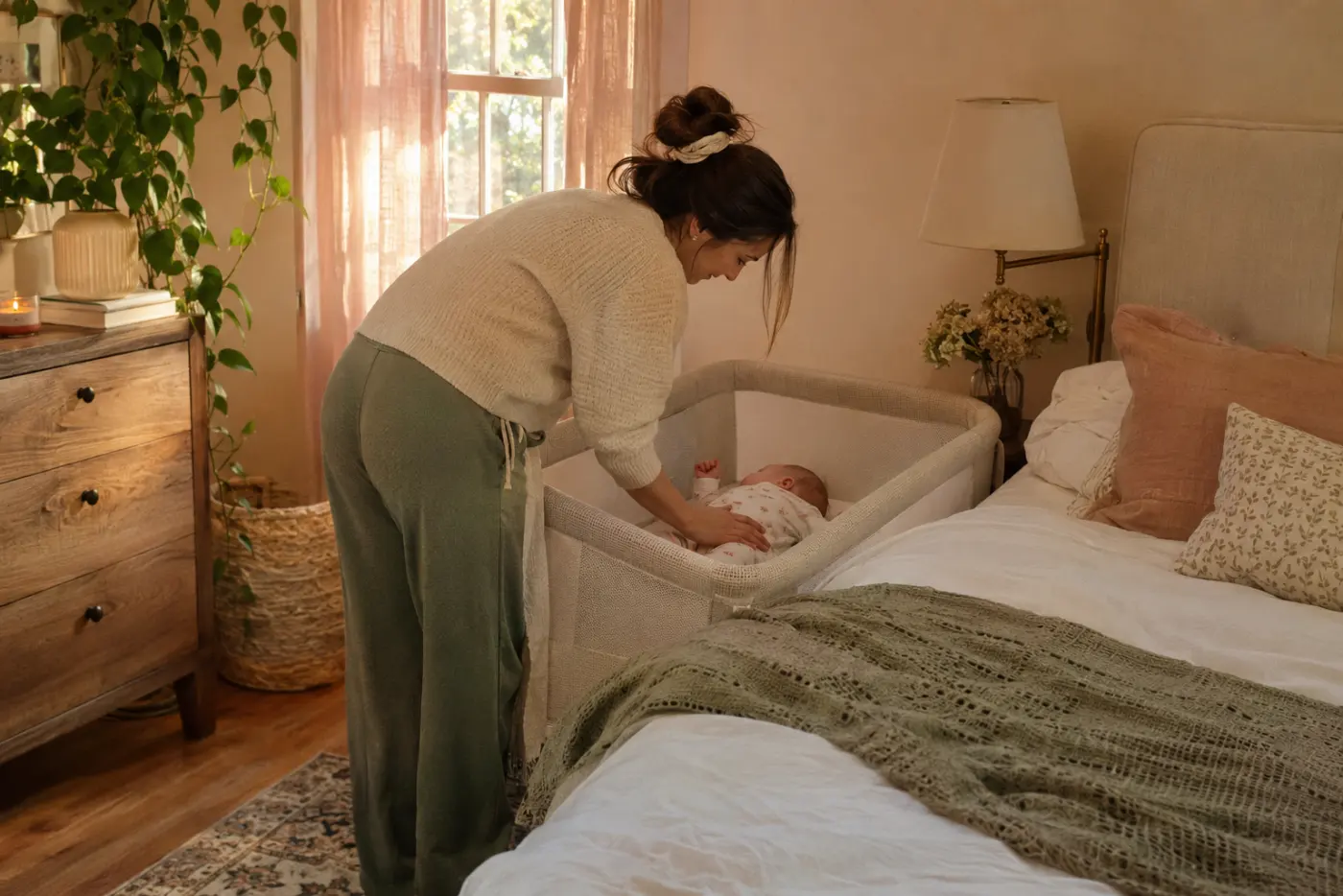
A bedside sleeper has a side that lowers or opens toward your mattress so you can reach your baby without getting out of bed. CPSC defines it as a frame "secured to an adult bed," and it has its own mandatory rule, 16 CFR part 1222, which incorporates ASTM F2906-23 for sleepers made after August 5, 2023. The rule's requirements include how the sleeper attaches to the adult bed (CPSC).
A freestanding bassinet that you simply push up against your bed is not the same product. Use the open or lowered side only on a product sold as a bedside sleeper, and only after you have fitted its attachment exactly as the manufacturer's instructions say. If the instructions don't describe an attachment, keep the side up, and leave the bassinet beside the bed instead of against it. Our bedside crib guide covers how to set one up.
Rocking and Motorized Bassinets
Rocking and swinging bassinets are allowed if they meet the standard, which sets limits on rock and swing angle. The sleep surface still has to be flat at rest. Because motion can lull a baby to sleep in a changed position, our suggestion is to turn the motion off and check the surface before you leave the room.
Motorized and app-connected models fall under the standard's electrical and battery rules too. Treat these features as comfort choices. The AAP says to avoid relying on home monitors to reduce SIDS risk, and says it's fine to use one if you like, as long as you also follow every safe sleep guideline (AAP).
How to Choose: A Buying Checklist
Use this list in the store or on a product page. The first four are about safety, and the rest are about fit.
- Standard. The label or manual names 16 CFR part 1218 or ASTM F2194. A bedside sleeper must also name 16 CFR part 1222 or ASTM F2906.
- Flat, firm pad. The mattress should be firm and shouldn't indent when your baby lies on it. NICHD describes a safe surface as firm, flat and level (NICHD).
- Stable base. Press down on the rim and nudge the frame. It shouldn't wobble, tip or fold.
- Printed limits. Find the weight or developmental limit and note it. Limits differ between models, and the printed one is the one that counts.
- Sides you can see through. Breathable mesh or rigid slats let you check on your baby from the bed.
- Footprint. Measure the space next to your bed and the doorway you'll roll it through.
- Fit and attachment for your bed. If you want a bedside sleeper, check that it names 16 CFR part 1222, that your mattress height matches its adjustable heights, and that it comes with the attachment the manual describes. Don't use the open side until that attachment is fitted.
- Washable cover. Newborn nights mean spit-up. Removable, machine-washable covers are worth having, and spare fitted sheets sized for it help too.
- Instructions and parts. Everything in the box, with assembly that doesn't need force.
- Your timeline. If you plan to room-share past the limit, budget for a crib or play yard in your room as well.
Prices run from a modest basic model to a premium motorized one, and the price tells you nothing about safety. Every bassinet sold in the US has to meet the same standard, so a higher price does not tell you it is safer. Check the label for the standard, whatever the price.
Features Worth Paying For (and Ones That Aren't)
Worth paying for: a stable frame, a snug fit beside your bed, a washable cover and a clear printed limit.
Nice to have: wheels with locks, a storage shelf, a soft light and a sound setting. For sound, our soothing sounds tool works from a phone, so you don't need a built-in speaker.
Skip or treat with care: anything that tilts your baby, adds loose padding or promises to prevent SIDS. The AAP says to avoid baby products that aren't consistent with safe sleep recommendations, especially ones that claim to reduce the risk of SIDS, because there's no evidence that this is true (AAP). Inclined sleepers over 10 degrees for infants up to 1 year can't legally be sold in the US, and neither can crib bumpers, since November 12, 2022 (CPSC).
How to Set Up Your Bassinet
Put it together before the due date, then use it the way you'll use it at night.
- Assemble and test. Follow the manual, then press and shake the frame. Registration card goes in the mail or online the same day.
- Fit the mattress. Use only the pad that came with it, and a fitted sheet made for that size. The AAP says nothing else should be in the sleep space with your baby (AAP).
- Place it near your bed. The AAP says to share a room with your baby for at least the first 6 months, with the sleep space close to your bed but not in it. If it is a bedside sleeper, fit the attachment exactly as the manufacturer specifies before you open the side toward your bed, and check it before every night. A freestanding bassinet stays beside the bed with its side up. NICHD notes that some data suggest room sharing reduces SIDS risk by as much as 50% (NICHD).
- Keep clear of hazards. Keep it away from cords, curtains and the edge of a table, and keep it on the floor.
- Put your baby down on their back. Every nap and every night.
The AAP's advice is to dress your baby in about one more layer than you're wearing, and a wearable blanket works if you worry about cold. The AAP says not to use weighted blankets, sleepers or swaddles. Our safe sleep guide walks through the full list.
Can You Use a Second-Hand Bassinet?
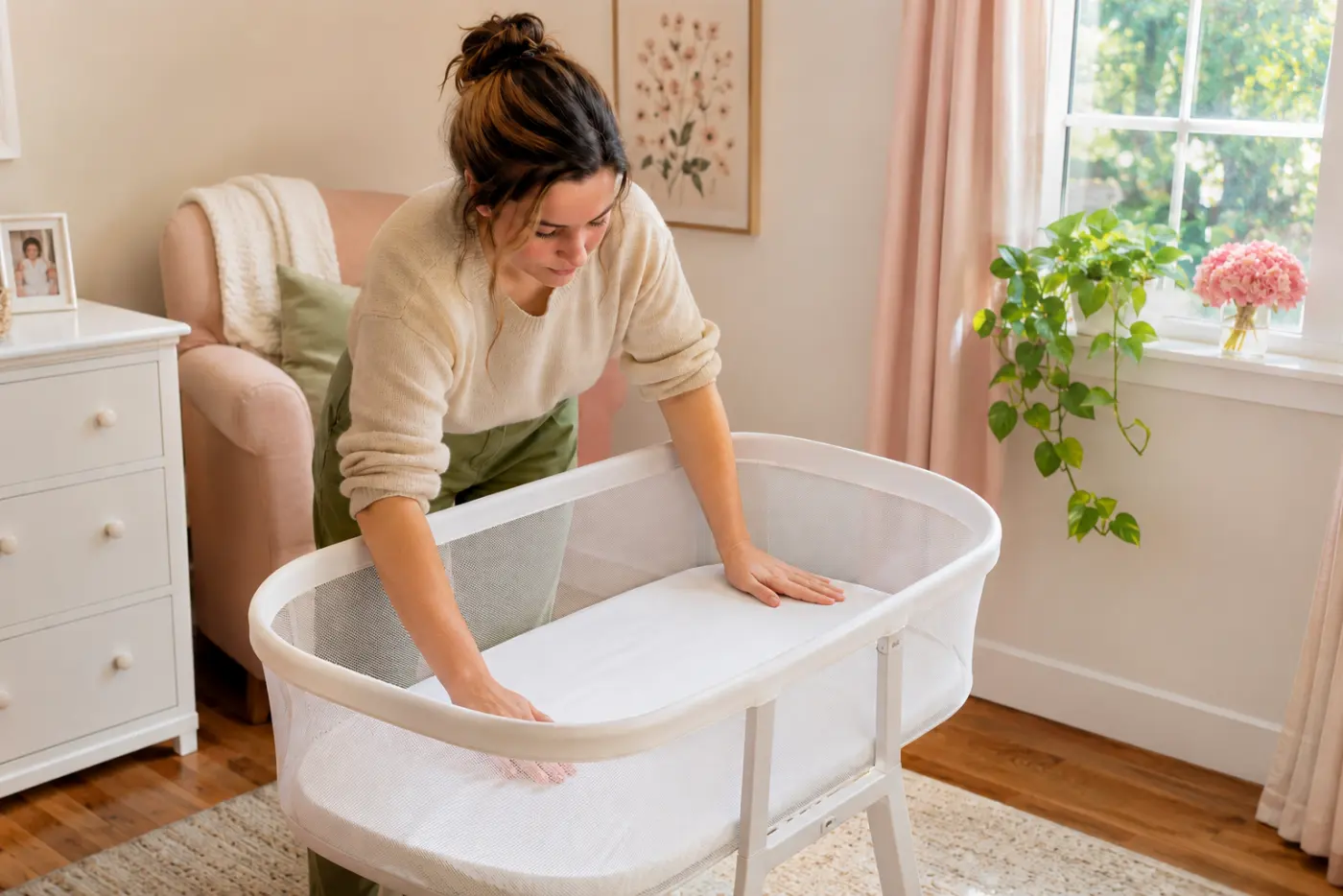
A hand-me-down can be fine if it's complete, comes with its instructions and has not been recalled. Check these before you use one:
- The date. Find the date of manufacture on the label. Bassinets made before April 23, 2014 weren't built to the current federal rule.
- The parts. The AAP says not to use a crib that doesn't have instructions, is missing hardware or is broken, and the same sense applies to a bassinet (AAP).
- Recalls. Search the model on CPSC's recall pages, especially if it's not new.
- The mattress. Use the pad made for that exact model. A different mattress can leave gaps.
If anything is missing or cracked, skip it. A new standard-compliant model is cheaper than any risk.
How Long Can a Baby Use a Bassinet?
Move your baby once they reach any limit printed on the bassinet, or once they can push up on hands and knees, whichever comes first. CPSC says a bassinet is not intended for use beyond the age of about 5 months or when a child is able to push up on hands and knees (CPSC, 2013).
Treat 5 months as the outer edge and the printed limit as the rule. Babies grow at different speeds. A baby who is long, strong or rolling early may reach the limit sooner than a baby who isn't. Our newborn sleep guide shows what to expect month to month.
Signs it's time to move:
- Your baby can push up on hands and knees, or tries to.
- They reach the weight or height limit in the manual.
- Their head or feet touch the ends.
- They start to roll toward the side. This is also the point to stop swaddling, since the AAP says to stop swaddling when your baby looks like they're trying to roll over.
If you're still room-sharing, put the crib or a play yard in your room. The AAP's advice covers where the bed is, so the room matters more than the product. The new bed follows the same rules: back to sleep, firm and flat, a fitted sheet only. Our crib guide can help you choose.

Frequently Asked Questions
What is the best baby bassinet?
The best bassinet is one that meets the federal standard (16 CFR part 1218), has a firm flat sleep surface, fits your bedroom and has limits that match how long you plan to room-share. A rocking base is an extra, and a bedside sleeper must also meet 16 CFR part 1222 and be attached to your bed as the manual says.
How long can a baby sleep in a bassinet?
Until they reach any limit printed on the bassinet or can push up on hands and knees. CPSC describes a bassinet as not intended for use beyond about 5 months or once a child can push up on hands and knees.
Is a bassinet safe for a newborn?
Yes, if it meets the CPSC standard and holds only its own firm mattress and a fitted sheet. The AAP lists a bassinet that meets CPSC standards as a safe place for your baby to sleep, on their back.
Do I need a bassinet if I have a crib?
No. One safe sleep surface is enough. A bassinet helps when a crib won't fit beside your bed and you want to room-share, which the AAP recommends for at least the first 6 months.
Is a rocking bassinet safe?
A rocking or swinging bassinet is allowed if it meets 16 CFR part 1218, which sets limits on rock and swing angles. When it is at rest, the sleep surface must be no more than 10 degrees from horizontal. If your baby falls asleep in a swing, the AAP says to move them to a firm, flat surface.
Can I use a second-hand bassinet?
Only if it is complete, undamaged, has its instructions and has not been recalled. Check the manufacture date on the label, search the model on CPSC's recall pages, and use only the mattress made for it.
Helpful tools
- Nursery and registry checklists: tick off the bassinet, sheets and the rest of the sleep space.
- Hush sleep tracker: log naps and nights once your baby is home.
- Soothing sounds: white noise from your phone, no extra gear.
Related articles
- Bassinet vs crib: which does your newborn need?
- Bedside crib guide
- Safe sleep for babies
- Newborn essentials checklist
- Baby registry checklist
This article is for informational purposes only and does not replace professional medical advice. Follow the instructions and warnings for your specific product, and talk with your pediatrician about guidance for your baby.
How This Guide Was Made
The Babysential Team wrote this guide from the AAP, CPSC and NICHD pages below, checked on November 8 and 11, 2026. AI-assisted drafting helped organize the page. Each safety statement links to a named source, and our own suggestions are labeled as ours. Babysential sells none of the products discussed here.
Sources
- How to Keep Your Sleeping Baby Safe: AAP Policy Explained, AAP (HealthyChildren.org), 2026
- Safe Sleep Environment, NICHD Safe to Sleep, checked November 2026
- Bassinets and Cradles Business Guidance, CPSC, 2026
- CPSC Approves New Federal Safety Standard for Bassinets and Cradles, CPSC, 2013
- Bedside Sleepers Business Guidance, CPSC, 2023
- 16 CFR Part 1222: Safety Standard for Bedside Sleepers, eCFR (CPSC), checked November 2026
- Safe Sleep for Babies Act Business Guidance, CPSC, 2022