The bottle aisle stretches half the store, and your registry still has a blank line next to "bottles."
Your answer to "how many bottles do you need for a newborn?" rests on two facts: how often a newborn eats, from the American Academy of Pediatrics (AAP), and the CDC's guidance to clean baby bottles after every feeding. Add how often you'll wash, and you get a number that fits your feeding plan. Once you have it, tick bottles off your baby gear checklist.
Count the feeds that happen between your washing rounds, then add two spares. A formula-fed newborn who eats every 2 to 3 hours, as AAP describes, needs more bottles than a mostly breastfed baby, for whom a few may be enough.
Key Takeaways
- Bottles = feeds between washes + 2 spares, our arithmetic on AAP feed counts and CDC cleaning guidance.
- Bottle-fed newborns eat at least 8 times in 24 hours (AAP, 2024).
- 4-ounce bottles cover the first weeks; formula feeds start at 1 to 2 ounces and reach at least 3 to 4 ounces by the end of the first month (AAP).
- A bottle warmer is optional, and the CDC says never to warm a bottle in a microwave.
How Many Bottles Do You Need for a Newborn?
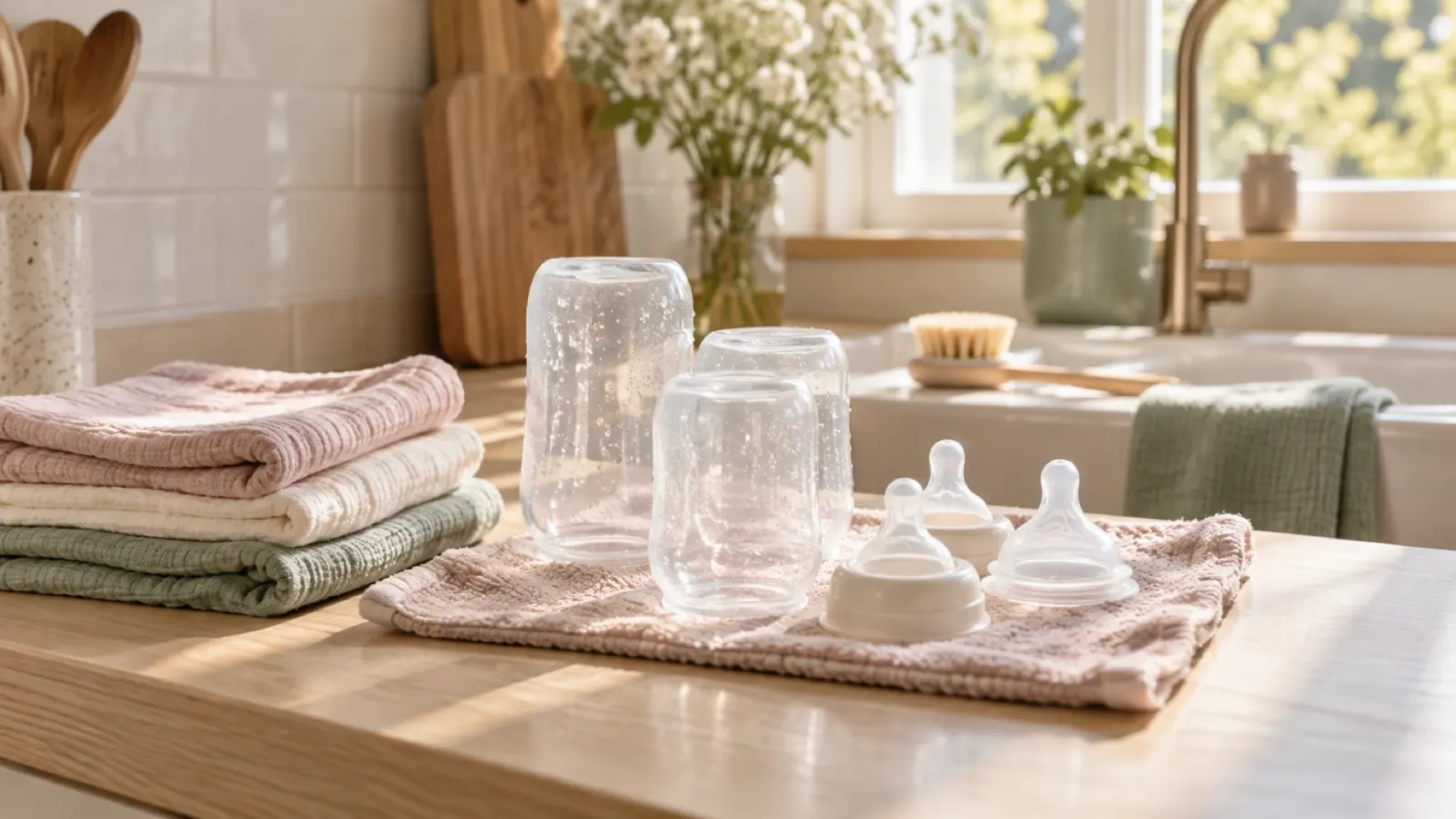
Every feed starts with a clean bottle. The CDC says to clean baby bottles after every feeding, warns that germs can grow fast when milk or formula is added to a partly used bottle, and asks you to let washed items air-dry thoroughly before storing them. Your count is therefore the feeds between washing rounds, plus spares for bottles still drying:
Bottles = (bottle feeds per day ÷ washing rounds per day) + 2 spares
The formula is ours; the inputs come from AAP. Most bottle-fed newborns "eat every 2 to 3 hours," with 8 feeds in 24 hours as the general minimum, so a newborn needs one bottle per feed, at least 8 a day. Breastfed newborns nurse about every 2 hours, and AAP (2024) calls 10 to 12 sessions in 24 hours the norm. By the end of the first month, feeds space out to about every 3 to 4 hours.
An example: a formula-fed baby feeding 8 times a day, with bottles washed morning and evening, needs 4 + 2 = 6 bottles. Washed once a day, the same baby needs 8 + 2 = 10.
Bottles by Feeding Plan
The number of bottle feeds depends on your plan:
- Formula only: every feed, so 8 or more a day.
- Pumped milk only: the same, plus milk storage containers. AAP says breastfed newborns usually nurse every 2 hours and take about 1 ounce per feeding in the first few weeks, so plan high.
- Combination: count only the bottle feeds (4 a day in the example row).
- Mostly nursing: 1 or 2 bottles a day at most (our assumption), or none if you don't plan to give bottles.
In the table, 12 feeds is what feeding every 2 hours adds up to, and the bottle columns use the formula above. Burp cloths assume one fresh cloth per two feeds, laundry every 2 days and 2 spares (our estimate, below); they track total feeds, so they barely change by plan.
| Feeding plan | Bottle feeds per 24 hours | Bottles if you wash once a day | Bottles if you wash twice a day | Burp cloths | Bibs |
|---|---|---|---|---|---|
| Formula only | 8 to 12 (AAP) | 10 to 14 | 6 to 8 | 10 to 14 | 0 to 3 |
| Pumped milk only | 8 to 12 (AAP) | 10 to 14, plus storage | 6 to 8, plus storage | 10 to 14 | 0 to 3 |
| Combination | 4 (example) | 6 | 4 | 10 to 14 | 0 to 3 |
| Mostly nursing | 1 to 2 (our assumption) | 3 to 4 | 3 | 10 to 14 | 0 to 3 |
"Bottles and nipples" and "Burp cloths (lots of them!)" are on the Baby Gear Must-Haves list in our checklists. Tick them off once you've picked your number.
A practical suggestion from us, with no clinical claim behind it: buy about half your number before the birth, and add the rest once you know which bottle shape and nipple flow your baby takes.
Small or Large Bottles?
Small ones, for now. AAP's formula schedule puts feeds at no more than about 1 to 2 ounces in the first week and at least 3 to 4 ounces per feeding by the end of the first month. A 4-ounce bottle holds the early feeds, though some babies will fill it by about a month, and it's the size the table counts. Breastfed babies take about 1 ounce per feed in the first few weeks (AAP).
Eight-ounce bottles fit later: by 6 months, AAP says babies take about 6 to 8 ounces at each of 4 or 5 feedings in 24 hours. Our suggestion is to buy them once feeds start to fill the small ones.
Bottle-fed babies may be more likely to overfeed, AAP says: "It's better to offer less, since you can always give more if your baby wants it." The CDC adds that you should stop when your baby shows they're full, "even if the bottle is not empty," and not prop the bottle.
Cleaning Changes the Count
Your washing rhythm moves the number more than anything else. The CDC says to clean bottles after every feeding and to sanitize them daily, or more often, if your baby is under 2 months old, was born prematurely or has a weakened immune system. For older, healthy babies, daily sanitizing may not be necessary if items are cleaned carefully after each use. In a dishwasher, the CDC suggests hot water and a heated drying cycle (or a sanitizing setting) when possible.
One dishwasher run a day puts you in the table's once-a-day column. Washing by hand morning and evening puts you in the twice-a-day column, with fewer bottles and more time at the sink. Before buying a gadget, note that the CDC says a dishwasher run with hot water and a heated drying cycle (or sanitizing setting) means a separate sanitizing step is not necessary. Our bottle sterilizer guide covers when a machine is worth it.
How Many Burp Cloths Do You Need?
Spit-up comes with the newborn months. The NHS says it's common for a baby under 1 to bring up a little milk during or shortly after a feed without being distressed. Burp cloths catch it, and the count follows your laundry:
Burp cloths = cloths per day × days between washes + 2 spares
At one fresh cloth for every two feeds (our estimate) and 8 to 12 feeds a day, that's 4 to 6 cloths a day:
- Laundry every day: 6 to 8 burp cloths
- Every 2 days: 10 to 14
- Every 3 days: 14 to 20
A baby who brings up milk at most feeds needs the next row down. The NHS suggests seeing a doctor if reflux isn't improving or your baby isn't gaining weight; in the US, that's your pediatrician. And because AAP says to keep soft objects out of your baby's sleep area, take the burp cloth with you when you lay your baby down.
Do Newborns Need Bibs?
Not many. In the milk months, burp cloths catch most of what comes back up, and 2 or 3 soft bibs cover a baby who dribbles through feeds (our estimate). You'll use bibs mostly once solid food starts, which AAP says is at about 6 months. Count them then, by meals and laundry, instead of guessing at sizes now.
How Many Pacifiers Do You Need?
AAP's pacifier advice is mostly about timing. "Offer a pacifier at nap time and bedtime," AAP says, as it helps reduce the risk of sudden infant death syndrome (SIDS). If you breastfeed, wait until breastfeeding is going well, which usually takes about 3 to 4 weeks; if you don't, AAP's safe sleep guidance says you can start whenever you like.
On numbers, AAP is blunt: "Buy some extras. Pacifiers have a way of getting lost or falling on the floor or street when you need them most." It also suggests trying different kinds until you find the one your baby prefers. Our suggestion: start with 2 of different shapes, then add 2 or 3 of the winner. Some babies refuse them, and AAP says not to force one.
AAP's safety basics: choose a 1-piece pacifier with a firm shield at least 1½ inches across, never tie a pacifier to the crib or around your baby's neck or hand, and don't attach one to their clothing while they sleep. If it falls out once your baby is asleep, you don't have to put it back. Our checklists list "Pacifiers (newborn size)" under Newborn Care Basics.
Do You Need a Bottle Warmer?
No; it's a convenience. The CDC's formula guidance says "Infant formula does not need to be warmed before feeding." To warm a bottle anyway, hold it under running warm water and test a couple of drops on your wrist.
"If you prefer to warm your baby's bottle, never use a microwave," the CDC adds, because microwaves "heat milk and food unevenly, resulting in hot spots that can burn your baby's mouth and throat." AAP says the same for breast milk: warm it in a bowl of warm water, since microwaving it "is not safe due to the risk of scalding your baby with hot milk."
In the first weeks you may cool bottles more than warm them. For babies under 2 months, born early or with a weakened immune system, AAP says to mix powdered formula with boiled water cooled for about 5 minutes, then cool the bottle to body temperature. A warmer makes more sense later, if you warm a lot of refrigerated milk.
Frequently Asked Questions
How many bottles do you need for a newborn?
Count the bottle feeds between washing rounds and add two spares. AAP says bottle-fed newborns eat at least 8 times a day, so formula feeding takes about 6 to 8 bottles if you wash twice a day, or 10 to 14 if you wash once.
How many bottles do I need if I'm breastfeeding?
For an occasional bottle, 3 or 4 is a fair estimate, and you may need none. If you pump for most feeds, count them like formula feeds and add containers for storing milk.
How many burp cloths do I need?
About 10 to 14 with laundry every 2 days, assuming one fresh cloth for every two feeds plus 2 spares. Daily laundry brings it down to 6 to 8.
Do newborns need bibs?
Not many. Burp cloths catch most milk in the newborn months, and you'll use bibs mostly once solid foods start, which AAP puts at about 6 months.
How many pacifiers should I buy?
Start with 2 of different shapes, then add a few of the one your baby takes, since AAP says pacifiers get lost. If you breastfeed, AAP suggests waiting until breastfeeding is going well, usually about 3 to 4 weeks.
Do I need a bottle warmer?
No. The CDC says infant formula does not need to be warmed before feeding. To warm a bottle anyway, use warm running water, never a microwave, which heats unevenly and can burn your baby's mouth.
What to Count Next
Bottles are one line on a long list. Next, work out how many diapers to stock, how many swaddles and crib sheets your laundry calls for, and whether a bassinet or crib suits your first months. Our newborn essentials checklist covers the rest, and you can check off the rest of your baby gear list as each number gets settled.
This article is for information only and does not replace advice from your pediatrician about how much and how often your baby should eat.
How This Guide Was Made
The Babysential Team wrote this guide from the AAP, CDC and NHS pages below, checked on October 11, 2026, with AI-assisted drafting. The counts are our own arithmetic and suggestions built on those sources and marked as such, and its own text names no products.
Sources
- How Often and How Much Should Your Baby Eat?. AAP (HealthyChildren.org), 2024
- Amount and Schedule of Baby Formula Feedings. AAP (HealthyChildren.org), 2022
- How to Clean, Sanitize, and Store Infant Feeding Items. CDC, 2025
- Infant Formula Preparation and Storage. CDC, 2026
- About Feeding From a Bottle. CDC, 2026
- Baby Pacifiers & Thumb Sucking: What Parents Need to Know. AAP (HealthyChildren.org), 2026
- How to Keep Your Sleeping Baby Safe: AAP Policy Explained. AAP (HealthyChildren.org), 2026
- Storing and Preparing Expressed Breast Milk. AAP (HealthyChildren.org), 2025
- How to Safely Prepare Formula with Water. AAP (HealthyChildren.org), 2026
- Reflux in babies. NHS, 2025