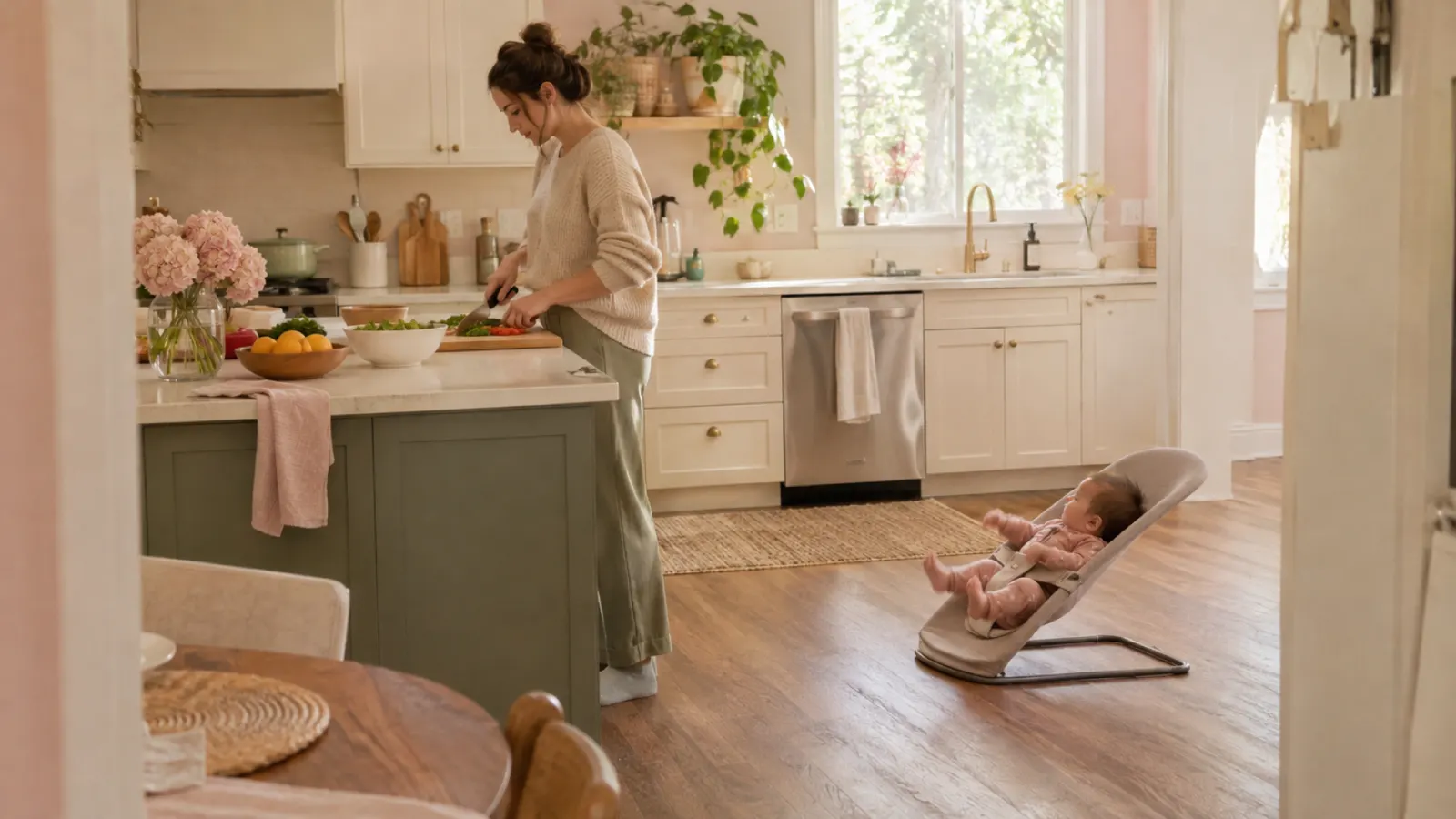
It is 5:40 p.m., dinner is half-made, and your baby has decided that being held is the only acceptable arrangement. A baby bouncer can buy you ten calm minutes with both hands free. Used well, it is one of the cheapest, lightest pieces of baby gear you can own.
Ready before the day comes.
Hospital bag, nursery and baby gear lists you can tick off as you go.
Start a checklistUsed badly, it is a product with a documented history of falls and suffocation. This guide covers what a bouncer is, the rules that matter, when to stop using one, and how to pick one without overspending.
In short
- A baby bouncer is for awake, supervised time on the floor, never on a bed, sofa, counter, or table. It is not a bed.
- Buckle the harness every time your baby is in the seat, even if they fall asleep there. Unbuckle only to lift them out.
- Stop when your baby tries to sit up or reaches the weight limit, which cannot be higher than 20 pounds.
- Short sessions are better than long ones. Mix in tummy time and being held.
- Buy a stable, easy-to-wash model made after March 2018. You do not need a premium one.
A baby bouncer is a good short-term place to set down an awake baby on the floor, from the first weeks until they start trying to sit up. Use the harness every time, stay nearby, and lift a sleeping baby out onto a flat sleep surface such as a crib or bassinet.
What is a baby bouncer?
The federal rule that governs bouncers describes one as a freestanding seat that holds a baby in a reclined position so they can bounce, either by their own movement, with a caregiver's help, or with a motor. It is meant for babies who cannot yet sit up on their own, roughly 0 to 6 months.
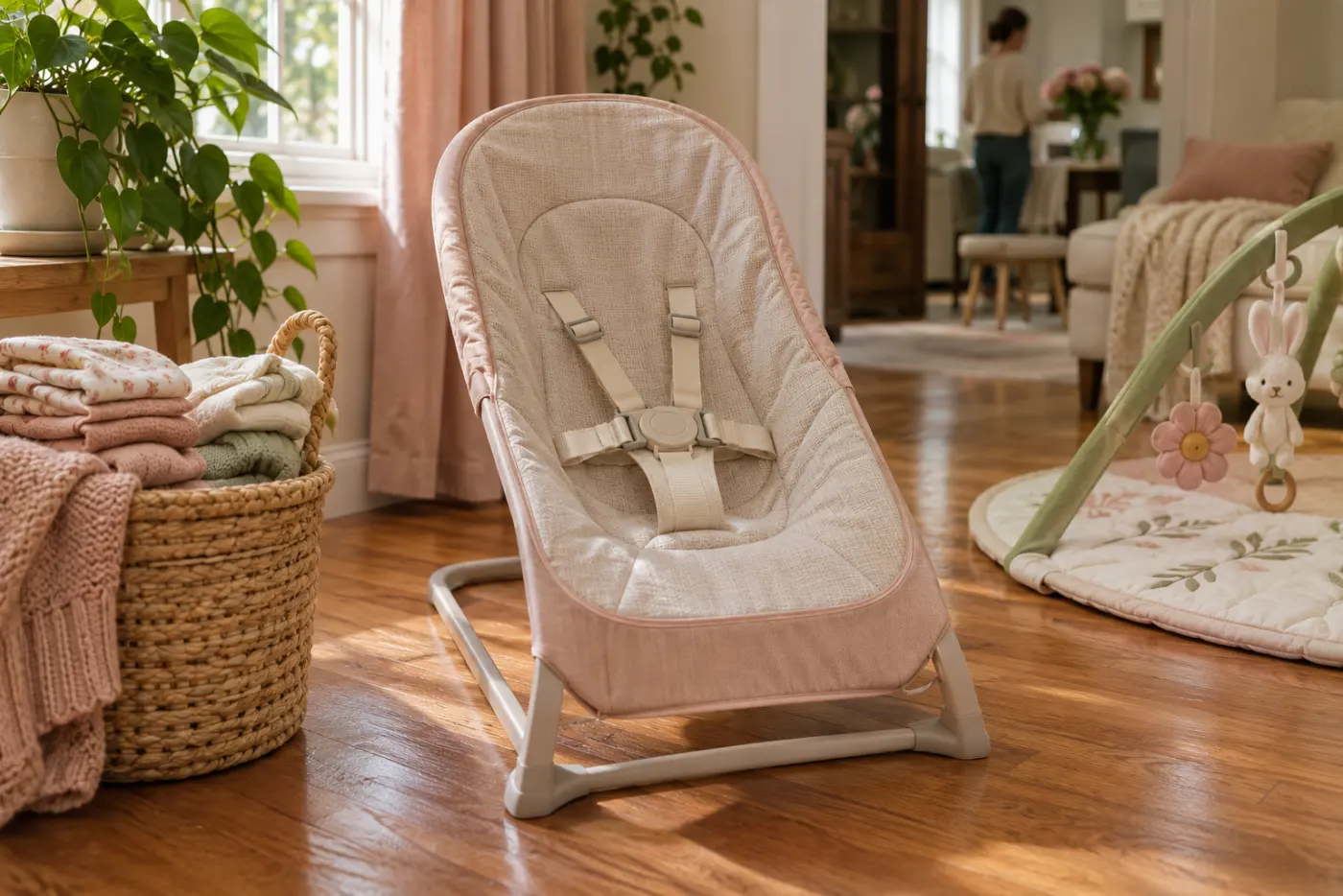
Most bouncers have a light frame, a fabric seat on a slight angle, a harness, and sometimes a toy bar or a gentle vibration setting. The bounce comes from your baby's own kicks, or from a quick tap from you. That is the main difference from a swing, which moves by motor or crank.
Bouncer, swing, rocker or jumper: which is which?
The word "bouncer" gets used for four different products, and the rules are not the same for each. Here is the quick map.
| Product | How it moves | Typical age | Awake only? |
|---|---|---|---|
| Bouncer seat | Baby's kicks, a tap, or light vibration | Weeks old until sitting up (about 0 to 6 months) | Yes |
| Baby swing | Motor or crank | Newborn until the maker's limit | Yes |
| Rocker | Gentle rock from baby's movement | Newborn to a few months | Yes |
| Jumper (door or stand-alone) | Baby pushes off with their legs | Only after solid head and neck control | Yes |
Jumpers are a different product with different limits. They suspend a baby upright and need strong head control, so they do not belong in the newborn weeks. If you are looking at a jumper, follow its own age and weight limits, not the ones in this guide.
For a deeper look at the motorized option, see our baby swing guide. A rocker or bouncer is lighter and cheaper, while a swing takes more floor space but keeps moving without your baby's help.
Is a baby bouncer safe?
Yes, when it is used as designed. The product itself has been under a mandatory federal safety rule since March 2018, covering restraints, stability, slip resistance, and a drop test.
The risk comes from how bouncers get used. The U.S. Consumer Product Safety Commission (CPSC) counted 347 bouncer incidents reported between 2006 and 2016, including 12 deaths and 54 injuries. The deaths were mostly suffocation, when unbuckled babies turned over in the seat, or when a bouncer tipped onto a soft surface such as a mattress or comforter. Most of the other incidents were falls from a bouncer set on a counter, table, or other raised spot.
That points to four simple habits:
- Floor only. Never put a bouncer on a counter, table, bed, or sofa. A baby's kicks can move it.
- Buckle every time. Fasten the restraints snugly every time, even for a two-minute stop and even if your baby falls asleep. Unbuckle only to lift your baby out.
- Stay close. Stay nearby and keep your baby in sight and earshot the whole time.
- No add-ons. Skip blankets, pillows, and extra padding, since a seated baby can slump into them.
Can a baby sleep in a bouncer?
No, and this is the rule parents hear least clearly in product descriptions. A bouncer holds a baby semi-upright, and a sleeping baby's head can tip forward and narrow the airway.
The American Academy of Pediatrics says sitting devices are not recommended for routine sleep at home or in hospital, especially for babies under 4 months. CPSC adds that inclined products with an angle greater than 10 degrees, such as rockers, soothers, and swings, should never be used for infant sleep. A bouncer sits on that incline, so the same advice applies.
Babies fall asleep in bouncers anyway, because the gentle motion works. When it happens:
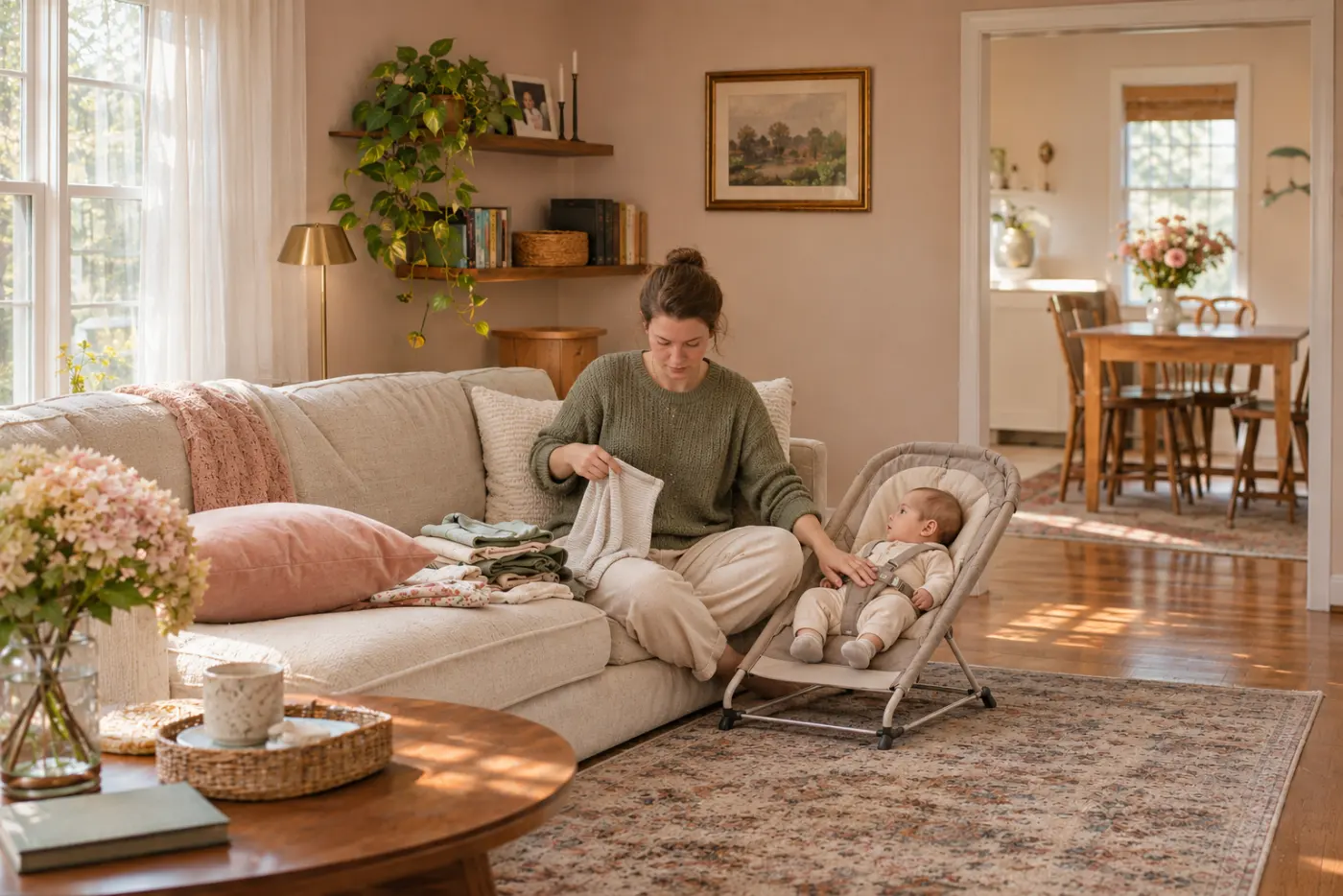
- Leave the bouncer on the floor. Do not carry the seat with your baby in it.
- Unbuckle the straps and lift your baby out.
- Lay them on their back on a firm, flat surface such as a crib, bassinet, or play yard, with nothing else in the sleep space.
A bouncer is not a nap spot, even a quick one. If your baby is sleepy, the safest next stop is a flat sleep surface on their back. Our safe sleep guide walks through the setup.
How long can a baby stay in a bouncer?
There is no official minutes-per-day limit from CPSC or the AAP, and we did not find one. What the AAP does say is practical: when your baby is awake, vary their position and limit time in freestanding swings, bouncy chairs, and car seats, because these items press on the back of the head.
Here is a sensible rhythm for a newborn day:
- Use the bouncer for a short stretch, about 15 to 20 minutes, while you eat, shower, or catch your breath. This is our editorial rule of thumb, not a medical limit.
- Follow it with floor play, being held, or a carrier walk.
- Fit in tummy time. The AAP suggests 2 to 3 short sessions a day from the first day home, building toward 15 to 30 minutes a day by about 7 weeks.
Tummy time works best when your baby is awake and alert, so it often follows a diaper change or a nap. Our tummy time guide has ideas for babies who protest. If you are still working out your baby's awake stretches, the wake windows chart can help you place a bouncer session in the day.

When to stop using a baby bouncer
Bouncers have a built-in end date. CPSC requires the warning label to tell you to stop when your baby starts trying to sit up or reaches the maker's recommended maximum weight, and that weight cannot be above 20 pounds. Whichever comes first ends it.
Signs it is time to retire the bouncer, even if the weight limit is still ahead:
- Your baby arches, twists, or pushes up against the harness.
- They try to pull themselves forward into a sitting position.
- They roll easily from back to front on the floor.
- The seat tips, rocks hard, or slides when your baby moves.
At that stage a baby is better off on the floor with space to move. Move on to a play mat and, a bit later, supervised floor play. Our milestones tool shows what most babies are working on at each age.
What to look for when you buy a baby bouncer
Most bouncers look alike and cost much less than a swing. The features that matter are boring ones.
Must-haves
- A harness that adjusts to fit snugly and a buckle you can open one-handed
- A wide, stable base with non-slip feet
- Clearly printed minimum and maximum weight limits and the stop-when-sitting-up label
- A manufacture date of March 2018 or later, since earlier models predate the federal rule
- A removable, machine-washable seat cover
- No recall on that exact model number
Nice to have
- A fold-flat or light frame so you can carry it, empty, from room to room. Never lift or carry the seat with your baby in it.
- A low vibration or gentle bounce setting
- A toy bar that clips on and off
- A recline that adjusts as your baby grows, if you want longer use
Usually skip
- Aftermarket head supports, inserts, and covers
- App-connected features that add cost but not safety
- Models that tilt up beyond what your baby's age calls for
Buying used
A secondhand bouncer is fine if you check it first. Find the model number and date on the label, then search the CPSC recall list for that model. Look for torn fabric, a loose buckle, a bent frame, or missing labels, and skip it if the instructions are gone.
Bouncers are a good borrow. Most babies use one for only a few months, so a hand-me-down from a friend with a clean recall check can stretch your registry budget. Our baby registry checklist can help you sort the essentials from the extras.
Do you need a baby bouncer?
No. Plenty of families skip one and do fine. A play mat, a carrier, a stroller walk, and your arms cover the same needs.
A bouncer earns its place if you want a light, cheap spot to set down an awake baby in the kitchen or bathroom doorway, and your baby likes the gentle motion. If your baby fusses in it, or you simply do not have space, there is no pressure to buy one.
Fussy evenings are a separate problem. If your baby cries for long stretches no matter what you try, read our guide to colic in babies, and talk to your pediatrician if you are worried.
When to call your pediatrician
A bouncer question rarely turns medical, but contact your pediatrician if:
- Your baby seems to have a flat spot on the back of their head, or always turns their head to one side
- Your baby is not holding their head up by the time they outgrow the bouncer
For a baby who is struggling to breathe, turning blue, or hard to wake, call 911. After any fall from a bouncer, call your pediatrician the same day. Go to the emergency room or call 911 if your baby vomits, cannot be comforted, or seems unusually sleepy.
This article is for informational purposes only and does not replace professional medical advice. Always consult your pediatrician for guidance specific to your child.
Frequently Asked Questions
Can a baby sleep in a bouncer?
No. A bouncer is for awake, supervised time. If your baby falls asleep, leave the bouncer on the floor, unbuckle the straps, lift your baby out, and lay them on their back on a firm, flat sleep surface.
How long can a baby stay in a bouncer?
No official time limit exists. AAP advises limiting time in bouncy chairs and varying your baby's position, so aim for short stretches between floor play, holding, and tummy time.
When should you stop using a baby bouncer?
Stop when your baby starts trying to sit up or reaches the maker's weight limit, which cannot exceed 20 pounds. Whichever comes first ends bouncer use.
Can a newborn use a baby bouncer?
Most can, once they meet the minimum weight printed on the product. Check the label, buckle the harness every time, and keep sessions brief and supervised.
Is a baby bouncer or a swing better?
Neither is essential. A bouncer is cheaper and lighter, and baby's own movement drives it. A swing moves on its own but takes more space. Both are awake-only products.
Helpful tools
- Soothing Sounds - Gentle white noise and lullabies for fussy stretches and bedtime.
- Hush sleep tracker - Log naps and see how awake time and sleep fit together.
- Baby Milestones Tracker - See when most babies start rolling and sitting, the cue to retire the bouncer.
- Checklists - Build a newborn gear list and mark what you already have or can borrow.
Related articles
- Baby swing guide - Safety, age limits, and how a swing compares with a bouncer.
- Safe sleep guide - Where and how baby should sleep, from newborn to 12 months.
- Tummy time guide - Easy ways to build tummy time into the day.
- Newborn essentials checklist - What you need in the first weeks, and what you can skip.
Sources
- CPSC: New Federal Standard to Improve Safety of Infant Bouncer Seats Takes Effect
- CPSC: Infant Bouncer Seats Business Guidance (16 CFR part 1229)
- CPSC: Safe Sleep, Cribs and Infant Products
- AAP: Sleep-Related Infant Deaths, Updated 2022 Recommendations
- AAP HealthyChildren.org: Back to Sleep, Tummy to Play