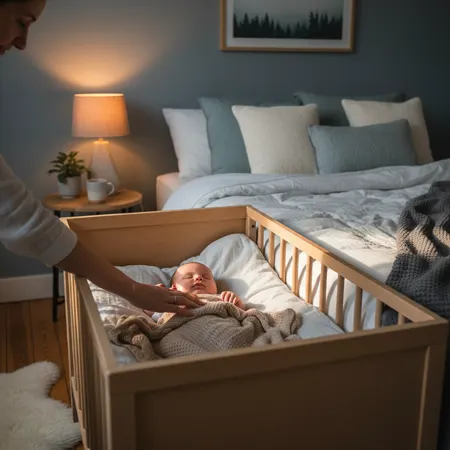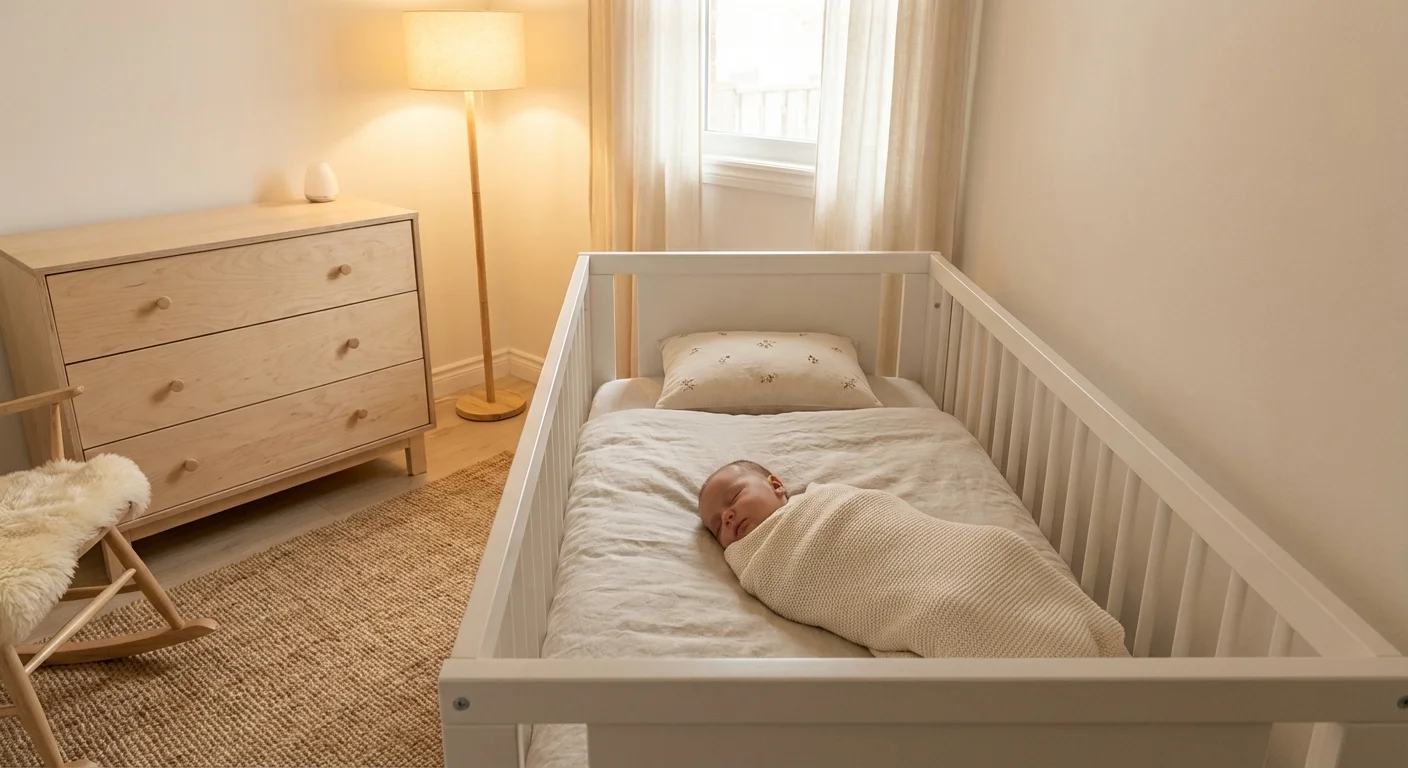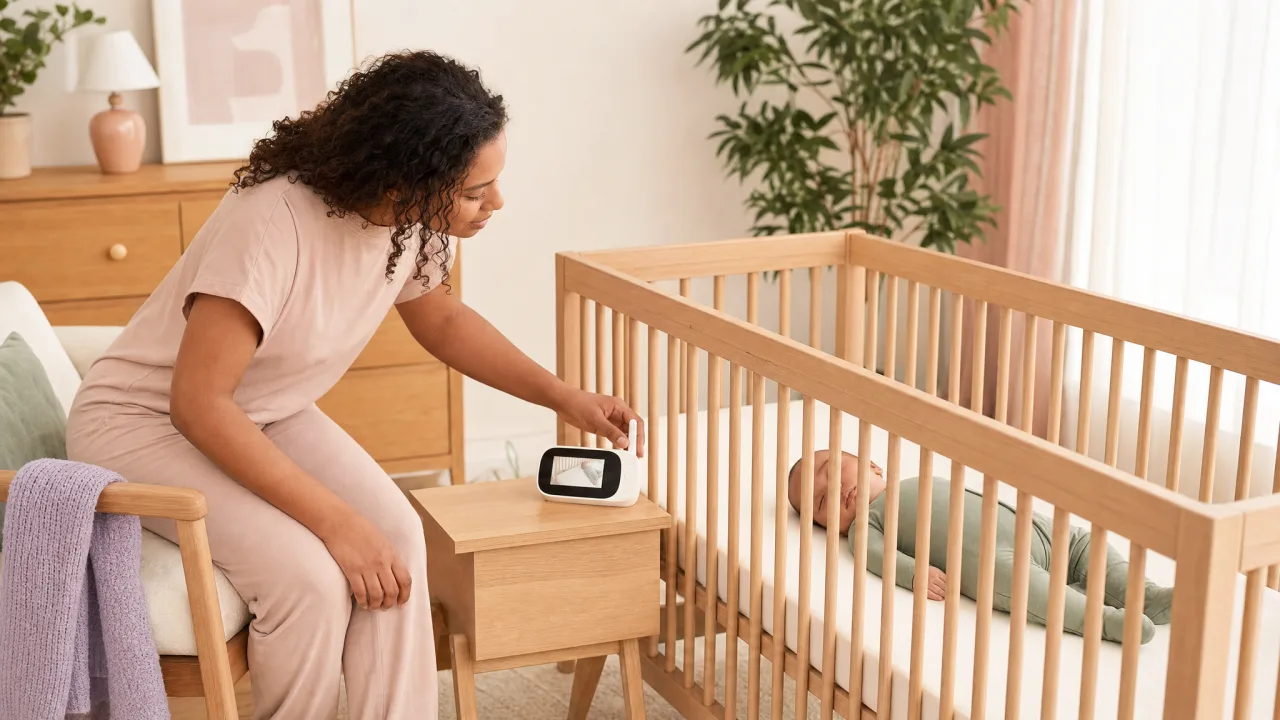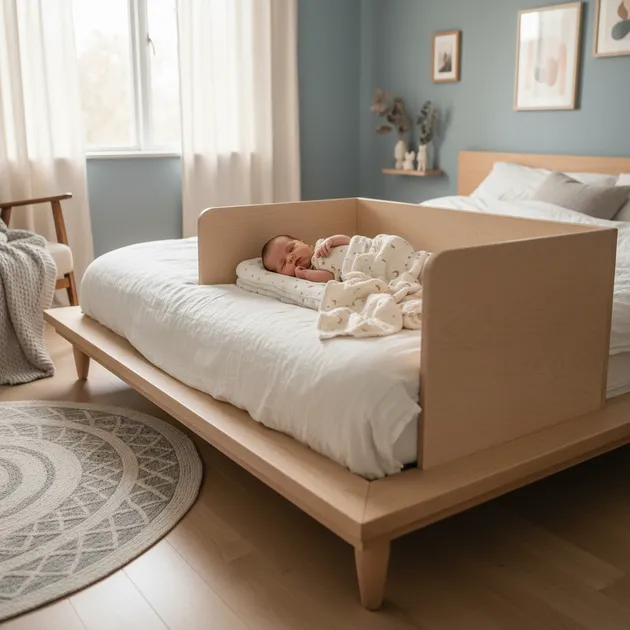
A bedside crib gives you the best of both worlds: your baby sleeps safely in their own bed, but within arm's reach all night. You don't have to get up to breastfeed, and your baby feels your closeness without sharing a bed.
Here's everything you need to know about bedside cribs, from benefits and safety to the most popular models available.
What is a bedside crib?
A bedside crib (also called a co-sleeper or bedside bassinet) is a small baby bed that attaches directly to the parents' bed. One side can be opened or lowered so you can reach your baby without getting up.
The crib has its own mattress and sides that prevent the baby from rolling over to the parents' bed. The baby sleeps in their own safe sleep environment, but right next to you.
Note: A bedside crib is very different from bed-sharing. The baby has their own firm, flat surface and bedding, and the risks associated with bed-sharing are eliminated.
Benefits of a bedside crib
Easier nighttime feeding
You can lift your baby over to you for feeding without leaving your bed. After the feed, you place your baby back in their own crib. Nighttime feeding goes faster, and both you and your baby fall back asleep more easily.
Safer than bed-sharing
The AAP recommends that babies sleep in their own sleep space in the parents' room for at least the first 6 months. A bedside crib meets this recommendation while providing closeness without the risks that bed-sharing involves.
Better sleep for the whole family
Babies sleep more calmly when they sense their parents' proximity. You can quickly check on your baby without getting up, and your partner doesn't get woken by you leaving the bed.
Space-saving
A bedside crib takes up less space than a traditional crib. It uses the parents' bed as one wall, and fits in most bedrooms.
Types of bedside crib
Standard bedside crib
Fixed crib with adjustable height that attaches to the parents' bed with straps or clamps. Most have a side that opens fully or lowers. Suitable from birth to approximately 6 months.
Travel bedside crib
A foldable version you can take to hotels, vacation rentals, or visits. Lighter construction, but often slightly less stable than fixed models. Useful as a second crib.
Bedside crib with rocking function
Some models can rock gently back and forth. This can help your baby settle, though it's not essential. The rocking function should be lockable for when your baby is asleep.
Safety, what to check
The mattress must be firm and flat. Use only the mattress that comes with the crib. Never add extra mattresses, pillows, duvets, bumpers, or soft toys to a bedside crib. Your baby should sleep on their back, on a flat and firm surface.
Requirements for a safe bedside crib
- Secure attachment to the parents' bed, no gap between the bedside crib and the adult bed
- Stable frame that cannot tip or shift
- Firm mattress that fits exactly in the crib without gaps at the edges
- Safety certification (JPMA or equivalent, ASTM F2906 standard)
- Adjustable height so the mattress level matches the parents' bed
Assembly and use
Always attach the crib to the parents' bed according to the manufacturer's instructions. Check the fastenings regularly, your baby will start moving more and may push against the sides. Confirm that no gap develops between the mattress and the crib edge.
Popular bedside crib models
Chicco Next2Me Magic
One of the most popular bedside cribs globally. Adjustable to 11 heights and can tilt slightly for babies with reflux. Easy to attach to most beds. Folds for travel.
Price: Around $200–300.
BabyBjörn Cradle
Scandinavian design with simple, clean aesthetics. Gentle rocking function that locks. Mesh sides provide good airflow. Suitable from birth to approximately 6 months.
Price: Around $300–350.
Snüz SnüzPod4
British design with a detachable pod that works as a portable bassinet. Mesh sides and an airflow system for ventilation. Has a gentle rocking function.
Price: Around $250–350.
HALO Bassinest Swivel Sleeper
Popular US option that swivels 360 degrees for easy access. Soothing sounds, nightlight, and vibration features. Meets AAP safe sleep guidelines.
Price: Around $200–300.
Budget tip: Check second-hand marketplaces for used bedside cribs. Many are only used for 4–6 months and are in great condition. Always buy a new mattress for a used crib to ensure proper hygiene and firmness.
Bedside crib vs. crib vs. bassinet
| Bedside crib | Crib | Bassinet | |
|---|---|---|---|
| Age | 0–6 months | 0–3 years | 0–4 months |
| Closeness | Attached to bed | Freestanding | Portable |
| Night feeding | Very easy | Must get up | Must get up |
| Space | Small | More | Smallest |
| Price | $150–350 | $100–600+ | $50–250 |
| Duration | 4–6 months | 2–3 years | 2–4 months |
A bedside crib is the best choice for the first months with a newborn. Many families transition to a crib when the baby is 5–6 months old and needs more space.
When should you stop using a bedside crib?
Most babies outgrow a bedside crib around 5–6 months. Switch to a crib when:
- Your baby can pull themselves up to sitting or standing
- Your baby is approaching the weight limit (usually around 20 lbs/9 kg)
- Your baby is rolling actively and needs more space
- Your baby starts pushing against the sides
Switch cribs in time. Once your baby can pull themselves up, a bedside crib is no longer safe. A crib with a lower mattress setting is the next step.
Tips for using a bedside crib safely
- Adjust the height precisely so the mattress level is even with the parents' bed
- Use only the included mattress, never add extra layers or pillows
- Keep room temperature between 65–68°F (18–20°C) for safe sleep
- Always place your baby on their back, always
- Check the fastenings weekly, especially as your baby starts moving more
Frequently asked questions
What is a bedside crib?
A baby bed that attaches to the parents' bed so you can reach your baby without getting up. The baby sleeps safely in their own crib, within arm's reach all night.
Which bedside crib is best?
The Chicco Next2Me Magic is one of the most popular, with 11 height adjustments and a foldable design. HALO Bassinest, BabyBjörn Cradle, and Snüz SnüzPod4 are also excellent choices.
How long can a baby sleep in a bedside crib?
From birth to around 5–6 months. Switch to a crib when your baby can pull themselves up or is approaching the weight limit.
Is a bedside crib safer than bed-sharing?
Yes. The baby has their own firm surface and sleeps in their own crib, while still being close to parents. This follows AAP safe sleep recommendations.
Can you use a bedside crib as a standalone bassinet?
Yes, most models can be used freestanding with all sides up. Useful for daytime naps or use in a different room.
Read more
Sources
- American Academy of Pediatrics. (2022). Safe Sleep Recommendations. healthychildren.org
- Consumer Product Safety Commission. Baby product safety standards.
- Moon, R.Y. (2016). SIDS and Other Sleep-Related Infant Deaths. Pediatrics, 138(5).
Last updated: March 2026
🔧 Helpful Tools
- Baby Sleep Tracker. Track and optimize your baby's sleep
- All Baby Tools. Browse all free tools for pregnancy and baby care
📖 Related Articles
- Baby Crib Guide 2026. Safe Sleep for Your Baby. Complete guide to baby cribs in 2026. Comparison of bedside bassinets, standard cribs, bassinets, and travel cribs. Tips for safe sleep from the AAP.
- Safe Sleep for Baby: 7 Rules That Reduce the Risk of SIDS. Learn the 7 most important rules for safe baby sleep. AAP safe sleep guidelines for sleep position, sleep environment, and SIDS prevention.