Your two-year-old sits next to another child in the sandbox. Both are digging with their own shovels but not looking at each other. Suddenly your child reaches for the other child's bucket. Tears and chaos follow. Welcome to social development in the toddler years.
Social skills are something children learn gradually, through experience, modeling, and countless attempts that don't always go well. Here is what you can expect, and how you can support your child along the way.
Stages of Social Development
Children develop social skills in a predictable sequence, but the pace varies from child to child. Researchers typically divide play into distinct stages.
0–12 months: Onlooker behavior and social smiling
Babies are social from birth. They track faces with their gaze, smile back, and imitate expressions from just a few weeks old. By the end of the first year they begin showing interest in other babies, reaching toward them, making sounds, and trying to touch them.
12–24 months: Parallel play
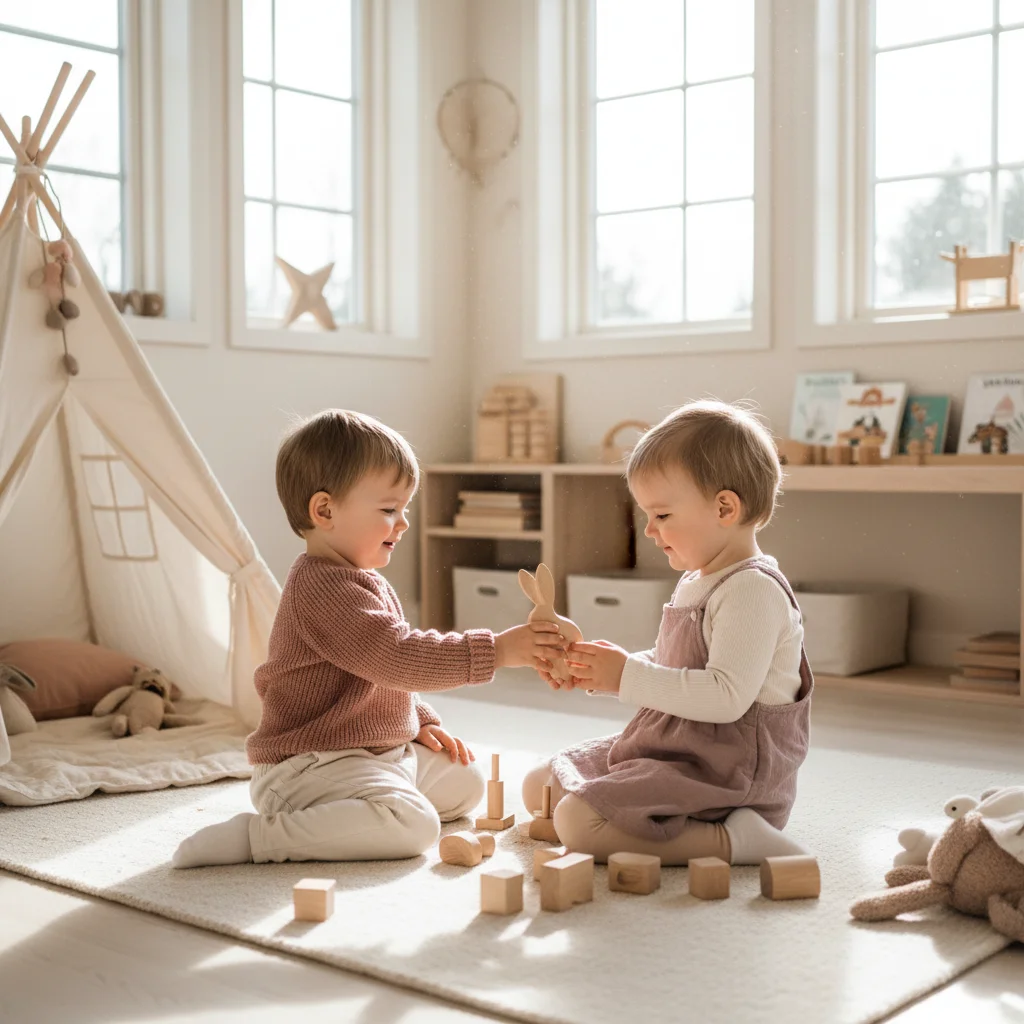
At this age, children often play alongside each other rather than truly together. This is called parallel play, and it is completely normal. The child is curious about other children and wants to be near them, but has not yet developed the skills needed to collaborate in play.
Typical characteristics:
- Sits next to other children and plays with similar toys
- Imitates what other children do
- Conflicts arise over toys and objects
- Needs a lot of adult support to navigate conflicts
Parallel play is learning. Even though it does not look like cooperation, your child is constantly observing and imitating. This is the foundation for all later social play.
2–3 years: First attempts at cooperative play
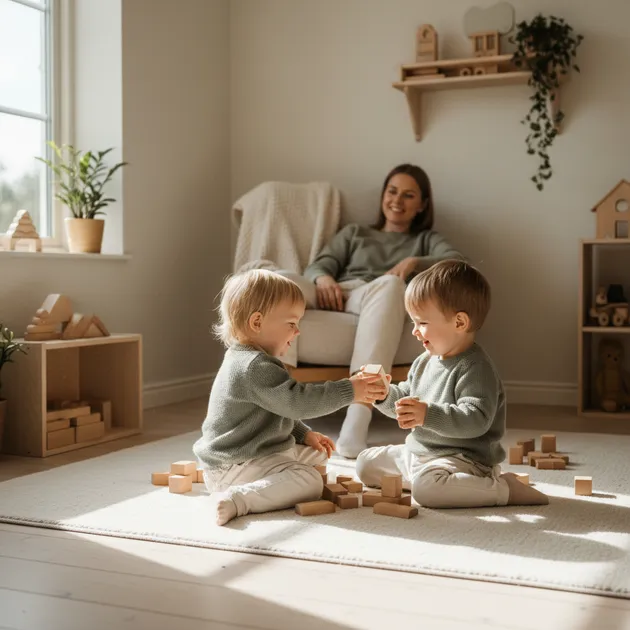
Around age two, many children begin taking the first steps toward playing together. They can follow each other's lead for brief moments, and glimpses of turn-taking and shared attention emerge.
From around age three a clear shift occurs. The child begins playing actively with other children, fantasizing together, assigning roles, and developing play as a group. Research shows that children from age three direct more attention toward other children than toward the adults around them.
3+ years: Cooperation and role play
Now the child can:
- Participate in rule-based games with simple rules
- Wait for a turn (with some help)
- Take roles in pretend play ("You're the mom, I'm the baby")
- Show early negotiation skills ("First it's your turn, then it's mine")
Learning to Share
Sharing is one of the most difficult social skills for toddlers. The brain of a two-year-old is simply not mature enough to understand the concept of voluntarily giving something up and getting it back.
How to support sharing
- Avoid forcing sharing. Instead say "When you're done with the shovel, Nora can have it" rather than "Share with Nora now."
- Use turn-taking. An egg timer can make it concrete: "You use it for two minutes, then it's Noah's turn."
- Have enough of popular toys. Two identical shovels are better than a fight over one.
- Praise when it happens naturally. "You gave Sofia the car! Look how happy she is."
Turn-taking before sharing. Turn-taking is easier to understand than sharing, because the child knows they will get the item back. Start with turn-taking and let genuine sharing emerge naturally over time.
Empathy Development in Toddlers
Empathy develops gradually throughout childhood. The first signs appear around 18–24 months, when a child can show concern for someone who is crying, perhaps by offering their own stuffed animal as comfort.
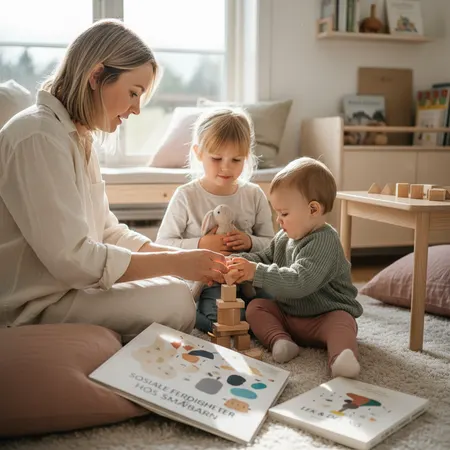
How empathy develops
- Emotional contagion (0–1 year): The baby cries because another baby is crying, without understanding why.
- Egocentric empathy (1–2 years): The child understands that someone is sad but assumes that what comforts them will comfort everyone. Offers their own stuffed animal to a crying child.
- True empathy (2–3 years): The child begins to understand that others have their own feelings and needs, and can adapt their comfort accordingly.
How to support empathy
- Name others' emotions: "Look, Ethan is crying. He's sad because he hurt himself."
- Read books with emotional themes and talk about what the characters are experiencing.
- Acknowledge your child's empathetic actions: "You patted Ethan on the cheek. That was very caring of you."
- Show empathy yourself, children learn most by watching you in action.
Conflict Resolution Between Toddlers
Conflicts between toddlers are inevitable and completely normal. They are actually part of the learning process. Children need help navigating conflicts, not avoiding them.
When to intervene
- When a child hits, bites, or pushes
- When one party is clearly scared or upset
- When the conflict has gone on for a while without resolution
How to help
- Stop the action physically if necessary, without scolding.
- Acknowledge both feelings: "You wanted the car. And you had it first. You're both upset right now."
- Describe the problem: "There is one car and two children who want it."
- Invite a solution: "What can we do?" (For younger children: offer two options.)
- Support the solution: Help the children carry out what they decide.
Avoid naming a "winner." When adults always give the toy to whoever had it first or whoever cries loudest, children learn to use crying as a strategy instead of negotiating.
The Role of Daycare in Social Development
Daycare is a unique setting for social learning. Here the child meets peers daily in a structured environment with adults who can guide them.
According to the AAP and early childhood education research, programs that support children's initiatives for interaction and ensure all children can experience friendship are most effective for social development.
What daycare offers
- Daily opportunities for interaction with peers
- Structured activities that practice turn-taking and cooperation
- Adults who can model social skills
- Small groups adapted to the child's level
- Dramatic play, role-playing, and conversations about feelings
Playdates and Social Situations
Playdates can be great practice arenas for social skills, but they should be adapted to the child's age.
Tips for successful playdates
- Under 2 years: Short meetings (30–60 minutes) with a lot of adult support. Have double the number of popular toys.
- 2–3 years: A little longer (1–2 hours). Activities with parallel play work well, sandbox, water play, drawing.
- 3+ years: The child can start having their own preferences for playmates. Simple rule-based games and pretend play.
Start with one child at a time. Large groups are overwhelming for toddlers.
Role Modeling
Your child learns social skills primarily by watching you. How you greet neighbors, thank cashiers, handle disagreements with your partner, all of this is being noted.
Practical things you can do:
- Narrate what you do socially: "I'm calling grandma because she's sick. I want her to know we're thinking of her."
- Use polite phrases consistently, "thank you," "please," "excuse me"
- Show how you repair after conflicts: "I got angry and said something unkind. Now I'm going to apologize."
When Should You Seek Advice?
Most children develop social skills at their own pace. But sometimes it is worth speaking with your pediatrician.
Contact your pediatrician if your child:
- Shows no interest in other children after age 2
- Consistently avoids eye contact
- Does not respond to their own name
- Has very limited play (repeats the same action over and over)
- Withdraws from all social situations
- Loses skills they previously had
This does not necessarily mean something serious, but early evaluation is always beneficial.
Frequently Asked Questions
Is it normal that my two-year-old won't share?
Yes, completely normal. Toddlers are developmentally egocentric, they do not yet understand that others have separate needs and wants. Genuine sharing begins to mature around ages 3–4. Until then, turn-taking with adult support is the best strategy.
My child prefers to play alone, should I be worried?
Not necessarily. Some children are more introverted or need time to observe before participating. As long as your child shows interest in others (watching, imitating from a distance) and is developing normally otherwise, it is likely just their personality. Talk to your pediatrician if you are unsure.
How do I handle my child biting others?
Biting is common between ages 1 and 3, especially when a child lacks words for frustration. Stop the action calmly, say "we don't bite, biting hurts," and help the child put their feeling into words. Offer an alternative: "You can say NO if you don't want to." Most children stop biting as language develops.
Should I intervene in every conflict between children?
No. Children learn a lot from trying to resolve things themselves. Intervene when there is physical aggression, when one child is clearly frightened, or when the conflict has become stuck. Give children the chance to find solutions before you offer help.
Summary
Social development in toddlers is a gradual process that takes time. Children move from parallel play to cooperation, from grabbing to sharing, from personal frustration to empathy for others. Your role is to be a patient guide, not to force social skills, but to create the conditions for them to grow.
Read More
- Emotional Development in Children
- The Tantrum Years: How to Get Through Them
- Starting Daycare
- Language Development in Children
- Setting Limits for Toddlers
- Play and Development in Toddlers
Sources
- AAP - Social Development
- CDC - Developmental Milestones
- Zero to Three - Social-Emotional Development
🔧 Helpful Tools
- Baby Milestones Tracker. Track your baby's developmental milestones
- Development Leaps. Understand your baby's developmental leaps
- All Baby Tools. Browse all free tools for pregnancy and baby care
📖 Related Articles
- Teaching Children to Share and Wait Their Turn: Age-Appropriate Guide. Toddlers don't share willingly - and that's completely normal. Learn how to support your child's development of social skills with realistic expectations.
- Concentration in Toddlers. How to Support It. Learn how to strengthen concentration in toddlers. Normal attention spans by age, activities, and tips for better focus in children 1–3 years.
- Creative Play at Home: 20 Activities for Toddlers, 20 simple and fun activities you can do at home with toddlers. Creative play that supports development without expensive equipment.