There's something magical about carrying your baby close to your body. The baby falls asleep almost instantly, your hands are free, and you can actually get things done. But in front of you lies a jungle of structured carriers, wraps, ring slings, meh dais, and hiking carriers. What do you choose?
This guide helps you navigate the options, understand what's ergonomically correct, and find the carrier that fits you and your baby best.
Key Takeaways
- Ergonomic carrying means the baby's hips are spread around the parent's body in an M-position (also called the frog position), avoid carriers where the baby's legs hang straight down, which can stress the hip joints.
- Research shows that babies who are carried regularly cry significantly less and sleep more easily, closeness regulates stress hormones and provides comfort.
- Structured carriers (SSC) are easiest to use for most parents, while stretchy wraps offer the closest hold for newborns but have a learning curve.
- Always follow the TICKS safety rules: Tight, In view at all times, Close enough to kiss, Keep chin off chest, Supported back.
- Most structured carriers are suitable from birth with a newborn insert, and convert to toddler-size as the child grows, making them a long-term investment.
Why Carry Your Baby?
Carrying your baby in a carrier or wrap has many benefits, for both child and parent.
Benefits for the Baby
- Closeness and security, the baby hears your heartbeat, feels your warmth, and smells you. This provides security and calms stress hormones
- Better sleep, many babies fall asleep more easily and sleep longer in a carrier than in a stroller
- Less crying, research shows that babies who are carried more cry less
- Stimulation, the baby sees the world from the parent's perspective and gets lots of sensory input
- Good for digestion, the upright position can help babies with colic and reflux
Benefits for the Parent
- Free hands, you can walk, shop, cook, or play with older siblings
- Easier on rough terrain, a carrier works where a stroller can't go
- Bonding, the close contact strengthens attachment between parent and child
- Exercise, carrying your baby is surprisingly good exercise for your back and core
Types of Baby Carriers
Structured Carrier (SSC. Soft Structured Carrier)
The most popular type of baby carrier. Has fixed buckles, padded straps, and a shaped panel.
Popular brands: Ergobaby, BabyBjorn, Manduca, Tula, Lillebaby
Pros:
- Easy to put on and take off
- Comfortable for longer outings
- Can be used by multiple people without much adjustment
- Many have newborn inserts or adapt from birth
Cons:
- More expensive than wraps
- Not as flexible as a wrap
- Some models don't fit all body types well
Best for: Parents who want something simple and quick, hikers, those who want to share with a partner.
Stretchy Wrap
A long, stretchy fabric that's wrapped around the body. Most commonly used for newborns and small babies.
Popular brands: Boba Wrap, Moby Wrap, Solly Baby
Pros:
- Very cozy and snug for newborns
- Adjustable, fits all body types
- Affordable
- Can be used from birth without any insert
Cons:
- Takes longer to put on (wrapping process)
- Can be warm in summer
- Many find the wrapping difficult to learn
- Stretchy wraps don't support well enough for heavier babies (over 13-15 lbs)
Best for: Newborns and the first few months, parents who love closeness, home use.
Woven Wrap
A long, woven fabric without stretch. More supportive than a stretchy wrap.
Pros:
- Can be used from birth to toddler
- Supports well even for large children
- Many wrapping methods (front, back, hip)
- Durable and beautiful
Cons:
- Steep learning curve, wrapping takes practice
- Long fabric that can get dirty outside
- Prices range from affordable to very expensive
Best for: Parents who enjoy learning a skill, those who want to carry for a long time (up to 2-3 years).
Ring Sling
A shorter fabric threaded through two rings for adjustment.
Pros:
- Quick to put on and take off
- Compact, easy to carry in your bag
- Great for short carrying sessions and nursing
- Can be used from birth
Cons:
- Asymmetric carrying (loads one shoulder)
- Not ideal for longer outings
- Can slip if not tightened properly
Best for: Short carrying sessions, on-and-off situations (store, pickup), nursing.
Meh Dai (formerly Mei Tai)
A hybrid between a wrap and a structured carrier. A square panel with long straps that tie.
Pros:
- Simpler than a wrap, more adjustable than an SSC
- Good weight distribution
- Fits many body types
- Can be used front and back
Cons:
- Less common in stores, harder to try
- Tying takes some time
Best for: Those who want something between a wrap and a structured carrier.
Try before you buy: Many babywearing groups and specialty stores offer rentals or trial programs. Local babywearing groups on Facebook have chapters across the country where you can try different models. Some pediatrician offices also lend carriers.
Ergonomic Carrying. The Correct Position
Correct carrying position is important for the baby's hip development and for the parent's back.
M-Position (Spread-Squat Position)
The most important rule for ergonomic carrying is that the baby should sit in M-position:
- Knees higher than bottom, the legs form an M-shape
- Legs spread to the sides, thighs should be supported from knee to knee
- Bottom at the lowest point, the baby sits in a natural "frog position"
This position supports natural hip development and is recommended by the International Hip Dysplasia Institute.
Back Support
- Natural C-curve, the baby's back should have a natural, rounded C-shape
- Panel should support from knee pit to knee pit and up to the neck
- Not too tight, the baby should be able to move arms freely
Head Support
- Newborns need full head support, the head should rest against the parent's chest
- Older babies can have their head free when awake
- Sleeping babies should always have head support
Airways
- Always visible face, you should be able to see the baby's face at all times
- Chin up from chest, there should be at least one finger width between chin and chest
- Nose and mouth free, never covered by fabric
Hip dysplasia: The AAP recommends that babies be carried in a spread-squat position (M-position) to support hip development. Carriers where the baby hangs with legs straight down (like some older models) are not recommended, as they can put stress on the hips. Choose a carrier where the thighs are supported and knees are higher than the bottom.
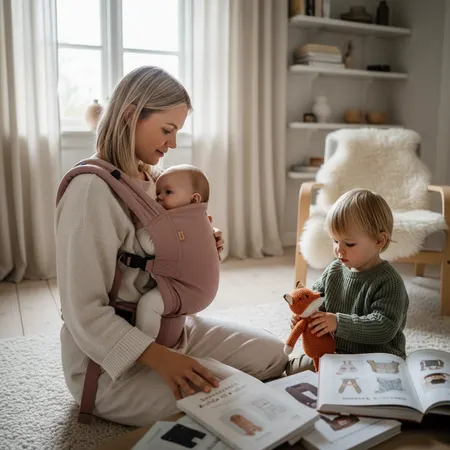
Baby Carrier by Age
Newborn (0-4 months)
Recommended: Stretchy wrap, ring sling, or structured carrier with newborn insert
- Baby should always be carried facing the parent
- Full head support is necessary
- Check that the baby's airways are always free
- Start with short carrying sessions (15-30 minutes) and increase gradually
- For premature babies, talk to your pediatrician before use
4-6 Months
Recommended: Structured carrier, woven wrap, meh dai
- Baby has better head control but still needs support during sleep
- Facing the parent is still best
- Longer carrying sessions are now possible
- Can start considering back carrying with woven wrap (with practice)
6-12 Months
Recommended: Structured carrier, woven wrap, meh dai
- Many babies want to see outward, some carriers allow forward-facing
- Back carrying is great for walks and housework
- Baby is heavier, choose a carrier with good weight distribution
- Adjust panel width to the baby's size
12 Months+
Recommended: Structured carrier in toddler size, woven wrap
- Carrying is still valuable for toddlers, especially on hikes and rough terrain
- Choose a carrier with good back length and wide straps
- Back carrying is most comfortable for the parent with heavier children
- Many carriers can be used up to 33-45 lbs (15-20 kg)
Forward-facing carrying: Some structured carriers allow the baby to be carried facing outward from about 5-6 months. This is fine in short periods (15-30 minutes) for babies with good head control, but should not be the default carrying position. The baby can become overstimulated and cannot turn away.
Babywearing in Different Weather
Winter
- Babywearing jacket, a jacket with an extension for the baby. The easiest solution
- Over the carrier, wear a large jacket or poncho over both of you
- Baby dresses lighter, the baby gets warmth from your body. Don't overdress
- Hat and socks, the head and feet stick out and need extra protection
Summer
- Light carrier, choose a carrier in mesh or thin fabric
- Sun protection, use a sun hat on the baby; a wrap can serve as a sunshade
- Hydration, the baby gets warm from body contact, offer water/breast milk often
- Baby's skin, avoid direct sun on baby's skin (sunscreen from 6 months)
Rain
- Rain poncho, available in versions that cover both parent and baby
- Rain cover for carrier, attaches over the carrier
- Watch for slippery surfaces, good footwear is important when carrying a baby
How to Choose the Right Carrier
Questions to Consider
- How old is the baby? Newborns need more support than older babies
- How much will you carry? Daily use requires more comfort than occasional use
- Will both parents use it? Structured carriers are easier to share
- Will you go on long walks? Good weight distribution is essential
- What's your budget? From $30 (secondhand wrap) to $300+ (premium carrier)
Buying Checklist
- Safety certified (ASTM F2236 or similar standard)
- M-position possible (thighs supported knee to knee)
- Adjustable panel width
- Good head support for newborns
- Comfortable for the parent (padded straps, waistbelt)
- Easy to put on and take off alone
- Easy to wash
Frequently Asked Questions
From what age can the baby use a carrier?
Most carriers and wraps can be used from birth, either directly or with a newborn insert. Stretchy wraps are especially well suited for the very smallest. Always check the manufacturer's age recommendation and minimum weight.
Is a carrier good for baby's hips?
Yes, provided the baby sits in M-position (spread-squat) with knees higher than bottom and thighs supported. The International Hip Dysplasia Institute recommends this position. Avoid carriers where the baby hangs with legs straight down.
Can I nurse in a carrier?
Yes, many carriers and wraps allow nursing. Ring slings are especially good for discreet nursing. In structured carriers, you can loosen the straps slightly and lower the baby to chest height. Practice at home first.
How long can the baby be in the carrier?
There's no fixed time limit, but use common sense. Check that the baby is comfortable, airways are free, and blood circulation in the legs is good. Most babies give clear signals when they want out. For newborns, start with short sessions and increase gradually.
Is it safe to carry the baby forward-facing?
Forward-facing carrying is safe in short periods for babies over 5-6 months with good head control. Make sure the baby sits in M-position even when facing outward. Avoid prolonged forward-facing carrying, as the baby can become overstimulated and can't turn away from stimuli.
Wrap or carrier, what's best?
It depends on your needs. A wrap is best for newborns and the close, cozy feeling. A structured carrier is simpler to put on and more practical for everyday life. Many parents start with a wrap and switch to a structured carrier after a few months.
Read More
Sources
- AAP. Hip Dysplasia in Children
- International Hip Dysplasia Institute. Baby Carriers
- WHO. Physical Activity for Young Children
- CPSC. Baby Carrier Safety
🔧 Helpful Tools
- All Baby Tools. Browse all free tools for pregnancy and baby care
📖 Related Articles
- Baby Carrier Jacket: Keep Your Baby Warm While Babywearing. Guide to baby carrier jackets. Find the right type for your carrier or wrap. Tips for winter and transitional seasons.
- Baby Wrap and Carrier: Safe Babywearing Guide. Complete guide to baby wraps and carriers. Correct carrying position, M-position, and tips for safe babywearing from newborn.