Choosing the right bike for your child is one of the most important gear decisions you'll make. A bike in the wrong size makes learning harder, and in the worst case can lead to accidents.
In this guide you'll find everything you need to know about kids' bikes: when your child is ready, which size fits, and how to teach them to ride safely.
When is your child ready for their first bike?
Most children start with a balance bike from around age 2. A pedal bike becomes relevant from ages 3–4, depending on your child's motor development.
Look for these signs that your child is ready:
- They walk and run confidently without tripping often
- They can jump with both feet
- They show interest in bikes and wheels
- They can sit steadily and maintain their balance
Tip: Don't rush it. Children develop at different rates, and it's completely normal for some to be ready at 2 while others need time until closer to 4. Follow your child's cues.
Balance bike vs pedal bike, which should you choose first?
This is the most common question parents ask. The answer is simple: start with a balance bike.
Balance bike (running bike), from around age 2
A balance bike has no pedals. Your child sits on the seat and pushes themselves forward with their feet. This teaches the most important skill: balance.
Advantages:
- Child learns to balance naturally and gradually
- Low seat height and low speed, safe for young children
- Easy to handle for small children
- Makes the transition to a pedal bike much easier
Age: 2–4 years, depending on the child's height and readiness.
Pedal bike, from around ages 3–4
When your child can manage a balance bike and coast with their feet lifted off the ground, they're ready for a pedal bike. Children who have used a balance bike often learn to ride a pedal bike without training wheels in just a few minutes.
Advantages:
- Child can ride longer distances
- Develops strength and endurance
- Greater speed potential for older children
Tip: Many preschools and daycares have balance bikes available. Ask whether your child can try one there, you'll quickly see if they're ready.
Should you use training wheels?
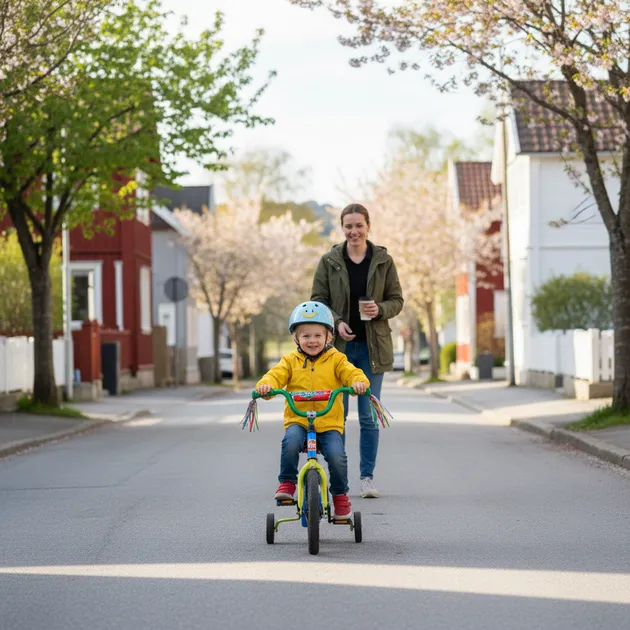
Training wheels are rarely recommended by experts today. They teach children to ride leaning to one side rather than finding their balance point. The child leans against one training wheel and never truly learns to balance.
A balance bike is a far better path to cycling than training wheels. If your child already has a bike with training wheels, remove them and use the bike as a makeshift balance bike with pedals.
Kids' bike sizes, how to find the right fit
Kids' bike sizes are measured in inches and refer to the wheel diameter. Wrong size is the most common mistake parents make when buying a bike for their child.
Size guide by age and height
| Wheel size | Child's height | Typical age | Inseam length |
|---|---|---|---|
| 12 inch | 85–100 cm (33–39 in) | 2–3 years | 35–42 cm (14–17 in) |
| 14 inch | 95–110 cm (37–43 in) | 3–4 years | 40–48 cm (16–19 in) |
| 16 inch | 105–120 cm (41–47 in) | 4–6 years | 45–55 cm (18–22 in) |
| 20 inch | 115–135 cm (45–53 in) | 6–8 years | 52–62 cm (20–24 in) |
| 24 inch | 130–150 cm (51–59 in) | 8–11 years | 60–72 cm (24–28 in) |
Important: Always go by your child's height and inseam, not their age. Children of the same age can vary significantly in size.
How to measure inseam length
Inseam is the most precise way to find the right bike size.
- Have the child stand barefoot with their back against a wall
- Place a book between their legs, held high up toward the crotch
- Measure from the top of the book down to the floor
- This is the inseam measurement
Rule of thumb: Your child should be able to touch the ground with their toes when seated with the saddle at its lowest position. On a balance bike, both feet should rest flat on the ground.
Don't buy a bike they'll "grow into"
It's tempting to buy a bike with room to grow. But an oversized bike is hard to control and unsafe for your child.
A child on a bike that's too big:
- Can't reach the brakes properly
- Can't put their foot down to stop
- Has poor control in corners
- Loses confidence and motivation
A bike that fits now gives better mastery and safer riding. Most children's bikes have adjustable seats and handlebars that provide 5–10 cm of growing room.
Bikes for 3-year-olds, the important first bike
For 3-year-olds, the common choices are a balance bike or a 12- or 14-inch pedal bike. The choice depends on whether they've used a balance bike before.
Never used a balance bike? Start with one now. A few weeks or months on a balance bike makes the transition to a pedal bike much easier.
Comfortable on a balance bike? Try a 12- or 14-inch pedal bike. Measure the inseam and check the table above.
Important for 3-year-olds:
- Choose a lightweight bike, heavy bikes are hard for small children to manage
- A coaster brake (backpedal brake) is easiest for young children
- A low step-through frame makes it easier to get on and off
- A fully enclosed chain guard protects fingers and clothing
Bikes for 4-year-olds, ready for adventure
By age 4, most children have good enough motor skills to manage a pedal bike. The typical size is 14 or 16 inches.
What to look for:
- Hand brakes in addition to the coaster brake (children start to need both)
- Adjustable seat with good room to grow
- Reflectors and the option to add lights
- A kickstand so the bike can stand on its own
Tip: Age 4 is a great time to start with short rides in the neighborhood. Stick to quiet roads and cycle paths, and let your child ride ahead of you so you can keep an eye on them.
Rules and safety for children on bikes
Helmet
Most countries and all safety organizations require children to wear a helmet when cycling. Parents are responsible for ensuring the child wears one. Read our complete guide to bike helmets for kids to find the right size.
Sidewalks and paths
Rules vary by country, but generally young children (typically under 10) may ride on sidewalks and pedestrian paths. They should give way to pedestrians and ride at low speed. Older children should ride in the bike lane or on designated cycle paths.
Lights and reflectors
For riding in low light or darkness, your child's bike should have:
- White light at the front and red light at the back
- Red reflector at the back
- Yellow reflectors on the pedals
- Reflectors on the wheels (spoke reflectors or reflective tires)
Traffic rules for children
Children have the same rights and responsibilities in traffic as adults. Teach your child the basics early:
- Stop and look both ways at intersections
- Signal with your hand when turning
- Keep to the right (or follow local traffic rules)
- No headphones while cycling
Road safety advice: Children should generally not cycle alone in traffic until ages 10–12. Assess your child's maturity, concentration, and knowledge of traffic rules.
How to teach your child to ride
The transition from balance bike to pedal bike often goes surprisingly quickly. Here is a simple method.
Step 1: Choose the right location
Find a flat, paved area away from traffic. An empty parking lot, a quiet cycle path, or a large playground all work well.
Step 2: Start without pedals (if needed)
Has the child never used a balance bike? Remove the pedals from the new bike and let them scoot and balance with their feet. Once they can coast with their feet up, reattach the pedals.
Step 3: Hold the child's back, not the bike
When your child starts pedaling, hold them lightly at the back or shoulders. Don't hold the seat or handlebars, that teaches the child to rely on your support rather than their own balance.
Step 4: Gradually let go
After a few meters, loosen your grip. Many children don't notice you've let go and keep riding on their own. Celebrate with lots of praise.
Step 5: Teach braking and stopping
Practice controlled stopping. Have your child ride toward you and stop. Practice putting a foot down after braking.
Tip: Most children learn to ride in 1–3 sessions. Short, positive sessions of 15–20 minutes work better than long training sessions. Stop while your child is still motivated.
Maintaining your child's bike
A well-maintained bike is safer and lasts longer. Check these things regularly:
Tires: Check the pressure every week. Soft tires make the bike heavy to ride and increase the risk of punctures. Correct pressure is listed on the side of the tire.
Brakes: Test the brakes before every ride. The brake pads should grip firmly without your child having to squeeze very hard.
Chain: Keep the chain clean and lubricated. Wipe it with a cloth and apply bike oil every 2–4 weeks, more often if the bike is used in wet weather.
Bolts: Check that all bolts are tight, especially on the handlebars, seat, and wheels. Vibration can loosen them over time.
Seat and handlebars: Adjust the height as your child grows. Check that the seat is secure and doesn't twist.
Gear checklist for every bike ride
- Bike in the right size
- Helmet with a good fit
- White light at the front and red light at the back
- Reflective vest for dark conditions
- Bell
- Water bottle and holder
- Puncture repair kit and pump
- Bike lock
Learning to ride a bike is a major motor milestone worth celebrating!
See also
- Bike helmets for kids, finding the right size
- Kids' scooters, guide to choosing the right one
- Bike trailers, everything you need to know
- Bike seats for children, guide to safe options
Frequently asked questions
What size bike for a 3-year-old?
Most 3-year-olds fit a 12- or 14-inch bike. Measure your child's inseam to find the right size. At 85–100 cm height, 12 inches is typical. At 100–110 cm, 14 inches fits better. Always let your child try the bike before buying.
When can children learn to ride without training wheels?
Children who have used a balance bike can often ride without training wheels from ages 3–4. Without balance bike experience it typically takes a little longer. Most children master two-wheeled riding between ages 4 and 6. Starting with a balance bike instead of training wheels is the recommended approach.
Is a balance bike better than training wheels?
Yes. A balance bike teaches the child to balance, which is the hardest part of cycling. Training wheels teach pedaling but prevent balance development because the child leans on one wheel. Children who start with a balance bike typically learn to ride a pedal bike faster than children who use training wheels.
How much does a good kids' bike cost?
A good children's bike costs roughly $150–$400 (£120–£300). Quality brands such as Woom, Frog, and Puky make lightweight bikes with solid components. Very cheap bikes are often unnecessarily heavy, which makes learning harder. A good-quality used bike is an excellent alternative.
How heavy should a kids' bike be?
A children's bike should weigh no more than 30–40% of the child's body weight. For a 15 kg (33 lb) child, that means a maximum of 4.5–6 kg (10–13 lbs). Many budget children's bikes weigh 8–10 kg, which is far too heavy. A lighter bike gives better control, makes starting easier, and keeps your child motivated.
Sources: Safe Kids Worldwide, road safety guidelines vary by country, check your local highway code.
Last updated: March 2026
Sources
- AAP. Developmental milestones for children
- CDC. Learn the Signs. Act Early., milestone tracking
- WHO. Child health and development
🔧 Helpful Tools
- All Baby Tools. Browse all free tools for pregnancy and baby care
📖 Related Articles
- Kick Scooters for Kids: The Complete Guide to Choosing the Right One. Everything about kick scooters for children. Age recommendations, types, safety, and best brands. How to choose the right scooter for your child.
- Kick Scooters for Kids: A Complete Guide to Choosing the Right One. Everything you need to know about kick scooters for kids. Age recommendations, types, safety, and the best brands. Find the right scooter for your child.
- Bed Rails for Toddlers: Safe Transition to a Big Kid Bed. Everything you need to know about toddler bed rails. Types, safety standards, installation tips, and advice for the transition from crib to big bed.