A bike helmet is the most important piece of safety equipment your child has. In many countries, including the US and across Europe, helmets are legally required or strongly recommended for children cycling, and the AAP recommends helmet use for all cycling, scooting, and skating activities.
But a helmet that doesn't fit properly provides poor protection. Here's everything you need to know to choose the right bike helmet for your child.
When does your child need to wear a helmet?
Safety organizations including the AAP (American Academy of Pediatrics) and the Bicycle Helmet Safety Institute recommend helmets for all children every time they ride, on bikes, balance bikes, scooters, and skates. Many US states have laws requiring helmets for children under 16.
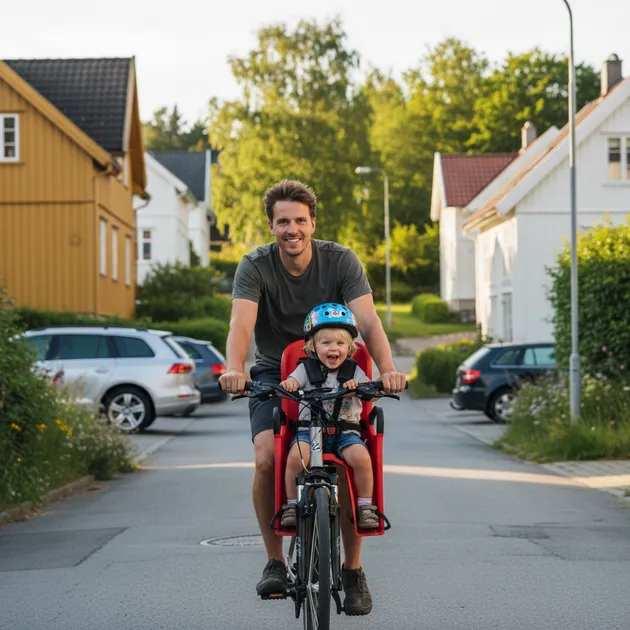
Children riding in a bike seat or bike trailer should also wear a helmet. That means your baby needs a helmet from the moment they sit in a bike seat, typically from around 9–10 months.
Remember: Parents are responsible for ensuring their children wear helmets. Always check local laws, as helmet requirements vary by state and country.
When does your child need their first helmet?
Most children need their first bike helmet in one of these situations:
- 9–12 months: Child sits in a rear bike seat on your bicycle
- 1–2 years: Child rides in a bike trailer
- 18 months – 2 years: Child starts on a balance bike
- 2–3 years: Child starts on a scooter
Tip: Wait until your child actually needs the helmet. Buying too early means it may not fit when needed. Head circumference grows rapidly in the first year.
How to measure your child's head
To find the right size you need your child's head circumference. Here's how to measure:
- Use a soft measuring tape (a tailor's measuring tape)
- Measure around the widest point of the head, just above the ears and eyebrows
- Measure 2–3 times to ensure an accurate result
- Add 0.5 cm for growth margin
No measuring tape? Use a piece of string, mark the length, then measure it against a ruler.
Size guide by age
This table is a starting point, but always measure the head, children vary greatly in size.
| Age | Typical head circumference | Helmet size |
|---|---|---|
| 6–12 months | 44–47 cm (17–18.5 in) | XXS / 44–48 |
| 1–2 years | 47–49 cm (18.5–19.5 in) | XS / 46–51 |
| 2–4 years | 49–52 cm (19.5–20.5 in) | S / 49–53 |
| 4–8 years | 52–54 cm (20.5–21 in) | S-M / 52–56 |
| 8–12 years | 54–58 cm (21–23 in) | M / 54–58 |
Most children's helmets have a dial adjustment at the back that allows the helmet to be tightened within a 3–4 cm range. Choose a size where your child's head falls in the lower part of the size range, leaving room for growth.
Key features to look for
MIPS technology
MIPS (Multi-directional Impact Protection System) is an extra protective layer that reduces rotational forces during angled impacts. The brain is especially vulnerable to rotation, and MIPS offers better protection than standard helmets.
MIPS helmets typically cost $15–30 more, but are worth the investment for your child's safety.
Ventilation
Children get warm quickly. Good ventilation with multiple air vents keeps your child comfortable and more willing to wear the helmet. Look for at least 6–8 ventilation openings.
Dial adjustment
A dial at the back lets you fine-tune the fit without changing helmets. It also allows the helmet to grow with your child for 1–2 seasons.
Visor
A small brim at the front protects against sun and rain. Not all helmets have this, but it's a nice bonus, especially for bike seats where the child can't move around.
Magnetic buckle
Some helmets have a magnetic buckle instead of a traditional clip. These are easier to open and close with one hand, and there's no risk of pinching your child's skin under the chin.
How to check the fit
A helmet that sits incorrectly doesn't protect properly. Use this checklist:
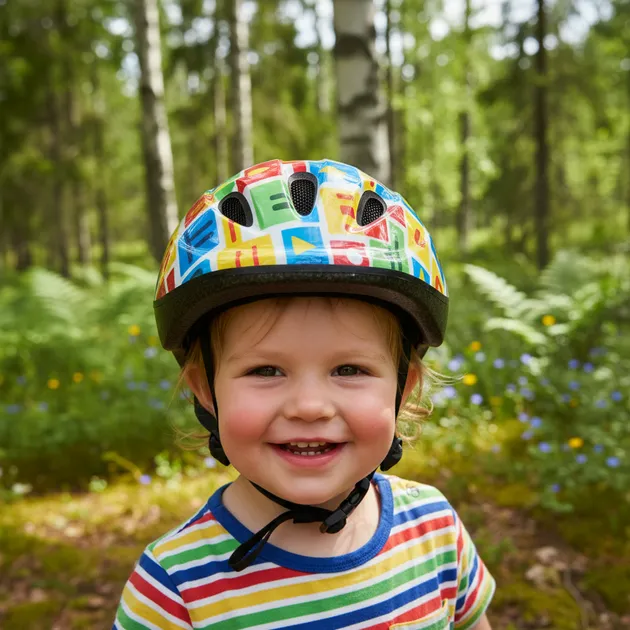
Two-finger rule: The helmet should sit two fingers above the eyebrows. Not further back, that leaves the forehead unprotected.
V-shape at the ears: The straps should form a V-shape just below each ear. Tighten the side straps until the V sits snugly around the ear.
One finger under the chin: The chin strap should be tight enough that only one finger fits between the strap and chin. Your child should be able to open their mouth, but the helmet should not come off without opening the buckle.
Rock test: Gently push the helmet forward and backward. It should not tilt more than 2 cm in any direction. Adjust the straps if it slides.
Shake test: Ask your child to shake their head. The helmet should follow the head without bouncing or shifting.
Never use a helmet that is too large. A loose helmet can slide off in an accident or twist so that it covers the eyes. An oversized helmet gives a false sense of security.
When should you replace the helmet?
A bike helmet doesn't last forever. Replace the helmet in these situations:
After a fall or crash: Even if the helmet looks undamaged, the internal structure may be compromised. EPS foam (which absorbs impact) compresses permanently. A helmet that has taken a hard blow should always be replaced.
Every 3–5 years: UV radiation and sweat break down the materials over time. Most manufacturers recommend replacement after 3–5 years, even without visible damage.
When it becomes too small: If the dial is at maximum and the helmet still feels tight, it's time for the next size.
Visible damage: Cracks, dents, or worn straps mean the helmet no longer provides full protection.
Popular brands
Abus (German)
Abus makes helmets with great fit and MIPS technology. The Smiley 3.0 model is popular for toddlers with fun colors and good ventilation.
Price: $40–75
Nutcase (American)
Known for playful designs with patterns and colors kids love. The Little Nutty series (ages 2–6) has MIPS and magnetic buckle.
Price: $60–95
Uvex (German)
Solid German quality with good ventilation. The Kid 3 series fits children aged 3–10 and comes in many colors.
Price: $35–65
Giro (American)
The Giro Scamp is one of the most popular children's helmets globally. Lightweight, good ventilation, and MIPS version available.
Price: $50–85
Woom (Austrian)
Woom makes bikes and helmets specifically designed for children. Very lightweight with excellent fit for small heads.
Price: $60–85
Money-saving tip: Helmets should NOT be bought secondhand unless you know the full history. You can't tell if the helmet has been in an accident. A helmet is the one thing you should buy new.
Helmets for different activities
Your child's helmet needs may vary depending on the activity:
Bike and scooter: Standard bike helmet with good ventilation. Most children's helmets cover this.
Sledding: A bike helmet works fine. It protects against impacts with the ground and collisions with other children.
Skiing and snowboarding: Your child needs a dedicated ski helmet with ear covers and room for ski goggles. A bike helmet is not suitable for skiing.
Roller skates and skateboard: A standard bike helmet works, but for children who focus on skateboarding, a skate helmet (which covers more of the back of the head) may be better.
How to get your child to wear a helmet
Many parents struggle with children who refuse to wear a helmet. Here are some tips:
Start early: Children who wear helmets from their very first ride rarely protest. It becomes a natural part of the activity.
Let your child choose: Take your child to the store and let them pick the color and design. A child who loves their helmet wears it more willingly.
Lead by example: Always wear your helmet yourself. Children copy their parents, if you take yours off, your child will do the same.
Make it a rule: No helmet, no ride. Be consistent from day one. The discussion stops quickly when the rule is clear.
Avoid discomfort: A helmet that pinches, gets too hot, or sits crookedly is uncomfortable. Ensure the right fit and adjust the straps as needed.
Checklist: bike helmet for your child
- Measure your child's head circumference
- Choose size based on the measurement (not age)
- Check that the helmet has CPSC or CE certification
- Consider MIPS for extra protection
- Test fit with the two-finger rule and V-check
- Buy reflective stickers for visibility in the dark
See also
- Balance bike guide for toddlers
- Childproofing your home: room by room guide
- Gifts for 1-year-olds
- Gifts for 2-year-olds
Frequently asked questions
What size bike helmet does my child need?
Measure your child's head circumference with a soft measuring tape just above the ears and eyebrows. Most 1–2-year-olds have a head circumference of 47–49 cm (size XS), while 2–4-year-olds are typically 49–52 cm (size S). Always choose based on measurement, not age, as children vary greatly.
When does my baby need a bike helmet?
Your baby needs a helmet from the moment they sit in a bike seat or bike trailer, usually from 9–12 months of age. Helmet use is strongly recommended by the AAP for all children every time they ride. This also applies to balance bikes, scooters, and sledding.
Can you buy a secondhand bike helmet for children?
It is not recommended to buy a secondhand bike helmet unless you know the history well. You cannot see if the helmet has been in an accident, the EPS foam inside may be compressed without any visible external damage. A helmet that has taken a blow does not provide full protection. A helmet is something you should buy new.
How often should you replace a bike helmet?
Replace the helmet every 3–5 years even without visible damage, as UV radiation and sweat break down the materials. Always replace after an accident or hard fall, and when the helmet becomes too small. Most children need a new helmet every 1–2 years as their head grows.
What is MIPS and is it worth it?
MIPS (Multi-directional Impact Protection System) is an extra layer that reduces rotational forces during angled impacts to the head. Research shows that MIPS provides better protection against concussion. MIPS helmets cost somewhat more than standard helmets and are absolutely worth the investment for children.
Sources
- AAP. Child safety and injury prevention
- CDC. Child injury prevention resources
- WHO. Reducing child mortality globally
🔧 Helpful Tools
- All Baby Tools. Browse all free tools for pregnancy and baby care
📖 Related Articles
- Bed Rails for Toddlers: Safe Transition to a Big Kid Bed. Everything you need to know about toddler bed rails. Types, safety standards, installation tips, and advice for the transition from crib to big bed.
- Bike Seat for Kids - Safe Cycling with Little Ones. Complete guide to bike seats for children. Front or rear, safety tips, and best brands. Everything you need for safe cycling with your child.
- Kids' Bikes: Guide to the Right Size and Type. Everything about bikes for children. Size by age and height, balance bike vs pedal bike, safety, and road rules. Here's how to choose the right one.