Cycling with your child is one of the best ways to explore your neighborhood. But it requires the right equipment and a little knowledge. A good bike seat provides safe transport, fresh air, and quality time, whether you're cycling to daycare or along the river.
This guide covers everything you need to know about bike seats for children: front or rear, safety, installation, and the best brands.
When can my child sit in a bike seat?
Your child can start using a bike seat when they can sit up steadily on their own without support. For most children, this is around 9–12 months of age.
The reason is simple: your child needs to hold their head upright and stable, especially with a helmet on. A child who can't sit firmly risks falling sideways and injuring their neck.
Do not use a bike seat before your child can sit completely stable without support. Even with good padding, vibrations and sudden movements can be too much for a small body without full head control.
Age guidelines
| Age | Recommendation |
|---|---|
| 0–9 months | Too early for a bike seat. Use a bike trailer with a reclining infant insert |
| 9–12 months | Can start in a front bike seat if the child sits firmly |
| 1–3 years | Front bike seat (up to 33 lbs / 15 kg) |
| 1–6 years | Rear bike seat (up to 48 lbs / 22 kg) |
Front or rear bike seat?
The big choice is whether to have your child in front of you or behind you. Both have clear advantages and disadvantages.
Front bike seat
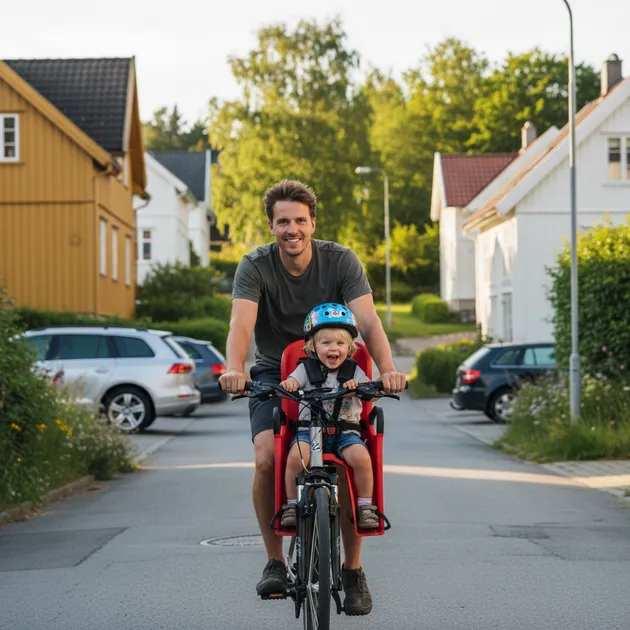
The seat mounts between the handlebars and you, either on the stem or on the frame.
Advantages:
- You can see your child at all times
- Your child has a good view forward
- Your child feels safer close to you
- Easier to talk to your child along the way
Disadvantages:
- Lower weight limit (max 33 lbs / 15 kg)
- Can affect steering, especially with heavier children
- Less space for you, can be cramped at the knees
- Child is more exposed to wind and weather
Front bike seats work best for younger children between 9 months and 2–3 years (depending on weight).
Rear bike seat
The seat mounts behind on the bike, either on the rack or on the seat frame.
Advantages:
- Higher weight limit (up to 48 lbs / 22 kg)
- Less effect on steering
- Plenty of space for you
- Child sits sheltered behind you from the wind
Disadvantages:
- You can't see your child (use a mirror)
- Child may feel more alone
- Slightly harder to communicate
- The bike becomes back-heavy, be careful when parking
Many families start with a front seat when their child is small and switch to a rear seat when the child approaches the 33 lb (15 kg) weight limit. This gives the best of both worlds.
Weight limits and safety
Weight limits are absolute and should never be exceeded. They are set for safety reasons, overloading can cause the mount to fail or the bike to become unstable.
| Type | Minimum | Maximum |
|---|---|---|
| Front (handlebar-mounted) | ~20 lbs (9 kg) | 33 lbs (15 kg) |
| Rear (frame/rack) | ~20 lbs (9 kg) | 48 lbs (22 kg) |
Harness
- 3-point harness, minimum requirement, keeps your child in place
- 5-point harness, safest, with straps over both shoulders and between the legs. Recommended for younger children
- Harness should be snug, you should just be able to slip one finger between the strap and your child's chest
Foot protection
All good bike seats have footrests with straps that keep feet in place. This is critical to prevent your child from putting their feet into the spokes.
Footrests are not optional. Children who get a foot caught in the spokes can suffer serious injuries. Check that the strap is secure before every ride.
Mounting systems
How the seat attaches to the bike varies. It's important to choose a system that fits your bike.
Frame-mounted (center)
The seat clamps onto the bike frame. Works with most bike types, but requires a tube with the right diameter (usually 28–40 mm).
The advantage is easy mounting and dismounting. The disadvantage is that it doesn't fit all frame shapes, especially carbon or unusual geometries.
Rack-mounted (rear)
The seat attaches to a rear rack. Requires a sturdy rack with the right capacity (check that the rack can handle the weight of the seat plus child).
This solution provides a low center of gravity and stable ride. The disadvantage is that you lose the rack for other uses.
Handlebar-mounted (front)
Front seats mount either on the stem or on the handlebar tube. Some models have their own quick-release mounting system.
Always check that the mount is compatible with your bike. Many e-bikes and mountain bikes have special geometry that requires an adapted mount.
Top brands
Hamax (Norway)
Norwegian brand that is one of the world's best-selling bike seat manufacturers. Hamax has extensive experience and offers models for both front and rear.
Popular models:
- Hamax Observer, front seat, up to 33 lbs, adjustable
- Hamax Caress, rear seat with adjustable backrest and footrests
- Hamax Zenith, rear seat, great value
Price range: $100–300
Thule (Sweden)
Known for quality products for active families. Thule bike seats are known for great padding and smart design.
Popular models:
- Thule Yepp 2 Mini, front seat, compact and lightweight
- Thule Yepp 2 Maxi, rear seat with rubber padding that's easy to clean
- Thule RideAlong, rear seat with adjustable recline
Price range: $150–350
Bobike (Netherlands)
Dutch brand with a wide range in many colors. Known for good ergonomics and attractive design.
Popular models:
- Bobike One Mini, front seat, minimalist design
- Bobike Go Maxi, rear seat with good ventilation
Price range: $110–240
Polisport (Portugal)
Affordable option with good quality. Polisport makes seats that meet all European safety standards at a lower price.
Price range: $75–170
Laws and regulations
In many countries and US states, children riding in bike seats must wear helmets. Always check the laws in your area. Regardless of what the law requires, the AAP recommends helmets for all children every time they ride.
Helmet choice for bike seats
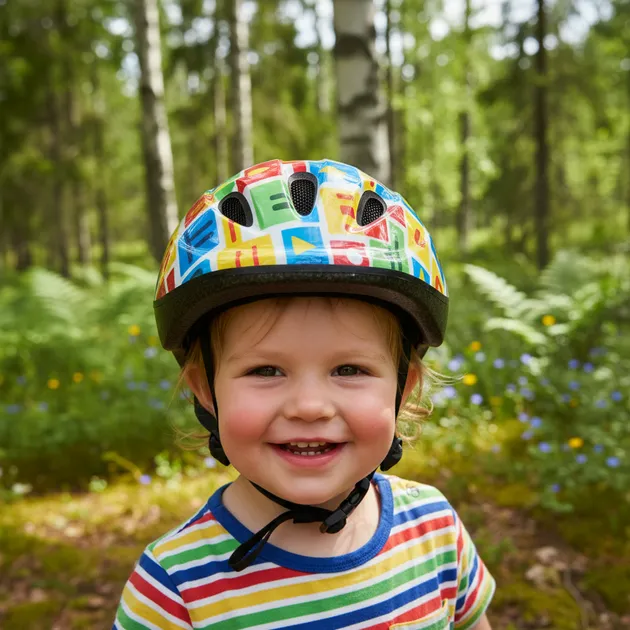
For children in bike seats, helmet fit is especially important. Choose a helmet with a flat back that doesn't push the head forward, standard round helmets can press the child's head into an uncomfortable angle in the seat.
Number of passengers
Your bike must be suited for the number of people on it. That means you need an approved bike seat, you cannot simply place your child on the rack.
Lights and reflectors
Standard cycling rules apply: white light at the front, red light at the rear, and reflectors. Add extra reflectors to the back of the bike seat.
Attach a reflective vest or reflective bands to your child in addition to reflectors on the bike. In low light, visibility is essential. Also check that your child is dressed appropriately for the temperature.
Safety tips for cycling with children
Before the ride
- Check the seat, are all mounting points tight? Is the harness intact?
- Check the helmet, does it fit well? Can your child move their head freely?
- Test stability, put your child in the seat while the bike is stationary and check that the balance feels good
- Plan your route, choose safe bike paths, avoid busy roads and steep hills
During the ride
- Keep a low speed, especially in turns and downhill
- Avoid sudden braking, brake smoothly and early
- Talk to your child, describe what you see, sing songs. A happy child sits more calmly
- Take breaks, children get colder and stiffer faster than adults because they sit still
After the ride
- Lift your child out before parking, a bike with a child in the seat tips easily
- Use a kickstand, a good double kickstand makes the bike more stable
- Don't leave your child in the seat unattended, even parked, the bike can tip over
Price guide
| Category | Price range | Examples |
|---|---|---|
| Budget | $75–120 | Polisport, basic Hamax |
| Mid-range | $120–220 | Hamax Caress, Bobike Go |
| Premium | $220–350 | Thule Yepp 2, Hamax Observer |
Used bike seats can be a good option, but check carefully that:
- No visible cracks in the plastic
- Harness and straps are intact
- The mounting mechanism works flawlessly
- The seat has not been in an accident
Bike seat vs. bike trailer
Not sure whether you need a bike seat or a trailer? Here's a quick comparison:
| Feature | Bike seat | Bike trailer |
|---|---|---|
| From age | ~9 months | From birth (with infant insert) |
| Capacity | 1 child | 1–2 children |
| Price | $75–350 | $350–1,500+ |
| Storage | Takes little space | Takes a lot of space |
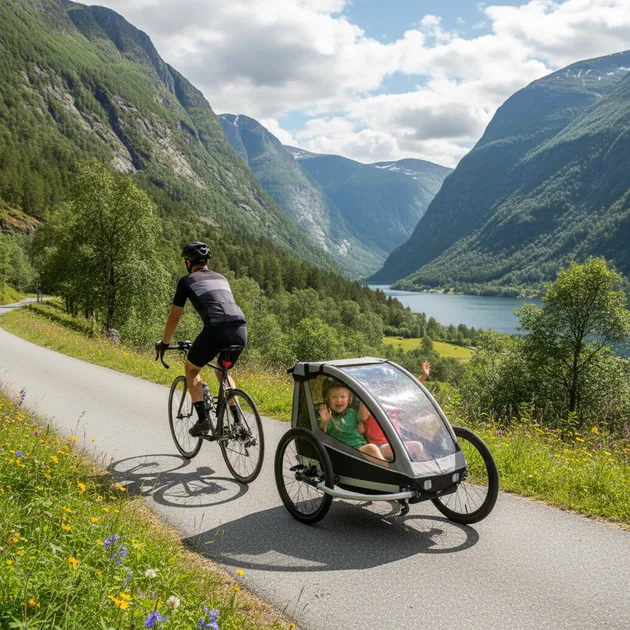
| Versatility | Cycling only | Cycling + jogging + walking |
| Safety | Good with helmet and harness | Very good (child is enclosed) |
| Rain/wind | Child is exposed | Rain cover protects |
For most families, a bike seat is the practical choice for everyday use. A bike trailer is more versatile, but requires a larger investment and storage space.
See also
- Car seat safety for children
- Childproofing your home
- Dressing your baby by season
- Stroller guide, how to choose the right one
Frequently asked questions
When can my baby start in a bike seat?
Your child can sit in a bike seat from when they can sit completely stable without support, usually around 9–12 months. The child must have full head control, especially with a helmet on. For younger babies, a bike trailer with a reclining infant insert is the safe alternative.
Is a front or rear bike seat safer?
Both are safe when used correctly. Rear seats have some safety advantages, the child is protected by your body in a frontal collision, and the bike is more stable with the weight at the back. But the front seat lets you keep an eye on your child at all times. Choose based on your child's age and weight.
Does my child need a bike helmet in a bike seat?
The AAP strongly recommends helmet use for all children every time they ride, including in bike seats. Helmets reduce the risk of serious head injury by up to 60%. Choose a helmet with a flat back that fits well with the seat.
Can I use a bike seat on an e-bike?
Yes, a bike seat can be used on an e-bike. Check that the mounting system is compatible with the e-bike's frame or rack. Be extra mindful of speed, it's easy to reach higher speeds with a motor, which increases the risk in a fall.
How long can my child sit in a bike seat?
There is no fixed rule, but most children tolerate 30–45 minutes well. Longer rides require breaks where the child can stretch. Children get colder than adults because they sit still, so dress your child warmly and take extra breaks in cool weather.
Sources
- AAP. Child safety and injury prevention
- CDC. Child injury prevention resources
- WHO. Reducing child mortality globally
🔧 Helpful Tools
- All Baby Tools. Browse all free tools for pregnancy and baby care
📖 Related Articles
- Bike Helmet for Kids - Safe Helmet in the Right Size. Complete guide to bike helmets for children. Size, fit, safety and best brands. How to choose the right helmet for your child.
- Bike Trailer for Kids - The Ultimate Guide. Everything about bike trailers for children. Types, safety, best brands, and what to look for. Complete guide to child bike trailers.