Your child has started climbing out of the crib, and it's time for a big kid bed. But the thought of them rolling out in the middle of the night keeps you up.
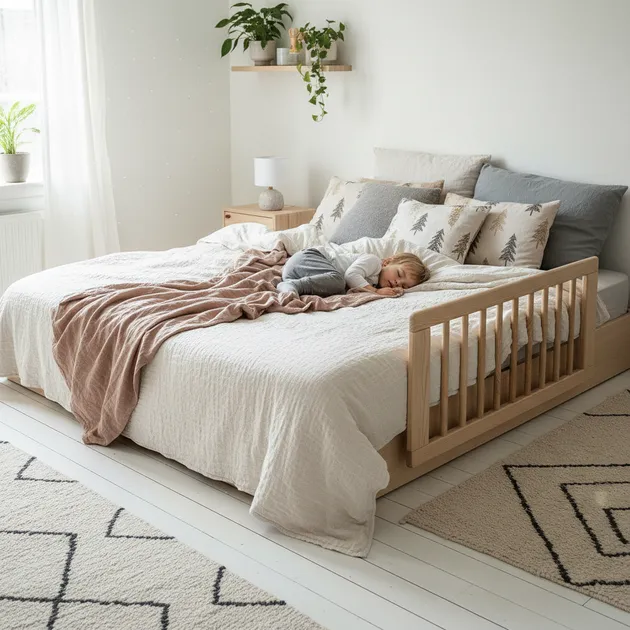
A bed rail gives you peace of mind during the transition. It prevents falls without turning the bed into a cage, and most children only need it for a few months.
Here's everything you need to know about bed rails, from which type works best, to safety standards and practical installation tips.
When Does Your Child Need a Bed Rail?
Most children transition from a crib to a big bed between 18 months and 3 years. Signs your child is ready:
- Your child is climbing out of the crib
- Your child has outgrown the crib (over 35 inches tall)
- Your child shows interest in a "big kid bed"
- The family needs the crib for a new sibling
During the first weeks and months after the transition, a bed rail is a smart idea. Children move around a lot in their sleep, and a bed rail prevents them from falling out and getting hurt.
Tip: Start the transition to a big bed during a calm period. Avoid switching beds at the same time as starting daycare, welcoming a new sibling, or other major changes.
Types of Bed Rails
There are three main types, each with their own advantages.
Folding Bed Rail
The most common type. It attaches with a frame that slides under the mattress and can be folded down when making the bed. Fits most beds with a width of 27 to 60 inches.
Advantages:
- Easy to fold down during the day
- Child can climb in and out independently
- Easy to pack for travel
- Fits various bed sizes
Fixed Bed Rail (Slat Guard)
A permanent solution that screws into the bed frame or wall. Provides solid protection and stays in place even with an active child.
Advantages:
- Extra stable and sturdy
- Cannot tip or shift
- Works well for children who move around a lot
Foam Bumper (Bed Bumper)
A soft foam bumper that slides under the fitted sheet along the edge of the bed. Creates a gentle barrier that prevents the child from rolling out.
Advantages:
- No installation required
- Completely silent
- Easy to move between beds
- Most affordable option
Safety Standards for Bed Rails
ASTM F1427. U.S. Safety Standard
All bed rails sold in the U.S. should meet ASTM International standard F1427. The standard sets requirements for:
- Height: At least 5 inches above the top of the mattress
- Gap width: No gaps larger than 2.4 inches between slats (prevents head or limb entrapment)
- Stability: Must withstand load without tipping
- Materials: Non-toxic and flame-resistant
In addition to ASTM standards, look for CPSC (Consumer Product Safety Commission) compliance when purchasing.
Safety: Bed rails are not recommended for children under 18 months. For infants, a crib with an approved mattress is the safest option. Learn more in our guide to safe sleep for babies.
Installation Checklist
Regardless of which type of bed rail you choose, verify the following:
- No gap between the bed rail and mattress, a child can become entrapped
- The bed rail is stable, shake it gently to test
- Correct height above the mattress, the child should not be able to roll over the top
- Placement, cover at least two-thirds of the bed's length
Bed Rails for Different Bed Sizes
Twin Bed Rail
A standard twin bed is 38 x 75 inches. Choose a rail that is 40–48 inches long, covering the upper portion of the bed where your child's head rests.
Full / Double Bed Rail
For wider beds, you will need a rail designed for full or double mattresses, or two shorter rails, one on each side.
Travel Bed Rail
Available in compact, foldable versions that fit in a suitcase. Great for hotel stays or visits to grandparents.
How to Install a Bed Rail Correctly
Folding Model
- Partially pull the mattress off the bed
- Slide the support board under the mattress, it should extend at least 12 inches in
- Secure any strap under the mattress or around the bed frame
- Make sure the rail stands straight and does not lean
- Push the rail in different directions to test stability
Fixed Model
- Position the rail along the edge of the bed
- Mark the screw holes
- Drill and secure with the included screws
- Test that it is firmly in place
Shopping tip: Many retailers offer free returns on bed rails. Consider ordering two different models, testing installation at home, and returning the one that does not fit.
When Can You Remove the Bed Rail?
Most children can manage without a bed rail from age 3–4. Signs your child is ready:
- Your child lies still in bed and rarely rolls toward the edge
- Your child can get up to use the bathroom at night without falling
- Your child asks to have the bed rail removed
Try folding the rail down at night for a few weeks first. If your child falls asleep without problems and does not fall out, you can remove it completely.
Use a Sleep Tracker to monitor sleep patterns during the transition. You will quickly see if your child is sleeping restlessly or waking more often after the rail is gone.
Tips for a Smooth Transition to a Big Bed
The transition from a crib is about more than just a bed rail. Here are some tips to make it easier:
Create a Safe Sleep Environment
- Place the bed with one long side against the wall
- Bed rail on the open side
- A soft rug or mat on the floor beside the bed
- Remove sharp corners and heavy objects nearby
Read more about sleep environment for kids for additional tips.
Build Consistent Routines
A predictable bedtime routine creates a sense of safety at bedtime. Bath, book, and song in the same order helps your child wind down and accept the new bed.
Our guide to bedtime routines has concrete suggestions that work.
Involve Your Child
Let your child choose their bedding and stuffed animal for the new bed. Give them ownership of the transition, it boosts motivation and reduces resistance.
Be Patient
Some children adjust in a few days, others need weeks. It is normal to have setbacks where the child wants to go back to the crib. Keep routines stable and praise your child for sleeping in the big bed.
Track sleep: Use the Babysential Sleep Tracker to see how the transition affects nighttime sleep. Log wake-ups and total sleep time, you will see whether your child needs more time to adjust.
Frequently Asked Questions
Can a bed rail be used on any type of bed?
Most folding bed rails fit beds with an interior width of 27 to 60 inches. Always check the minimum and maximum mattress width in the product description. For beds with an unusual frame (low profile, curved, or without a side edge), fixed installation may be necessary.
Is a bed rail safe for infants?
No. Bed rails are designed for children over 18 months who have transitioned to a big bed. For infants, the AAP recommends a crib with a firm mattress and no loose objects. Read our safe sleep guide.
What should I do if my child climbs over the bed rail?
If your child climbs over, the rail is either too low or your child is old enough to manage without one. Try lowering the mattress or consider removing the rail and placing a soft mat on the floor beside the bed instead.
Can I use a bed rail on one side and the wall on the other?
Yes, that is the most common solution. Place the bed with one long side against the wall and the bed rail on the open side. Make sure there is no gap between the mattress and the wall.
How long does a child need a bed rail?
Most children use a bed rail for 6–18 months after transitioning to a big bed. Some children need it longer, others manage after a few weeks. Remove it gradually once your child is sleeping stably.
Read More
- Transitioning to a Big Kid Bed
- Sleep Environment for Kids
- Safe Sleep for Babies
- Bedtime Routines That Work
- Sleep Tracker
- Parent Checklists
Sources
- ASTM International. "ASTM F1427. Standard Consumer Safety Specification for Portable Bed Rails." astm.org
- American Academy of Pediatrics (AAP). "Safe Sleep." healthychildren.org
- U.S. Consumer Product Safety Commission (CPSC). "Portable Bed Rails." cpsc.gov
Last updated: March 2026
🔧 Helpful Tools
- All Baby Tools. Browse all free tools for pregnancy and baby care
📖 Related Articles
- Bike Helmet for Kids - Safe Helmet in the Right Size. Complete guide to bike helmets for children. Size, fit, safety and best brands. How to choose the right helmet for your child.
- Kids' Bikes: Guide to the Right Size and Type. Everything about bikes for children. Size by age and height, balance bike vs pedal bike, safety, and road rules. Here's how to choose the right one.