Your baby changes every single week. What's today a little one who only sleeps and eats will in a few months be an active little person crawling around and saying their first words.
Baby development in the first year is rapid and remarkable. Here's a complete overview of what you can expect month by month, from newborn to one year old. Everything is based on pediatric guidelines from the AAP and WHO.
All children develop at their own pace. The tables below show averages, it's completely normal to be a little ahead or behind. Talk to your pediatrician if you're concerned.
Baby Development: The First Months (0-3 Months)
The first three months are an intense period where your baby adjusts to life outside the womb. The senses awaken, reflexes develop, and the first social smiles appear.
Newborn (0-4 weeks)
The newborn baby is driven by reflexes. The sucking reflex and the Moro reflex (startle reflex) are the most visible. Your baby can see clearly at 8-12 inches, exactly the distance to your face when you're breastfeeding or bottle-feeding.
Your baby recognizes their parents' voices from birth. This is the result of having listened to your voices in the womb during the final weeks of pregnancy.
1 Month
Your baby begins to lift their head briefly during tummy time. Their eyes follow objects that move slowly in front of their face. Many babies are especially drawn to faces and high-contrast patterns.
2 Months
Now your baby lifts their head and chest during tummy time. The social smile arrives, and it's something entirely different from the reflex smile of the newborn period. Your baby makes cooing sounds and begins to "talk" back when you speak.
3 Months
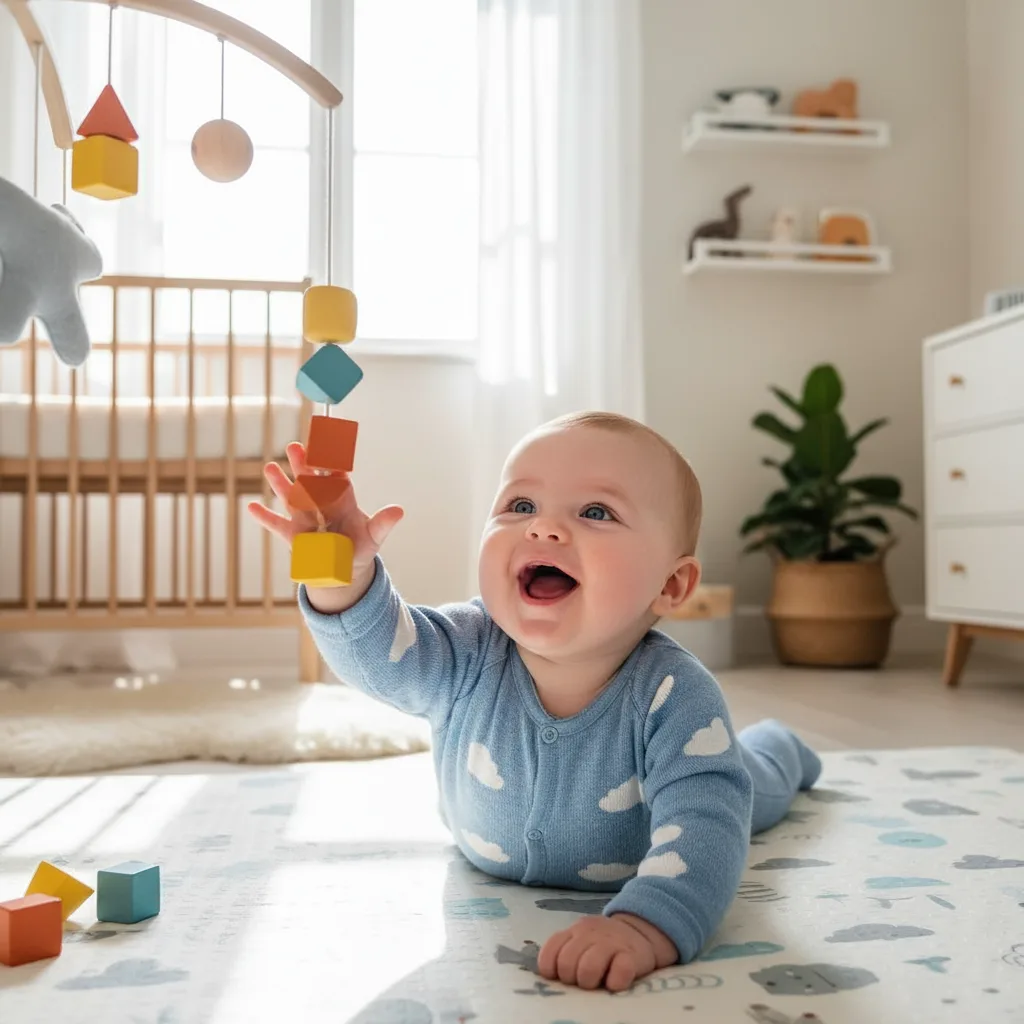
At three months, your baby holds their head up well during tummy time. They begin to reach for toys, laugh out loud for the first time, and have clear eye contact. Many parents find that the interaction really blossoms now.
| Age | Motor Skills | Communication | Senses |
|---|---|---|---|
| Newborn | Sucking reflex, Moro reflex | Crying | Sees 8-12 inches, recognizes voices |
| 1 month | Lifts head slightly during tummy time | Listens to voices | Follows with eyes |
| 2 months | Lifts head and chest | Social smile, cooing | Discovers own hands |
| 3 months | Holds head up well, reaches for toys | Laughs out loud, eye contact | Tracks objects 180° |
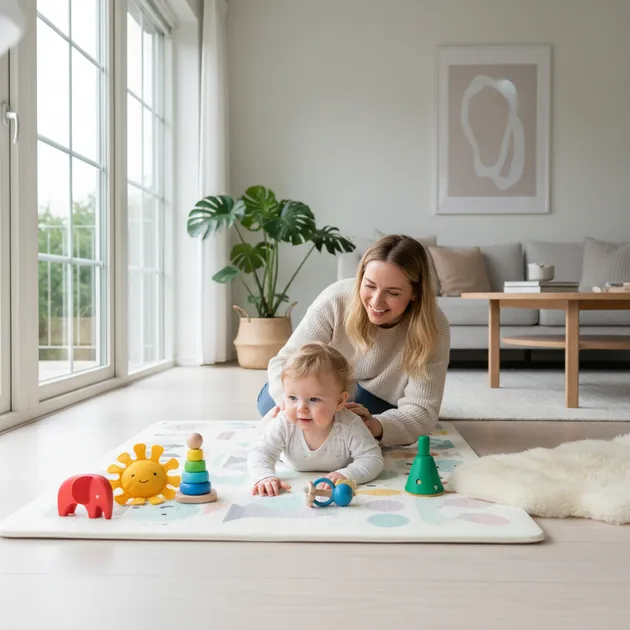
Regular tummy time is important for strengthening the muscles your baby needs for rolling, sitting, and crawling. Start gently with 1-2 minutes at a time from the first days at home.
Development 4-6 Months. New Skills
Between four and six months, there's a huge leap forward. Your baby becomes more active, curious, and social. Many start to roll, and hands become an important tool for exploration.
4 Months
Your baby rolls from tummy to back. Their grasp becomes more precise, and they reach for toys with purpose. Babbling with consonants begins, you may hear sounds like "ba," "da," and "ga."
5 Months
Now your baby rolls both ways and can sit with support. Everything is explored with the mouth, this is completely normal and an important part of sensory development. Your baby shows clear joy when they see familiar faces.
6 Months
An important turning point. Your baby sits unsteadily on their own. Stranger anxiety may begin to appear, your baby prefers familiar caregivers. Some babies start to say "mama" and "dada," though they don't always connect the words to the right person.
Six months is also the time to start solid foods. According to the WHO and AAP, babies are ready for solid food from this age.
| Age | Motor Skills | Communication | Social Development |
|---|---|---|---|
| 4 months | Rolls tummy to back, precise grasp | Babbles consonants | Laughs a lot, recognizes parents |
| 5 months | Rolls both ways, sits with support | Varies sounds | Explores everything with mouth |
| 6 months | Sits unsteadily alone | "mama/dada" sounds | Stranger anxiety begins |
At 6 months, the WHO and AAP recommend starting solid foods. Begin with iron-rich foods like cereal, meat, and vegetables.
Baby Development 7-9 Months. On the Move
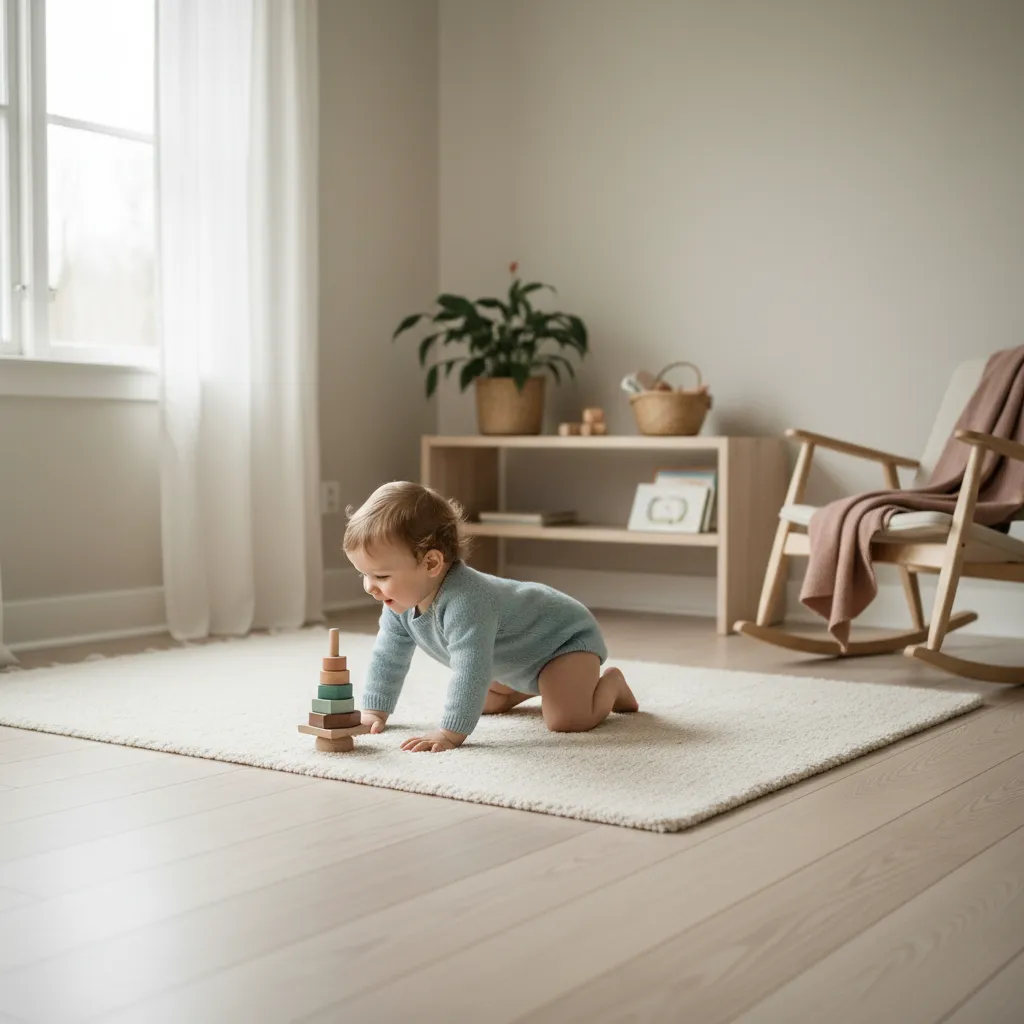
Now your baby starts moving for real. Crawling, pulling up, and the first attempts at standing, this period requires baby-proofing your home.
7 Months
Your baby sits independently without support. Many start by crawling backward first, this is perfectly normal. Your baby claps, waves, and loves playing peekaboo.
8 Months
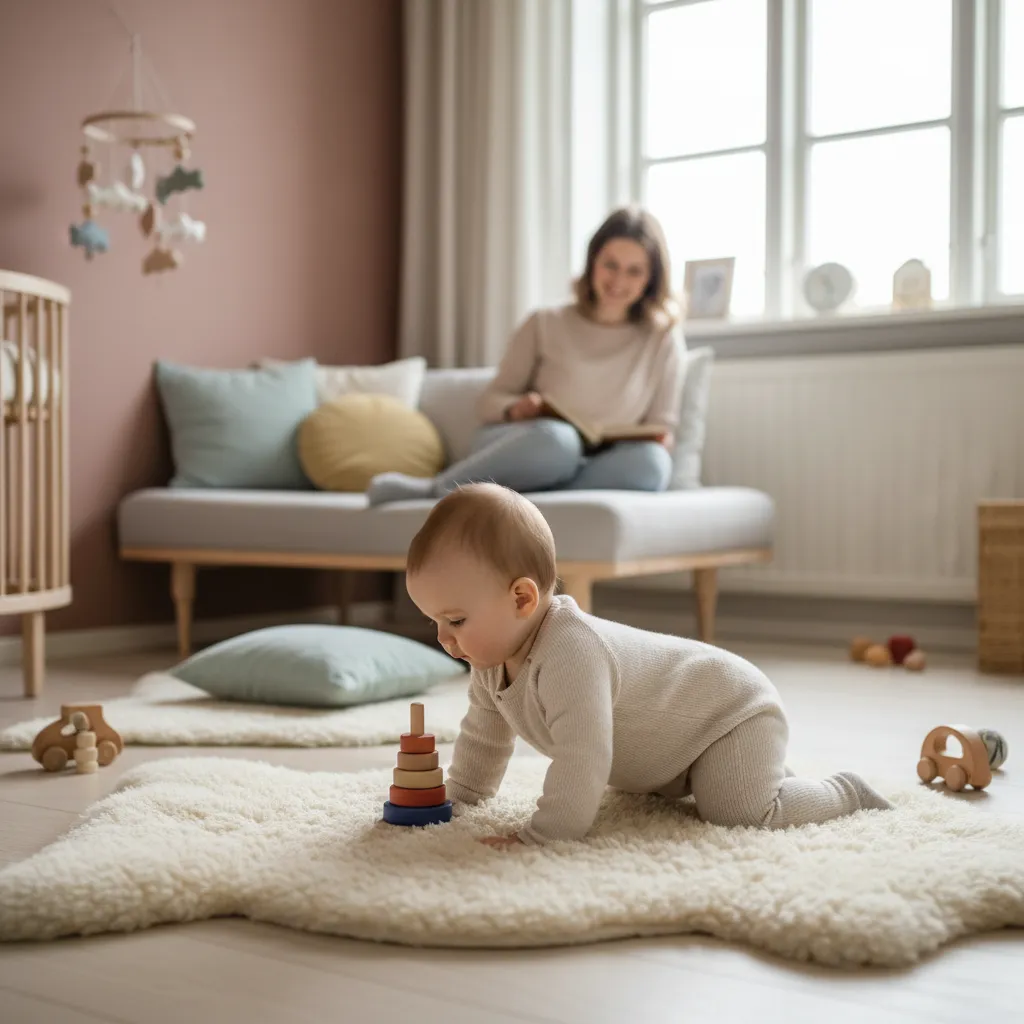
Forward crawling begins. Your baby pulls up to standing by holding onto furniture. The finger grasp becomes finer, your baby can pick up small items between thumb and index finger (pincer grasp).
Separation anxiety can be strong during this period. Your baby protests intensely when you leave the room.
9 Months
Your baby stands well with support and may begin cruising along furniture. The pincer grasp is established, and your baby may have 1-2 meaningful words. They understand simple instructions like "no" and "come here."
| Age | Motor Skills | Communication | Cognition |
|---|---|---|---|
| 7 months | Sits independently, crawls backward | Waves, claps | Finds hidden toys |
| 8 months | Crawls forward, pulls up | Points at things | Separation anxiety |
| 9 months | Stands with support, cruises along furniture | 1-2 words, understands "no" | Imitates actions |
When your baby starts crawling and pulling up, it's time to baby-proof your home. Cover outlets, lock cabinets with cleaning supplies, and install gates at stairs.
10-12 Months. Toward the First Steps
The last quarter of the first year is filled with big milestones. The first steps, the first words, and an increasingly independent little person.
10 Months
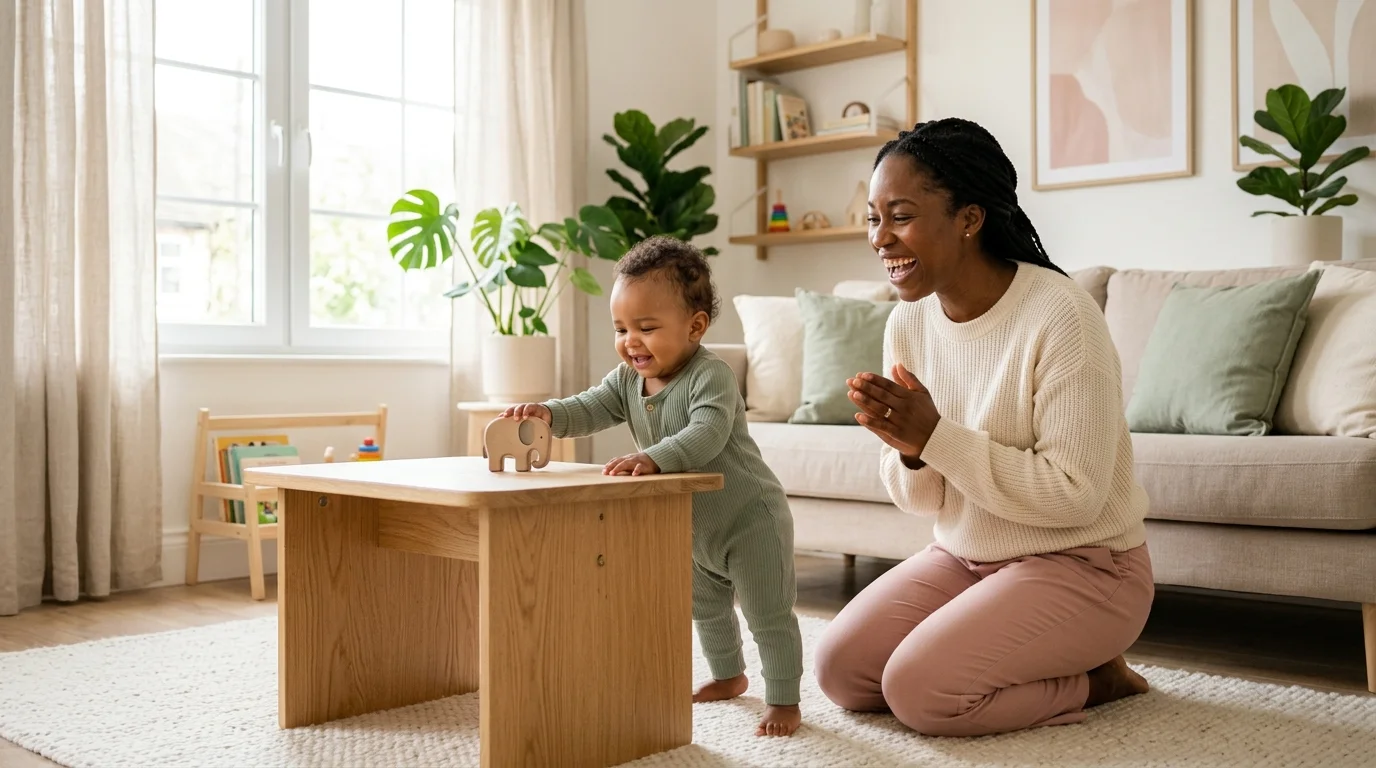
Your baby walks along furniture with growing confidence. They love imitating what you do, talking on the "phone," feeding a doll, sweeping with a broom. Problem-solving develops, your baby tries to reach things that are out of range by using other objects.
11 Months
Some babies take their first steps while holding a hand. Vocabulary grows to 2-3 meaningful words. Your baby understands more and more of what you say, even though they can't say it back.
12 Months
Congratulations, your baby is a one-year-old! Many children take their first independent steps around this age, but some wait until they're 15-18 months. Both are completely normal.
The one-year-old typically has 3-6 words and understands many more. They can follow simple instructions and point at things they want.
| Age | Motor Skills | Communication | Social Development |
|---|---|---|---|
| 10 months | Walks along furniture | Imitates sounds | Problem-solving |
| 11 months | First steps with support | 2-3 meaningful words | Shows will and preferences |
| 12 months | Walks alone (many) | 3-6 words, understands instructions | Gives and takes objects |
Motor Development. What's Normal?
Parents often compare their baby's development with other children. It's human, but it can create unnecessary worry.
According to pediatric guidelines, there's a wide range of normal in child development. Some babies never crawl, they go straight to walking. Others crawl for months before they stand up.
What matters more than timing:
- That your baby shows progress over time
- That they use both sides of their body
- That they're curious and explorative
- That they have contact and interaction with caregivers
Average Weight and Length
Here are average values for babies in the first year, based on WHO growth charts:
| Age | Average Weight | Average Length |
|---|---|---|
| Newborn | 7.7 lbs (3.5 kg) | 19.7 in (50 cm) |
| 3 months | 12.8 lbs (5.8 kg) | 24 in (61 cm) |
| 6 months | 17 lbs (7.7 kg) | 26.8 in (68 cm) |
| 9 months | 19.8 lbs (9.0 kg) | 28.7 in (73 cm) |
| 12 months | 21.8 lbs (9.9 kg) | 29.9 in (76 cm) |
Weight and length vary greatly between children. Your pediatrician follows your child's individual growth curve, what counts is that your child follows their own curve, not that they're at the average.
When Should You Contact Your Pediatrician?
All children develop differently, but some signs should be followed up. Contact your pediatrician if your child:
- Doesn't smile socially by 3 months
- Doesn't reach for objects by 5 months
- Doesn't sit without support by 9 months
- Doesn't make sounds or babble by 9 months
- Doesn't point or wave by 12 months
- Has no words by 15 months
- Loses skills they already had
These points are guidelines, not a diagnosis. Some children are late in one area but right on track in others. Your pediatrician does a comprehensive assessment and can refer for further evaluation if needed.
Remember that you know your child best. If your gut feeling says something isn't right, reach out. It's always better to check one time too many than one time too few.
How to Support Your Baby's Development
You don't need expensive toys or special programs. The best things you can do for your baby's development are:
- Talk and sing. Language development starts long before your baby says their first word
- Play on the floor. Tummy time, rolling, and crawling strengthen the whole body
- Read books. Even newborns enjoy hearing your voice and seeing pictures
- Respond to signals. When your baby babbles, talk back. This builds attachment and bonding
- Give time. Let your baby explore at their own pace, without too much help
Frequently Asked Questions
My baby isn't crawling, is that normal?
Yes. Many children never crawl in the traditional way. Some scoot on their bottom, roll forward, or go straight to walking. As long as your child finds a way to move, there's no cause for concern.
When do babies take their first steps?
Most children take their first independent steps between 9 and 18 months. The average is around 12 months, but late walking is not a sign of developmental delay.
Should I compare my baby with other children?
Every baby has their own timeline. It's more useful to follow your child's own progress than to compare with others. Your pediatrician monitors development at regular checkups and will let you know if anything needs further evaluation.
How do I know if my baby has good development?
Look for curiosity, interaction, and progress over time. A baby who is interested in their surroundings, makes eye contact, produces sounds, and gradually learns new things has good development.
What does it mean if my baby "loses" a skill?
Sometimes it can look like your baby is going backward in development. Often it's because they're concentrating on a new skill. But if your child clearly loses established skills, for example, stops babbling after having babbled a lot, you should contact your pediatrician.
Sources
🔧 Helpful Tools
- Baby Milestones Tracker. Track your baby's developmental milestones
- Development Leaps. Understand your baby's developmental leaps
- All Baby Tools. Browse all free tools for pregnancy and baby care
📖 Related Articles
- Baby at 3 Months: Development and Milestones. What can your baby do at 3 months? Complete guide to motor, social, and cognitive development with tips for stimulation.
- Baby Not Rolling at 6 Months: Should You Worry?. Baby not rolling at 6 months? Learn about normal variation, when to contact your pediatrician, and exercises that encourage rolling.
- Baby Not Sitting at 9 Months: What Is Normal?. Baby not sitting at 9 months? Learn about normal variation, the difference between supported and independent sitting, and when to seek advice.