Your child is screaming in the supermarket because you said no to a chocolate bar. Their whole body is trembling with rage, tears are streaming, and people are staring. You feel your own pulse rising. In this moment, your child needs you more than ever, not to be stopped, but to be helped through the storm.
Toddlers have adult-sized emotions in a body and brain that is not yet equipped to handle them. Understanding this changes everything.
Why Toddlers Have Big Feelings
The prefrontal cortex, the part of the brain that controls impulse regulation, planning, and emotional regulation, is not fully developed until the mid-twenties. In a two- or three-year-old child, this region has barely got started.
This means your child:
- Feels as intensely as you do, but lacks the tools to regulate those feelings
- Cannot "pull themselves together", this is biologically impossible at this age
- Responds with their whole body because words are not enough
- Becomes overwhelmed quickly by sensory input, tiredness, and hunger
A toddler's tantrum is not manipulation. It is a distress signal from an overloaded brain that does not yet have the tools to regulate intense emotions. Your child is not choosing to "behave badly", they are coping with something they cannot manage.
Emotional Development Step by Step
0–6 months: Basic needs
Babies communicate emotions through crying, smiling, and body language. Emotions centre on comfort and discomfort, hunger, tiredness, pain, safety.
6–12 months: New emotions emerge
Separation anxiety, stranger anxiety, and frustration at limitations appear. Babies begin to show anger when something is taken away, and joy at reunion.
12–24 months: The emotional explosion
A lot happens here. Your child experiences pride, shame, jealousy, and empathy for the first time. Emotions are intense, fast-moving, and hard to control. Tantrums typically begin in this period.
2–3 years: Words for feelings
Your child begins to name their emotions: "angry," "sad," "scared." Tantrums are still frequent, but the gaps between them grow longer. With support, children can begin to use simple strategies.
3–4 years: Early self-regulation
Children can sometimes pause and use strategies they have learned, take a deep breath, move away, ask for help. They still need a lot of adult support, but the first seeds of self-regulation are present.
Co-Regulation: Your Most Important Role
Before your child can regulate themselves, they need to be regulated by you. This is called co-regulation, and it is the foundation for all later emotional development.
What co-regulation looks like in practice
When your child is in an emotional storm, you act as an anchor. Your calm is contagious. Your presence tells your child's nervous system that they are safe.
How to co-regulate:
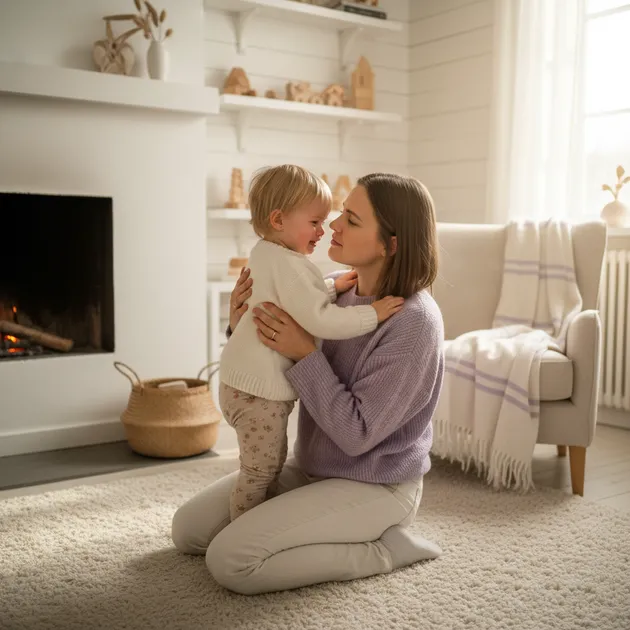
- Lower yourself physically. Get down to your child's level. Eye contact at the same height.
- Speak calmly. Lower your voice, speak slowly. Use few words.
- Name the emotion. "You're very angry right now." State it, don't ask.
- Validate. "I understand you wanted that chocolate. It's disappointing when you can't have what you want."
- Be available. Some children want to be held; others need space. Follow your child's signals.
- Wait. The emotion needs to run its course. Don't try to fix or distract too early.

You don't need to solve the emotion, just hold space for it. Your child's job is to feel. Your job is to keep them safe while they do.
Techniques That Help
Name feelings
Giving feelings a name is one of the most effective things you can do. Neuroscience research shows that labelling an emotion ("affect labelling") reduces activity in the amygdala, the brain's alarm centre.
Practical tips:
- Use simple feeling words: angry, sad, scared, happy, surprised, frustrated
- Show with your face: "See? Mummy is happy. My smile is going up."
- Use books: point at illustrations and talk about what the characters are feeling
- Make a feelings board with pictures of facial expressions your child can point to
Calm-down corner
A calm-down corner is a defined space in your home where your child can go when feelings get big. Not as punishment, as a tool.
What to include:
- Soft cushions or a small mat
- A "squeeze toy" or stress ball
- Books about feelings
- Optionally, a glitter jar (shake it and watch the glitter slowly settle)
Breathing exercises for little ones
Children from age 2–3 can learn simple breathing exercises:
- Flower breath: "Breathe in like you're smelling a flower. Breathe out like you're blowing a dandelion."
- Belly breath: Lay a small soft toy on your child's tummy. "Can you make the teddy ride up and down?"
- Slow breath: "Breathe out so slowly the candle flame only flickers."
Common Emotions and What Helps
Anger
Anger is a normal, healthy emotion. The problem is never the anger itself, it is what your child does with it.
Help your child find safe outlets:
- Stomping on the floor
- Hitting a pillow
- Tearing up paper
- Running a lap around the garden
- Shouting into a pillow
Frustration
Toddlers want to do more than they can. They picture what they want to build, but the blocks keep falling. They want to say something, but the words aren't there. Frustration is the driving force behind much "defiant" behaviour.
Help by:
- Breaking the task into smaller steps
- Offering just enough help, don't do it for them
- Acknowledging the effort: "You're really trying hard!"
Fear
Children's fears change with age. Fear of the dark, monsters under the bed, loud noises, all are common and developmentally normal.
- Take fears seriously, never say "there's nothing to be scared of"
- Show that you take your child seriously: "You're scared of the dark. Let's find a solution together."
- Give your child control: a torch, a nightlight, a "monster spray bottle" filled with water
Don't Dismiss Feelings
Well-meaning adults often say things that unintentionally dismiss a child's emotions:
| Instead of this | Try this |
|---|---|
| "Stop crying" | "It's okay to cry. I'm here." |
| "That's nothing to get angry about" | "You got angry. What happened?" |
| "Big kids don't cry" | "Everyone cries sometimes. Adults too." |
| "Pull yourself together" | "I'll help you through this." |
| "Look, a bird!" (distraction) | "You're upset right now. Would you like to sit in my lap?" |
Distraction works short-term but teaches nothing. Every time you help your child through a feeling instead of distracting from it, you are building their ability to handle emotions independently later on.
Books About Emotions for Children
Picture books are great tools for talking about feelings outside of intense moments:
- "When Sophie Gets Angry. Really, Really Angry" (Molly Bang), a classic about big feelings
- "The Color Monster" (Anna Llenas), explores emotions through colour
- "Grumpy Monkey" (Suzanne Lang), relatable story about not wanting to feel happy
- "The Invisible String" (Patrice Karst), about connection and separation feelings
Read the books when your child is calm and in a good mood. Pause and talk: "What do you think she feels right now? Have you ever felt like that?"
Frequently Asked Questions
How long do tantrums last?
A typical tantrum in a two-year-old lasts 1–3 minutes, even if it feels like forever. If tantrums consistently last more than 15–20 minutes or occur many times daily, it may be worth talking to your pediatrician.
Should I ignore tantrums?
No. "Ignore it and it will stop" is outdated advice. Your child needs to know you are there, even when emotions are big. You don't need to do anything active, just stay available. Say "I'm here when you're ready" and keep yourself close.
Can children learn emotion regulation too early?
You cannot start too early with naming feelings and co-regulating. But don't expect self-regulation to be in place before age 4–5 (and even then, only partially). Emotion regulation is a skill that develops throughout childhood.
Is it normal for my child to hit me when they're angry?
Sadly, yes, it is common behaviour between ages 1–3. Your child does not have enough impulse control to stop themselves. Calmly stop their hand, say "I won't let you hit. Hitting hurts," and help your child express their anger in a different way.

Summary
Your child has big feelings because their brain does not yet have the tools to regulate them. Your job is not to stop the feelings, but to help your child through them. Name, validate, be present. Over time, you are building your child's ability to handle emotions on their own, a skill that lasts a lifetime.
Further Reading
- Emotional Development in Children
- The Defiant Toddler. How to Get Through It
- Setting Limits for Toddlers
- Separation Anxiety in Babies
- Night Terrors in Children
Sources
- AAP. Emotional Development in Children
- CDC. Positive Parenting Tips
- Zero to Three. Social-Emotional Development
🔧 Helpful Tools
- Baby Milestones Tracker. Track your baby's developmental milestones
- Development Leaps. Understand your baby's developmental leaps
- All Baby Tools. Browse all free tools for pregnancy and baby care
📖 Related Articles
- Toddler Tantrums: Practical Tools for Handling Meltdowns. Practical tools for handling tantrums in toddlers. Learn about co-regulation, validating emotions, and what actually works in the moment.