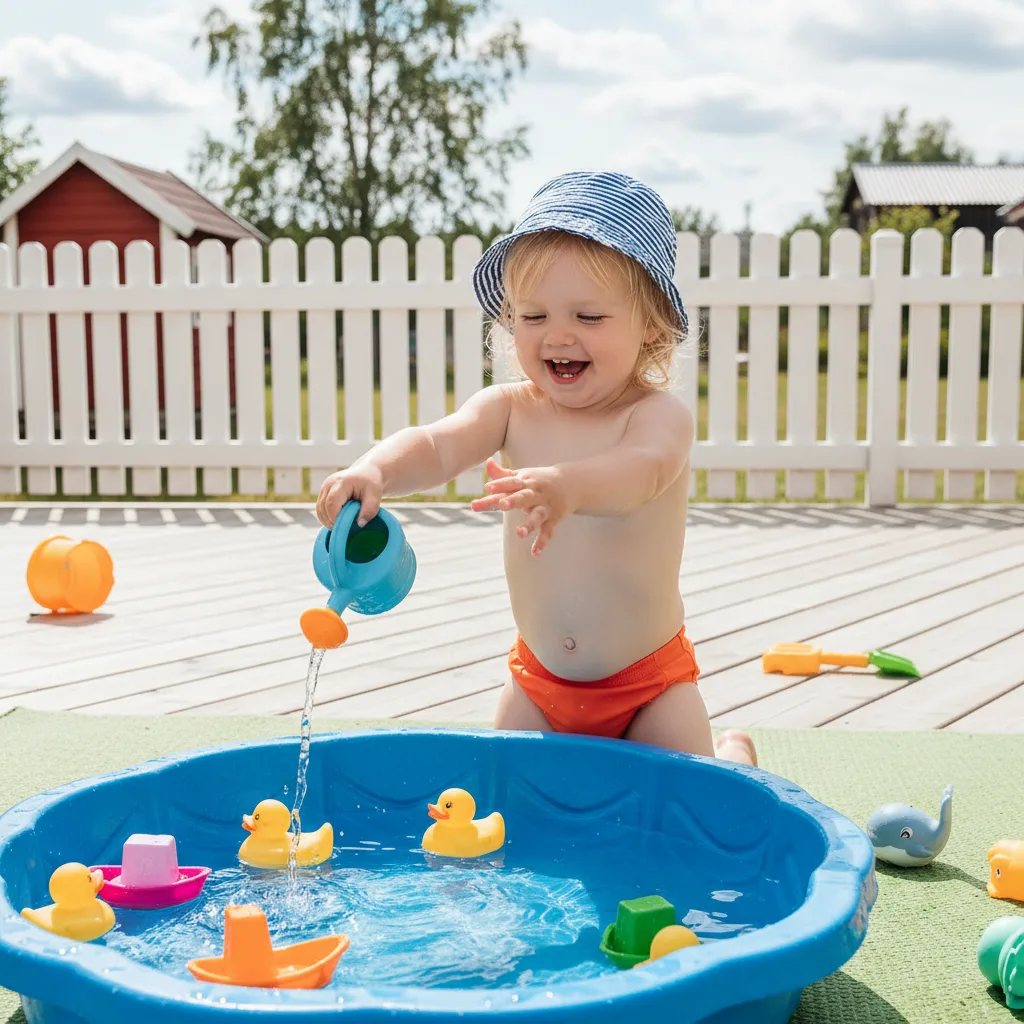
Few things fascinate a toddler quite like water. It flows, splashes, trickles, and changes shape. It's free, available everywhere, and provides hours of focused play.
Water play stimulates nearly all the senses at once. Your child feels the temperature, hears the splashing sounds, sees how the water moves, and experiences resistance when pushing things underwater. All of this builds brain connections at an incredible pace.
Here are 10 hands-on water activities you can do at home and outdoors, plus the safety rules you need.
Why Water Play Is So Good for Development
Water play is about much more than fun. Research on child development shows that sensory play strengthens multiple developmental areas at the same time.
Fine motor skills: Pouring from one cup to another, squeezing sponges, and picking up small objects from the water trains the precision grip.
Gross motor skills: Carrying water buckets, pouring from pitchers, and squirting with water guns exercises arms, hands, and coordination.
Language development: Water play offers rich vocabulary opportunities. Pour, scoop, drip, splash, float, sink, warm, cold, wet, dry. Talk to your child while you play together.
Math concepts: Concepts like full, empty, more, less, a lot, and a little become concrete and understandable.
Concentration: Many children who are otherwise restless can focus for a long time during water play. Water has a calming effect.
For sensory-sensitive children: Start with a small amount of water and let your child set the pace. Some children need time to become comfortable with wet hands. Never force it, let curiosity win.
5 Indoor Water Activities
1. Sensory Water Bin
Fill a large plastic bin with lukewarm water and add various objects:
- Cups and spoons in different sizes
- Sponges to squeeze
- Plastic animals
- Funnels and strainers
- Ping pong balls that float
Place a large towel under the bin. Let your child explore freely. Ask open-ended questions: "What happens if you push the sponge underwater?"
2. Color the Water
Drop a few drops of food coloring into cups of water. Give your child pipettes or teaspoons to mix colors.
- Yellow + blue = green
- Red + yellow = orange
- Red + blue = purple
Use white muffin tin cups or an ice cube tray as a palette. Children from about age 2 love this activity.
3. Pouring and Scooping
Set out cups, pitchers, funnels, and bowls in various sizes. Let your child pour water from one container to another. This activity trains concentration and fine motor skills, and is inspired by Montessori education.
Montessori tip: In Montessori daycare settings, pouring exercises are one of the first practical life activities. Start with large cups and a small amount of water, and gradually increase the difficulty.
4. The Bathtub as a Playground
Make bath time more than just washing:
- Bath crayons. Draw on the tiles; it washes off easily
- Bubble bath with toys. Hide plastic animals in the foam
- Water wheel. Attach a suction-cup water wheel and let your child pour water through it
- Cups with holes. Punch holes of different sizes in plastic cups. Watch the water stream out
5. Ice Excavation
Freeze small plastic animals, beads, or leaves inside a large ice block. Give your child lukewarm water, salt, and a small (plastic) hammer. Let your child dig out the "treasures" from the ice.
This activity also works great outdoors and keeps children busy for 30–60 minutes.
5 Outdoor Water Activities
6. Water Run with Pipes
Use leftover downspout pipes, halved plastic bottles, and tape to create a water run along a fence or wall. Your child pours water in at the top and follows it flowing down.
You can buy ready-made water run sets at toy stores, but homemade ones work just as well.
7. Paint with Water
Give your child a wide paintbrush and a bucket of water. Let them "paint" on the fence, house wall, or sidewalk. The paint disappears when the water dries, an endless canvas.
This activity is perfect for children who love to paint but where you don't want paint mess everywhere.
8. Plant Watering
Give your child their own small watering can and the responsibility of watering the flowers. Toddlers love having a "job." Show how much water each plant needs. This activity builds a sense of responsibility and connection to nature.
9. Sprinkler Play
On warm summer days, all you need is a lawn sprinkler and a swimsuit. Let your child run through the water spray. Mix it up by throwing balls through the sprinkler or setting up an "obstacle course" with water stations.
Summer tip: Use lukewarm water in the bin on cooler days, children don't need tropical temperatures to enjoy water play. Any warm day is a good day for outdoor water fun.
10. Creek and Shoreline Exploring
Nature offers fantastic opportunities for water play. A shallow creek or the water's edge is a natural playground.
- Throw stones in the water and count the ripples
- See what floats and what sinks
- Look for crabs, snails, and small fish
- Build dams with rocks and sticks
Safety Rules for Water Play
Water and toddlers always require adult attention. Drowning accidents can happen even in very shallow water.
Drowning risk: According to the AAP, a small child can drown in as little as 2 inches (5 cm) of water. Always keep your child within arm's reach around water. Never leave a child near water, not even for a moment.
Checklist for Safe Water Play
- Always have an adult present, within arm's reach
- Empty all water containers after use, including buckets, bins, and plant waterers
- Secure garden ponds with fencing or netting
- Use flotation aids in deep water (but they don't replace supervision)
- Check water temperature, lukewarm is best for play (about 82–90°F / 28–32°C)
- Apply sunscreen and a hat for outdoor water play in summer
For a complete guide to water safety, read Water Play and Safety for Children.
Water Play and Sensory Development
Water play is one of the most effective forms of sensory play. Water activates the sense of touch, temperature sense, and the vestibular sense (movement and balance) all at once.
For children who are sensitive to new sensory input, water play can be a gentle way to expand their comfort zone. Start with just fingertips in the water and let your child set the pace.
Want your child to become more confident in the water? Look into baby swimming classes, many pools offer sessions for babies from 3 months old.
Helpful tools on Babysential:
- My Baby. Track your baby's development, health, and milestones
- Checklists. Practical checklists for parents
Frequently Asked Questions
Can toddlers play with water in winter?
Yes. Water play in the bathtub or in a bin on the kitchen floor works year-round. You can also let your child play with snow and ice, that's water play in a different form.
How long should a water play session last?
As long as your child is interested and the temperature is comfortable. Most toddlers stay focused for 15–30 minutes. Some children can keep going for over an hour.
What do I do with all the water afterward?
Place a large towel or shower mat under the bin. Have dry clothes ready. Water spills are part of the fun, expect the floor to get wet. Focus your energy on letting your child help with the cleanup afterward.
Is it safe to use food coloring in the water?
Yes, regular food coloring is harmless and washes easily off hands and clothes. Avoid watercolor paint or craft paint, which may contain substances you wouldn't want on your child's skin.
From what age can children play with water?
Children can start with simple water play from about 6 months (under constant supervision). From 1 year they understand more about cause and effect, and from 2 years they can participate in more structured water activities.
Read More
- Water Play and Safety for Children
- Sensory Play for Babies
- Baby Swimming. A Complete Guide
- Play and Development for Toddlers
Sources
🔧 Helpful Tools
- Baby Milestones Tracker. Track your baby's developmental milestones
- Development Leaps. Understand your baby's developmental leaps
- All Baby Tools. Browse all free tools for pregnancy and baby care
📖 Related Articles
- Play for 1-Year-Olds: 20 Activities That Support Development, 20 fun activities for your 1-year-old that stimulate motor skills, language, and senses. Simple ideas you can do at home with what you already have.
- 15 Indoor Activities for Toddlers on Rainy Days, 15 simple and creative indoor activities for toddlers when it's raining outside. Play that stimulates development without screens.
- Creative Play at Home: 20 Activities for Toddlers, 20 simple and fun activities you can do at home with toddlers. Creative play that supports development without expensive equipment.