The search usually starts at 2 a.m. You are feeding the baby, scrolling with your free thumb, and every review seems to say the other monitor is the one that will finally let you sleep.
Ready before the day comes.
Hospital bag, nursery and baby gear lists you can tick off as you go.
Start a checklistHere is the honest version. Nanit and Owlet are not two flavors of the same thing. Nanit is a camera that watches. Owlet is a sock that measures. They answer different worries, they cost different amounts over two years, and neither one prevents sudden infant death syndrome (SIDS).
Short answer: Pick Nanit if you want the best overhead video, breathing-motion alerts without a wearable, and sleep data you will actually read. Pick Owlet if your worry is your baby's pulse and oxygen level and you want the only one of the two with FDA authorization for those alerts. If you mostly want to see and hear your baby, you may not need either.
In short
- Nanit watches your baby from above and reads breathing motion from a patterned band. Live video, alerts and breathing motion are free; sleep analytics and video history are paid plans.
- Owlet puts a sensor in a sock that reads pulse rate and oxygen saturation. The FDA authorized those notifications for babies 1 to 18 months and 6 to 30 pounds.
- Cost over two years ranges from about $200 to about $510 depending on the bundle, the sale and whether you pay for a plan.
- Neither prevents SIDS. The FDA and the American Academy of Pediatrics (AAP) are both clear on that. A firm, flat, empty crib and back sleeping are what lower the risk.
This article contains affiliate links. If you buy through one, Babysential may earn a small commission at no extra cost to you. Recommendations are based on our own research, never on commission. As an Amazon Associate, Babysential earns from qualifying purchases.
How we compared them
We did not lab-test these monitors ourselves, and we say that up front. Instead, we read what the people who did test them found, then checked every spec and price against the source:
- Independent testing: BabyGearLab (updated October 2026), Babylist (June 2026), Fathercraft (October 2026, ten monitors on two kids for at least eight weeks each), Reviewed (July 2026) and PureWow's side-by-side by two parents (2024).
- Video reviews: eight YouTube reviews from Fathercraft, Babylist, Smart Baby Buys, MomReviews and parents testing both systems, read through their full transcripts.
- Primary documents: the FDA's De Novo file for the Owlet Dream Sock, the FDA's 2025 safety communication on infant vital-sign monitors, the AAP's 2022 safe sleep update and the 2018 JAMA accuracy study of the Owlet Smart Sock 2.
- Maker pages: Nanit's and Owlet's own product and membership pages, read on November 24, 2026, for prices, specs and what is free.
- Parent forums: threads where parents who used one or both describe false alarms, fit and subscriptions.
Nobody paid for placement here. Some links below are affiliate links, marked as such; they go to Amazon searches, not to one seller's deal.
Nanit vs Owlet at a glance
Prices and specs as shown on each maker's site on November 24, 2026, during their Black Friday sales. Prices change often, so check before you buy.
| Nanit (Smart Baby Monitor, wall mount) | Owlet Dream Duo (Gen 3) | |
|---|---|---|
| What it tracks | Video, sound, motion, breathing motion (with Breathing Wear), room temperature and humidity | Video, sound, motion, pulse rate and oxygen saturation (with the Dream Sock), room temperature |
| How breathing is tracked | The camera reads the pattern on a cotton band or swaddle; no electronics on the baby | A sensor in a sock on your baby's foot reads pulse and oxygen by light |
| FDA status | Not FDA authorized; Nanit sells it as a wellness product | Dream Sock has FDA De Novo authorization (DEN220091) |
| Ages | Breathing Band sizes for babies up to 24 months | Dream Sock for 1 to 18 months, 6 to 30 lbs |
| Video | 1080p HD, overhead view; 130° on the Anywhere Stand | 2K camera, 130° wide-angle lens |
| Wi-Fi | 2.4 GHz required | Needs Wi-Fi plus Bluetooth |
| Where alerts go | Your phone app, or the optional Nanit Home display | A base station that lights up and sounds in the room, plus the app |
| Free without a plan | Live video, sound and motion alerts, Breathing Motion Monitoring, two-way audio, temperature and humidity | Core monitoring, including the sock readings |
| Paid plans | Sleep Plan (3 months free, then under $10 a month), Memories $10 a month, Milestones $25 a month | Owlet360, $9.99 a month (14-day video storage, morning reports) |
| Regular price | $289.99 | $379.99 |
| Sale price seen Nov. 24 | $199.99 | $269.99 |
What each one actually tracks
This is the line most comparisons blur, and it matters more than video resolution.
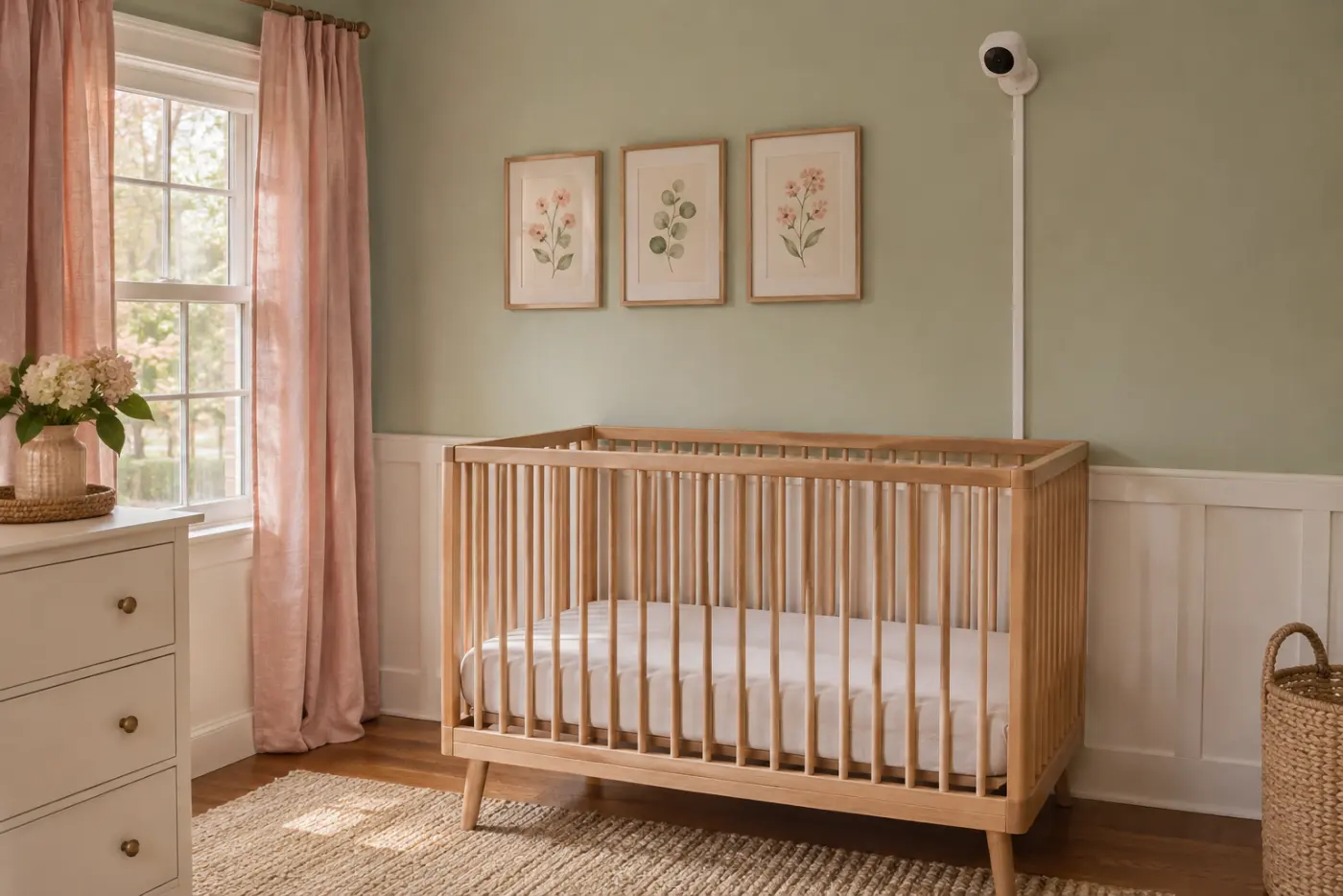
Nanit watches motion. You dress your baby in a Breathing Band, swaddle or sleeping bag printed with a geometric pattern. The camera, mounted over the crib, tracks how that pattern rises and falls and alerts your phone if it sees no breathing motion. Nothing electronic touches your baby. The tradeoff is that it can only judge what the camera sees, so a blanket over the pattern or an adult moving in the frame can confuse it. One parent reviewing both systems pointed out that Nanit picks up any movement, which is why the overhead crib setup is the one Nanit recommends for nightly use.
Owlet measures the body. The Dream Sock wraps around your baby's foot and uses light (pulse oximetry, the same idea as the clip a nurse puts on your finger) to read pulse rate and oxygen saturation. When either reading leaves a preset range, the base station in the room lights up and sounds an alarm, and the app notifies you. The FDA's De Novo file describes exactly that: a notification that prompts a caregiver to go check, plus trends over time.
So the real question is not "which is better." It is "what am I worried about?" If it is "Is my baby still breathing?", both answer it in different ways. If it is "Is my baby's oxygen level okay?", only Owlet measures that.
The 3 a.m. test: what happens when it alerts
Specs do not tell you what your night feels like. Here is what each system does when something trips it.
Nanit: your phone buzzes. If your phone is on silent, in another room or out of battery, you may miss it. BabyGearLab flagged exactly this: the Nanit does not sound an alarm in the nursery. Nanit now sells an optional touchscreen display, Nanit Home, for parents who do not want the monitor living on their phone.
Owlet: the base station glows and sounds in the room, and the app alerts you too. That is louder and harder to miss. Reviewed's tester noted the base station alarm can be loud enough to wake the baby, which is the point when it is a real alert and the frustration when it is not.
False alarms are real on both. Owlet's most common complaint, in forums and in Babylist's own testing, is the sock losing connection or slipping, which triggers a "check sock" or reading alert. Nanit's breathing alerts can fire when the band is covered or the baby moves out of view. Parents in the forum threads we read were split: some had two or three false alarms in two years and called the device worth every penny, others said the alerts fed their anxiety.
Before the first night, set off a test. Unclip the Owlet sock away from your baby to hear what a "check sock" alert sounds like, and turn your phone's Nanit notifications to override silent mode. Knowing the sounds ahead of time makes 3 a.m. less frightening.
How accurate are they?
Owlet publishes accuracy data for the Dream Sock and says its oxygen readings are within 3 percentage points of arterial blood gas measurements. That is the company's own claim. What gives it more weight than a marketing line is that the FDA reviewed clinical data before granting De Novo authorization in the over-the-counter category it created (product code QYU).
The older history is worth knowing. In 2018, a JAMA study at the Children's Hospital of Philadelphia tested the Owlet Smart Sock 2 on 30 hospitalized infants. It caught low oxygen with 88.8% sensitivity and 85.7% specificity, but it did not flag any of the episodes of slow heart rate the hospital monitor recorded. In 2021, the FDA sent Owlet a warning letter for selling the Smart Sock without authorization, and Owlet pulled it from the U.S. market. The Dream Sock is the redesigned product that went through the FDA process.
Nanit has no peer-reviewed accuracy study for breathing motion that we could find, and Nanit does not claim FDA authorization. That does not make it inaccurate. It means you are trusting the company's engineering rather than a regulator's review.
The FDA's 2025 safety communication adds a useful tip for any brand: an infant vital-sign monitor the FDA has authorized will show up in its De Novo or 510(k) database. Many cheaper monitors sold online that claim to read heart rate or oxygen have never been reviewed.
What neither monitor can do
Neither product prevents SIDS, and neither company claims it does. The FDA states that no device, including infant monitors, has been authorized to prevent SIDS or sudden unexpected infant death (SUID). The AAP's 2022 safe sleep update goes further and says not to use home cardiorespiratory monitors as a strategy to reduce SIDS risk.
That is not a reason to skip a monitor. It is a reason to keep the monitor in its lane. What lowers the risk is the AAP's safe sleep basics:
- On the back for every sleep, naps included
- A firm, flat crib or bassinet mattress with only a fitted sheet
- No pillows, bumpers, blankets or toys in the sleep space
- Room-sharing without bed-sharing, ideally for the first six months
A monitor that makes a parent comfortable with a blanket in the crib, or a baby sleeping in a swing, is doing harm. The AAP's concern is exactly that false sense of security.
If your baby has a heart or lung condition, was born early, or came home from the NICU, talk to your pediatrician. A consumer gadget is not a substitute for medical monitoring, and some babies qualify for prescription monitors that insurance may cover.
Two-year cost: what you really pay
Here is the math most "vs" articles skip. We used the prices on each maker's site on November 24, 2026.
| Nanit | Owlet | |
|---|---|---|
| Starter bundle, sale price | $199.99 (camera, wall mount, one 0–3 month band, 3-month Sleep Plan trial) | $269.99 (camera, Dream Sock, base station, 4 socks in two sizes) |
| Extra items as baby grows | Medium and Large Breathing Bands, about $20 each at regular price | None until 18 months, when the sock is outgrown |
| Two years with no paid plan | About $240 | About $270 |
| Two years with the most common plan | About $430 (Sleep Plan after the free trial, at about $9 a month) | About $510 (Owlet360 at $9.99 a month) |
| At regular price, no plan | About $330 | $379.99 |
Two things stand out. First, Nanit's paid plans are optional for breathing alerts, which many buyers do not realize; the free tier is more generous than its reputation. Second, Owlet's sock has a hard stop at 18 months, while Nanit's band sizes run to 24 months. After that, both are cameras.

What independent testers concluded
| Tester | Nanit | Owlet |
|---|---|---|
| BabyGearLab (Oct. 2026) | "Best One and Done Monitor" | "Best Vitals Tracking Monitor" |
| Babylist (June 2026) | Best Wi-Fi monitor | Best wearable |
| Fathercraft (Oct. 2026) | 9/10, pick for data-minded parents | 8.5/10, pick for pulse and oxygen |
| PureWow side-by-side (2024) | Winner on reliability and setup | Winner on price; pick if you want vitals |
| Reviewed (2025–2026) | Best overall monitor | Recommended for parents who want peace of mind |
The pattern is consistent. Testers rank Nanit higher as an everyday monitor and sleep tool, and point parents with a specific health worry toward Owlet. The common complaints are consistent too:
- Nanit: the price, a subscription that unlocks the features in the ads, Wi-Fi dependence, and a camera that is hard to move between rooms (BabyGearLab called it a poor travel monitor).
- Owlet: the sock connection dropping a few times a week for some testers, a camera that ships with a wall mount but no stand, a 2.4 GHz Wi-Fi requirement for the sock, and data that BabyGearLab warned can be "anxiety-inducing" for some parents.
What parents say after months of use
Forum threads tell a story that reviews do not. Across the parent discussions we read, three themes came up again and again.
Peace of mind is the product. Parents who loved either monitor rarely talked about video quality. They talked about sleeping again. Parents with a family history, a NICU stay or a baby with breathing trouble leaned hard toward Owlet.
Anxiety can grow instead of shrink. Some parents with postpartum anxiety said checking numbers became a loop. One YouTube reviewer who has anxiety herself argued against buying either, because constant checking gives a quick burst of relief that makes anxiety worse over time. If that sounds like you, it is worth talking to your doctor about the anxiety itself, and maybe choosing a simpler monitor.
Many end up using it as a camera. Reviewers and parents on both sides make the same point: after the newborn months, parents stop putting on the sock or band and use the camera alone. If you think that is likely, buy for the camera first.
Which one should you buy?
Choose Nanit if:
- You want the clearest overhead view of the whole crib
- You would rather not put a wearable on your baby
- You like sleep data and will open the app to read it
- You will keep the camera in one nursery most of the time
Choose Owlet if:
- Your worry is specifically oxygen level or heart rate
- You want an alarm that sounds in the room, not only on your phone
- FDA authorization of the alerts matters to you
- You are fine charging a sock every day and checking the fit
Consider neither if:
- You mainly want to see and hear your baby; a good non-Wi-Fi monitor costs around $100 and works with no app
- You travel or use a babysitter often and want a simple parent unit
- Your baby needs real medical monitoring; ask your pediatrician about prescription options
Can you use both? Yes. They run in separate apps. Some parents pair a Nanit camera with an Owlet sock. You pay for two systems and get two sets of alerts, so be honest with yourself about whether that helps or adds noise.
Add it to your list
Once you have decided, put the monitor where the rest of your nursery planning lives:
- Tick off "Baby monitor" in the Nursery Essentials list in our baby checklists, next to the crib, mattress and white noise machine.
- Add your pick to Tote, your baby shopping list, so the price counts toward your running total and nobody in the family buys a second one.
- Building a registry? Our baby registry checklist shows where a monitor fits among the essentials.
Ready to compare prices? Look at Nanit monitors on Amazon (affiliate link) and the Owlet Dream Duo on Amazon (affiliate link). If you decide a simple camera is enough, start with video baby monitors on Amazon (affiliate link). Prices on the makers' own sites were lower than usual during their Black Friday sales, so compare both before you buy.
Frequently Asked Questions
Is Nanit or Owlet better?
Neither is better for everyone. Nanit is the stronger camera and sleep-data system and tracks breathing motion through a patterned band. Owlet's Dream Sock reads pulse rate and oxygen level and is the only one of the two with FDA authorization for those notifications.
Can Nanit or Owlet prevent SIDS?
No. The FDA says no device, including infant monitors, has been authorized to prevent SIDS or SUID, and the AAP says not to use home monitors as a way to lower SIDS risk. Safe sleep practices do that work.
Do you need a subscription for Nanit or Owlet?
Not for the core monitor. Nanit's live video, sound and motion alerts and Breathing Motion Monitoring work without a plan; sleep analytics and video history need one. Owlet's core monitoring is free and Owlet360 ($9.99 a month) adds storage and reports.
How long can you use the Owlet sock and the Nanit band?
Owlet's Dream Sock is authorized for babies 1 to 18 months and 6 to 30 pounds. Nanit sells its Breathing Band in three sizes for babies up to 24 months. Both cameras keep working as regular monitors after that.
Can you use Nanit and Owlet together?
Yes. The two run in separate apps and do not interfere with each other. Some parents pair a Nanit camera with an Owlet sock, but you pay for two systems and get two sets of alerts.
Helpful tools
- Baby checklists: nursery, registry and hospital bag lists you can tick off
- Tote shopping list: one list for everything you still need to buy, with running totals
- Sleep tracker: log naps and nights without a subscription
Related articles
Sources
- FDA: Do Not Use Unauthorized Infant Devices for Monitoring Vital Signs (2025)
- FDA: De Novo decision summary, Dream Sock (DEN220091)
- FDA: Baby Products with SIDS Prevention Claims
- FDA: Warning letter to Owlet Baby Care (2021)
- AAP: Updated safe sleep recommendations (2022)
- AAP HealthyChildren: A Parent's Guide to Safe Sleep
- Bonafide CP et al. Accuracy of Pulse Oximetry-Based Home Baby Monitors. JAMA, 2018
- Nanit: Memberships and what works without a plan
- Nanit: Smart Baby Monitor product page
- Nanit: Breathing Band
- Owlet: Dream Duo (Gen 3)
- BabyGearLab: Best Baby Monitors
- Babylist: Best Baby Monitors of 2026
- Fathercraft: Baby Monitor Reviews
- PureWow: Nanit vs Owlet, tested by two parents
- Reviewed: Owlet Dream Duo Gen 3 review