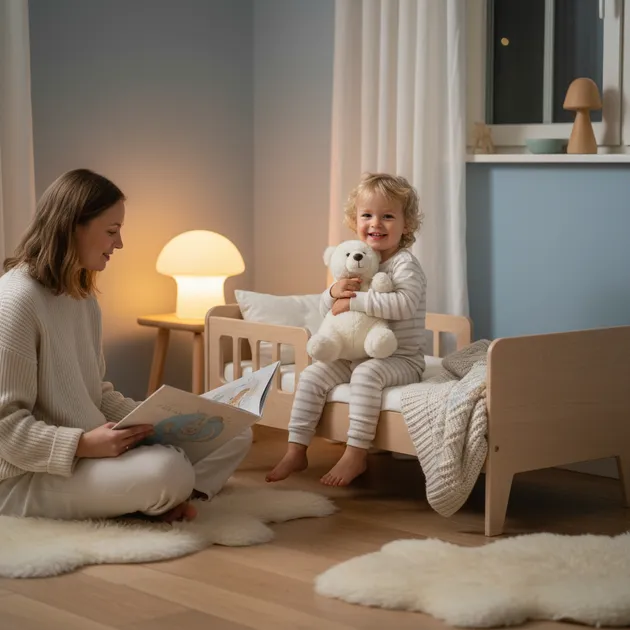
You've put the baby down seven times. Seven times the baby has protested. It's almost nine o'clock and you still haven't eaten dinner. Sound familiar?
A predictable bedtime routine can completely transform your evenings. Research shows that children who follow a consistent evening routine fall asleep faster, sleep longer, and wake less often during the night. Here are practical routines that actually work, tailored to your child's age.
Key Takeaways
- Research published in Sleep Medicine Reviews shows a consistent bedtime routine of 20–45 minutes leads to faster sleep onset, fewer nighttime wakings, and better daytime mood for children.
- It typically takes 1–2 weeks of consistent follow-through before a child begins to respond to a new bedtime routine, stick with it even if the first few nights are rough.
- The ideal bedtime routine changes with age: keep it simple (10–15 min) for newborns, build to 20–30 minutes by 3–6 months, and add reading and wind-down rituals for toddlers.
- Starting wind-down 30–60 minutes before bedtime, dim the lights, reduce screen time, and lower stimulation, makes the routine itself much more effective.
- A warm bath, massage, or consistent song or story acts as a sleep cue, signaling to the brain that sleep is coming.
Why Do Bedtime Routines Work?
Babies and toddlers thrive on predictability. When the same things happen in the same order every evening, it sends a signal to the brain: sleep is coming soon.
Research published in Sleep Medicine Reviews shows that a consistent bedtime routine lasting 20–45 minutes leads to:
- Faster sleep onset, children take less time to fall asleep
- Fewer nighttime wakings, children sleep more continuously
- Better daytime mood, well-rested children are happier and more focused
- Less stress for parents, evenings become predictable for the whole family
It isn't that the routine is magical in itself. What happens is that the child learns to wind down. Step by step, evening after evening, you build a bridge between active play and restful sleep.
It often takes 1–2 weeks of consistent follow-through before a child starts responding to a new bedtime routine. Give it time and stick with the plan.
Bedtime Routines by Age
0–3 Months: Keep It Simple
Newborns don't yet have a circadian rhythm, so a fixed bedtime routine has less impact at this stage. But you can start laying the groundwork.
Simple evening routine (10–15 minutes):
- Change diaper and put on sleepwear
- Dim the lights and lower noise in the room
- Quiet nursing or bottle feeding
- Rock or hold the baby until drowsy
- Place the baby down in their own sleep space
At this stage it's mostly about creating a calm environment. The baby will likely wake several times during the night, and that's completely normal.
3–6 Months: Build the Routine
From around 3–4 months, most babies begin developing a circadian rhythm. A bedtime routine now starts to have more effect.
Evening routine (15–20 minutes):
- Bath or wash (not needed every night, but it's a clear signal)
- Baby massage with lotion (calm, gentle touch)
- Put on sleep sack and sleepwear
- Nurse or bottle-feed in dim lighting
- A short book or song
- Put down in the crib awake but drowsy
"Awake but drowsy" is the gold standard. Try placing the baby down while they are still halfway awake. This way, the child gradually learns to fall asleep on their own, without being nursed or rocked all the way to sleep.
6–12 Months: Consistent Structure
Between 6 and 12 months, most babies have a more predictable daily rhythm. Bedtime can become more fixed, and the routine clearer.
Evening routine (20–30 minutes):
- Calm play after dinner (no active play in the last hour before bedtime)
- Bath 2–3 times per week (other evenings: wash face and hands)
- Put on sleep sack and sleepwear
- Last nursing or milk feed
- Brush teeth (from the first tooth)
- Read 1–2 short books in dim lighting
- Sing a lullaby or say goodnight
- Put in the crib with a comfort object and pacifier if used
1–2 Years: More Involvement
Toddlers have opinions about everything, including bedtime. Give your child choices within the structure.
Evening routine (20–30 minutes):
- Tidy up toys together (a clear signal that the day is ending)
- Bath or evening wash
- Put on pajamas, let the child choose between two options
- Brush teeth
- Evening snack if the child is hungry (milk, yogurt, or fruit)
- Read 2–3 books, let the child choose
- Lullaby or quiet cuddle time
- Say goodnight and leave the room
Let your child choose the books and their pajamas. Small choices give the child a sense of control, which reduces resistance at bedtime.
What Every Bedtime Routine Should Include
Bath or Wash
Warm water is relaxing and signals the transition from day to night. Daily baths aren't necessary for the skin, 2–3 times a week is enough. On other evenings, wash the face, hands, and diaper area.
Baby Massage
Gentle massage with lotion lowers stress hormones and promotes bonding. It doesn't need to take more than 5 minutes. Long, calm strokes along the arms, legs, and tummy work well.
Reading
Books stimulate language development and are a calming activity that helps your child wind down. From 3–4 months, babies can look at pictures. By 1 year, many children start pointing and "reading along."
Song
A consistent lullaby becomes a powerful sleep signal over time. Pick a calm song you can sing every evening. It doesn't need to be perfectly sung, it's your voice the child finds comforting.
Physical Closeness
Cuddles, hugs, and gentle touch before bedtime give your child security. A few minutes of quiet closeness in dim lighting is a good way to close the routine.
What to Avoid Before Bedtime
Screens: Blue light from tablets, TVs, and phones suppresses melatonin production. Avoid screens for at least 30 minutes, ideally an hour, before bedtime.
Active play: Rough-and-tumble, tickling, and wild play activate the nervous system. Keep the last hour calm.
Sugar: Sweet snacks before bed cause an energy spike. If your child needs food, choose something calming like bread with cheese or a banana.
New activities: The bedtime routine should be predictable. Don't introduce new elements in the middle of a difficult sleep phase.
Long routines: Keep it under 30–45 minutes. Routines that go on too long become hard to maintain and difficult to shorten.
When the Bedtime Routine Isn't Working
Sometimes nothing seems to work, even with the best routine in place. This is normal, and it's often due to:
Sleep Regressions
Around 4, 8, 12, and 18 months, many children experience sleep regressions. Sleep temporarily gets worse, often coinciding with developmental leaps. Stick to the routine, it usually passes within 1–3 weeks.
Teething
Teething can disrupt sleep, especially with the first teeth and molars. A pain reliever (as recommended by your pediatrician) can help on the worst nights.
Illness
A cold, fever, or ear infection makes everything harder. During illness, it's fine to adapt the routine and offer extra comfort. Return to the normal routine once your child is well again.
Wrong Bedtime
If your child consistently protests a great deal, the bedtime may be off. A child put to bed too early isn't tired enough. A child put to bed too late is overtired, and paradoxically harder to settle.
Use a sleep tracker to log when your child falls asleep and wakes up. Over time you'll see a pattern that helps you find the right bedtime.
Involving Your Partner
The bedtime routine is a great opportunity for both parents to connect. If one parent always handles bedtime, the other misses out on an important bonding moment, and the one who always does it never gets a free evening.
Tips for sharing:
- Take turns putting the child to bed, or divide tasks (one does bath, the other reads)
- Both parents should be able to carry out the full routine independently
- Keep the routine consistent regardless of who is doing it
- Expect some resistance at first if the child is used to only one parent
Frequently Asked Questions
How long should a bedtime routine take?
Between 20 and 45 minutes is ideal. Less than 15 minutes doesn't allow enough time to wind down. More than 45 minutes can become exhausting for everyone and hard to sustain night after night.
Can I change the routine as my child grows?
Yes, the routine should adapt as your child gets older. Make small adjustments gradually, don't change everything at once. For example, you can add book reading once the child starts showing interest in books.
What do I do when we're away from home?
Bring what you can from the routine: a favorite book, the sleep sack, a comfort toy. Familiar elements provide security even in unfamiliar surroundings. Accept that sleep may be a bit worse for a few days, and return to the normal routine once you're back home.
Sources
- Mindell JA, et al. "Behavioral treatment of bedtime problems and night wakings in infants and young children." Sleep Medicine Reviews.
- American Academy of Pediatrics (AAP). "Healthy Sleep Habits: How Many Hours Does Your Child Need?" healthychildren.org
- WHO. "Guidelines on physical activity, sedentary behaviour and sleep for children under 5 years of age." who.int
🔧 Helpful Tools
- Baby Sleep Tracker. Track and optimize your baby's sleep
- Soothing Sounds. White noise and soothing sounds to help your baby sleep
- All Baby Tools. Browse all free tools for pregnancy and baby care
📖 Related Articles
- Bedtime for 2- and 3-Year-Olds: A Guide to Better Sleep. When should 2- and 3-year-olds go to bed? Get practical tips on bedtime routines, the right bedtime, and how to handle night waking in toddlers.
- Co-Sleeping With Your Baby. Safe or Dangerous?. What do health authorities say about co-sleeping? The difference between bed-sharing and room-sharing, risk factors, and safe alternatives.
- Sleep and Starting Daycare: Adjusting Your Child's Routines. Starting daycare affects sleep. Get tips on sleep routines, settling in, and how to help your child sleep well during the daycare transition.