"Crib vs cot" is one of those parenting questions that sounds simple until you realize the answer depends on which side of the Atlantic you're on. The same piece of baby furniture has different names in US English and British English, and when you add bassinets, bedside cribs, and Moses baskets into the mix, the confusion multiplies quickly. This guide cuts through the terminology, explains the real differences between each sleep option, and tells you when to move between them.
Key Takeaways
- In the US, a crib is the full-size baby bed; in the UK and Australia, the same thing is called a cot. They refer to the same item.
- A bassinet (US) or Moses basket (UK) is a smaller, portable newborn sleep space, typically used for the first 3–4 months.
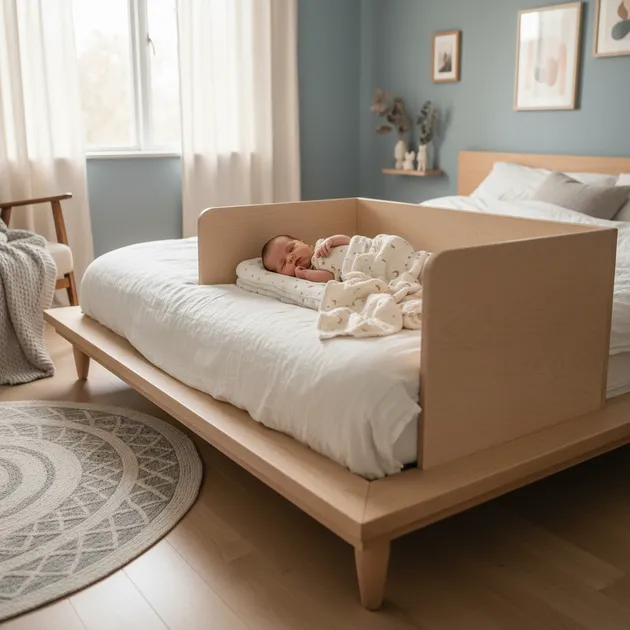
- A bedside crib (also called a bedside sleeper or co-sleeper) attaches to the parents' bed, allowing easy access without bed-sharing.
- The AAP recommends room-sharing (not bed-sharing) for at least the first 6 months, which makes a bedside crib or bassinet a practical choice early on.
- Transition from bassinet to crib when your baby hits the weight limit, starts rolling, or can push up, whichever comes first.
- All sleep surfaces must meet CPSC crib standards: firm, flat, with snug-fitting mattress and no loose bedding.
The US vs UK Terminology Problem
The confusion starts with language. Here's the plain translation:
| US English | UK/Australian English | What it means |
|---|---|---|
| Crib | Cot | Full-size baby bed, typically used from birth to around age 2–3 |
| Bassinet | Moses basket or crib (UK uses "crib" for smaller!) | Small, portable newborn sleep space |
| Crib mattress | Cot mattress | Firm mattress that fits the sleep frame |
| Toddler bed | Toddler bed | Smaller low bed, often a crib converted down |
Yes, the UK uses "crib" to mean the smaller newborn basket, while the US uses "crib" for the full-size bed. If you're reading UK parenting forums or NHS guidance and US pediatrician advice at the same time, you'll see the same word meaning opposite things. Always check where the advice originates.
In this article, we'll use US conventions: crib = full-size, bassinet = small/newborn, cot = the UK equivalent of a US crib.
The Four Main Newborn Sleep Options
If you are deciding between a bassinet and a full-size crib for the first months, see our bassinet vs crib guide.
1. Bassinet (Moses basket in the UK)
A bassinet is a small, lightweight sleep space designed for newborns typically up to about 15–20 lbs or 4–5 months of age, depending on the model. Most have a firm, flat mattress and breathable mesh sides.
Pros: Portable (move between rooms), easy to position next to your bed, often lower sides for easier newborn access, cheaper than a full crib.
Cons: Short lifespan (outgrown in 3–5 months), weight and rolling limits mean you'll transition sooner than you expect.
Best for: The first 3–4 months when room-sharing matters most.
2. Bedside Crib (Bedside Sleeper / Co-Sleeper)
A bedside crib is a bassinet-style unit with one side that drops down or folds away, designed to attach to the height-adjustable frame of a parent's bed. The baby sleeps in their own separate, firm surface, not in the adult bed, but within arm's reach.
Pros: Easy nighttime feeding access without full bed-sharing, reduces the sleep disruption of getting up to a crib across the room, supports the AAP recommendation for room-sharing without the risks of bed-sharing.
Cons: More expensive than a standalone bassinet, assembly and height adjustment can be fiddly, still limited lifespan (typically 3–6 months depending on model and baby size).
Safety note: Check that the bedside crib certification meets CPSC standards in the US (or ASTM F3118) or BS EN 1130 in the UK. Gaps between the unit and the adult mattress must be zero, any gap is a suffocation risk.
Best for: Breastfeeding parents who want close access without bed-sharing.
3. Standard Crib (US) / Cot (UK)
The full-size sleep space, typically 52 × 28 inches in the US. Designed to last from birth through toddlerhood (usually age 2–3). Many convert to toddler beds.
Pros: Long lifespan, more room for a growing baby, typically more bedding and mattress options, firm mattress with snug fit.
Cons: Larger footprint (harder to fit in a small bedroom), higher sides make early nighttime access harder.
CPSC standards for US cribs:
- Slat spacing no wider than 2⅜ inches (prevents head entrapment)
- No drop-side rails (banned in the US since 2011)
- Firm mattress that fits snugly, less than two fingers of gap between mattress and any crib side
- No corner post extensions over ⅛ inch (entanglement risk)
NHS standards for UK cots:
- Firm, flat mattress in good condition with no sagging or gaps
- No pillow, duvet, or bumpers in the cot
- Mattress should fit the cot with no gap larger than 4 cm on any side
Best for: From birth onward, or as the transition destination from a bassinet.
4. Play Yard / Pack-n-Play
A foldable, portable option that includes a bassinet insert for newborns and a larger play area floor for older babies. CPSC-approved models meet the same safety standards as cribs.
Best for: Travel, grandparents' houses, or as a secondary sleep space. Not ideal as a primary sleep space long-term due to thinner mattress padding.
When to Transition from Bassinet to Crib
The AAP is clear that the trigger for transitioning isn't age, it's development and size. Move your baby to a full crib when:
- Weight limit reached. Most bassinets list a weight limit (commonly 15–20 lbs). Do not exceed it.
- Rolling. Once a baby can roll from back to front, the sides of a bassinet become a hazard. Move immediately.
- Pushing up or pulling. Any sign of the baby being able to lever against the sides or get close to the edge.
- Outgrowing the space. If the baby is longer than the bassinet or touching the sides, it's time.
Most families transition somewhere between 3 and 5 months. Some babies are ready at 8 weeks; others make it to 5 months. Watch the baby, not the calendar. For the choice between the two sleep spaces in the first place, see bassinet vs crib.
The transition dip: Many babies sleep worse for 3–7 nights after moving to a crib. This is normal. The space feels different, the sounds are slightly different, and the familiar bassinet smell is gone. Consistent bedtime routine and keeping the crib in your room (if size allows) for the first few weeks helps.
Safe Sleep Applies to All Options
Whether it's a bassinet, bedside crib, or standard crib/cot, the AAP safe sleep rules are the same:
- Back to sleep for every sleep, every time, until the baby can roll both ways independently
- Firm, flat surface, no incline, no positioners, no wedges
- Alone, no pillows, blankets, stuffed animals, bumpers, or positioning devices
- Room-sharing, not bed-sharing, in your room for at least the first 6 months, ideally 12
- Avoid overheating, dress baby for the room temperature; no hats indoors during sleep
The NHS guidance for the UK (cot safety) aligns with these principles, adding that second-hand mattresses carry a slightly elevated risk, if using one, ensure it is firm, dry, and from a cot of known history.
🔧 Helpful Tools
- Sleep Tracker. Log every nap and night sleep. Useful during transitions to spot where the sleep disruption is actually coming from.
- Soothing Sounds. White noise to help your baby settle in a new sleep space after a crib transition.
- Baby Checklists. Nursery setup checklist covering crib, mattress, and safe sleep essentials before baby arrives.
- Development Leaps. Understanding where your baby is developmentally can explain why a sleep transition is happening now.
Sources
- American Academy of Pediatrics. Safe Sleep. AAP.org. 2026. https://www.aap.org/en/patient-care/safe-sleep/
- U.S. Consumer Product Safety Commission. Cribs Safety Education Center. CPSC.gov. 2024. https://www.cpsc.gov/Safety-Education/Safety-Education-Centers/cribs
- National Health Service. Reduce the risk of sudden infant death syndrome. NHS.uk. 2025. https://www.nhs.uk/conditions/baby/caring-for-a-newborn/reduce-the-risk-of-sudden-infant-death-syndrome/
- American Academy of Pediatrics. A Parent's Guide to Safe Sleep. HealthyChildren.org. 2025. https://www.healthychildren.org/English/ages-stages/baby/sleep/Pages/A-Parents-Guide-to-Safe-Sleep.aspx
This article is for general informational purposes and does not replace advice from your pediatrician. Always follow the safety guidelines that come with your specific sleep product, and contact your healthcare provider if you have concerns about your baby's sleep environment.