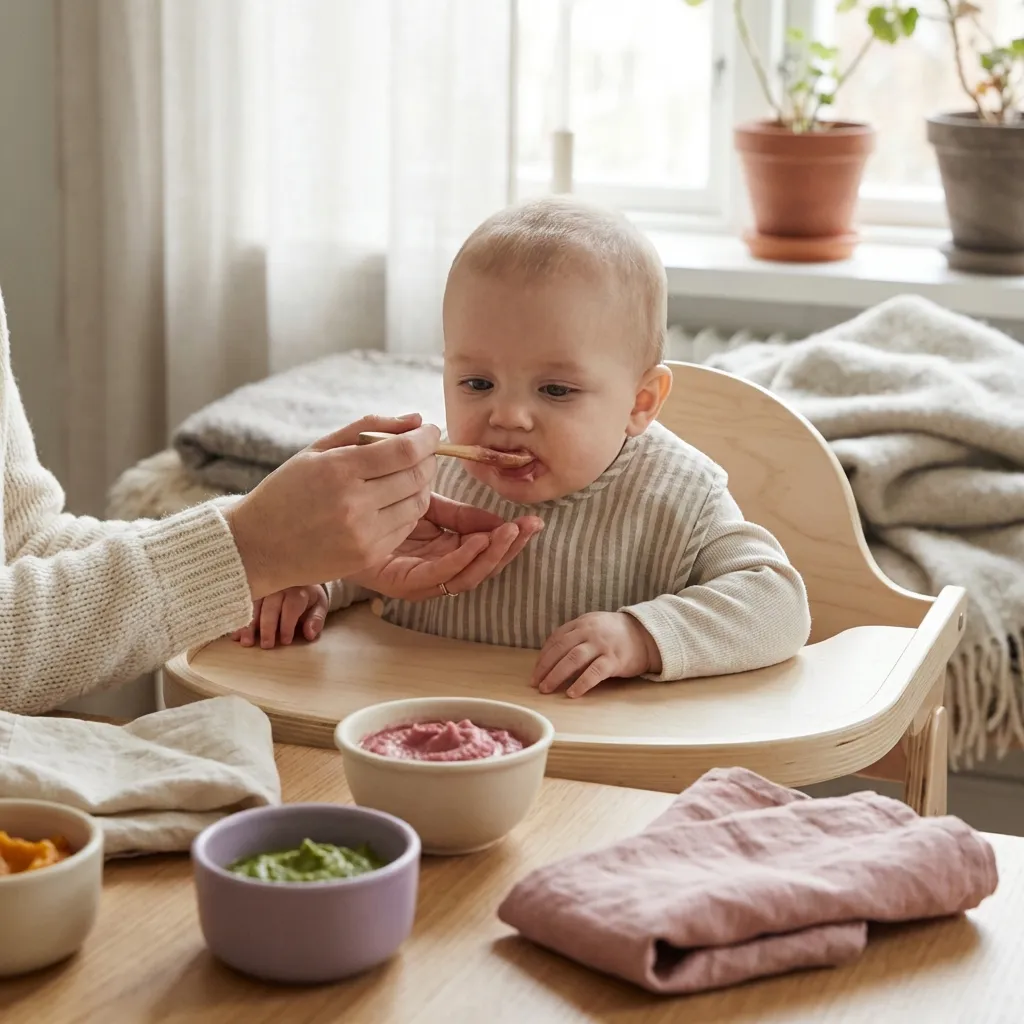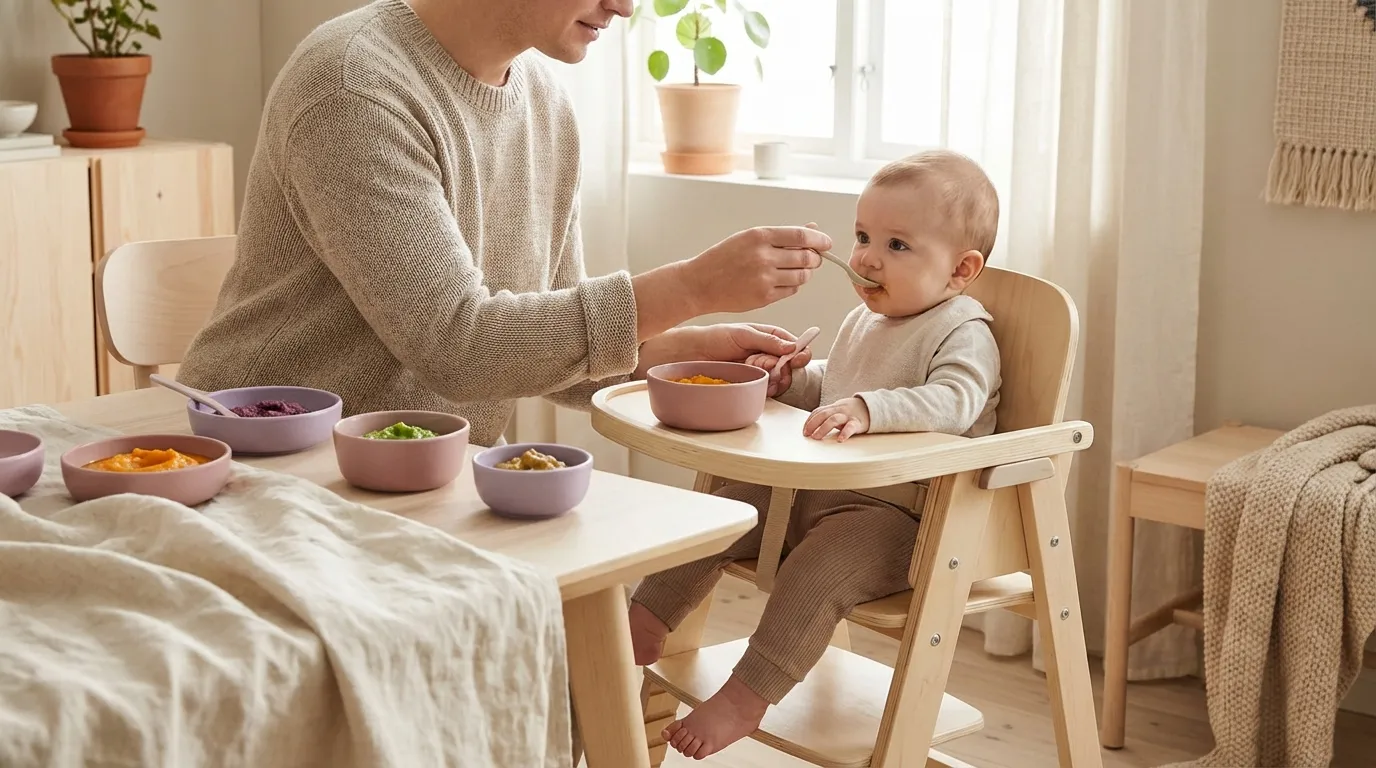
Starting solid foods is one of the most exciting, and sometimes nerve-wracking, milestones of the first year. When should you start? What do you give first? How much? What about allergies?
This guide takes you through everything, step by step, from the first taste of puree to a varied diet by 12 months.
Key Takeaways
- Both the WHO and the AAP recommend starting solid foods at around 6 months of age, starting before 4 months is not recommended as the digestive system and kidneys are not yet mature enough.
- The three key readiness signs are: sitting with minimal support, showing interest in food, and losing the tongue-thrust reflex that automatically pushes food out of the mouth.
- Introduce one new food at a time and wait 2–3 days before adding another, this makes it easy to identify any allergic reaction.
- Common allergens (peanuts, egg, fish, wheat, dairy) should be introduced early and gradually from around 6 months, not delayed, early introduction reduces the risk of allergy, according to AAP guidelines.
- The first 6–8 months of solids are about exploration and learning, not nutrition, breast milk or formula remains the primary source of nutrition until at least 12 months.
When Is Baby Ready?
The World Health Organization (WHO) and the American Academy of Pediatrics (AAP) both recommend starting solid foods at around 6 months of age. Most babies are ready somewhere between 4 and 6 months, but the goal is to wait until the baby shows clear signs of readiness.
Signs of Readiness
Your baby is ready to start solids when they:
- Can sit up with minimal support and hold their head steady
- Show interest in food, watching when others eat, reaching toward food
- Have lost the tongue-thrust reflex, they no longer automatically push food out of their mouth with their tongue
- Can move food to the back of their mouth and attempt to swallow
- Weigh approximately double their birth weight (usually around 6 months)
Note: Starting before 4 months is not recommended, as the digestive system and kidneys are not mature enough.
Before You Start: Practical Preparations
Before the first meal, it's worth getting a few things sorted:
- High chair with good support, the baby should sit upright, not leaning back
- Soft spoons, silicone or baby spoons with a small, shallow bowl
- Bibs, you'll go through many
- Small bowls, easy to portion small amounts
- A relaxed mindset, the first weeks are about exploration, not nutrition
At 6 months, breast milk or formula still provides the vast majority of nutrition. Food introduction is about learning textures, tastes, and the concept of eating, not replacing milk feeds.
What to Start With
There's no single "right" first food, but some options work better than others for a first taste:
Good First Foods (6 months)
- Root vegetable purees: carrot, sweet potato, parsnip, butternut squash
- Fruit purees: apple (cooked), pear, banana (mashed)
- Baby rice cereal mixed with breast milk or formula (iron-fortified)
- Soft mashed avocado
Why These?
These foods are mild in flavor, easy to digest, and have smooth textures that are easy for beginners to swallow. They're also naturally sweet, which babies tend to accept more readily at first.
Week-by-Week Plan: The First Month
Week 1: The Very First Tastes
Goal: Get baby used to the idea of a spoon and food that isn't milk.
- Offer food once a day, at a time when baby is happy and alert (not overtired or too hungry)
- Start with 1–2 teaspoons of a smooth single-ingredient puree
- Offer after a milk feed so baby isn't ravenous
- Use a soft spoon and let baby set the pace
- Expect most food to end up on the bib, this is completely normal
First week example menu:
- Days 1–3: carrot puree
- Days 4–7: sweet potato puree
Week 2: Expanding the Palette
Goal: Try a few more single-ingredient purees and observe reactions.
- Continue with one meal per day
- Introduce 1 new food every 2–3 days to watch for allergic reactions
- Increase amount slightly if baby seems interested
Week 2 example menu:
- Butternut squash puree
- Mashed banana
- Pear puree
Week 3: Adding Protein
Goal: Introduce some protein sources.
- Try smooth lentil puree (red lentils work well)
- Try finely mashed chicken mixed into vegetable puree
- Quantities are still small, 2–4 tablespoons total
Week 4: Combining Flavors
Goal: Start mixing foods and introduce two meals per day.
- Combine foods baby has already accepted: carrot + sweet potato, apple + pear
- Move to two meals per day if baby seems ready and interested
- Textures can be slightly thicker now
Month-by-Month Guide
4–6 Months (if starting early, consult pediatrician first)
If your pediatrician recommends starting before 6 months:
- Only smooth, very runny purees
- Single ingredients only
- Very small amounts (1–2 teaspoons)
- Breast milk or formula remains primary nutrition
6–8 Months: Learning to Eat
Texture: Smooth purees → slightly lumpy mashes Meals per day: 1–2, working toward 2–3 Milk: Still the main nutrition source
Foods to introduce:
- Vegetables: broccoli, peas, green beans, zucchini, spinach
- Fruits: mango, peach, plum, blueberries (mashed)
- Grains: oats, baby rice, soft pasta or rice
- Protein: chicken, turkey, fish (white fish without bones), lentils, beans
- Dairy: full-fat yogurt, mild cheese (small amounts)
- Eggs: well-cooked scrambled egg or hard-boiled yolk
Introducing allergens: This is the ideal window to introduce the 8 major allergens (one at a time, with 2–3 days between each):
- Peanuts (smooth peanut butter thinned with water)
- Tree nuts
- Eggs
- Fish
- Shellfish
- Wheat
- Soy
- Dairy (cow's milk in food, not as a drink yet)
Early introduction of allergens reduces the risk of allergy development, according to AAP guidelines.
8–10 Months: Textures and Finger Foods
Texture: Mashed → soft lumps → soft finger foods Meals per day: 3 meals, 1–2 snacks Milk: Still important, but food is now contributing meaningfully to nutrition
By 8–9 months, most babies are ready for:
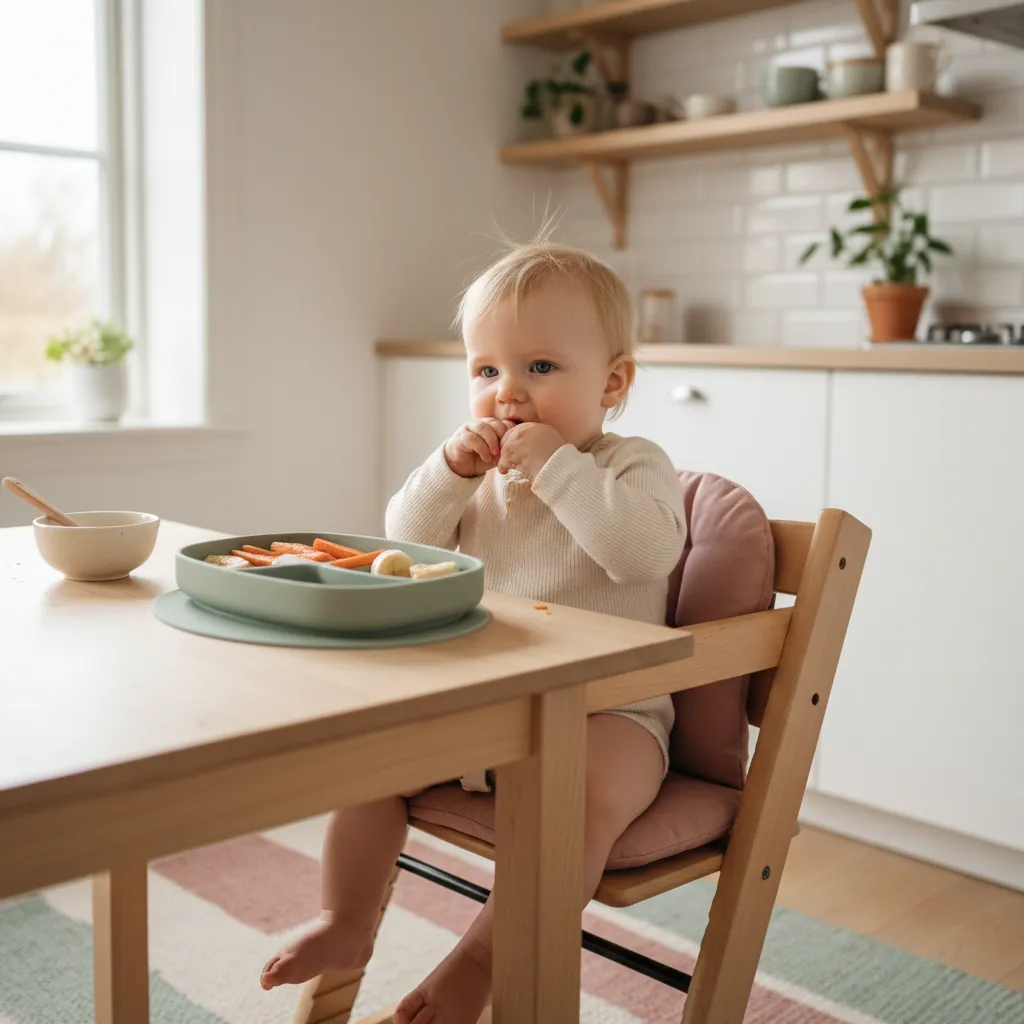
- Soft finger foods they can pick up themselves
- Slightly more complex textures
- Stronger flavors
Good finger foods (soft and easy to gum):
- Soft-cooked vegetable sticks: broccoli, carrot, sweet potato
- Ripe banana pieces, soft pear slices
- Toast strips with mashed avocado
- Soft-cooked pasta shapes
- Small cubes of soft cheese
- Scrambled egg pieces
- Soft-cooked fish flakes
Baby-led weaning (BLW): Some families choose to skip purees entirely and go straight to soft finger foods. This is a valid approach, the key is that foods are always soft enough to be safely gummed and cut into appropriate sizes.
10–12 Months: Family Foods
Texture: Soft family foods, minced or finely chopped Meals per day: 3 meals + 2 snacks Milk: Still 3–4 feeds per day (breast milk or formula)
By 10 months, babies can eat most of what the family eats, as long as it's:
- Not too salty (babies' kidneys can't handle much salt)
- Not too spicy (though mild spices are fine)
- Cut into appropriate small pieces
- Soft enough to be safely gummed
Introduce now:
- Soft-cooked meat cut small
- Soft-cooked whole grains (rice, quinoa, barley)
- Most vegetables and fruits (raw soft ones, or cooked harder ones)
- Beans and legumes (well-cooked, mashed if needed)
How Much Should Baby Eat?
This is one of the most common worries, and the answer is: it varies enormously between babies, and it's not worth stressing about.
General Guidelines by Age
6–7 months:
- 1–2 tablespoons per meal, 1–2 meals per day
7–8 months:
- 2–4 tablespoons per meal, 2–3 meals per day
8–10 months:
- 4–6 tablespoons (or a small jar) per meal, 3 meals + 1–2 snacks
10–12 months:
- Approximately ¼ to ½ cup per meal, 3 meals + 2 snacks
Remember: Breast milk or formula provides the bulk of nutrition until 12 months. Food amounts at this stage are secondary, the goal is learning and gradual transition.
Common Concerns
"My baby keeps spitting the food out."
This is normal, especially in the beginning. The tongue-thrust reflex takes time to fade, and some babies need multiple attempts to figure out how to move food backward in the mouth. Keep offering, it gets better.
"My baby isn't interested in food."
Some babies take several weeks to show real interest in solids. As long as they're growing well on breast milk or formula, there's no rush. Continue offering without pressure, and interest usually develops naturally.
"My baby gags."
Gagging is a normal part of learning to eat, it's a safety reflex that prevents choking. Gagging (where the baby makes retching sounds and moves food forward in the mouth) is different from choking (where the baby is silent and can't breathe). As long as baby is making noise and seems to recover quickly, it's usually safe gagging. Talk to your pediatrician if you're concerned.
"My baby refuses vegetables but loves fruit."
This is extremely common, sweet foods are naturally more appealing. Keep offering vegetables alongside the fruits baby likes. It can take 15 or more exposures before a baby accepts a new food. Don't give up after a few rejections.
Foods to Avoid in the First Year
Some foods should be avoided entirely before 12 months:
| Food | Why to Avoid |
|---|---|
| Honey | Risk of infant botulism, serious bacterial illness |
| Cow's milk as a drink | Not as a main drink (fine in foods like yogurt, cheese) |
| Added salt | Kidneys can't process it; damages developing kidneys |
| Added sugar | No nutritional benefit; creates unhealthy preferences |
| Whole nuts | Choking hazard |
| Hard raw vegetables (whole carrots, celery sticks) | Choking hazard |
| Whole grapes, cherry tomatoes | Choking hazard (must be halved or quartered) |
| Undercooked eggs | Salmonella risk |
| Raw fish or shellfish | Bacterial risk |
| Very spicy foods | Can cause digestive discomfort |
| Large amounts of oily fish | Mercury concerns, max 2 portions per week |
Tips for a Good Start
- Offer water from a cup, small amounts of water with meals from 6 months (a sippy cup is fine)
- Eat together, babies learn by watching; family mealtimes are powerful
- Don't add salt or sugar, get babies used to natural flavors
- Vary flavors early, research shows babies who eat a wide variety of foods early are less likely to be picky eaters later
- Trust baby's hunger cues, stop when baby turns away or closes their mouth
- Make it fun, messy play with food is how babies learn; embrace the chaos
- Keep a food diary, useful for tracking new foods and noting any reactions
When to Contact Your Pediatrician
Get in touch with your pediatrician if:
- You notice a rash, swelling, hives, or vomiting after introducing a new food (possible allergic reaction)
- Baby seems to have pain or significant discomfort after eating
- Baby is losing weight or not growing well
- Baby refuses all solid foods after 7–8 months despite repeated attempts
- You have concerns about development that may be affecting feeding
Starting solids takes time, there is no fixed schedule. Some babies take to it immediately; others need weeks of patience and repeated offers. Either way, by 12 months most babies are enthusiastically exploring a wide range of foods, and the hard work of the early months pays off with an adventurous little eater.
See also: Introducing Allergens to Your Baby and Meal Plan for Baby 6–12 Months
Sources
- AAP. Infant and toddler nutrition guidelines
- WHO. Global infant feeding recommendations
- CDC. Infant and toddler nutrition resources
🔧 Helpful Tools
- Baby Food Guide. Safe foods and introduction schedule for your baby
- Breastfeeding Tracker. Log feeds, track supply, and monitor nursing sessions
- All Baby Tools. Browse all free tools for pregnancy and baby care
📖 Related Articles
- Introducing Allergens to Your Baby: A Safe Step-by-Step Guide. How to safely introduce allergens to your baby. Eggs, peanuts, dairy, and gluten, when, how, and what to watch for. Based on current AAP and WHO guidelines.
- Baby Food at 8 Months: Chunkier Textures and Finger Foods. What can your baby eat at 8 months? Guide to textures, portions, finger foods, and meal routines for babies 8–10 months based on WHO and AAP recommendations.
- Eggs for Baby: When and How to Introduce Them Safely. When can babies eat eggs? Complete guide to safely introducing eggs for babies from 6 months, boiled eggs, scrambled eggs, omelets, and allergy advice from WHO and AAP guidelines.