The Short Answer
Most babies begin crawling between 7 and 10 months of age, with the average around 9 months. However, crawling is not a universal milestone, some babies skip crawling entirely and move straight to pulling up and walking, which is developmentally normal.
Key Takeaways
- Average crawling age is 9 months: The normal range is 7–10 months. Some babies start as early as 6 months; others not until 11 months.
- Crawling is not required: The AAP confirms that skipping crawling is normal. Bottom shuffling, army crawling, and rolling straight to pulling up are all valid movement patterns.
- Tummy time is the best preparation: The AAP recommends tummy time from birth, working up to 30 minutes per day by 3–4 months. It builds the strength needed for crawling.
- There are many types of crawling: Classic, army (commando), bear, and bottom shuffling are all normal. There is no single correct method.
- Talk to your doctor if: Your baby is not sitting independently by 9 months, not mobile in any way by 12 months, or shows asymmetric movement (using only one side of the body).
Stages Leading Up to Crawling
Crawling does not happen overnight. It builds on a sequence of motor skills:
1. Tummy Time (0–6 Months)
Daily tummy time strengthens the neck, shoulder, arm, and core muscles needed for crawling. The AAP recommends starting tummy time from birth, working up to 30 minutes per day by 3–4 months.
2. Rolling (4–6 Months)
Rolling front-to-back and back-to-front builds the coordination and body awareness that prepares babies for moving through space.
3. Sitting Independently (6–8 Months)
Once a baby can sit without support, they have developed enough trunk strength to support themselves in a crawling position.
4. Rocking on Hands and Knees (6–9 Months)
A baby who rocks back and forth on all fours is figuring out weight distribution and timing, the neural groundwork for forward movement.
5. Crawling (7–10 Months)
Most babies use cross-pattern crawling (opposite arm and leg moving together), which also promotes bilateral brain development. Some babies use alternative methods first.
Types of Crawling
All of these are normal:
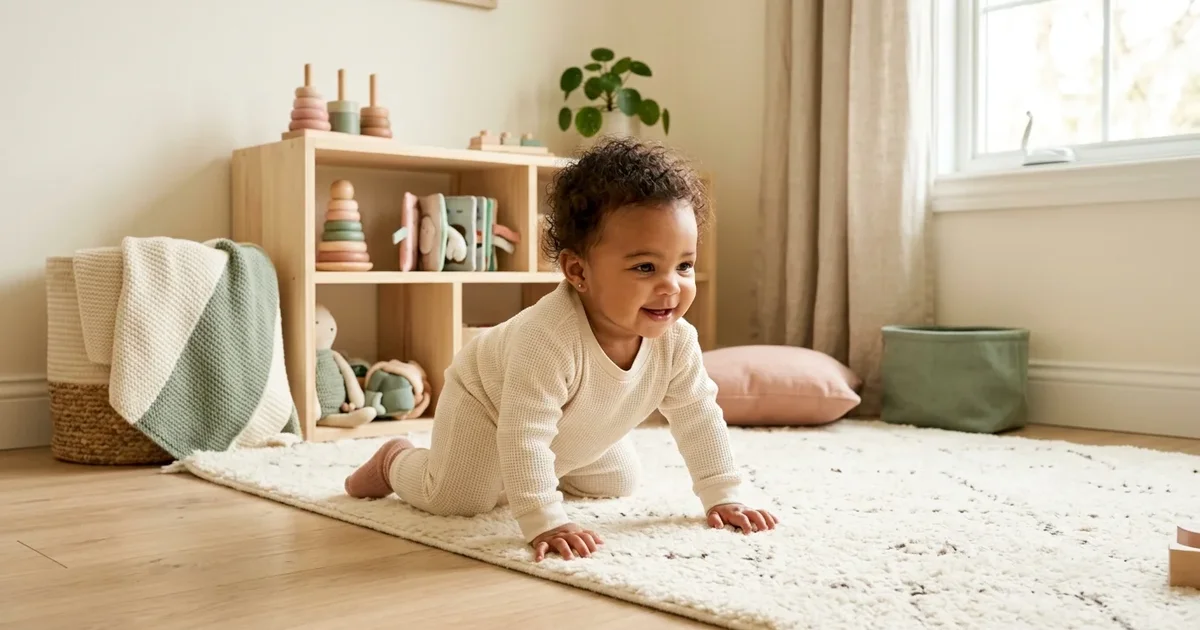
- Classic crawling: Opposite hand and knee move together
- Army/commando crawling: Belly on the floor, pulling with arms
- Bear crawling: Arms and legs straight, bottom in the air
- Bottom shuffling: Sitting upright and shuffling on the bottom
- Rolling: Some babies roll to their destination instead of crawling
Signs Your Baby Is Getting Ready to Crawl
- Pushes up onto hands and knees from tummy time
- Rocks back and forth on all fours
- Reaches forward while seated, shifting weight onto hands
- Starts moving backwards before they can go forward (very common)
- Explores surroundings with greater urgency
How to Encourage Crawling
- More tummy time, the single most important preparation for crawling
- Place toys just out of reach during tummy time to motivate reaching and moving
- Get down on the floor with your baby and model crawling
- Reduce time in bouncers and swings, floor play builds the muscles that containers cannot
- Use a crawling tunnel or low obstacle for babies who are close but not yet moving
When to Talk to Your Doctor
Contact your paediatrician if your baby:
- Is not sitting independently by 9 months
- Is not showing any attempt at mobility by 12 months (rolling, crawling, scooting, or pulling up)
- Has asymmetric movement (only using one side of the body)
- Has stiff, rigid, or floppy muscle tone that seems abnormal
- Loses skills they previously had (regression always warrants evaluation)
The CDC's "Learn the Signs. Act Early." programme emphasises that early referral to a developmental paediatrician or physiotherapist leads to better outcomes if delays are present.
Do All Babies Need to Crawl?
No. Research from the American Academy of Pediatrics confirms that crawling is not a required milestone. Many healthy babies bottom-shuffle or pull to standing and never crawl, and go on to walk and develop normally. What matters is that babies are moving and exploring, not the specific method they use.
Frequently Asked Questions
When do babies start crawling?
Most babies begin crawling between 7 and 10 months of age, with the average around 9 months. There is significant natural variation, some babies begin as early as 6 months, others not until 11 months. Crawling is preceded by a sequence of motor skills built through tummy time, rolling, and sitting.
Is it normal for a baby to skip crawling?
Yes, the AAP confirms that crawling is not a required milestone. Many healthy babies bottom-shuffle, army-crawl, roll, or pull straight to standing without ever crawling on hands and knees, and go on to walk and develop completely normally. What matters is that babies are mobile and exploring, not the specific movement pattern.
What are the signs that my baby is about to start crawling?
Key pre-crawling signs include: pushing up onto hands and knees from tummy time, rocking back and forth on all fours, reaching forward while seated (shifting weight onto hands), and moving backwards before forwards (very common). These typically appear 2–6 weeks before a baby begins moving forward.
How can I encourage my baby to crawl?
The single most effective preparation is tummy time, starting from birth and building to 30 minutes per day by 3–4 months. Place interesting toys just out of reach during tummy time to motivate reaching and movement. Reduce time in bouncers and swings, floor play builds the muscles that containers cannot. Modelling crawling alongside your baby also helps.
When should I talk to my doctor about crawling?
Contact your paediatrician if your baby is not sitting independently by 9 months, shows no attempt at any mobility (rolling, scooting, crawling, pulling up) by 12 months, has asymmetric movement using only one side of the body, or has muscle tone that seems unusually stiff or floppy. The CDC's "Learn the Signs. Act Early." programme emphasises that early referral leads to better outcomes.
Does army crawling count as real crawling?
Yes, army crawling (belly on the floor, pulling with arms) is a legitimate and common crawling style. Classic cross-pattern crawling (opposite arm and leg), bear crawling, bottom shuffling, and rolling are all normal variations. There is no single "correct" way to crawl.
Key Sources
- AAP. Movement Milestones: Babies 4 to 7 Months
- CDC. Developmental Milestones
- NHS. Your Baby's Development
Sources
- AAP. Developmental milestones for children
- CDC. Learn the Signs. Act Early., milestone tracking
- WHO. Child health and development
🔧 Helpful Tools
- Baby Food Guide. Safe foods and introduction schedule for your baby
- Baby Milestones Tracker. Track your baby's developmental milestones
- All Baby Tools. Browse all free tools for pregnancy and baby care
📖 Related Articles
- Baby Developmental Milestones by Month (0–24 Months). A complete guide to baby developmental milestones from birth to 2 years, covering social, language, motor, and cognitive development by month, based on CDC and AAP guidelines.