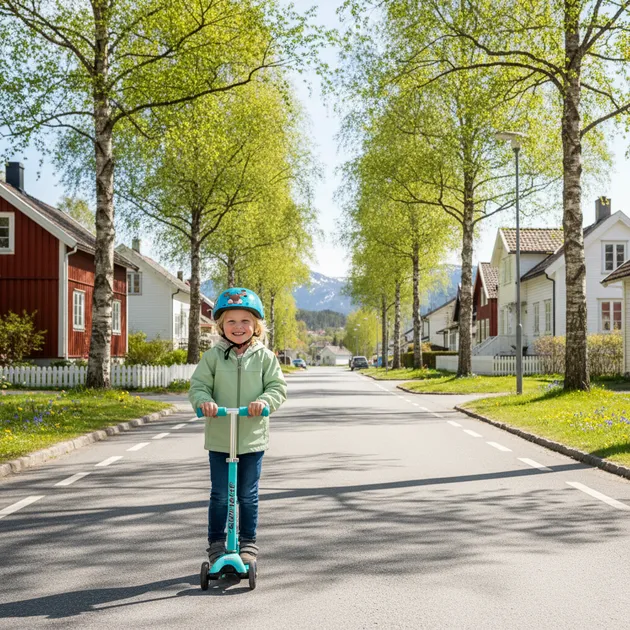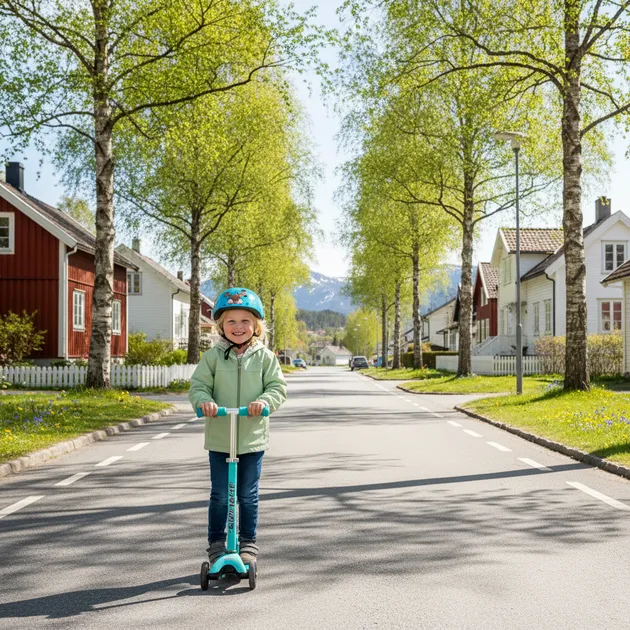
A kick scooter is one of the most popular gift ideas for toddlers and young children. It builds balance, coordination, and brings a lot of joy to everyday life. But when is your child actually ready, and which type should you choose?
Here's a complete guide to kick scooters for kids, covering everything from age recommendations to safety and maintenance.
When can my child start using a kick scooter?
Most children can start with a kick scooter from around age 2. By then they usually have enough balance and coordination to stand on the deck and kick forward.
Some children are ready as early as 18 months, while others need a little more time. Look for these signs:
- Your child walks confidently without falling often
- They can stand on one leg for a few seconds
- Your child shows interest in wheels and speed
Tip: Let your child try a scooter at the store or at a friend's house before you buy. You'll quickly see whether they're ready.
Benefits for motor development
A kick scooter is much more than just fun. It builds important skills that your child will benefit from for years.
Balance and coordination: Your child learns to distribute their weight correctly and steer while kicking. This is fundamental for all movement.
Gross motor skills: Kicking with one leg while balancing on the other strengthens the muscles in the legs, hips, and core.
Spatial awareness: Your child learns to judge distances, navigate around obstacles, and brake in time.
Confidence: Mastering a scooter gives a huge sense of achievement and makes your child more confident in their own body.
Types of scooter: 3-wheel vs. 2-wheel
The right type depends on your child's age and experience.
3-wheel scooter (from around age 2)
Three-wheeled scooters have two wheels at the front and one at the back, providing extra stability. Most models use a lean-to-steer mechanism where your child leans to turn, rather than twisting the handlebars.
Good for:
- Children ages 2–5
- Beginners who need extra support
- Uneven surfaces like gravel or cobblestones
Advantages:
- Very stable, hard to tip over
- Easy to learn
- Many models grow with your child (adjustable handlebars)
2-wheel scooter (from around age 5)
Two-wheeled scooters look like adult models in miniature. They require better balance and allow for higher speeds.
Good for:
- Children age 5 and up
- Children who have mastered a 3-wheel scooter
- Asphalt and smooth surfaces
Advantages:
- Easier to maneuver at speed
- Compact and easy to carry
- Many models fold flat
Important: Don't skip the 3-wheel stage if your child is under 4–5 years old. A 2-wheel scooter without sufficient balance can lead to painful falls.
How to choose the right scooter
Here are the most important factors to consider:
Height and handlebar height
The handlebars should reach roughly to the middle of your child's stomach or chest. Handlebars that are too low cause back strain; too high means poor control.
- Child height 31–37 in (80–95 cm): Handlebar height approx. 20–26 in (50–65 cm)
- Child height 37–43 in (95–110 cm): Handlebar height approx. 24–30 in (60–75 cm)
- Child height 43–51 in (110–130 cm): Handlebar height approx. 28–34 in (70–85 cm)
Choose a model with adjustable handlebars so the scooter can grow with your child.
Weight limit
Always check the manufacturer's stated weight limit. Most children's scooters support 44–110 lbs (20–50 kg). Exceeding this can cause breakage and accidents.
Wheel size
Larger wheels give a smoother ride and handle bumps better.
- 100–120 mm: Standard for young children, best on smooth asphalt
- 120–145 mm: Good all-around size
- 145–200 mm: For older children, faster and smoother
Deck width
A wider deck provides more stability. Look for at least 24 mm width for young children. PU (polyurethane) wheels provide good cushioning without puncturing.
Scooter weight
A scooter that's too heavy is hard for a child to handle. Aim for a maximum of 4–6 lbs (2–3 kg) for 2–3-year-olds and 6–9 lbs (3–4 kg) for children over 4.
Safety features to look for
Not all scooters are equally safe. Prioritize these features:
Brake: A rear brake (foot brake over the back wheel) is standard and important. Some premium models also have a hand brake.
Non-slip deck: The surface your child stands on should have a non-slip coating, ideally rubberized. Smooth plastic is dangerous when wet.
Wide deck: The wider the standing surface, the safer. Look for at least 4–5 inches (10–12 cm) width for young children.
Rounded edges: No sharp edges or protruding parts that could cause injury in a fall.
Safety certification: Make sure any scooter you buy meets applicable safety standards in your country (ASTM F2264 in the US, EN 14619 in Europe).
Popular brands and prices
Here are some of the most popular brands available internationally:
Micro (Swiss)
Micro is the market leader for children's scooters and known for high quality. The Micro Mini (ages 2–5) and Micro Maxi (ages 5–12) are bestsellers.
Price: $80–$180
Globber (French)
Globber makes colorful scooters with good stability. The Primo series (3-wheel) is popular for the youngest riders.
Price: $60–$150
Puky (German)
German quality brand with a long tradition. Known for solid construction and good ergonomics.
Price: $70–$160
Budget options
You can also find less expensive scooters from major retailers for around $30–$60. These can work fine as a starter scooter, but often have shorter lifespans and lower-quality bearings.
Money-saving tip: Check local buy-and-sell sites or Facebook Marketplace for used scooters. Micro and Globber scooters hold up very well and work great secondhand. A used Micro Mini typically runs $30–$60.
Safety: helmets and rules
Always wear a helmet
A properly fitted bicycle helmet is essential when riding any scooter. Head injuries from scooter falls are just as serious as from bicycle falls. Make wearing a helmet a non-negotiable habit from the very first ride.
Read our complete guide to bike helmets for kids for help choosing the right one.
Where can your child ride?
- Sidewalks and paths: Yes, but be considerate of pedestrians
- Bike lanes: Yes, but stay to the right
- Roads without a sidewalk: Get off the scooter and walk
- Parking lots: No, too dangerous
Supervision
Children under 5–6 years old should always have adult supervision when using a scooter. Make sure your child understands to stop at intersections and driveways.
Kick scooter vs. balance bike, which should you get first?
Many parents wonder whether to start with a scooter or a balance bike. Both are great for motor development, but they train slightly different skills.
| Kick Scooter | Balance Bike | |
|---|---|---|
| Starting age | Around age 2 | Around 18 months–2 years |
| Trains | Coordination, standing balance | Seated balance, bike readiness |
| Speed | Low to moderate | Can get quite fast |
| Leads to | Larger scooter | Regular bike |
| Practical | Lightweight, foldable | Takes more space |
Bottom line: A balance bike prepares your child best for a regular bicycle. A kick scooter gives more varied motor training. Many families have both, and that works great.
Maintenance and storage
A well-maintained scooter lasts for years and can be used by multiple children.
Wheels: Check regularly that the wheels spin freely without scraping. Replace worn wheels, most brands sell replacement parts.
Steering column: Should move smoothly without friction. Apply a small amount of light machine oil if it creaks.
Screws: Check all screws and bolts monthly. Vibration can loosen them over time.
Deck surface: Check the grip on the standing surface. Worn grip can be roughened up again with coarse sandpaper.
Storage: Store indoors or under cover. Moisture and cold break down plastic and rubber faster.
Checklist: Everything you need for the scooter
- Scooter suited to your child's age and height
- Properly fitted bicycle helmet
- Knee and elbow pads (optional but recommended for beginners)
- Reflective vest for darker seasons
- Replacement wheels (for later)
Read also
- Bike helmets for kids, finding the right safe helmet
- Childproofing your home: room-by-room guide
- Gifts for a 1-year-old
- Gifts for a 2-year-old
Frequently asked questions
Which kick scooter is best for kids?
The Micro Mini Deluxe scores highly in most tests for children ages 2–5. It has adjustable handlebars, solid construction, and a non-slip deck. For older children (5+), the Micro Maxi Deluxe and Globber Elite are popular choices.
Can a 2-year-old use a kick scooter?
Yes, many children can start with a kick scooter from age 2. Choose a 3-wheel model with a low deck and wide standing surface. Make sure your child can reach the ground with a flat foot while holding the handlebars. Start on flat, smooth asphalt and always use a helmet.
What's the difference between a 3-wheel and 2-wheel scooter?
A 3-wheel scooter has two wheels at the front and one at the back, providing extra stability. The child steers by leaning to the side. A 2-wheel scooter requires better balance and is steered with the handlebars. 3-wheel suits children ages 2–5; 2-wheel suits children from age 5.
How much should I pay for a kids' scooter?
A good kids' scooter costs between $60 and $180. Budget models at $30–$60 can work for a first try, but often have lower-quality bearings and a shorter lifespan. Quality brands like Micro, Globber, and Puky hold up well and can be used by multiple children.
Should my child wear a helmet on a scooter?
Absolutely, yes. Head injuries from scooter falls are just as serious as from bicycle falls. Make a helmet a habit from the very first ride, it normalizes safety equipment early.
Sources
- AAP. Developmental milestones for children
- CDC. Learn the Signs. Act Early., milestone tracking
- WHO. Child health and development
🔧 Helpful Tools
- All Baby Tools. Browse all free tools for pregnancy and baby care
📖 Related Articles
- Kick Scooters for Kids: The Complete Guide to Choosing the Right One. Everything about kick scooters for children. Age recommendations, types, safety, and best brands. How to choose the right scooter for your child.
- Kids' Bikes: Guide to the Right Size and Type. Everything about bikes for children. Size by age and height, balance bike vs pedal bike, safety, and road rules. Here's how to choose the right one.