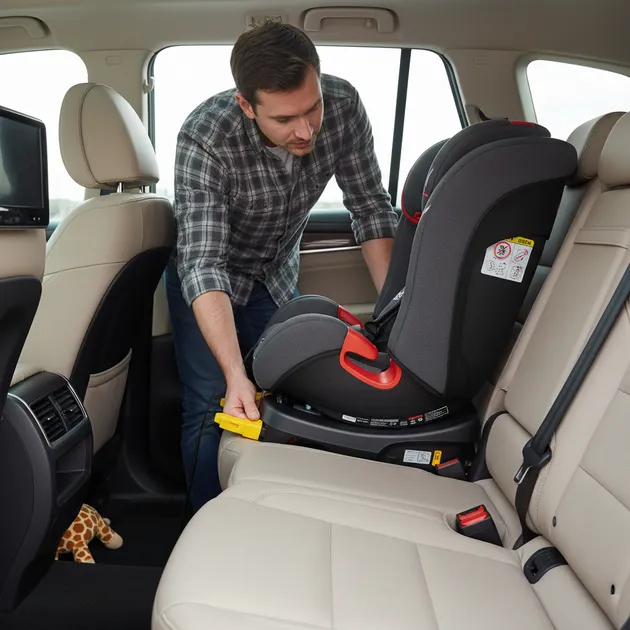
ISOFIX is the safest and easiest system for securing a car seat in your vehicle. Instead of threading a seatbelt through the seat, you click the ISOFIX arms directly into the car's anchor points. This creates a firm, stable connection that is difficult to install incorrectly.
Yet many parents still make mistakes during installation. In this guide you'll find everything you need to know about ISOFIX, how it works, step-by-step installation, and the most common mistakes to avoid.
What is ISOFIX?
ISOFIX is an internationally standardized anchor system for child car seats. It was developed to eliminate the most common cause of poor car seat safety, incorrect installation with a seatbelt.
The system consists of two metal bars located between the seat cushion and the backrest of the car seat. The child seat has two corresponding arms with click-connectors that attach directly to these bars. The result is a firm, fast, and fail-safe connection.
Three types of ISOFIX installation
ISOFIX seats use different methods to prevent the seat from rotating forward in a collision:
- Support leg, an adjustable leg from the seat to the car floor. The most common solution for rear-facing seats.
- Top tether, a strap from the top of the seat attached to an anchor point at the rear of the car. Most commonly used for forward-facing seats.
- Some seats use both for extra stability.
Check the manual: The car seat manual always indicates which anti-rotation method should be used. Some cars don't have floor space for a support leg (e.g., over a storage compartment), in which case you need a seat with a top tether instead.
Does your car have ISOFIX?
All new cars sold in the EU/EEA from 2014 onwards include ISOFIX as standard. Many older cars have it too, going back to the early 2000s.
How to check
- Look between the seat cushion and backrest of the rear seat. Feel for two metal bars approximately 28 cm apart.
- Look for markings. Many cars have a small ISOFIX symbol (child seat icons or the text "ISOFIX") on or near the seat.
- Check the car's owner manual. It will state which seats have ISOFIX anchors.
- Check for a top tether anchor. Look for a small metal hook with an anchor symbol behind the backrest or on the back of the rear seat.
Older car without ISOFIX? You can still use a safe car seat. Many ISOFIX seats can also be installed with a seatbelt. Some garages can retrofit ISOFIX into older cars, ask your car dealer.
ISOFIX vs. belt installation
Both methods are approved and safe, but ISOFIX has clear advantages.
| ISOFIX | Belt installation | |
|---|---|---|
| Easy installation | Click-connector, hard to get wrong | Requires correct belt routing, easier to make mistakes |
| Stability | Firm connection, minimal movement | Can loosen over time |
| Misuse rate | Very low | Up to 50% incorrectly installed (road safety studies) |
| Flexibility | Requires ISOFIX anchors in the car | Works in all cars with a three-point belt |
| Price | Somewhat more expensive | Less expensive |
When belt installation is the right choice
Belt installation is a good option if your car doesn't have ISOFIX, or if you need to move the seat between multiple cars. The key is to follow the car seat manual exactly and tighten the belt securely.
Step-by-step: Installing a car seat with ISOFIX
Here's how to safely install an ISOFIX car seat:
1. Locate the ISOFIX anchors
Feel between the seat cushion and backrest for the two metal bars. Some cars have plastic covers you need to remove first.
2. Extend the ISOFIX arms
Most car seats have a button or lever that releases the ISOFIX arms from the seat. Pull them out to their full length.
3. Connect to the anchors
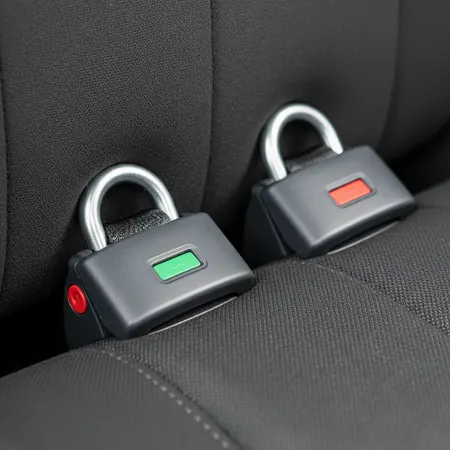
Guide the seat's ISOFIX arms toward the car's metal bars. You should hear a clear click from both sides. Many seats have color indicators, green means correctly attached.
4. Set up anti-rotation
- Support leg: Adjust the leg down to the car floor. It should stand stable and firm. Check that there is no storage compartment underneath.
- Top tether: Pass the strap over the backrest and attach it to the anchor point at the rear. Tighten until firm.
5. Check the installation
Grab the seat and try to twist and pull it. The seat should not move more than 2–3 cm in any direction. Check the color indicators, all should show green.
Never use ISOFIX and a seatbelt at the same time unless the car seat manual specifically instructs you to. The two systems are designed to work independently of each other.
The i-Size standard (R129)
i-Size (ECE R129) is the latest European safety standard for child car seats. It has stricter requirements than the older R44 standard, and ISOFIX is a central part.
Key requirements in i-Size
- ISOFIX is standard for all i-Size seats (except booster cushions for older children)
- Rear-facing until at least 15 months and 76 cm (road safety authorities recommend rear-facing until age 4)
- Side-impact protection is mandatory (not required under R44)
- Based on height, not weight, easier to choose the right seat
- Stricter crash tests with more realistic test dummies
Safety recommendation: Even though i-Size requires rear-facing until 15 months, road safety experts recommend keeping children rear-facing as long as possible, ideally until age 4. Scandinavian children have among the lowest car fatality rates in Europe, largely due to the long rear-facing tradition.
R44 vs. i-Size, what does it mean for you?
From September 2024, it is prohibited to sell new car seats with only R44 approval in the EU/EEA. Seats you already own with R44 markings are still legal to use. When buying a new seat, choose i-Size.
Common ISOFIX installation mistakes
Even though ISOFIX is simpler than belt installation, parents still make errors:
- Not clicked in properly. Both sides must click into place. Check the color indicators.
- Support leg standing on a storage compartment. The lid can give way in a collision. Place a rigid board over the compartment, or use a seat with a top tether.
- Top tether not tightened. A loose top tether gives the seat much more forward movement.
- Wrong seat chosen. Not all seats have ISOFIX anchors. The center rear seat rarely has ISOFIX.
- Thick winter jacket left on under harness straps. Always remove the outer jacket. Place a blanket over the child after the straps are tightened.
- Seat used past its expiry date. Car seats have a lifespan of 6–10 years from the date of manufacture.
When should the child turn forward-facing?
This is one of the most common questions parents have. Here are the guidelines:
Legal requirement (EU/i-Size): Rear-facing until at least 15 months and 76 cm.
Expert recommendation: Rear-facing as long as possible, ideally until age 4 and 18 kg.
The reason is simple: in a frontal collision, the body is thrown forward. Small children have a large and heavy head relative to their body. Rear-facing distributes the forces across the entire back. Forward-facing places enormous strain on the neck.
Research from VTI (the Swedish National Road and Transport Research Institute) shows that rear-facing is up to 5 times safer for children under 4 years old.
Don't turn too early. Many parents switch to forward-facing because the child's legs touch the backrest. This is normal and harmless. Children often sit with bent legs and are perfectly comfortable rear-facing long after their legs appear too long.
Car seat laws
Traffic regulations are clear:
- Children under 135 cm must use approved safety equipment suited to the child's size
- All new car seats must have ECE R129 marking (i-Size)
- Older R44/04-approved seats are still legal to use
- Front seat: Children may sit in front, but NEVER in a rear-facing seat with an active front passenger airbag
- Fines: The driver receives a fixed penalty for each child without approved restraint
Road safety authorities recommend a car seat or booster cushion until the child is 150 cm, even though the legal requirement is 135 cm.
Safety testing and approvals
All car seats sold must be approved under either ECE R44/04 or ECE R129 (i-Size). Look for the approval mark (E-mark with country code) on the seat.
Independent tests
- ADAC/TCS, the most recognized independent testing organization in Europe. Tests car seats to stricter standards than legal requirements.
- Road safety organizations, publish recommendations based on European tests
- Consumer organizations, provide advice and tips on child safety in cars
Check the test results: Before buying, search for the model on ADAC's website. They test crash performance, usability, ergonomics, and harmful substances. Seats rated "gut" (good) or "sehr gut" (very good) are safe choices.
Scandinavian brands
Scandinavia is a world leader in child car safety. These brands are especially strong on rear-facing and ISOFIX:
BeSafe (Norwegian):
- Focus on extended rear-facing and ISOFIX
- The iZi range is among the best-selling internationally
- Available at major baby retailers and BeSafe.com
Axkid (Swedish):
- Specialized in rear-facing up to 36 kg
- The Minikid range is a classic
- Solid seats with long lifespan
Other good brands: Cybex (German), Britax Römer (British/German), Maxi-Cosi (Dutch), Joie (British)
Checklist: Before you buy an ISOFIX car seat
Use this checklist to make sure you choose the right seat:
- Check whether your car has ISOFIX anchors
- Check whether your car has a top tether anchor point
- Choose a seat with i-Size (R129) approval
- Verify compatibility with your car model
- Choose rear-facing for children under 4 years old
- Check ADAC test results
- Try installation in the store before purchasing
- Confirm that the support leg or top tether fits
Frequently asked questions
Do all cars have ISOFIX?
All new cars sold in the EU/EEA from 2014 have ISOFIX as standard. Many older cars have it too. Check your car's owner manual or feel for metal bars between the seat cushion and backrest in the rear seat. Some cars only have ISOFIX on the two outer rear seats.
Can I use an ISOFIX car seat without ISOFIX in the car?
Many ISOFIX car seats can also be installed with a seatbelt. Check the car seat manual. Installation is safe with either method, but ISOFIX provides simpler and more fail-safe installation.
How long does an ISOFIX car seat last?
Most car seats have a lifespan of 6–10 years from the date of manufacture, depending on the manufacturer and model. Check the label on the seat for the production date and expiry date. After expiry, the seat should not be used.
Is it safe to buy a second-hand ISOFIX car seat?
Second-hand is OK if you know the seat's history. The seat must never have been in an accident, all parts must be intact, and it must not have exceeded its lifespan. Check that the ISOFIX arms click properly and that the color indicators work. Never buy second-hand from strangers.
Can my child sit in the center rear seat with ISOFIX?
Most cars only have ISOFIX on the two outer rear seats. Some newer cars (e.g., certain Volvo models) also have ISOFIX in the center. Check your car's manual. The center rear seat is statistically the safest place for a child, so belt installation there can be a good option.
Read more
- Child car seat safety guide
- Childproofing your home
- Stroller: How to choose the right one
- Flying with a baby
Sources
- VTI. Rearward-facing car seats
- BeSafe. Car seats and ISOFIX
- ADAC. Child seat tests
- European Commission, i-Size regulation
Last updated: March 2026
🔧 Helpful Tools
- All Baby Tools. Browse all free tools for pregnancy and baby care
📖 Related Articles
- How to Choose a Car Seat for Your Baby. Choosing the right car seat depends on your child's age, weight, and height. Learn the stages of car seats, key safety features, and installation tips.