First flight with a baby? You are not alone in feeling nervous. With a bit of planning, it goes surprisingly well. This guide covers everything from ticket prices and baggage rules to how to prevent ear pain, based on guidelines from major airlines and pediatric health authorities.
How Old Does a Baby Have to Be to Fly?
Infants can fly from as young as 2 weeks old. Most airlines and doctors recommend waiting until the baby is at least 7 days old.
A baby is counted as an infant until they turn 2 years old. After that, the child needs their own ticket and seat.
Babies under 1 week old should generally not fly. Talk to your doctor first if your baby was premature or has health problems.
What Does It Cost to Fly with a Baby?
Most major airlines follow a similar pricing structure:
| Domestic flights (0–2 years) | International flights (0–2 years) | Children 2–11 years | |
|---|---|---|---|
| Lap infant | Free or small fee | ~10% of adult fare + taxes | Discounted child fare |
The child must be under 2 on the travel date (some airlines also check the return date). If the child turns 2 before the return flight, a child ticket may be required for the full journey.
One adult can carry a maximum of two lap infants, but if you have two, one of them must have their own seat with an approved car seat.
Stroller and Car Seat on the Plane
Most airlines allow you to check a stroller and car seat for free, in addition to your regular baggage allowance. The equipment is checked in as special baggage at the check-in desk or at the gate.
Tips:
- A lightweight umbrella stroller is the easiest to travel with
- Some airlines require strollers to be placed in a plastic bag or protective box
- A travel system (stroller + car seat) is practical, the seat can be detached from the frame
If you want to use a car seat on board, you must purchase a seat for your child. The car seat should be placed in the window seat and positioned forward-facing on the aircraft.
Approved car seats for air travel:
- European standard: labeled ECE R44-04 or ECE R129, with "For use in Aircraft"
- US standard: FMVSS No 213 with red text "Certified for use in motor vehicles and aircraft"
Baby Food and Milk Through Security
Good news: Baby food is exempt from the 100 ml rule in most countries.
According to most airport security regulations, you may bring:
- Breast milk and infant formula (even over 100 ml)
- Baby food in jars
- Water for formula
- Everything the baby needs for the journey
You do not need to place it in a clear plastic bag. Take baby food out of your hand luggage at the security checkpoint, spot checks may occur.
Bring empty water bottles. You can fill them at water stations in the terminal after going through security.
How to Prevent Ear Pain in Your Baby
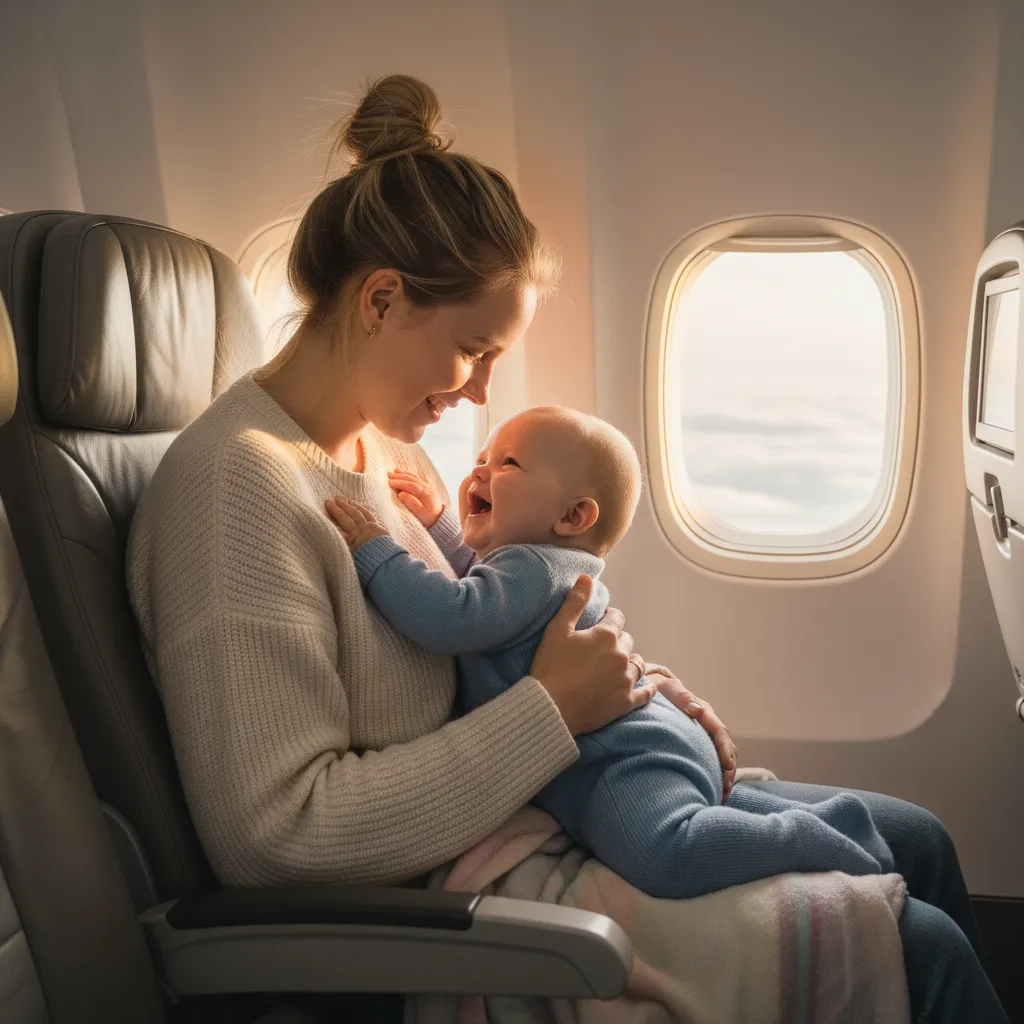
The most common problem with babies on planes is ear pain during descent. A baby's eustachian tube is not fully developed, making pressure equalization harder than for adults.
Preventive Measures
- Breastfeed or bottle-feed during descent: Swallowing continuously equalizes pressure. Start when the plane begins to descend
- Pacifier: Also works, but slightly less effective than feeding
- Keep the baby awake: People swallow less frequently when asleep, so swallowing to equalize pressure happens less
- Nasal spray: Can help preventively if your baby has a cold. Give it before the plane begins its descent
- Squeeze pouches: For babies over 6 months
Ear pain on a plane is harmless and disappears shortly after landing. Lasting complications are very rare.
Do not fly with an active ear infection. The pressure changes can make the pain much worse. Consult a doctor first.
Practical tip: Make sure your baby is a little hungry during descent so they will want to feed. Many experienced parents wait to feed the baby until the plane begins its descent.
Passports and Travel Documents for Your Baby
International Travel
All children need their own passport for travel outside their home country. Children cannot be added to a parent's passport.
How to apply for a passport for your baby:
- Apply at your nearest passport office or government office (allow 4–6 weeks processing time)
- Both parents or guardians typically need to consent
- Bring your baby to the appointment, the photo is usually taken there
- Children's passports are valid for 5 years in most countries
Validity: Always check the expiration date before booking, many countries require that a passport be valid for at least 6 months beyond the trip dates.
Domestic Travel
Airlines may ask for proof of the child's age. Carry the birth certificate or a health record card to confirm your baby's age.
Emergency Passport
Forgot the passport? Emergency or expedited passports can often be obtained at a passport office or major airport. Check your country's official passport authority for requirements.
Where Should You Sit with a Baby?
- Toward the back of the plane: More engine noise (which can be soothing), and easier to get up without disturbing other passengers
- By the aisle: Easier to get up with diapers and a stroller
- Not two infants in the same row: Airlines typically allow only one lap infant per row due to the number of oxygen masks available
Some airlines offer bassinets (sky cots) on long-haul flights for children up to a certain weight and height. Book in advance through the airline.
Many larger airports have family lanes at security that make the process a little easier with young children.
Packing List for Flying with a Baby
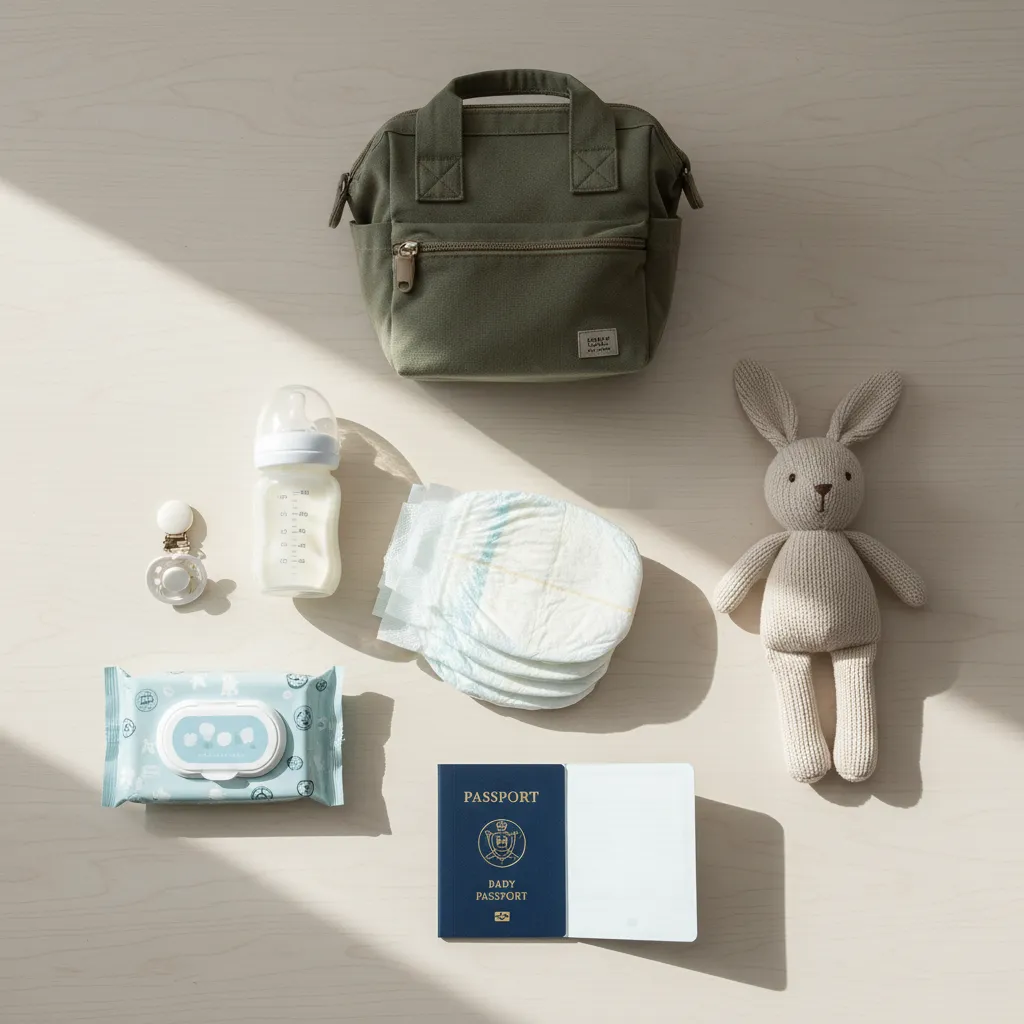
A good packing list makes the difference between a stress-free flight and chaos. Here is a complete overview of everything you should bring, organized by category.
Documents
- Baby's passport (international travel)
- Birth certificate or health record card (domestic travel, to confirm age)
- Insurance documents and travel health insurance card (for international travel)
- Boarding pass (tip: download the airline app for a mobile boarding pass)
- Consent letter from the other parent (if traveling alone internationally with the child)
Diapers and Changing
- Diapers, estimate at least 1 per hour + 3–4 extra for delays
- Wet wipes (bring an extra pack)
- Travel changing mat
- Disposal bags for used diapers and dirty clothes
- Diaper cream (small tube)
Food and Drink
- Breast milk, formula, or water (exempt from liquid restrictions)
- Bottles and pacifiers (bring spares)
- Baby food in jars or squeeze pouches (babies over 6 months)
- Small snacks, rice cakes, fruit pieces, crackers (babies over 6 months)
- Spoon and bib
- Empty water bottles (fill after security)
Entertainment
- Pacifier or favorite comfort toy
- 1–2 small quiet toys (teething toys, soft books, stacking cups)
- Picture books
- For older babies (10+ months): stickers, drawing supplies, tablet with downloaded videos
Clothing
- Change of clothes for the baby, at least 2 sets (diaper leaks and spit-up happen)
- An extra top for yourself (you will be spit up on!)
- Light blanket or large scarf (multipurpose: warmth, nursing cover, play mat)
- Extra socks and hat (it can get cold in the cabin)
- Light jacket for the baby
Medicines and Health
- Children's acetaminophen (paracetamol) in the correct dosage for your baby's weight
- Children's nasal spray (for congestion, prevents ear pain)
- Any regular medication your baby takes
- Band-aids and antibacterial cream
- Sunscreen (for travel to warm climates)
Checked Baggage (usually free)
- Stroller (checked in at the gate or check-in desk)
- Car seat (if using it on board, your child needs their own seat)
Packing tip: Put the essentials (diapers, food, a change of clothes) in a small bag you can easily access in the cabin. Pack a full change of clothes in a zip-lock bag, ready to use during a leak without rummaging through the whole bag.

Frequently Asked Questions
Is it free to bring a stroller on a plane?
Most major airlines allow you to check a stroller and car seat for free, in addition to your regular baggage allowance. Check your specific airline's policy before you fly.
Can I breastfeed during takeoff and landing?
Yes. It is both permitted and recommended. Swallowing helps your baby equalize the pressure in their ears.
Can I travel with a baby without a passport?
On domestic flights, a passport is usually not required, but you should carry proof of the child's age (birth certificate or health record). For all international travel, your child will need their own passport.
How do I prevent ear pain during descent?
Feed your baby (breastfeed or bottle-feed) during the descent. A pacifier can also help. Keep your baby awake during landing. See the ear pain section above for more detail.
Summary
Flying with a baby requires a little extra planning, but it is far easier than most people expect. Apply for a passport well in advance, pack smart, and remember: feeding during descent is the best trick for preventing ear pain. Wondering how much your baby should sleep during the trip? Read our guide to sleep needs by age to plan your travel days better.
Sources
- FAA. Flying with Children
- TSA. Traveling with Children
- AAP. Air Travel with Baby
- Mayo Clinic. Ear pain during flights
🔧 Helpful Tools
- Baby Sleep Tracker. Track and optimize your baby's sleep
- Baby Food Guide. Safe foods and introduction schedule for your baby
- All Baby Tools. Browse all free tools for pregnancy and baby care