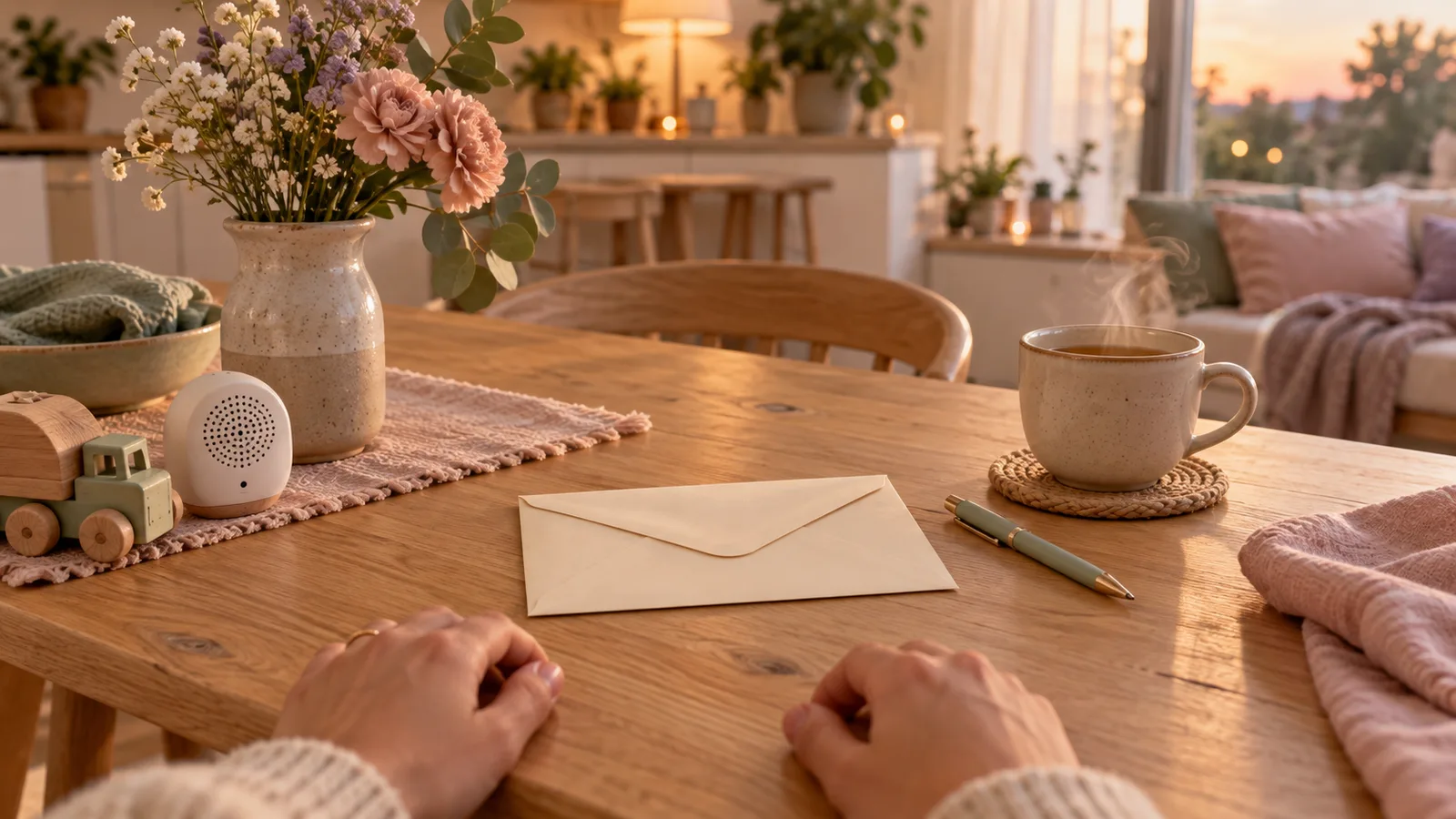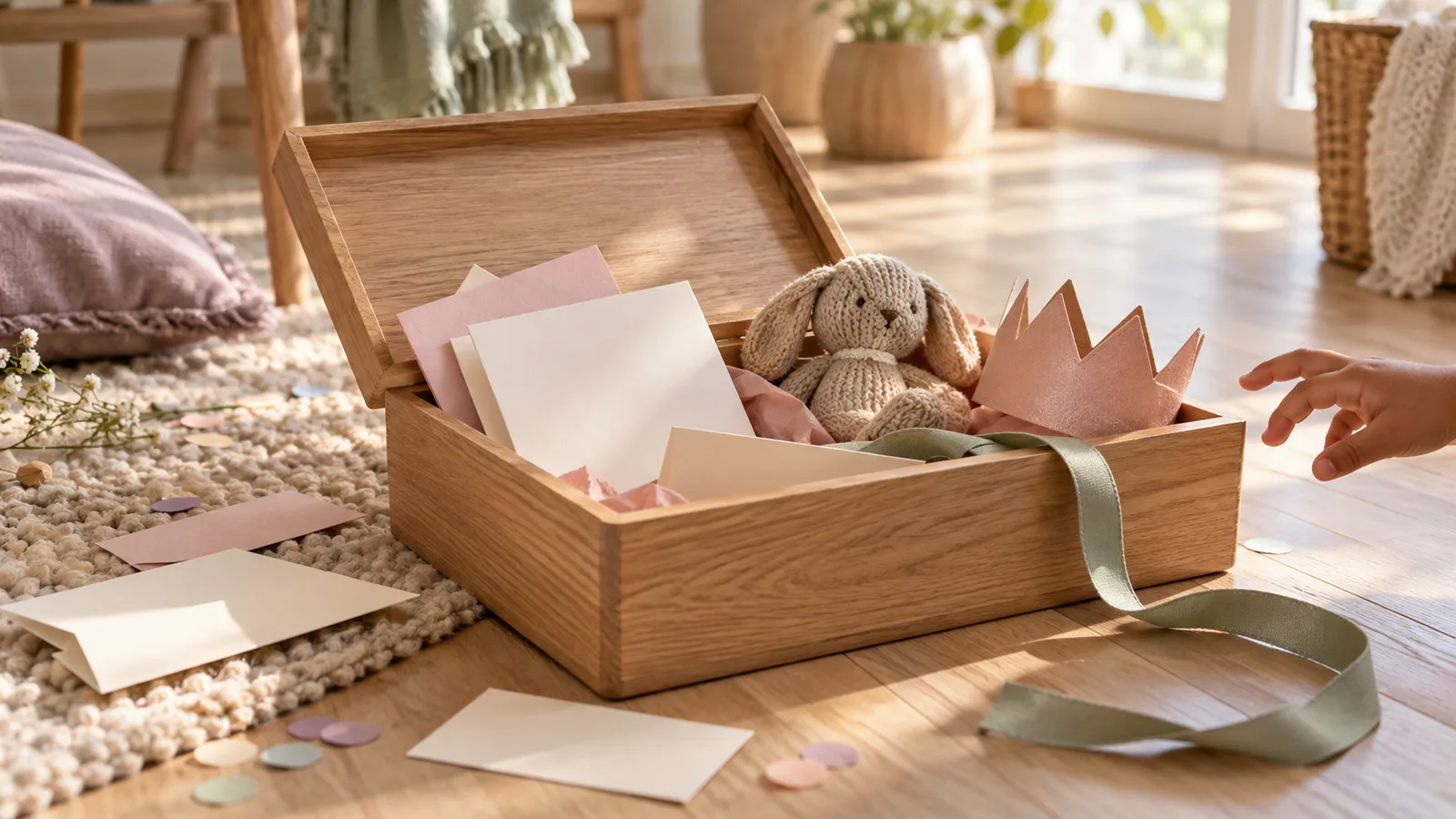
The party is two weeks away, someone has said "time capsule," and now you need to know what goes in the box. A first birthday time capsule can be a letter, a list of the year's moments and a few small things, packed so that tape, glue and damp stay away from them.
This guide covers what to put in a first birthday time capsule, what to leave out, a short version of the letter, party ideas, how to store the box and when to open it. The storage rules come from the National Archives and the Library of Congress.
Put words in first: a letter from you, a list of the year's memories and short notes from the people at the party. Add a few small things from the year, keep photographs in archival sleeves without tape or glue, and store the box somewhere cool and dry, not the attic, basement or garage.
Key Takeaways
- Words first. A letter, a list of the year's moments and guests' notes come before any objects.
- Nothing sticky or squeezing on photographs. The Library of Congress says no paper clips, rubber bands, tape, sticky notes or glue.
- Cool and dry. The National Archives says below 75°F and below 65% relative humidity, out of damp basements, garages and hot attics.
- Print what matters. The Library of Congress says digital materials can be more difficult to preserve than physical ones.
- Pick the opening date now and write it on the outside of the box.
What to Put in a First Birthday Time Capsule
Start with words, then add a few small things. The table lists ten ideas, why each earns a place and how to protect it.
| Item | Why keep it | How to protect it |
|---|---|---|
| A letter from you | It records the year in your own voice. | Flat in an envelope or folder, with no paper clip, rubber band or tape. |
| A year of memories in words | It holds the small moments a photograph does not show. | Copy your favorites onto sheets of paper and keep them flat. |
| Notes from party guests | Each note adds a voice from the day. | Plain cards, no stickers or glue, kept flat. |
| A "this year in numbers" card | Prices change, and written down they show what the year cost. | Write the price of bread, gas and a stamp on one card. |
| Songs, shows and books from the year | It lists what the house played and read. | Write the list on paper. |
| One or two printed photographs | They show a face and the room the year happened in. | A sleeve of uncoated polyester, polyethylene or polypropylene. No clips, bands, tape, sticky notes or glue. Label only if you must, on the back near the edge, in soft graphite pencil (Library of Congress). |
| A predictions card | Family guesses about the birthday child at 18, to check when you open the box. | One sheet, kept flat. |
| A small piece of clothing | It is something the birthday child wore that year. | Clean and fully dry. Neither archive page covers fabric, so this one is our suggestion. |
| The year's headlines, written out | They show what the news was without newsprint in the box. | Write or type five or six on a sheet. If you add a real newspaper, give it its own folder. |
| A pencil tracing of a hand | It shows size at one year in outline. | Trace on plain paper and keep it flat. |
A letter and a handful of guest notes make a full capsule.
What to Put in a Time Capsule So It Lasts (and What to Leave Out)
Paper and photographs last longer when they sit cool and dry, lie flat and stay clear of anything that sticks or squeezes. The rules below come from the National Archives page on preserving family archives and the Library of Congress pages on photographs and works on paper. If their numbers differ, this guide names the page.
Leave these out:
- Paper clips, rubber bands and other fasteners. The Library of Congress says not to use paper clips, rubber bands or other mechanical fasteners to mark or organize prints, and its page on works on paper gives the same advice for paper, with tape and glue added. The National Archives also lists rubber bands, pressure-sensitive tape, several glues, and non-stainless steel staples and paper clips among the materials to avoid.
- Tape, sticky notes, glue and other adhesives on photographs. The photograph page names all four.
- Unknown plastics and PVC. The National Archives recommends sleeves of stable plastics such as polyester, polypropylene or polyethylene, and says to avoid unknown plastics and polyvinyl chloride (PVC). The Library of Congress names uncoated polyester, polyethylene and polypropylene, and warns that photographs may stick to plastic sleeves in high humidity, especially above 70%. Keep plastic sleeves out of damp spots; photo-safe paper enclosures are the other option it lists.
- An overstuffed box. The National Archives says not to overstuff the box and to size it so items do not shift.
- Food, liquids and anything that can rot or leak. Leaving them out is our rule. The National Archives adds that items should be stored away from food and water, which attract insects and rodents.
- A USB stick or disc as the only copy. The Library of Congress says digital materials can be more difficult to preserve than physical materials. Print what matters and keep the paper in the box.
- Newspaper touching letters or photographs. The Library of Congress advises storing acidic papers individually so acids do not migrate into other works on paper. Its page does not name newspaper, so applying the advice to a newspaper is our judgment. Give any real newspaper its own folder.
How to Write a Time Capsule Letter
The letter is the part only you can write, and a short first birthday letter is enough. Four things fill it:
- A moment from the party. Who came, what the room sounded like, what your child did with the cake.
- Who your child is right now. What they reach for, what makes them laugh, where they like to fall asleep.
- What you hope. One or two lines.
- An "open on" date. Write it on the envelope.
A sample opening:
Dear [Name],
Today you turned one. Your grandparents sang, half the cake ended up on the floor, and you fell asleep in the car before the last guest left. These days you laugh when the dog sneezes and carry a wooden spoon from room to room. We hope you stay curious. Open this on [date].
For longer guides to the letter itself, see a letter to your son and a letter to your daughter.
A Year in Words: Keep the List All Year
A running list is easier to write across twelve months than the night before the party. If a line a day suits you, see a line a day, all year.
Twelve line starters to copy into your notes:
- The sound you made when...
- Your favorite place to fall asleep is...
- Today you laughed at...
- You reached for...
- The song that settled the house was...
- When a stranger said hello, you...
- The meal you wore was...
- The toy that went everywhere with us was...
- The word we kept hearing you try was...
- A day we will talk about for years was...
- The thing that made your grandparents laugh was...
- The ordinary evening we want to keep is...
You do not need a checklist of firsts. For a general picture of the year, see what the first birthday often looks like; the capsule works with only the moments you noticed.
Keep the list all year in Memory Book: a dated entry for each moment, tagged with First smile, First word, First steps or Birthday when one fits, and grouped by month. It is free and works without an account. On the birthday, copy your favorites onto cards for the capsule. Memory Book does not print, so the copying is by hand.
Memory Book holds text and milestone tags only. Photographs for the capsule come from your camera roll or a print shop.
Time Capsule Ideas for the First Birthday Party
- A guest-letter station. Set out plain cards, something to write with and a sign that says "Open on" with the date.
- A predictions jar. Guests drop in slips guessing what the birthday child will be like at 18. Empty the jar into an envelope before you pack the box.
- A photograph of each guest. Take the pictures at the party, print one or two later and put them in sleeves.
- A family signature on the lid. Family and guests sign the outside of the box, keeping ink off the papers inside.
- A gift that fits in an envelope. Bringing a present? A short note on a plain card, written for the box, is easy to carry.
How Do You Store a Time Capsule So It Lasts?
The box. The National Archives says to use a container big enough for items to lie flat or stand without folding, and made of lignin-free and acid-free or buffered board. A box that holds photographs should have passed the Photographic Activity Test (PAT). The Library of Congress also calls for photo-safe boxes for photographs, and lists acid- and lignin-free folders and document boxes from preservation suppliers, alkaline buffered or neutral pH. It adds that some media on paper can be sensitive to alkaline pH.
The place. The National Archives says to keep the temperature below 75°F and the relative humidity below 65%, avoid humidity below 15% and store items out of damp basements, garages and hot attics. For photographs, the Library of Congress gives a tighter range of 30-50% relative humidity and 70°F or below, and says to avoid attics, basements and spots close to vents, fireplaces and radiators. If your box holds photographs, aim for the Library of Congress range; that pick is our suggestion. The National Archives also says to keep items on a shelf, away from pipes, windows and known roof leaks. A closet shelf in the part of the house you live in is one option; neither page names a closet, so that choice is ours.
The label. Put a contents list on the outside of the box, where a taped sheet cannot touch the papers inside.
The second copy. Keep a copy of the letter and the contents list outside the box, for example in our free Memory Book, on this device or synced to a free account. A letter of a couple of pages fits in one memory. Without an account, entries stay in that browser on that device; signing in syncs them to your account. The paper original stays in the box.
For the rest of the year's keepsakes, see how a paper or digital memory book compares.
When Should You Open a Time Capsule?
Pick the date now. You might choose the 10th birthday, high school graduation or the 18th birthday. Write it on the outside of the box and on each envelope inside. A time capsule for a baby can sit for years, so tell a second adult where the box is.
Frequently Asked Questions
What do you put in a first birthday time capsule?
Start with words: a letter from you, a list of the year's memories and short notes from party guests. Add a few small things from the year, and keep any photographs in sleeves made of uncoated polyester, polyethylene or polypropylene.
What should you not put in a time capsule?
Keep rubber bands, paper clips, tape, sticky notes and glue off photographs, says the Library of Congress. Also leave out food, liquids and anything that can rot or leak.
How do you store a 1st birthday time capsule so it lasts?
Keep it below 75°F and 65% relative humidity, out of damp basements, garages and hot attics, says the National Archives. Use a box made of lignin-free and acid-free or buffered board, and do not overstuff it.
When do you open a first birthday time capsule?
That is your family's choice. You might pick the 10th birthday, high school graduation or the 18th birthday. Write the date on the outside of the box and on each envelope inside.
What do you write in a time capsule letter?
A moment from the party, who your child is right now, what you hope, and the date to open it. Use plain paper and keep paper clips and tape away from it.
How This Guide Was Made
The Babysential Team wrote this guide from the National Archives and Library of Congress pages listed below, opened on October 17, 2026, with AI-assisted drafting. Our own suggestions are marked as ours.
Sources
- How to Preserve Family Archives (papers and photographs). National Archives, page last reviewed September 18, 2025
- Care, Handling and Storage of Photographs. Library of Congress, undated page
- Care, Handling and Storage of Works on Paper. Library of Congress, undated page
- Personal Archiving: Preserving Your Digital Memories. Library of Congress, undated page