The house is quiet, the dishes are done, and the page headed "Letter to my son" is still blank.
A letter to your son can be plain. One scene, a few true details and a hope are enough, and you can finish all three in about 20 minutes. This guide gives you five steps, prompts for the days worth writing about, two example letters to change, and a plan for keeping the paper safe until he is old enough to read it. Writing to a daughter as well? Our guide to writing to your daughter starts from a different place.
A good letter to your son says what you see in him right now, tells him one story he is too young to remember, and ends with what you hope for him, in your own words. Date it, write when he should open it, and keep a copy somewhere other than the envelope.
Key Takeaways
- Five steps: choose when he will read it, open with a scene from today, say what you see in him, add one story and one hope, then close, date and label the envelope.
- One page is enough. A few lines still count, and a short letter each year adds up to a series.
- Keep paper cool and dry in an acid- and lignin-free folder, away from damp basements, garages and hot attics (National Archives, Library of Congress).
- Keep a second copy. The Library of Congress says digital materials can be harder to preserve than physical ones, so keep both.
How to Write a Letter to Your Son in Five Steps
Set a timer for 20 minutes and put a pen next to a cup of something warm. Your reader is years away, so concrete detail has to do the work that explaining cannot.
1. Decide When He Will Read It
Pick the day before you pick the words. A letter for next week can mention the dog's newest trick, while a letter for his 18th birthday should skip anything that will mean nothing in ten years.
If you cannot choose, write for "whenever you need this one" and say so in the first line.
2. Open With a Scene From Today
Start in the room you are in. A line like "Right now you are asleep in the next room with one arm over your head" puts him in the picture. Save the big statements for later, after he can see what you see.
3. Tell Him What You See in Him Now
Stick to what you can observe: what he does, notices and chooses. He lines up his shoes by the door. He stops to look at every dog. He gives the bigger half away without being asked. Details like these make a better portrait than adjectives do.
4. Add One Story He Won't Remember, and One Hope
Pick one story from before he could hold on to it, such as the day he arrived or how you chose his name. Then add one hope, or two, in your own words. One or two hopes read as a wish. Ten read as a list of rules.
5. Close, Sign, Date It and Mark the Envelope
End with a sentence that sounds like you and sign with the name he uses for you. Write today's date on the letter, and "Open on" plus the day on the envelope. Without a date on the outside, the envelope gives no hint when to open it.
Write the letter in our free Memory Book: put the date you wrote it under When, a title like "Open on your 18th birthday," the letter itself under The memory, and tag it Birthday if it is a birthday letter. Add his name or a nickname under Who if you like.
The When field takes today or earlier, so the "open on" date lives in the title. The memory box holds up to 8,000 characters, about 1,300 words. Memory Book keeps a digital copy only. It does not print or export, so the envelope still needs a letter you write or copy out by hand.
Letter Prompts for Every Age and Occasion
Answer each prompt in a sentence or two, and skip the ones that do not fit.
A Letter to Your Unborn Son
- Describe where you are sitting and what the house is like right now.
- Name the first ordinary day you keep imagining with him.
- Say who else is waiting for him and what they are doing to get ready.
A Letter to Your Newborn Son
- Tell him what the house sounds like at 3 a.m. this week.
- List who came by, what food showed up and what made you cry.
- Pick one small habit of his to remember word for word.
A Letter to Your Son on His First Birthday
- Walk through a regular day, from the first morning noise to the last light off.
- Name what he reaches for first and what makes the whole room stop.
- Say one thing you learned about yourself this year.
If you are gathering objects for a box as well, you can seal it in a first birthday time capsule together with the letter.
A Letter on Every Birthday After That
- Note what he asks for, collects or argues about this year.
- Tell him one thing he taught you in the last twelve months.
- Ask him a question to answer when he reads this.
His First Day of School
- Describe the morning: breakfast, the backpack, who held whose hand.
- Say what you wanted to tell him at the door and didn't.
- Name something you are proud of that has nothing to do with school.
After a Hard Day
This one can be short, and it can go to him that night instead of into the envelope.
- Say what happened in one sentence with no blame in it.
- Say what you wish you had done instead.
- Tell him what is still true.
A Letter for His 18th Birthday
- Remember the first time you held him.
- Pick one line from an earlier letter to read aloud to him.
- Name something he chose for himself that you admire.
Letters to My Son: One Letter a Year
One letter marks one day. A series lets you set a few years side by side. Chronicle Books publishes Letters to My Son, written by Lea Redmond: 12 letter templates, ten with a prompt to finish and two left blank, each a fold-and-mail envelope with stickers to seal it, so you can postdate the letters and he opens them later.
You can run the same idea for free. Pick one date a year, such as his birthday, and write one letter on it. Label each envelope with the year and an "open on" date, and keep an index card in the same folder listing what each letter covers, so you do not tell the same story twice.
| Letter | What it covers | Open on |
|---|---|---|
| 1 | The night he arrived and his first nickname | His 18th birthday |
| 2 | A normal Tuesday, hour by hour | His 18th birthday |
In between, try a line a day between letters: one sentence in whatever notebook is closest, ready to mine when the date comes around.
An Example Letter to My Son From Mom
Treat this as an example to change. Swap in your own details and keep the lines that sound like you.
Dear [Name],
It is a little after nine, and you fell asleep in the middle of a sentence about the dog. I am sitting on the edge of your bed because getting up felt like too much to ask.
Right now you line your shoes up by the door and get upset when someone moves one. You wave at every bus. You hum while you eat.
Here is a story you will not remember. The first night home, I held you for four hours because I thought that if I put you down, I would miss something. I missed nothing, and I would do it again.
I hope you find work that keeps you curious and friends who tell you the truth with kindness. I hope you always know you can call me.
Love, Mom
Written [date]. Open on your 18th birthday.
A Letter to My Son From Dad
This example is built from a place, a confession and a request. Change anything that does not sound like you.
[Name],
I am writing this in the car outside your school, five minutes before pickup, because it is the only quiet I get all week.
I have a confession. I had read every book before you arrived and still had no idea what I was doing. You were loud and sure of yourself, so I decided you would be fine, and I was right.
Here is what I have worked out since. You do best when someone sits beside you and says nothing for a while. So do I.
If you are reading this, you are older than I am picturing you now. I have one request. Write back. Tell me which parts I got wrong, what I forgot, and what you wish I had said.
Dad
Short Words to My Son for a Card or a Lunchbox
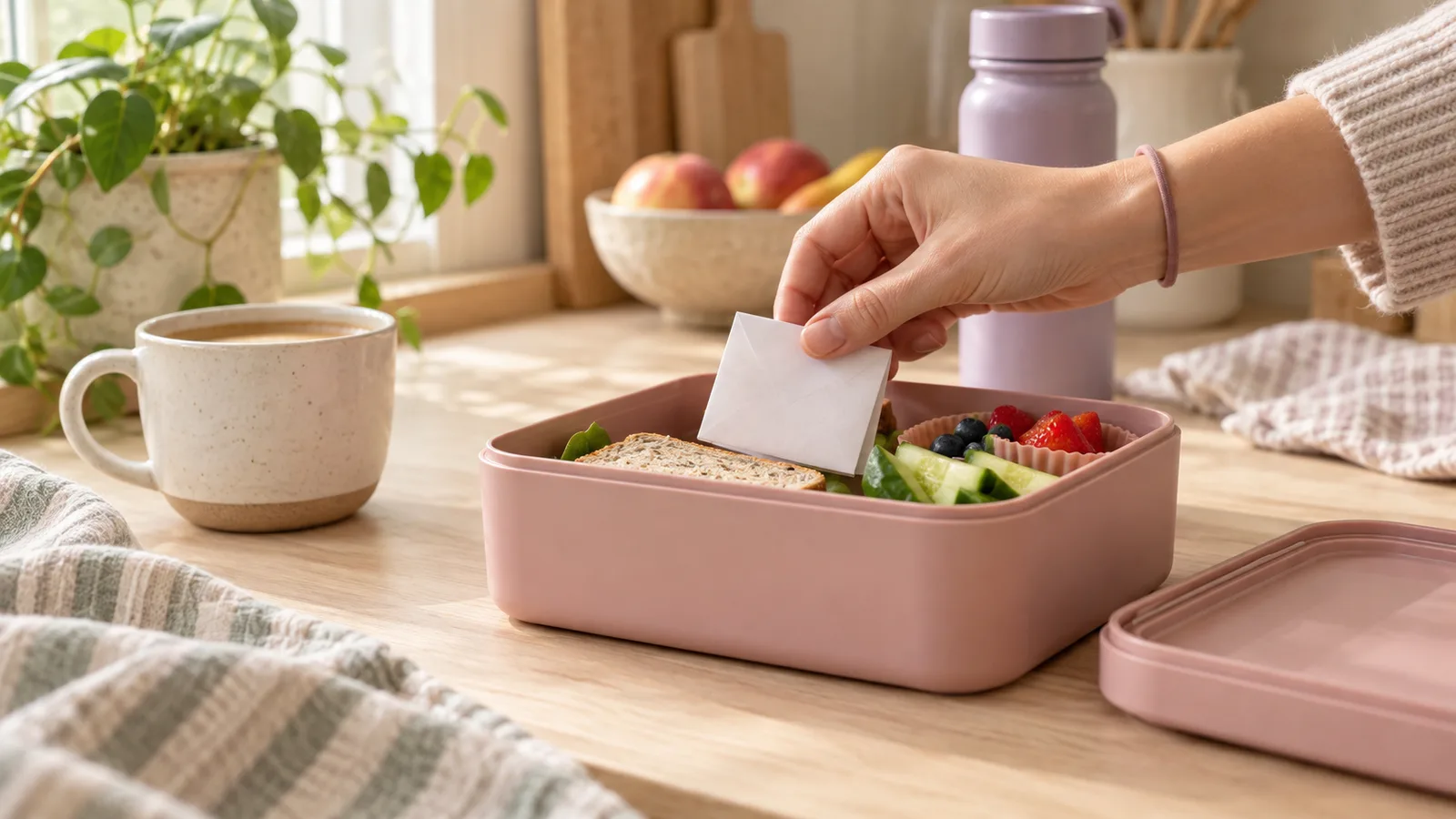
Some messages fit on a card, in a lunchbox or in a text.
- "I saw you hold the door for the whole line. That was good to see."
- "Your question at dinner is still on my mind. Bring me another one tonight."
- "However the test goes, dinner is at six and your chair is saved."
- "You tried the hard thing today. That is the part I care about."
- "Pack your sandwich, your best joke and some patience. See you at three."
- "Good luck today. Whatever happens, tell me about it at dinner."
- "You make our house louder and better."
What to Leave Out of a Letter to Your Son
Three things are worth a second look before you seal the envelope.
- Comparisons with a brother, sister or cousin. Each letter should be about him.
- Adult worries he cannot act on, such as money, a relative's illness or an argument between grown-ups.
- Anything you would not want read aloud at his wedding. If it makes you wince, cut it.
How to Keep a Letter for 18 Years
A letter can wait a long time in a drawer, and the conditions in that drawer matter. This advice comes from the National Archives and the Library of Congress.
Paper
- Folder: board or folder stock that is lignin-free and acid-free or buffered (National Archives). The Library of Congress lists acid- and lignin-free folders and boxes, alkaline buffered or neutral pH, among its protective enclosures.
- Fasteners: no paper clips, rubber bands, self-adhesive tape or glue on paper, and no sticky notes on photographs (Library of Congress).
- Climate: below 75°F and below 65% relative humidity, and not below 15% (National Archives). The Library of Congress aims lower: about 35% relative humidity for paper and 30 to 50% for photographs.
- Place: out of damp basements, garages and hot attics. A closet shelf or dresser drawer inside the living space fits that advice, though the suggestion is ours.
- Light: minimal, and none that is direct or intense (Library of Congress).
- Photographs: if you slip one in, use a sleeve of uncoated polyester, polyethylene or polypropylene, with no adhesive on the photograph.
A Copy Elsewhere
The Library of Congress says digital materials can be more difficult to preserve than physical ones, so keep both. For digital files it suggests at least two copies in different places, a yearly check that you can open them, and new copies every five years or when needed.
Keep a digital copy in Memory Book, on this device or synced to a free account. Memory Book does not print, so the paper copy is the one you write or copy out by hand.
For the rest of the family's memories, see paper or digital.
Frequently Asked Questions
What do you write in a letter to your son?
Write what you see in him now, one story he won't remember and one hope. Specific details, such as what he does, notices and chooses, work better than big statements. One page is enough.
How do I start a letter to my son?
Start with a scene from today, such as "Right now you are asleep in the next room." A concrete picture gets the page moving faster than a speech about how much you love him.
How long should a letter to my son be?
One page is enough, and a few lines still count as a letter. A short letter each year builds a series without any single letter taking long to write.
When should I give my son the letter?
There is no single right age. A birthday, the first day of school or his 18th birthday each work. Write the "open on" date on the envelope so there is no guessing when to open it.
How do I keep a letter safe until he is grown?
Use a folder that is lignin-free and acid-free or buffered, keep it cool and dry, and avoid basements, garages and attics. Keep a second copy elsewhere, and keep the paper too, since digital files can be harder to preserve than physical ones.
How This Guide Was Made
The Babysential Team wrote this guide from the National Archives and Library of Congress pages below, checked on October 17, 2026, with AI-assisted drafting. The prompts and example letters are our own.
Sources
- How to Preserve Family Archives (papers and photographs). National Archives, reviewed 2025
- Care, Handling and Storage of Photographs. Library of Congress
- Care, Handling and Storage of Works on Paper. Library of Congress
- Personal Archiving: Preserving Your Digital Memories. Library of Congress
- Personal Digital Records. Library of Congress