The card is open, the pen is out, and nothing sounds right yet.
Whether it is a letter to my daughter for a big day or a note for tomorrow's lunchbox, it can run two lines or two pages. This guide gives you a five-part structure for the long version, a bank of words about who she is, short messages for ordinary days, two examples and a way to keep everything together. If you also have a son, a letter to your son follows its own method, built around one letter a year.
Write to your daughter about who she is: something she did, something she noticed, a choice she made. Leave her appearance out. A full letter can follow five short parts, and a message can be one true sentence.
Key Takeaways
- Five parts make a full letter: a moment from today, who she is now, a story she won't remember, a hope or two, and a closing line.
- Words are easiest to write when tied to something she did, noticed or chose, with a real memory behind it.
- A message can be one sentence for a lunchbox, a card or a text.
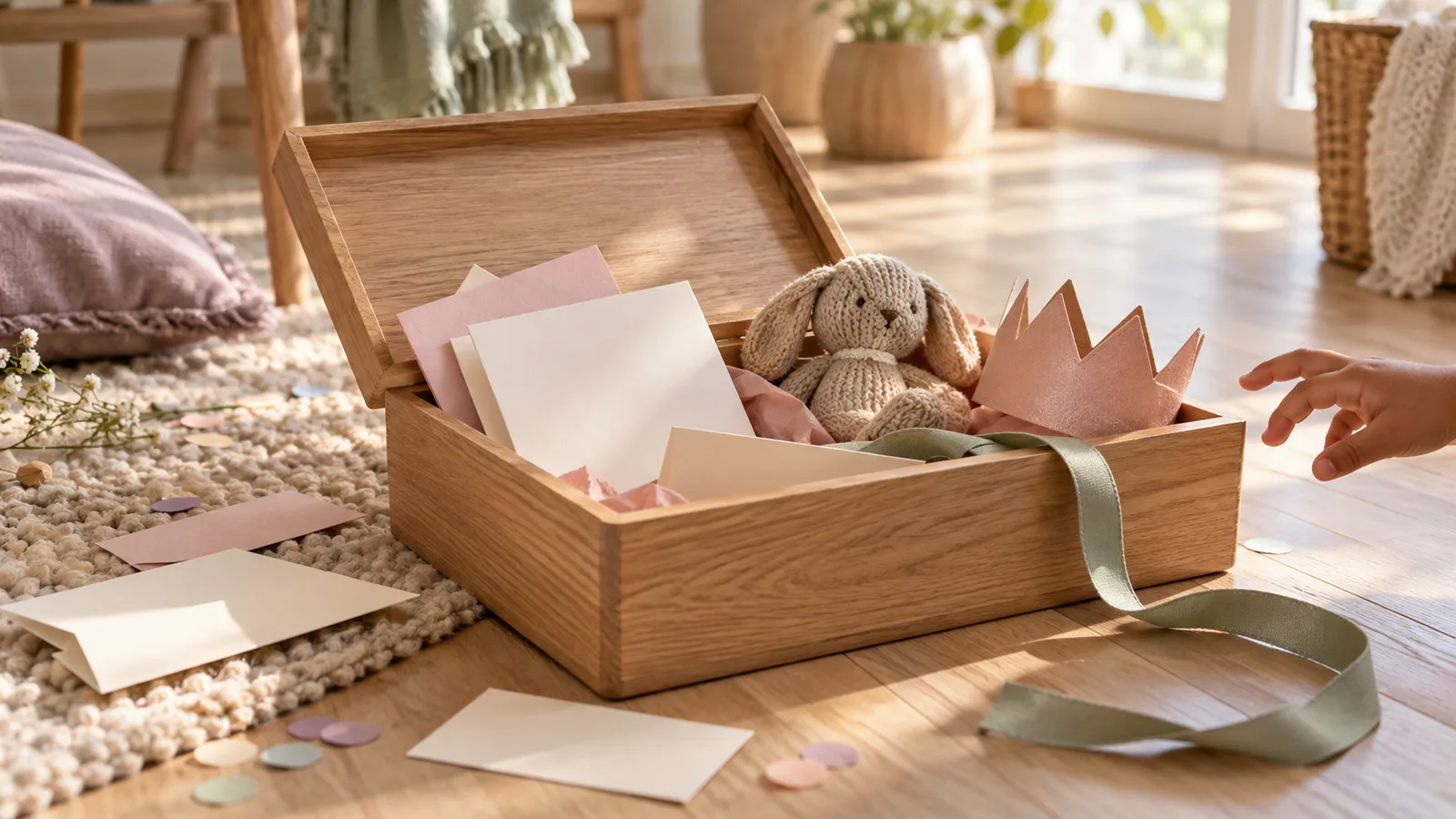
- Give the letters one acid- and lignin-free folder, cool and dry, away from damp basements, garages and hot attics (National Archives, Library of Congress), and make a second copy.
What Should You Write in a Letter to Your Daughter? Five Parts
Five short parts give a letter a spine. Each one can be two or three sentences, and together they make a page she can pick up at any age.
A Moment From Today
Begin with something happening around you: the steam on the window, the sound of her door, the toast she left half eaten. One concrete detail opens a letter faster than a greeting does.
A frame to borrow: "This morning you..."
Who She Is Right Now
Describe what she does, notices and chooses, and use verbs. "You ask a second question after everyone else has moved on" gives her something to recognize. The next section has a bank of phrases to start from.
A Story She Won't Remember
Choose a scene from before she could keep it: the day she was born, a trip, a conversation at a stoplight. Give it a paragraph and let one detail carry the feeling, such as who was there, what the weather did, or what you ate afterward.
What You Hope for Her
Pick one or two hopes and phrase each as something you wish for her, such as "I hope you find a friend who laughs at your worst jokes." Leave out instructions. A hope reads as a wish for her, and an instruction reads as a rule.
A Closing Line She Can Keep
End with a sentence short enough to repeat to herself. "Whatever this year holds, I am on your side" works for almost any year. Sign it, and date it.
Beautiful Words for My Daughter, About Who She Is
Skip her hair, her outfit and her size. Each phrase below names something she does, notices or chooses, and each is built to be finished with an example from your own house. "You keep asking until it makes sense" becomes "You kept asking until it made sense, like the afternoon with the broken kite."
What She Does
- "You keep asking until the answer makes sense."
- "You finish what you start, even when it takes the whole afternoon."
- "You say sorry and mean it."
- "You make up rules for a game and then follow them yourself."
- "You try the hard version first."
What She Notices
- "You see the person standing alone at the edge of the group."
- "You hear the one wrong note in the song."
- "You spot the small detail in a picture that everyone else missed."
- "You can tell when someone in this house is tired, and you turn the music down."
What She Chooses
- "You pick the friend who needs a seat."
- "You tell the truth when it would be easier to stay quiet."
- "You start over instead of giving up."
- "You choose the odd color on purpose."
After each phrase, add "like the time..." and a real memory. A phrase with a memory behind it is easier to write and gives her a real scene to picture.
Short Messages to My Daughter for Ordinary Days
These fit on a sticky note or a text, and each is tagged by the moment it suits. Change the details to match hers.
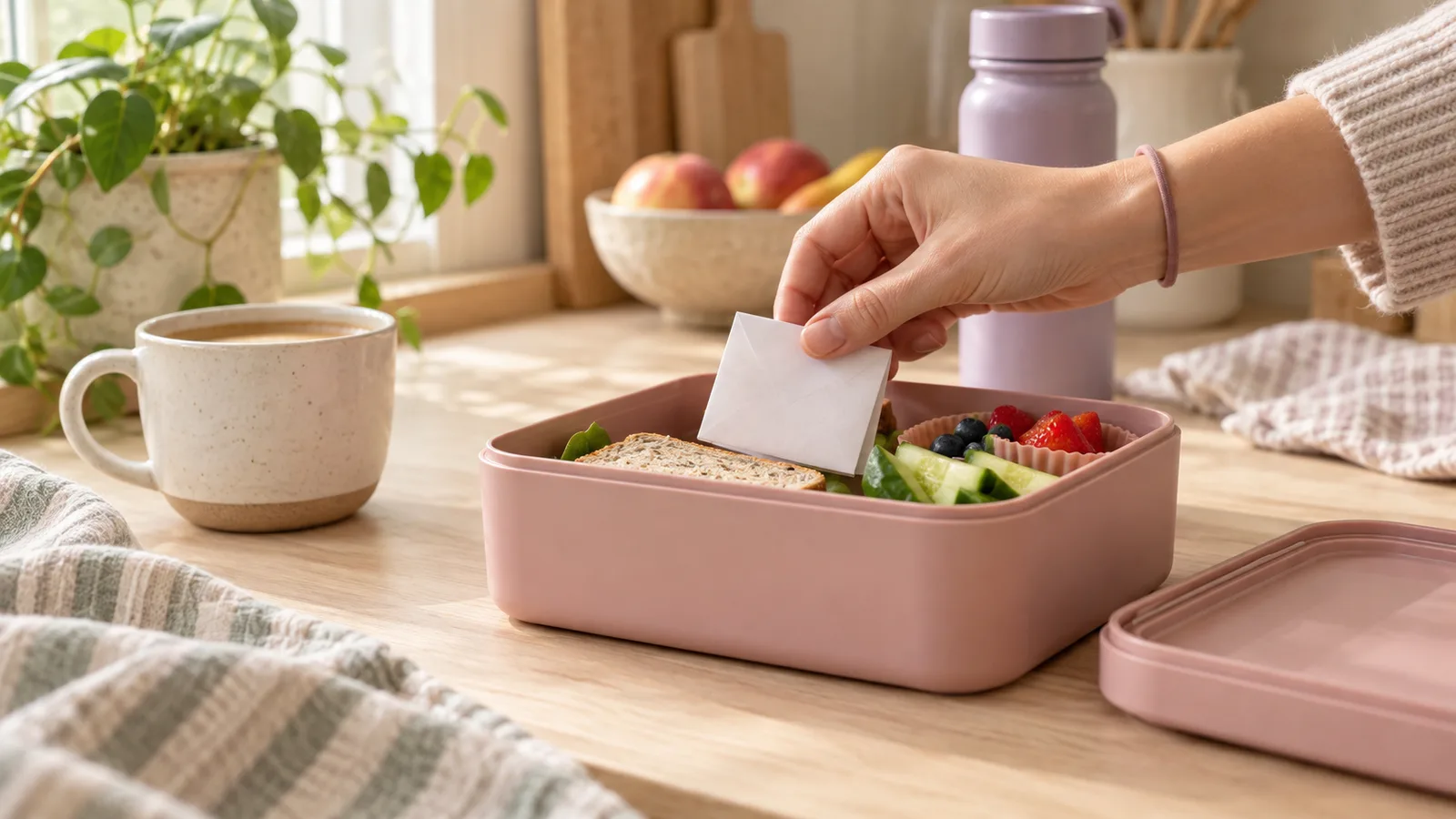
- Lunchbox: "Half of this sandwich is love and half is cheese. Eat both."
- Lunchbox: "Somebody in that cafeteria is lucky to sit with you today."
- First sleepover: "Have a loud, sleepless, wonderful time. Call if you want a ride home, no questions."
- First sleepover: "Brush your teeth even if nobody else does."
- Before a test: "You studied. You know more than you think. Breathe, then begin."
- Before a test: "Whatever the score says, I am proud of how you prepared."
- After a hard day: "Today was hard. Tonight is soft: blankets, snacks, no talking required."
- After a hard day: "I am here, and nothing needs fixing tonight."
- A text when she's older: "Thinking of you at your desk. Drink some water."
- A text when she's older: "No reply needed. I just wanted to say I'm glad you exist."
Keep the short ones too. One dated line in Memory Book takes a minute: the day, a title, the words you said, and the name or nickname she has now. The tool holds text only, so the lunchbox note itself stays on paper.
If you want a habit to start, a one-line-a-day journal is an easy one, and a line a day becomes next year's letter.
A Touching Letter to My Daughter From Mom
This is an example to change. Replace every detail with one of yours.
Dear [Name],
This morning you put on two different socks and announced that matching was boring. I let you walk out the door that way and smiled about it all day.
You are someone who asks the second question. You notice who is sitting alone. You say sorry fast and you mean it, which took me thirty years to learn.
You will not remember the airport. Your shoe fell off on the moving walkway, and you watched it go with the calmest face and said, "Well, that's gone." We laughed until a stranger joined in.
I hope you find people who think your questions are the best part of you. I hope you pick the things that interest you. Whatever this year holds, I am on your side.
Mom
A Letter to My Daughter From Dad
This example uses a different shape: a short list of lessons, written on an ordinary day. Rewrite it in your voice.
[Name],
I wanted to write down what I have learned from you this year, because I keep forgetting to say it out loud.
- Slow down when something is interesting. You spent twenty minutes on one beetle, and I started to see it too.
- Ask for help before it gets hard. You do it without embarrassment, and I am practicing.
- Change your mind when you get new information. You did it at dinner, and the table went quiet with respect.
- Make the rules fair before the game starts.
A longer letter is coming for your next big day. This one is for a Tuesday.
I am proud of you, and I am paying attention.
Dad
Letters for Her Biggest Days
For a longer letter, a few questions can unlock the first paragraph. Answer two or three and let the rest go.
Before She Is Born
- Do you picture the two of you on a slow Sunday? Describe it.
- Name the small things you have already bought and keep rearranging.
Her First Birthday
- What did she teach you this year?
- Say which sound in the house you would bottle if you could.
These questions also work on a card to drop into a first birthday time capsule.
The Day She Starts School
- Describe the outfit she picked and the negotiation that came with it.
- Tell her one thing you hope she asks a teacher.
- Say what you will do with the quiet house after she goes in.
When She Leaves Home
- Name the habit of hers you will miss most in the kitchen.
- List the calls she can make whenever she likes, with no reason.
- Tell her one story she has not heard.
How Do You Keep Letters to Your Daughter Safe?
Give her letters one home. A single folder or box is easy to find in twenty years, and the National Archives says folders and boxes should be made of board or folder stock that is lignin-free and acid-free or buffered. Put it somewhere cool and dry, below 75°F and below 65% relative humidity, and away from damp basements, garages and hot attics.
Check what touches the paper. The Library of Congress says to keep rubber bands, paper clips, tape and glue away from paper and photographs, and it names uncoated polyester, polyethylene and polypropylene as suitable plastic sleeves if a picture travels with a letter.
Then make a second copy. The Library of Congress says digital materials can be more difficult to preserve than physical ones, and for personal digital records it recommends at least two copies stored in different places.
Keep a copy of each letter in our free Memory Book, on this device or synced to a free account. Memory Book has no print option, so the paper letter is the one you write out yourself. A letter meant for later carries "open on" in its title, since the date field only accepts today or earlier. For a longer comparison of formats, see paper or digital.
Looking for Maya Angelou's Letter to My Daughter?
Letter to My Daughter is also the title of a book by Maya Angelou. This page is about writing your own letter, so it does not cover the book.
Frequently Asked Questions
What should I write in a letter to my daughter?
Start with a moment from today, then say who she is now, add a story she won't remember, one or two hopes and a closing line. Use things she does, notices and chooses.
What is a good short message for my daughter?
One specific, true sentence about something she did or chose. Try "You tried the hard version first today" or "That second question you asked was a good one."
What are beautiful words to say to my daughter?
Words tied to something she did, such as "You keep asking until it makes sense." Add a real memory after each phrase, and leave out hair, clothes and size.
When should I give my daughter a letter?
Any day you want her to remember. If the letter is for later, write the "open on" date on the envelope. A short message can go in a lunchbox or a text today.
How do I keep letters to my daughter safe until she's older?
Keep them in one folder that is lignin-free and acid-free or buffered, in a cool, dry place, not a damp basement, garage or hot attic. Make a second copy somewhere else.
How This Guide Was Made
The storage advice here comes from the National Archives and Library of Congress pages listed below, which we read on October 17, 2026. The structure, phrases and example letters are the Babysential Team's own, drafted with an AI assistant.
Sources
- How to Preserve Family Archives (papers and photographs). National Archives, reviewed 2025
- Care, Handling and Storage of Photographs. Library of Congress
- Care, Handling and Storage of Works on Paper. Library of Congress
- Personal Archiving: Preserving Your Digital Memories. Library of Congress
- Personal Digital Records. Library of Congress