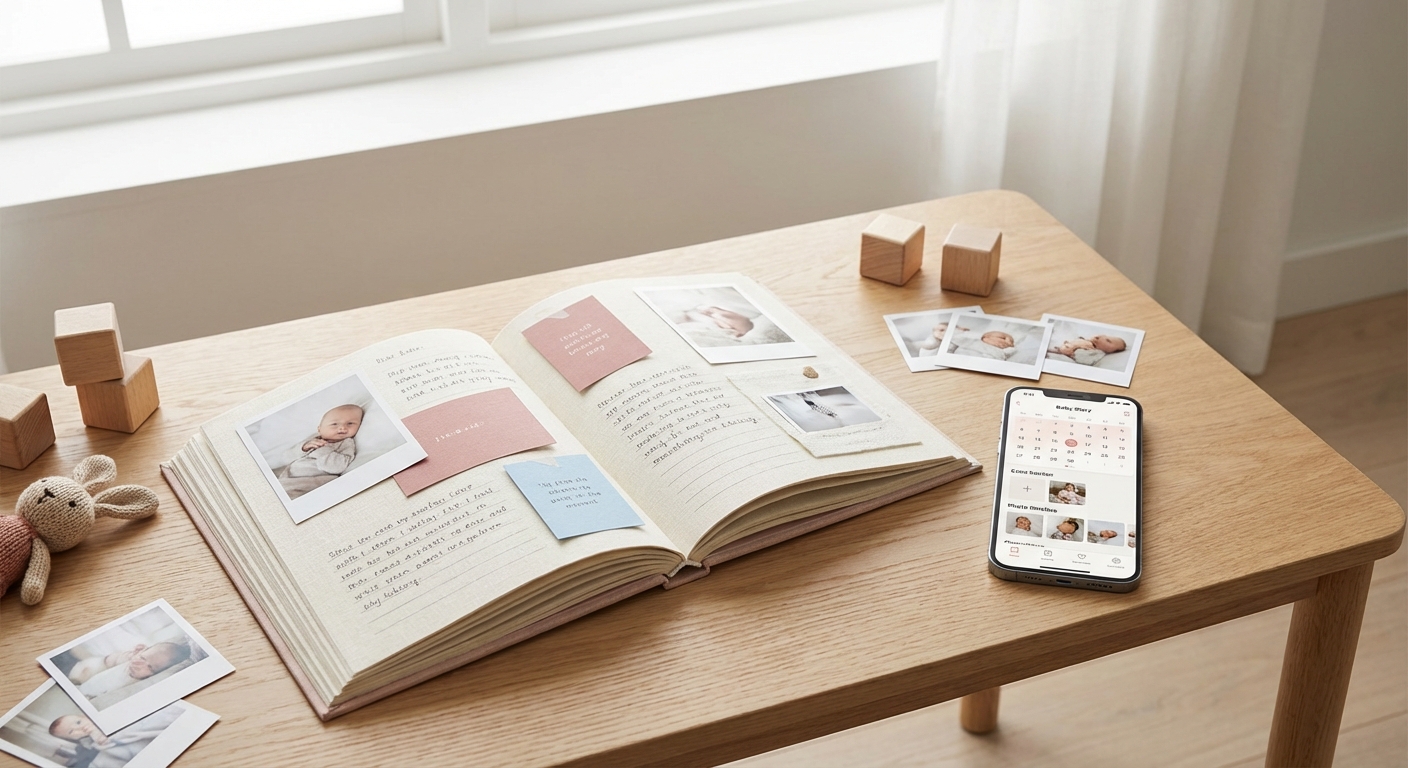
The short answer: for most families, the best baby memory book is both: a digital app to capture moments as they happen, then a curated paper book printed at the end of the first year. Paper wins on keepsakes and heirloom value; digital wins on convenience, backup, and sharing.
Your baby's first year is full of moments you'll want to remember forever. The question isn't whether to document it, it's how.
Baby memory books have existed for generations, but today's parents have more options than ever. Do you go for a beautiful physical book you can hold and flip through? A digital version that's always backed up and easy to share? Or some combination of both?
This guide compares digital and paper memory books across every dimension that matters, so you can make the right choice for your family.
There's no single right answer here. The best memory book is the one you'll actually use. Consider your lifestyle, how you interact with technology, and how you imagine sharing these memories years from now.
What Is a Baby Memory Book?
A baby memory book is a structured way of preserving memories, photos, and milestones from your child's early life. Unlike an unorganized photo album or camera roll, a memory book provides a narrative, a curated story of the first year (or years) of your baby's life.
Traditional memory books include:
- Pregnancy memories and birth story
- Monthly milestone notes and photos
- First words, first foods, funny moments
- Baby's measurements at each checkup
- Special occasions (holidays, first trip, first birthday)
- Notes and letters to your child
Digital memory books offer the same structure but in app or online platform form, with the added benefit of searchability, automatic backups, and easy sharing.
Physical Baby Memory Books
There's something irreplaceable about a physical book. It's tangible, it requires no technology to access, and it communicates care through the very act of filling it in.
Pros of Paper Memory Books
Emotional warmth Holding a physical book and seeing handwritten notes, pressed flowers, a lock of hair, or a tiny hospital bracelet creates an emotional connection that no screen can replicate. Your child will be able to hold and flip through this book for the rest of their life.
No technology required A physical book doesn't need a subscription, an app update, or a charged device. It works in fifty years the same as it does today.
Tangible keepsakes Physical books allow you to include things that can't be digitized: a footprint, a lock of hair, the hospital bracelet, a handwritten note from a grandparent. These tactile elements make the book genuinely irreplaceable. If you have more keepsakes than a book can hold, a DIY memory box is a natural companion.
Heirloom quality A high-quality printed memory book is an heirloom. It can be passed down. It communicates that this person's beginning mattered enough to document carefully.
No risk of platform closure You never have to worry about a company shutting down or changing their terms, your book exists physically and always will.
Cons of Paper Memory Books
Requires consistent effort Physical books don't fill themselves. You need to set aside time to write, print photos, and fill in entries. For exhausted new parents, this can fall by the wayside.
Risk of loss or damage A house fire, flood, or simple loss could destroy an irreplaceable physical book. Photos can never be recovered unless you've also made digital copies.
Hard to share Sharing with distant family requires photographing pages and sending them digitally, or passing the book around in person. It's not inherently shareable.
Printing photos takes time In the age of digital photography, most of us take hundreds of photos but print almost none. Getting photos printed and into a physical book adds friction that many parents never get around to.
You can only be in one place The book lives in your home. Grandparents in another city or country can't look at it without you sending it to them.
The Best Physical Baby Memory Books
When choosing a physical memory book, look for:
- High-quality binding that will last decades
- Acid-free paper (so photos won't yellow or fade)
- Clear structure with prompts (helps exhausted parents know what to fill in)
- Enough space for photos as well as writing
- A design aesthetic you genuinely love, you'll look at it for years
Digital Baby Memory Books
Digital memory books range from simple apps to sophisticated online platforms that create printed books on demand. If you already know you want to go digital, our digital memory book guide walks through setting one up step by step.
Pros of Digital Memory Books
Always with you Your phone is always in your pocket. Digital baby apps let you capture and document a milestone the moment it happens, before you forget, before life gets in the way.
Automatic backup Good digital platforms back up your content automatically. Your memories survive a broken phone, a house move, or a hardware failure.
Easy to share Send grandparents a link. Share a milestone post. Invite family members to view or contribute. Digital formats are inherently shareable across any distance.
Photo integration Digital apps connect directly to your camera roll, making it easy to include photos without printing them first.
Search and find Looking for that photo from when baby first laughed? A digital book is searchable. A physical book requires you to remember approximately where in the book something is.
Collaborative Some platforms (like Tinybeans) allow multiple family members to contribute, comment, and add their own memories. Grandparents who live far away can actively participate.
Flexible and revisable Made a typo? Forgot to add something? Digital entries are editable. Physical books require correction fluid or crossing things out.
Cons of Digital Memory Books
Technology dependency Apps require updated devices, active subscriptions, and companies that remain in business. A platform that closes down or changes its model could put your memories at risk. Always export regularly.
Screen fatigue Looking at digital memories requires a screen. For some families, that feels less special than flipping through a physical book on a rainy afternoon.
Less tactile You can't press a flower into a digital app. You can't include a lock of hair or feel the texture of the paper. The physicality of memory-keeping has genuine emotional value that digital can't fully replace.
Privacy considerations Any digital platform involves sharing data with a company. Consider the privacy implications, especially for children's photos and personal milestones. Our guide to sharing baby memories safely covers private-by-default alternatives.
Risk of losing everything If you don't export and back up regularly, a subscription lapse or account loss could mean losing everything. Digital is only as safe as your backup habits.
The Best Digital Memory Book Apps
Tinybeans. Private family sharing with milestone tracking, photo albums, and journal entries. Grandparents and family members can be invited to view and contribute.
Momento. Aggregates photos and social media posts into a digital diary. Great for people who already document on social media.
Baby Connect. More tracking-focused (feeding, sleep, diapers) but includes milestone logging.
ChatBooks or Artifact Uprising. These services automatically create printed photo books from your Instagram or camera roll, a great hybrid approach.
Google Photos. Not a memory book app specifically, but with albums, shared libraries, and automatic backups, many families use it as their primary photo archive.
Side-by-Side Comparison
| Factor | Physical Book | Digital Book |
|---|---|---|
| Emotional warmth | Very high | Moderate |
| Ease of sharing | Low | Very high |
| Includes physical keepsakes | Yes | No |
| Risk of loss | Medium (fire, damage) | Low (with backups) |
| Effort required | High | Low–Medium |
| Long-term durability | High (if stored well) | Depends on exports |
| Grandparent access | Limited | Easy |
| Collaborative | Difficult | Easy |
| Cost | One-time (book cost) | Often subscription-based |
| Heirloom quality | Very high | Depends on printing |
| Privacy | Total | Platform-dependent |
Our Recommendation: Combine Both
The most satisfying approach, and what many experienced parents recommend, is to use both:
Use a digital app for day-to-day capture. When baby does something wonderful, document it immediately in your app. Add a photo, a short note, a voice memo. Don't let the moment slip away because you can't find your physical book.
Create a printed book at the end of the first year. Services like Artifact Uprising, Chatbooks, or Printique let you turn your digital photos and journal entries into a beautiful printed book. This becomes the physical heirloom, carefully curated from a year of digital documentation.
This approach gives you:
- The ease and immediacy of digital capture
- The backup safety of cloud storage
- The easy sharing and collaboration of digital platforms
- The emotional warmth and heirloom quality of a physical book
- A physical object your child can hold and treasure
If you decide to create a printed book at the end of the year, block out a weekend in advance, before the first birthday, and commit to it. Many parents intend to do this and never quite get around to it. It's worth the effort.
Tips for Whichever Format You Choose
For Physical Books
- Set a regular time to fill in entries, the first of each month works well.
- Print photos as you go rather than leaving it all to the end.
- Keep the book accessible, on a coffee table, not packed away in a drawer.
- Involve your partner, sharing the documentation work means neither of you burns out.
- Make photocopies or scans of completed pages as a safety backup.
For Digital Apps
- Enable automatic backup immediately, don't skip this step.
- Set a reminder to do a proper export every 3 months.
- Add captions and dates to photos when you take them, you'll thank yourself later.
- Invite grandparents to join the platform if it supports family access.
- Download everything before your subscription renews, or cancel if you switch platforms.
Frequently Asked Questions
When should I start a baby memory book?
Ideally during pregnancy. Many physical memory books have a section for pregnancy memories, ultrasound photos, and the birth story, all of which are easier to fill in while you're living them. If you're starting after baby has arrived, don't worry, start now with where you are.
How much time does it take to maintain a memory book?
A physical book might take 1–2 hours per month if you stay on top of it. A digital app can take just a few minutes per day, the key is capturing moments in real time rather than trying to reconstruct them later.
What if I fall behind?
Everyone falls behind at some point. Don't let the perfect be the enemy of the good. A partially filled memory book is infinitely better than one that was never started. Pick it back up without guilt and continue forward.
Should I include difficult memories, illness, a hospital stay, hard days?
This is personal. Many parents choose to document the full reality of the first year, including the hard parts, because those experiences are also part of the story. A note about a difficult week can be just as meaningful as a milestone photo, and your child may someday appreciate knowing that parenthood wasn't just filtered highlight reels.
Is it okay to share baby photos publicly?
This is a deeply personal decision. Many families choose to keep baby photos in private, family-only spaces rather than public social media. Whatever you decide, be intentional and consistent, and remember that your child will eventually have opinions about their own digital footprint.
Looking for more memory-keeping ideas? Read our guides on milestone cards for baby, first year memories, and documenting your baby's first words.
Sources
- ACOG. Clinical guidance on pregnancy and women's health
- WHO. Global recommendations for maternal health
- Mayo Clinic. Evidence-based pregnancy health information
🔧 Helpful Tools
- All Baby Tools. Browse all free tools for pregnancy and baby care
📖 Related Articles
- Milestone Cards for Baby: Creative Ways to Document the First Year. Everything you need to know about milestone cards for your baby, what they are, DIY ideas, digital alternatives, and the most important moments to capture.
- 52 Baby Memories from the First Year You Won't Want to Forget. Week by week baby memories to treasure. A complete list of moments to document during your baby's first year.