This article contains affiliate links. If you buy through one, Babysential may earn a small commission at no extra cost to you. Recommendations are based on our own research, never on commission.
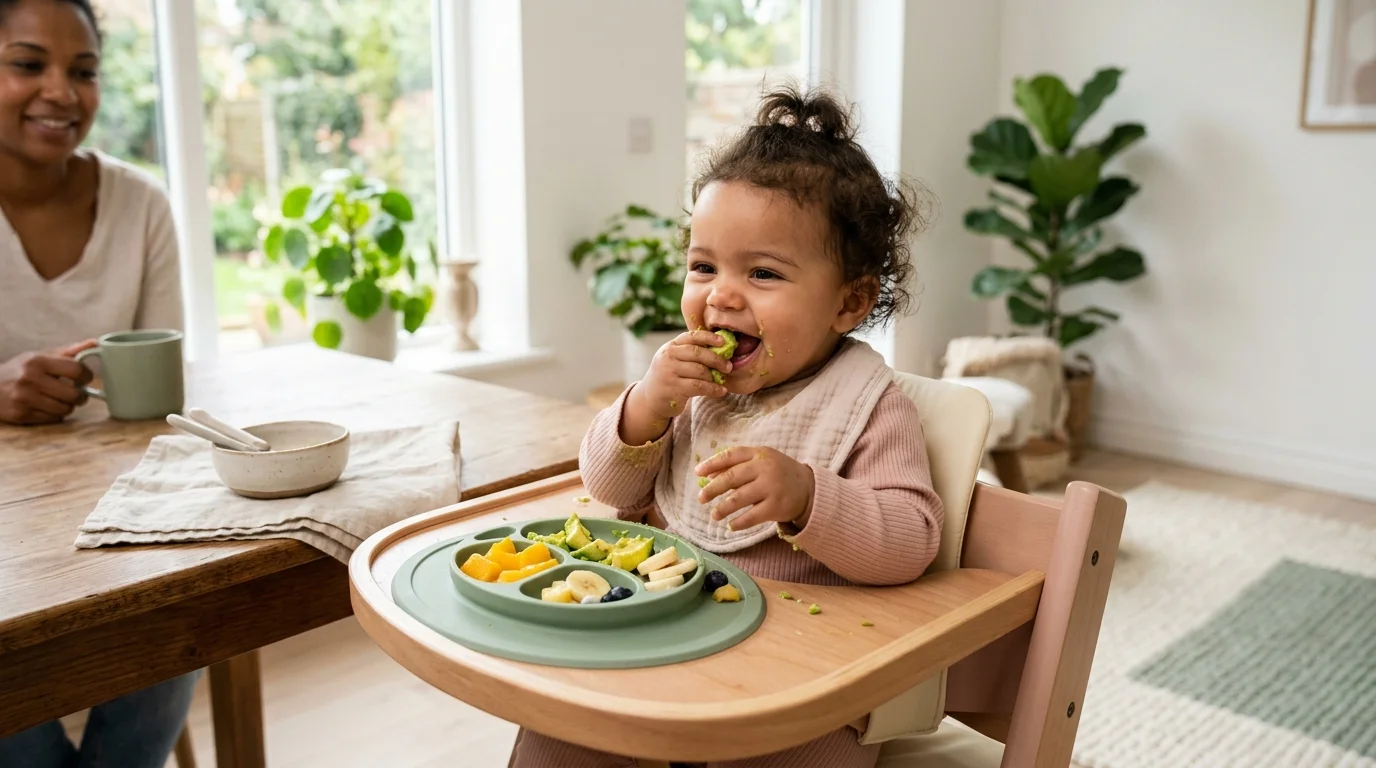
Your baby grabs a strip of ripe banana off the highchair tray, squishes it, inspects it, and eventually gets some into their mouth. Most of it ends up on the floor. This is baby-led weaning. It is messy, it is slow, and it works.
This guide covers what BLW is, when to start, what to serve, what to avoid, and how to handle the parts that make parents nervous. All grounded in current guidelines from the WHO, AAP, and NHS.
Key Takeaways
- The WHO and AAP recommend introducing complementary foods at around 6 months, when babies show all five readiness signs (sitting upright, head control, interest in food, loss of tongue-thrust reflex, and hand-to-mouth coordination).
- Gagging is a normal safety reflex in babies; choking is silent and requires immediate action, taking an infant CPR course before starting BLW is the single most important safety step.
- Iron-rich foods should be among the first solids introduced at 6 months, as a baby's iron stores from birth begin to deplete at this point.
- The AAP recommends introducing common allergens early (from 6 months), one at a time every 2–3 days, delaying introduction does not reduce allergy risk and may increase it.
- Breast milk or formula remains the primary source of calories until around 12 months; the first weeks of BLW are about exploration, not nutrition.
What Is Baby-Led Weaning?
Baby-led weaning (BLW) means letting your baby feed themselves soft finger foods from the start of solids, instead of spoon-feeding purees. The baby controls what goes in their mouth, how much, and how fast.
The term was popularized by Gill Rapley, a UK health visitor and midwife, in the early 2000s. But the concept is not new. Families around the world have been handing babies soft food from the family table for generations.
BLW vs. Traditional Purees
Both approaches are valid. The AAP and WHO do not recommend one over the other. Many families use a combination, offering purees at some meals and finger foods at others. There is no wrong answer here.
The key difference is control. With purees, the parent decides the pace. With BLW, the baby does. Research published in BMJ Open suggests that BLW may support self-regulation of appetite, though more large-scale studies are needed.
What matters most is that your baby gets adequate nutrition and is exposed to a variety of tastes and textures during this critical developmental window.
When to Start: Signs of Readiness
Both the WHO and AAP recommend introducing complementary foods at around 6 months of age. Before that, breast milk or formula provides everything your baby needs.
But 6 months is a guideline, not a switch. Your baby's individual development matters more than the calendar. Look for these signs of readiness:
- Can sit upright with minimal support in a highchair
- Has good head and neck control and can hold their head steady
- Shows interest in food by watching you eat, reaching for your plate, or opening their mouth when food is near
- Has lost the tongue-thrust reflex and no longer automatically pushes food out of their mouth
- Can bring objects to their mouth with reasonable coordination
All of these signs should be present together. One sign alone is not enough. If your baby is showing interest but cannot sit up, they are not ready yet.
Safety First: Gagging vs. Choking
This is the part that scares most parents. It is also the part that matters most to understand clearly.
Gagging Is Normal
Gagging is a safety reflex. In babies, the gag reflex is triggered further forward on the tongue than in adults. When your baby gags, they are moving food away from their airway. It looks alarming but it is the body doing its job.
Gagging sounds: coughing, sputtering, retching. The baby's face may turn red. They usually resolve it on their own within a few seconds.
Choking Is Silent
Choking happens when food blocks the airway. A choking baby cannot cough, cry, or make noise. Their face may turn blue. This requires immediate action.
Before starting BLW, take an infant CPR course. This is not optional. Knowing the difference between gagging and choking, and knowing what to do if choking happens, is the single most important safety step you can take.
How to Reduce Risk
- Always supervise your baby during meals. No exceptions.
- Serve food in appropriate shapes: long strips or sticks that your baby can grip, not small round pieces.
- Avoid high-risk choking foods (listed below).
- Make sure your baby is sitting upright in a proper highchair, never reclined.
- Never put food directly into your baby's mouth during BLW. Let them pick it up themselves.
Best First Foods for BLW
Start simple. Offer one or two foods at a time so your baby can focus. Foods should be soft enough to squish between your thumb and forefinger, and cut into strips roughly the size of an adult finger.
Great starter foods (from 6 months):
- Avocado strips or spears
- Banana (cut in half lengthwise, leave some peel on for grip)
- Steamed broccoli florets (the stem makes a natural handle)
- Steamed sweet potato sticks
- Steamed carrot sticks (soft enough to mash with gums)
- Ripe mango strips
- Ripe pear slices
- Cooked pasta (large shapes like fusilli)
- Strips of well-cooked chicken or turkey
- Soft-cooked egg (scrambled or as an omelet strip)
- Plain full-fat yogurt loaded onto a pre-loaded spoon
- Iron-fortified infant cereal mixed thick and offered on a spoon
Iron-rich foods are particularly important starting at 6 months, as a baby's iron stores from birth begin to deplete. The AAP recommends iron-rich complementary foods as among the first solids introduced.
EZPZ Mini Mat Silicone Suction Plate
Suctions to the highchair tray so your baby cannot flip it. Divided sections for offering different foods. Dishwasher safe.
Foods to Avoid Under 12 Months
Some foods are unsafe or inappropriate for babies in their first year:
- Honey in any form, due to risk of infant botulism
- Whole nuts, seeds, and large nut pieces (choking hazard; smooth nut butters thinned and spread are fine)
- Whole grapes, cherry tomatoes, and blueberries unless cut in half or quartered lengthwise
- Raw apple, raw carrot, or other hard raw vegetables (choking hazard)
- Added salt because baby kidneys cannot process excess sodium
- Added sugar because it offers no nutritional benefit and displaces nutrient-dense foods
- Cow's milk as a main drink (small amounts in cooking are fine from 6 months; as a drink, wait until 12 months)
- Rice cakes or popcorn (expand in the throat)
- Processed meats high in sodium and nitrates
Practical Tips for the First Weeks
The first few weeks of BLW are about exploration, not nutrition. Breast milk or formula remains the primary source of calories until around 12 months. Do not worry if very little food is actually swallowed.
Start with one meal a day. Choose a time when your baby is alert and not too hungry. If they are starving, they will be frustrated by the slow pace of self-feeding. Offer milk first, then solids about 30 to 60 minutes later.
Embrace the mess. Put a splash mat under the highchair. Use a long-sleeve bib with a pocket to catch food. Strip your baby down to a diaper in warm weather. The mess is part of the learning process.
Eat together. Babies learn by watching. Sit at the table and eat the same or similar food. This is one of the strongest benefits of BLW: meals become a shared family experience from the start.
Offer variety early. Research suggests that babies who are exposed to a wide range of flavors between 6 and 12 months are more likely to accept those foods later. Do not stick to just banana and avocado. Introduce herbs, spices (without salt), and different textures.
Do not force or rush. If your baby pushes food away, turns their head, or loses interest, the meal is over. Responsive feeding means following their lead.
Stokke Tripp Trapp High Chair
Grows with your child from 6 months through adulthood. Pulls right up to the table so baby eats with the family. Solid beech wood.
Progressive Allergen Introduction
Current guidelines from the AAP and other international bodies recommend introducing common allergens early, not avoiding them. Delaying allergen introduction does not reduce allergy risk and may increase it.
The major allergens to introduce one at a time, starting from 6 months:
- Peanut (smooth peanut butter thinned with breast milk or water, spread thin on a strip of toast)
- Egg (well-cooked scrambled egg or omelet)
- Cow's milk products (plain yogurt, cheese)
- Tree nuts (smooth almond or cashew butter, thinned)
- Wheat (toast strips, pasta)
- Soy (tofu strips)
- Fish (soft-cooked salmon flaked into pieces)
- Sesame (tahini spread on toast)
Introduce one new allergen every 2 to 3 days. Offer it early in the day so you can observe for reactions. Signs of an allergic reaction include hives, swelling around the mouth, vomiting, or difficulty breathing. If you see any of these, stop the food and contact your doctor.
If your baby has severe eczema or a known egg allergy, talk to your pediatrician before introducing peanut. The LEAP study demonstrated that early peanut introduction in high-risk infants significantly reduced peanut allergy development.
Tracking What Your Baby Eats
Keeping track of new foods, allergen introductions, and your baby's reactions helps you stay organized and gives your pediatrician useful information at checkups.
Our SmartStart food guide helps you log new foods, track allergen introductions, and get age-appropriate meal ideas based on what your baby has already tried.
The Bottom Line
Baby-led weaning is not complicated. It is messy, sometimes nerve-wracking, and always slower than you expect. But it gives your baby the chance to explore food on their own terms, develop fine motor skills, and join family meals from the very beginning.
Start at 6 months when readiness signs are present. Offer soft, appropriately shaped food. Learn infant CPR. Sit together and eat. The rest figures itself out.
Frequently Asked Questions
Is baby-led weaning safe?
Baby-led weaning is safe when started at the right time (around 6 months, with all readiness signs present), with appropriately shaped soft foods, and with full supervision at every meal. The key safety distinction is between gagging, a normal reflex, and choking, which is silent and rare. Taking an infant CPR course before starting BLW significantly reduces risk.
How is baby-led weaning different from purees?
With purees, the parent controls the pace and quantity. With BLW, the baby controls what goes in their mouth, how much, and how fast. Both approaches are valid, the AAP and WHO do not recommend one over the other. Many families use a combination, and there is no evidence that one method produces better outcomes.
What are the best first foods for baby-led weaning?
Good starter foods include avocado spears, banana (cut lengthwise), steamed broccoli florets with stems intact, steamed sweet potato sticks, soft-cooked scrambled egg, and strips of well-cooked chicken. All foods should be soft enough to squish between your thumb and forefinger and cut into strips roughly the size of an adult finger.
Do I need to stop breastfeeding when I start BLW?
No. Breast milk or formula continues to be the primary nutrition source until around 12 months. The AAP recommends offering milk first, then introducing solids 30–60 minutes later. BLW and breastfeeding work alongside each other.
When should I introduce peanuts and other allergens?
The AAP now recommends introducing common allergens early, starting from 6 months, not avoiding them. Introduce one new allergen every 2–3 days, early in the day so you can watch for reactions. Babies with severe eczema or a known egg allergy should be evaluated by a pediatrician before peanut introduction.
Sources: WHO Guideline for complementary feeding of infants and young children 6-23 months, AAP - Starting Solid Foods, NHS Start4Life - Introducing solid foods, CDC - When, What, and How to Introduce Solid Foods.
Sources
- AAP. Infant and toddler nutrition guidelines
- WHO. Global infant feeding recommendations
- CDC. Infant and toddler nutrition resources
🔧 Helpful Tools
- Baby Food Guide. Safe foods and introduction schedule for your baby
- Breastfeeding Tracker. Log feeds, track supply, and monitor nursing sessions
- All Baby Tools. Browse all free tools for pregnancy and baby care
📖 Related Articles
- BLW: Baby-Led Weaning. The Complete Guide. Complete guide to BLW (Baby Led Weaning), self-feeding with finger foods from the start. When to begin, best first foods, safety, and choking risk. Based on international pediatric guidelines.
- How to Start Baby-Led Weaning: A Complete Guide. Baby-led weaning (BLW) lets babies feed themselves soft finger foods from 6 months. Learn how to start safely, what foods to offer, and how to reduce choking risk.
- Starting Solids: Complete Guide from 6 to 12 Months. Complete guide to introducing solid foods to your baby. When to start, what order to follow, how much to offer, and signs your baby is ready, based on WHO and AAP guidelines.