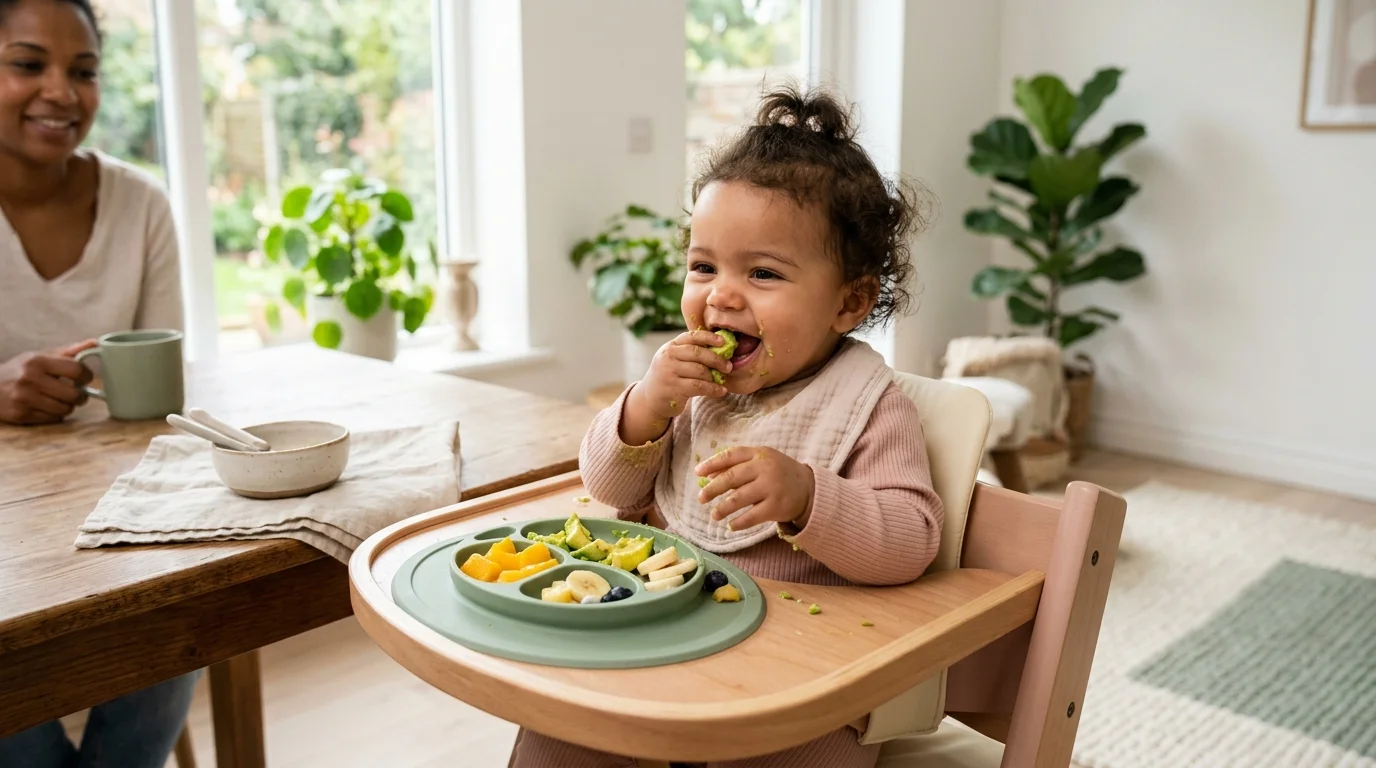
Imagine your baby picking up a piece of steamed broccoli, exploring it with their hands, and taking their own tiny bites. That's the essence of BLW. Baby Led Weaning.
Instead of spoon-feeding purees, you let the baby take charge of mealtimes. Here's a safe guide to BLW based on recommendations from the WHO and the American Academy of Pediatrics (AAP).
What Is BLW (Baby Led Weaning)?
BLW means the baby picks up and eats finger foods from the very start of solid food introduction. The baby decides what to taste, how much to eat, and at their own pace.
The method was popularized by British health visitor Gill Rapley. The idea is simple: instead of an adult controlling the spoon, the baby explores food independently.
Breast milk or formula remains the primary source of nutrition throughout the first year. BLW doesn't replace milk, it's a supplement and a learning experience.
BLW vs. Traditional Puree Feeding
Most families start with spoon-fed purees. BLW is an approach where the baby skips the puree stage and goes straight to whole foods. Both approaches have advantages.
Benefits of BLW
- Motor development: The baby trains fine motor skills, hand-mouth coordination, and chewing from day one
- Self-regulation: The child learns to stop when full, because they control their own intake
- Family meals: The baby can eat adapted versions of what the family eats, which simplifies mealtimes
- Sensory exploration: The child becomes familiar with different textures, shapes, and consistencies early on
Drawbacks to Be Aware Of
- Mess: BLW is messy. Food ends up on the floor, in the hair, and everywhere, that's part of the process
- Gagging concern: Many parents find the gag reflex alarming at first
- Nutrient intake: It can take time before the baby is actually eating enough for it to matter, especially iron
- Not for every baby: Some children prefer being spoon-fed, and that is completely fine
When Can You Start BLW?
The WHO and AAP recommend starting solid foods around 6 months for breastfed babies who are growing well. For BLW, 6 months is particularly important, because the baby needs to have developed certain motor skills.
Readiness Signs to Look For
All of these signs should be present before starting BLW:
- Sits independently: The baby can sit upright without falling to the side. Good trunk stability is important for safe eating
- Grasps and releases: The child can pick up objects and bring them to their mouth intentionally
- Tongue-thrust reflex is gone: The baby no longer automatically pushes food out of the mouth with the tongue
- Shows interest: The child reaches for food and wants to join in at mealtimes
Never start BLW before the baby can sit stably without support. A baby that leans forward or to the side has an increased risk of choking.
Best Foods to Start With
The key is soft foods that are easy to grab and safe to chew with just the gums. Start with foods that can easily be mashed between your fingers, then they are soft enough for the baby.
Vegetables
- Steamed broccoli, natural "handle" that's easy to grip
- Sweet potato, cut into sticks, steamed until soft
- Carrot, cooked until thoroughly soft (never raw, too hard)
- Avocado, cut into thick strips, naturally soft
Fruit
- Banana, split lengthwise into strips; leaving a bit of peel on helps with grip
- Mango, soft strips with lots of flavor
- Pear, ripe and soft, in sticks
- Blueberries, mash slightly between fingers for younger babies; whole from about 9 months
Protein-Rich Foods
- Eggs, hard-boiled and cut into pieces, or scrambled
- Ground meat, well-cooked, in small pieces the baby can grab
- Fish, baked or steamed, in large flakes
- Beans and lentils, well-cooked and slightly mashed, from 6 months (AAP)
How to Cut Food Safely
The shape of the food matters for safety. A baby aged 6–8 months grasps with the whole hand (palmar grasp), while a pincer grasp develops around 8–9 months.
For Babies 6–8 Months
Cut food into sticks or strips roughly the length of an adult finger. The baby grabs around one end and sucks/chews on the other.
- Broccoli with a long stem
- Sweet potato in finger-thick sticks
- Avocado in wide strips
- Banana halves lengthwise
From 8–9 Months
When the pincer grasp develops, you can offer smaller pieces:
- Blueberries (halved)
- Peas
- Small pasta pieces
- Shredded cheese (from about 10 months)
Avoid round, smooth foods like whole grapes, cherry tomatoes, and rounds of hot dog, these are choking hazards. Always cut grapes and cherry tomatoes lengthwise.
Gagging vs. Choking
This is the most important thing to understand as a BLW parent. The gag reflex and choking are two completely different things.
The Gag Reflex (Gagging)
The gag reflex is a safety mechanism. In babies, it sits further forward in the mouth than in adults. When food reaches that point, the baby gags, it looks dramatic, but it's the body doing its job.
The baby may cough, gag, and turn red in the face. It's uncomfortable to watch, but it means food is being moved forward and out of the throat. Most babies learn to handle this quickly.
Choking
Choking occurs when food blocks the airway. The baby goes silent, may turn bluish around the lips, and is unable to cough or make sound. This is an emergency.
Learn infant first aid before starting BLW. The American Red Cross and the AAP provide instructions for what to do if a baby is choking. Many pediatric offices and community centers offer infant CPR and first aid courses.
Foods That Are Especially High Choking Risk
- Whole grapes and cherry tomatoes (always cut lengthwise)
- Whole nuts (use nut butter instead, from 6 months)
- Raw carrot and apple (too hard; use cooked/steamed)
- Round pieces of hot dog (cut lengthwise, then into smaller pieces)
- Popcorn and hard crackers
Safety at Mealtimes
Follow these rules for safe meals:
- Always upright: The baby must sit straight in the high chair, never reclined
- Never alone: Always sit at the table when the baby is eating. Never leave the room
- No distractions: Screens and TV should be off during meals
- Calm and unhurried: Don't rush the baby. Let the child explore at their own pace
- Check food texture: Confirm food is soft enough by squeezing it between your fingers
- First aid: Both parents should know what to do in case of choking
Combined Approach. The Most Common in Practice
In practice, most families use a mix of BLW and traditional spoon-feeding. The WHO and AAP don't prescribe a specific method, but recommend that babies get varied foods from around 6 months.
A combined approach might look like this:
- Breakfast: Puree or porridge on a spoon + banana sticks the baby eats themselves
- Lunch: Finger food meal with steamed vegetables and soft bread
- Dinner: Adapted family food in suitable pieces + some puree on a spoon
The advantage is that the baby gets to practice self-feeding while you know they're getting enough nutrition. Especially iron can be easier to ensure with iron-fortified cereals in the beginning.
The AAP and WHO recommend introducing iron-rich foods early in solid food introduction. Iron-fortified cereals, meat, fish, and legumes are good sources.
Frequently Asked Questions About BLW
Does the baby get enough food with BLW?
In the beginning, BLW is mostly about exploration, not nutrition. Breast milk or formula meets the nutritional needs. Most babies gradually increase food intake between 6 and 12 months.
Can I start BLW at 4 months?
No. BLW requires the baby to sit independently and have developed a grasp, skills that are rarely in place before 6 months. The AAP and WHO recommend starting solids around 6 months for breastfed babies.
What do I do when the baby gags?
Stay calm. The gag reflex is normal and protective. Don't put your finger in the baby's mouth, it can make the situation worse. Let the child cough and handle it themselves. Only intervene in the case of actual choking (silent baby, no sound, bluish color).
Do I need special equipment?
You need a good high chair where the baby sits upright (such as a Stokke Tripp Trapp or similar), a bib with a catcher, and a solid floor mat. Otherwise, standard kitchen equipment is all you need.
Can the baby eat the same food as the rest of the family?
Yes, with some adjustments. Avoid added salt and sugar in the first year. Cut food into suitable shapes. Avoid honey (botulism risk under 12 months), whole nuts, and raw, hard vegetables.
Sources
- AAP. Infant and toddler nutrition guidelines
- WHO. Global infant feeding recommendations
- CDC. Infant and toddler nutrition resources
🔧 Helpful Tools
- Baby Food Guide. Safe foods and introduction schedule for your baby
- Breastfeeding Tracker. Log feeds, track supply, and monitor nursing sessions
- All Baby Tools. Browse all free tools for pregnancy and baby care
📖 Related Articles
- Baby-Led Weaning: A Complete Starter Guide. Complete guide to baby-led weaning: when to start, safe first foods, choking vs gagging, and practical tips for parents.
- Baby Formula: Everything You Need to Know. Complete guide to infant formula. Types, step-by-step preparation, storage, transitioning from breastfeeding, cost, and reassurance. Safe guidance for formula-feeding parents.
- Baby Porridge: Guide to Your Baby's First Cereal. Everything about introducing porridge and cereal to your baby. Which grains to start with, when to begin, and simple recipes. Based on WHO and AAP recommendations.