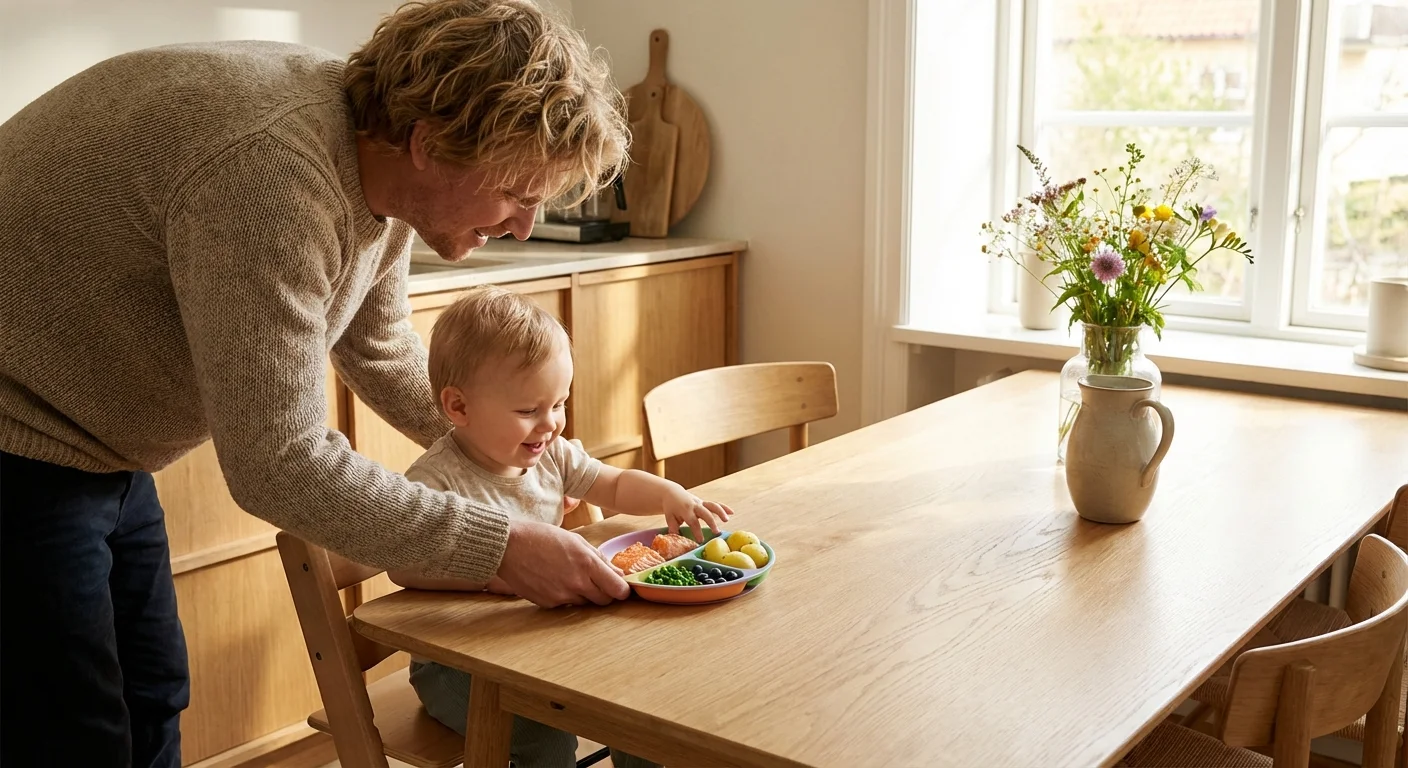
The WHO and AAP recommend starting solid foods at around 6 months, while continuing breast milk or formula as the primary nutrition source until 12 months. Before 4 months, no solid foods should be introduced. This guide covers what, when, and how to feed your baby from birth to one year.
Key Takeaways
- The WHO, AAP, and NHS all recommend starting solid foods at around 6 months, not before 4 months under any circumstances.
- The three readiness signs are: head control, ability to sit with support, and loss of the tongue-thrust reflex, age alone is not sufficient.
- Iron-rich foods (pureed meat, iron-fortified cereals, legumes) should be among the first solids, as breast milk is low in iron by 6 months.
- Early allergen introduction (peanut, egg, wheat, fish) from around 6 months reduces allergy risk, per the 2015 LEAP Study and AAP 2023 guidance.
- Honey must be avoided until 12 months due to botulism risk; cow's milk as a drink should not replace breast milk or formula before 12 months.
When Should Babies Start Solid Foods?
The World Health Organization (WHO), American Academy of Pediatrics (AAP), and NHS all align on the same recommendation: around 6 months. The digestive system, kidneys, and oral motor skills needed for solid food are not sufficiently mature before this point.
Introducing solids before 4 months is associated with increased risk of obesity, allergies, and gastrointestinal problems. After 7 months, delayed introduction can increase the risk of iron deficiency and make texture acceptance harder.
The 6-month guideline refers to developmental readiness, not the calendar date alone.
Signs Your Baby Is Ready for Solids
The AAP identifies three signs that together indicate readiness:
- Head control, baby can hold their head steady and upright without support
- Sitting with minimal assistance, baby can sit supported and hold an upright position during feeding
- Loss of the tongue-thrust reflex, baby no longer automatically pushes food out of their mouth with their tongue
Interest in food, watching others eat, and reaching toward food are supporting signs but are not sufficient on their own. Age alone is not a reliable indicator, a 5-month-old showing all three signs may be ready; a 6-month-old who lacks head control is not.
Feeding by Age: Complete Guide
0–4 Months
Breast milk or formula is the only appropriate food during this period. No water, juice, purees, or cereals. The AAP is explicit: introducing solids before 4 months carries measurable health risks and no documented benefit.
Breastfed babies feed 8–12 times per 24 hours. Formula-fed babies feed every 3–4 hours, consuming roughly 60–90 ml per feed at 1 month, increasing to 120–180 ml by 3–4 months.
4–6 Months
Continue exclusive breast milk or formula. If a baby is showing readiness signs before 6 months, and is at least 4 months old, discuss with your pediatrician before introducing solids. The AAP has shifted its recommendation to "around 6 months" rather than "4–6 months" precisely because early introduction is more commonly associated with risk than benefit.
6–7 Months
This is the primary introduction window. Start with:
- Single-ingredient purees, cooked and pureed vegetables (carrot, sweet potato, pea, broccoli), fruits (apple, pear, banana), and iron-rich foods (pureed meat, iron-fortified cereal)
- Consistency, smooth puree at first, thickening gradually over the first few weeks
- Quantity, start with 1–2 teaspoons once a day; increase to 2–3 tablespoons once or twice a day by 7 months
- Breast milk or formula first, continue offering milk feeds before solid meals; milk remains the primary nutrition source at this stage
Introduce new foods one at a time with 2–3 days between new foods, to identify any reactions.
7–9 Months
By 7–8 months, most babies can handle:
- Thicker textures, mashed rather than pureed, with small soft lumps
- Finger foods, soft pieces of banana, cooked carrot, avocado, scrambled egg (once eggs have been introduced)
- More variety, grains, dairy (yogurt, cheese, but not cow's milk as a drink until 12 months), fish, legumes
- Frequency, 2–3 solid meals per day plus milk feeds
Baby-led weaning (BLW) can be introduced at this stage or from 6 months, it involves offering soft finger foods rather than purees and allowing the baby to self-feed. Both approaches are supported by evidence; the AAP notes that a combined approach works for many families.
9–12 Months
Approaching one year, feeding looks increasingly similar to family meals:
- Texture, soft chopped pieces, family foods with appropriate modifications (no added salt or sugar, no honey)
- Variety, baby should be eating from all food groups: protein, vegetables, fruit, grains, dairy
- Frequency, 3 solid meals plus 1–2 snacks per day
- Milk, breastfeeding or formula continues; approximately 500–600 ml of formula per day is typical alongside solid meals. Do not introduce cow's milk as a main drink before 12 months.
Iron: The Most Critical Nutrient for Babies Starting Solids
Iron is the nutrient most likely to be deficient when babies start solids, particularly in breastfed babies. Breast milk is low in iron, and the iron stores a baby is born with are largely depleted by 6 months.
The AAP recommends that the first solid foods should include iron-rich options:
- Meat, pureed chicken, beef, or lamb (the most bioavailable iron source)
- Iron-fortified cereals, oatmeal or rice cereals specifically fortified for infants
- Legumes, lentils, beans, chickpeas (less bioavailable but still useful)
- Eggs, a good source of iron and protein
Pairing iron-rich foods with vitamin C (tomato, broccoli, mango) increases absorption. Avoid giving cow's milk with iron-rich meals, the calcium in milk inhibits iron absorption.
Allergen Introduction: Start Early
Research, particularly the landmark LEAP Study (2015), has changed guidance on allergen introduction. Early, regular introduction of the top allergens is now recommended to reduce the risk of allergy.
The AAP (2023) recommends introducing the top 9 allergens from around 6 months, one at a time:
| Allergen | First food example | Notes |
|---|---|---|
| Peanut | Thinned peanut butter | Do not give whole nuts, choking risk |
| Egg | Scrambled egg or pureed hard-boiled | Well-cooked only at first |
| Cow's milk | Yogurt, cheese | Not as a drink before 12 months |
| Tree nuts | Nut butters thinned with water | Introduce one variety at a time |
| Wheat | Porridge, bread, pasta | After egg and peanut are established |
| Soy | Tofu, edamame (pureed) | |
| Fish | Cooked white fish, pureed | Avoid high-mercury fish (swordfish, shark) |
| Shellfish | Cooked prawn, pureed | |
| Sesame | Tahini thinned with water or food |
Introduce each allergen on a day when you can observe the baby for 1–2 hours. Mild reactions (slight redness around the mouth) are common and not necessarily allergic responses. Swelling, hives, vomiting, or breathing difficulty requires immediate medical attention.
What to Avoid in the First Year
| Food | Reason |
|---|---|
| Honey | Risk of botulism, toxic for infants under 12 months |
| Cow's milk as a drink | Not suitable as a main milk before 12 months (dairy products such as yogurt and cheese are fine) |
| Added salt | Kidneys cannot process adult salt levels |
| Added sugar | Establishes preference for sweet foods; no nutritional benefit |
| Whole nuts | Choking hazard, always use nut butters or finely ground |
| Whole grapes, cherry tomatoes | Choking hazard, always halve or quarter |
| Raw shellfish | Infection risk |
| Unpasteurised cheese or juice | Listeria and other infection risks |
| Shark, swordfish, marlin | High mercury content |
| Rice drinks | Arsenic levels inappropriate for infants |
Baby Feeding Comparison Table by Age
| Age | Primary nutrition | Solid meals/day | Texture |
|---|---|---|---|
| 0–4 months | Breast milk or formula only | 0 | – |
| 4–6 months | Breast milk or formula only | 0 (or start per pediatrician advice) | – |
| 6–7 months | Breast milk or formula + starting solids | 1 | Smooth puree |
| 7–9 months | Breast milk or formula + solids | 2–3 | Mashed, soft lumps, finger food |
| 9–12 months | Breast milk or formula + solids | 3 + snacks | Soft chopped family food |
| 12 months+ | Cow's milk or continued breastfeeding | 3 + snacks | Family meals |
Frequently Asked Questions
When should babies start solid foods?
The WHO, AAP, and NHS all recommend starting solid foods at around 6 months. The baby should show three readiness signs: head control, ability to sit with support, and loss of the tongue-thrust reflex. Starting before 4 months is not recommended and is associated with increased health risks.
What are the best first foods for babies?
The AAP recommends iron-rich foods as a priority at 6 months, including pureed meat, iron-fortified infant cereals, and legumes. Vegetables and fruits are also excellent early foods. There is no required order for introduction; offering a variety of flavours early is associated with better food acceptance later.
How do I know if my baby is eating enough?
In the first weeks of solid introduction, quantity is less important than variety and exploration. A baby who is growing well on breast milk or formula, feeding regularly, and developing normally is almost certainly getting adequate nutrition even if solid intake appears small. Consult your pediatrician if weight gain slows after solids are established.
Should I introduce allergens early?
Yes. Current evidence, including the LEAP Study, shows that early introduction of common allergens (peanut, egg, milk, wheat, tree nuts, fish, shellfish, soy, sesame) starting from around 6 months reduces the risk of developing allergies. The AAP (2023) specifically recommends this approach. Introduce one allergen at a time and observe for 1–2 hours.
What is baby-led weaning?
Baby-led weaning (BLW) is an approach where soft finger foods are offered from the start of solid introduction, allowing the baby to self-feed rather than being spoon-fed purees. It supports fine motor development and encourages responsive feeding. The NHS acknowledges BLW as a valid approach, and evidence suggests it results in similar nutritional outcomes to traditional spoon-feeding when done correctly.
Can I give my baby water?
Small amounts of water (60–120 ml per day) can be offered from 6 months alongside solid foods. Before 6 months, no water is needed, breast milk and formula provide all hydration required. Do not give juice, sugary drinks, or large amounts of water in the first year.
What is the best way to introduce vegetables?
Introduce vegetables before fruits to avoid establishing a strong preference for sweet tastes. Offer each vegetable several times (8–10 exposures) before concluding the baby dislikes it, initial rejection is normal and does not indicate aversion. Bitter vegetables (broccoli, pea, spinach) often require more exposures than sweet ones.
How much formula or breast milk at 6 months with solids?
At 6 months, milk remains the primary nutrition source. Formula-fed babies typically continue on approximately 600–900 ml per day. Breastfed babies continue on-demand feeds. Solid meals complement rather than replace milk at this stage. By 9–12 months, the balance shifts and solid meals take on a more central role, with formula reducing to approximately 400–600 ml per day.
Sources
- World Health Organization (WHO). Infant and Young Child Feeding. 2023.
- American Academy of Pediatrics (AAP). Starting Solid Foods. 2023.
- NHS. Your baby's first solid foods. 2024.
- Du Toit G, et al. Randomized Trial of Peanut Consumption in Infants at Risk for Peanut Allergy (LEAP Study). New England Journal of Medicine. 2015.
- Centers for Disease Control and Prevention (CDC). When, What, and How to Introduce Solid Foods. 2024.
🔧 Helpful Tools
- Baby Food Guide. Safe foods and introduction schedule for your baby
- Baby Sleep Tracker. Track and optimize your baby's sleep