Millions of families have dogs, and many of those families also have young children. Dogs and toddlers can become the best of friends, but it takes adults who take responsibility for safety.
Children between 1 and 3 years old are the age group most often bitten by dogs. Not because dogs are dangerous, but because toddlers don't yet understand a dog's limits. They squeeze hard, pull on ears, and make sudden movements.
Here you'll find concrete rules for safe interaction, tips for teaching your child to read a dog's body language, and what to do if something goes wrong.
Ground rules for dogs and toddlers
No matter how gentle your dog is, these rules always apply:
- Never leave a dog and toddler alone without supervision. Not even for two minutes while you grab something from the kitchen
- The dog must have its own safe space where the child is not allowed to go. A dog bed or a separate room with a gate
- Never disturb the dog while it eats, sleeps, or chews on something. Toddlers don't grasp this intuitively, you need to actively prevent it
- Food and toys must be kept separate. Dog treats and children's snacks look the same to a 2-year-old
Dog bites in children: According to the American Veterinary Medical Association, most dog bites to children happen at home, from a dog the child knows. The 1–4 age group is most at risk because they cannot yet read the dog's signals.
What active supervision looks like in practice
"Supervision" means an adult is actively paying attention, not sitting on the sofa with their phone while the child and dog are on the floor. Good supervision looks like this:
- You are in the same room, with full focus on the interaction
- You are close enough to intervene immediately
- You guide the child in real time: "Look, Fido is turning away. He wants a little space"
- You end the interaction when the child or dog gets tired
Teach your child to read dog body language
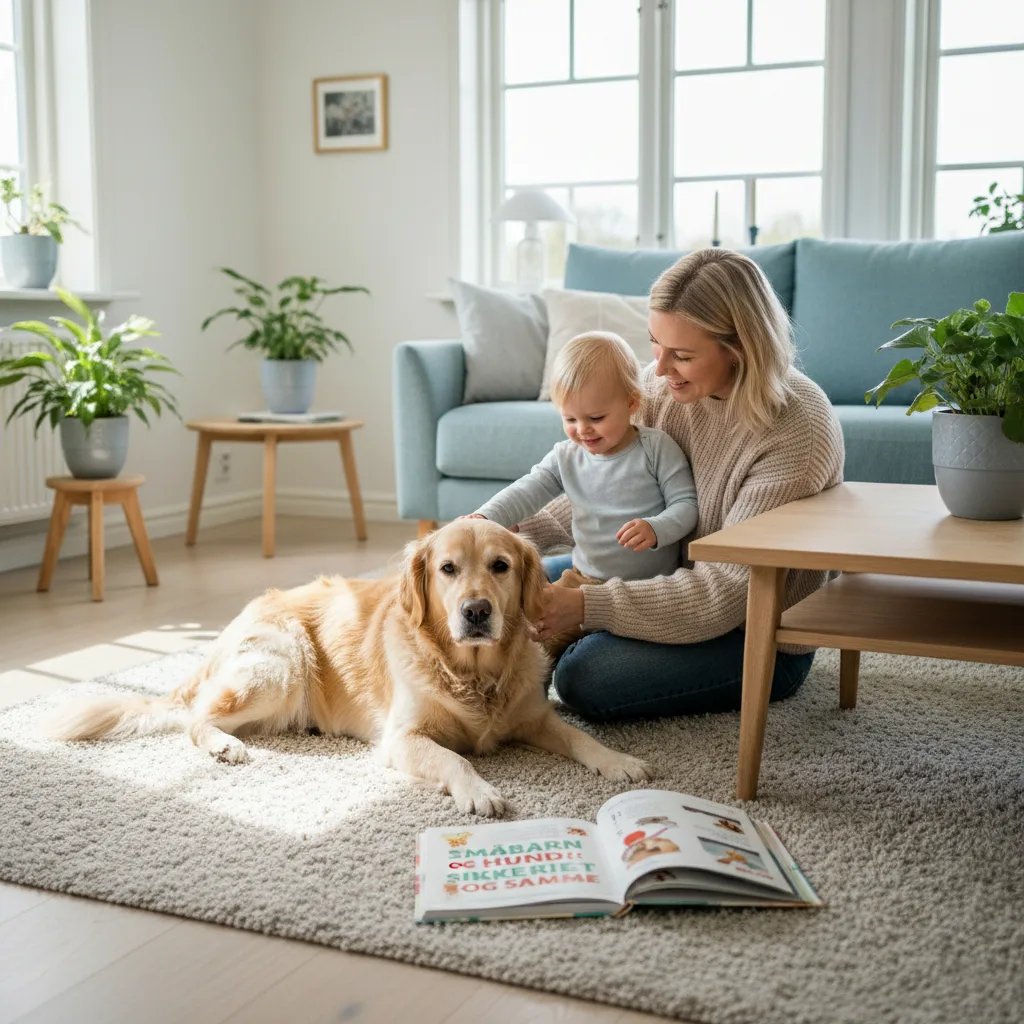
Children as young as 18 months can begin to recognize simple signals. Use picture books, point at the dog, and explain with simple words.
Signals that mean "leave me alone"
- Yawning, the dog is trying to calm down the situation
- Licking around the mouth, a sign of stress
- Turning the head away, doesn't want contact right now
- Ears pinned back, feels uncomfortable
- Body stiffens, a serious warning sign. Move the child away calmly
Signals that mean "I'm happy and relaxed"
- Wiggling the whole body, not just the tail
- Loose, open mouth that looks like a smile
- Play bow, the dog lowers its front end with its rear in the air
- Soft eyes with no white showing around the edges
Practice with pictures: Show your child photos of happy and uncomfortable dogs. Ask: "Is this dog happy or sad?" Children learn faster with visual examples than with words alone.
Teaching your child to pet gently
Toddlers have little control over the force in their movements. A "pat" can quickly become a slap. Practice this:
- Show on yourself first. Pat your own arm with a flat hand and say "gentle." Let the child try on you
- Then on a stuffed animal. Let the child practice "gentle" on a toy
- Then on the dog. Hold the child's hand and guide slow, light strokes along the back. Never on the face or tail
- Reward gentle behavior. "Look how nicely you petted! See, Fido likes it!"
Places dogs don't like to be touched
Most dogs dislike being touched in these spots:
- Paws
- Tail
- Ears
- Nose
- Top of the head (reaching down from above)
Teach your child to pet the back, chest, or side, and only when the dog comes over on its own and shows it wants contact.
Dog breeds and temperament
Any dog can bite, regardless of breed. But some breeds generally have more patience with children than others.
Typically child-friendly breeds:
- Golden retriever and Labrador
- Cavalier King Charles Spaniel
- Bernese Mountain Dog
- Beagle
Breeds that may need extra training:
- Terrier breeds (high energy, can be snappy)
- Guard dogs (protective instincts)
- Hunting dogs (high prey drive)
Breed is only part of the picture. Individual experiences, training, and socialization matter far more than breed. A well-socialized mixed breed can be far safer than an unsocialized purebred.
What to do if the dog bites
Even with all precautions, accidents can happen. Here's what to do:
First aid steps
- Stay calm. Your child looks to you to know whether to be frightened
- Rinse the wound with lukewarm water for at least 5 minutes
- Stop any bleeding with a clean cloth or bandage
- Assess the severity:
- Superficial scratches: Clean and monitor
- Deeper bites or bites on the face: Seek urgent care
- Heavy bleeding: Call emergency services (911)
When to see a doctor
Seek medical care if:
- The bite is deep or on the face, hands, or near a joint
- The skin is torn open
- The child is not up to date on tetanus vaccination
- There are signs of infection (redness, swelling, warmth) after 1–2 days
Reporting: In many states and countries, serious dog bites must be reported to animal control or local authorities. The dog owner may be held liable. Check the rules in your area.
After the incident
Don't punish the dog. It reacted to something it perceived as threatening. Instead, consider:
- What triggered the bite? Was the child being too intrusive?
- Were there warning signals you missed?
- Does the dog need behavioral training?
- Contact a certified animal behaviorist for an assessment
Rules for strange dogs, teaching toddlers
Teach your child the rules for dogs they encounter outside:
- Always ask the owner first, "Can we say hello to your dog?"
- Never run toward a dog, walk up calmly
- Let the dog sniff first, hold the hand still and low, let the dog come to the child
- Never pet a tied-up dog without the owner present
- Never take the ball or toy from a strange dog
Help your child with a "rule song": Make a short song or rhyme about the dog rules. "First we ask, then we wait, the dog sniffs, then we pat." Children remember rules better with rhyme and song.
Benefits of growing up with a dog
Research shows that children who grow up with a dog may have several advantages:
- Physical activity, children with dogs are more active and spend more time outdoors
- Immune system, some studies suggest lower risk of allergies and asthma (see baby and pets for more)
- Empathy, children learn to consider another creature's needs
- Emotional support, the dog becomes a comfort and a friend to confide in
- Responsibility, even 2-year-olds can help fill the water bowl
Read more about childproofing your home to make the rest of the house safe for your toddler.
Relevant tools on Babysential:
- My Baby. Track your baby's development, health, and milestones
- Checklists. Practical checklists for parents
Frequently asked questions
Should we get a dog when we have a toddler?
It depends on the family's capacity. A puppy requires almost as much attention as a newborn. Many recommend waiting until the child is at least 3–4 years old, or choosing an adult, socialized dog from a rescue.
Can the dog become jealous of the child?
Dogs don't experience jealousy the way humans do, but they can react to changes in routine and attention. Give the dog extra affection and include it in family walks. Let the dog be part of daily life rather than something kept at a distance.
Should the dog be allowed in the child's bedroom?
Most experts recommend that the dog not sleep in the child's bedroom. The child's room should be the child's safe zone, just as the dog's bed is the dog's safe zone. Exceptions can be made for older, calm dogs that the family knows well.
Is it true that some dog breeds are "dangerous for children"?
No breed is inherently dangerous to children. But some breeds have stronger bite force or higher energy levels, which demands more experience from the owner. Training and socialization are far more important than breed.
Read more
Sources
- American Veterinary Medical Association, dog bite prevention
- Centers for Disease Control and Prevention, dog bite data
- American Academy of Pediatrics, pets and children
🔧 Helpful Tools
- Baby Milestones Tracker. Track your baby's developmental milestones
- All Baby Tools. Browse all free tools for pregnancy and baby care
📖 Related Articles
- Baby and Pets: Safe Introduction for the Whole Family. Bringing a baby home to a dog or cat? Get safe tips for introduction, allergies, and safety from day one.
- Poisoning in Children. Prevention and First Aid. Child poisoning: how to prevent it and act quickly. Poison control, first aid, and childproofing your home. Evidence-based guidance.