A New Year's rocket goes off, a fire alarm sounds, the music at the café is louder than you expected. Suddenly you wonder: is this dangerous for my baby's ears? Your instinct is right, a baby's hearing is fragile, and noise-induced damage is permanent.
The good news is that simple steps can protect it. Here's an overview of what your baby's ears can tolerate, when you should use ear protection, and how to navigate a noisy world with a small baby.
A Baby's Hearing Is Vulnerable
Babies hear better than adults across many frequencies. Hearing is fully developed at birth, but the ear canals are shorter and narrower than in adults. This means that sound pressure inside the ear can actually be higher for a baby than for an adult exposed to the same sound.
Hearing damage occurs when the delicate hair cells in the cochlea are injured by excessively loud sound. These cells do not regenerate, the damage is permanent. Children cannot tell you their ears hurt or that the sound is too loud, so the responsibility rests entirely with you as a parent.
Permanent damage: Noise-induced hearing loss cannot be repaired. Even brief exposure to very loud sounds (above 120 dB) can cause immediate damage. Prolonged exposure to moderate levels (above 85 dB) is also harmful over time.
Sound Levels You Should Know
To protect your baby's hearing, it helps to understand what different decibel levels mean in practice.
| Sound source | Approximate dB | Safe for baby? |
|---|---|---|
| Whispering | 30 dB | Yes |
| Normal conversation | 60 dB | Yes |
| Vacuum cleaner | 70–80 dB | Yes, briefly |
| City traffic | 80–85 dB | Borderline |
| Concert / nightclub | 100–120 dB | No |
| Fireworks | 120–170 dB | No, never |
| Fire alarm | 85–120 dB | Use ear protection |
Rule of thumb: If you have to raise your voice to be heard by the person next to you, the noise level is too high for your baby. Put on ear protection or leave the area.
Guidance from Health Authorities
WHO and AAP guidelines recommend that children not be exposed to sustained noise above 85 dB. For babies and young children, it is wise to be even more cautious. Many pediatric audiologists recommend ear protection for babies and young children in any situation where sound levels exceed 80 dB.
When Does Your Baby Need Ear Protection?
Some situations require ear protection; others you can safely skip.
Always Use Ear Protection
- Fireworks. New Year's Eve, Independence Day, festivals with fireworks. Distance helps, but sound pressure is unpredictable
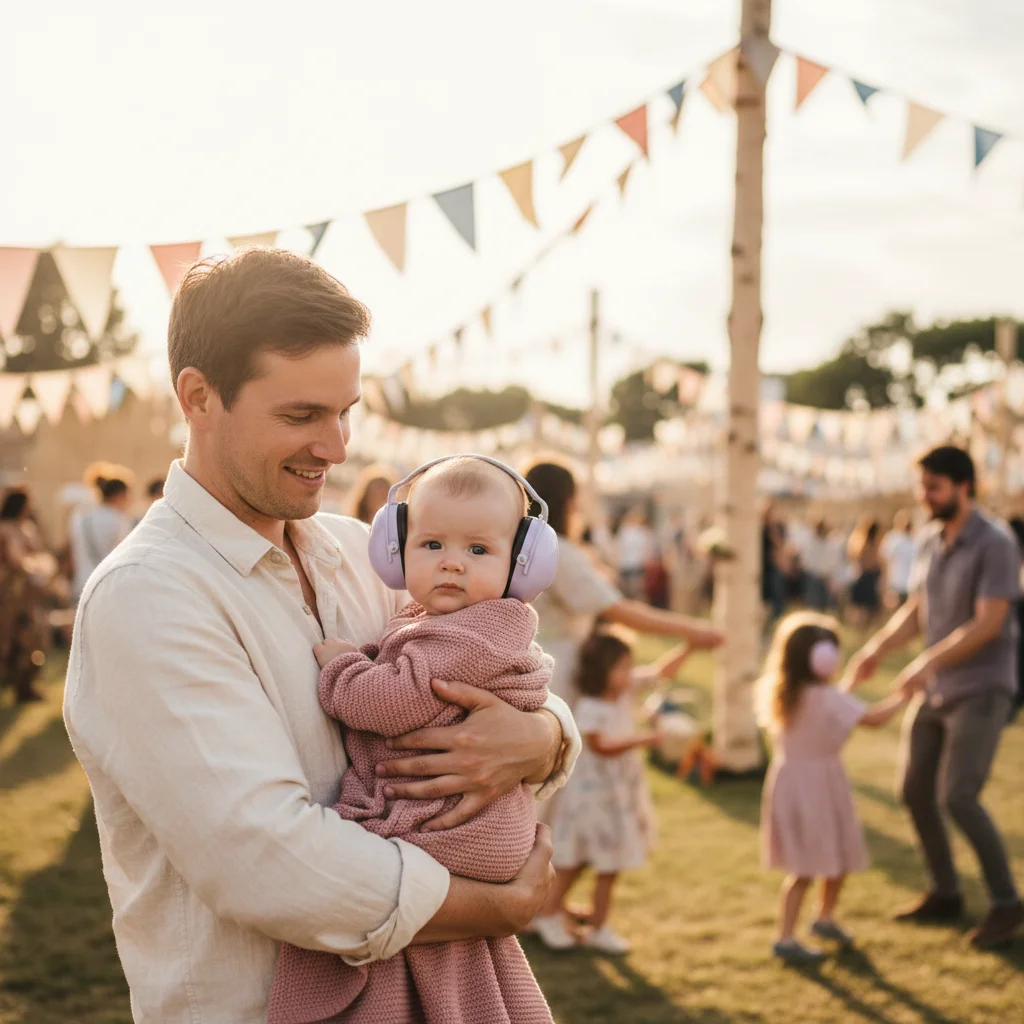
- Concerts and festivals, even outdoor concerts can reach 100–120 dB
- Motor sports, racetracks, boat races, snowmobiles
- Weddings and parties, live bands and loud speakers
- Construction and renovation, drills, circular saws, rotary hammers
Consider Ear Protection
- Parades and national celebrations, marching bands and cannon salutes can be loud, especially up close
- Sporting events, soccer matches, ice hockey with sirens
- Movie theaters, sound can be surprisingly high, especially action films
- Restaurants and cafés, some have very high background noise levels
Normally Safe Without Ear Protection
- Typical home environment. TV at normal volume, conversation, housework
- Walks in nature, birdsong, wind, streams
- Shops and shopping centers, normal background noise
- Car travel, with windows closed
Sound meter on your phone: Download a decibel meter app (many are free). It won't give you laboratory accuracy, but it provides a good enough picture of the noise level in the room. If the app reads above 80 dB, your baby should wear ear protection or you should move away.
Choosing the Right Ear Protection
Baby ear protection is specially designed for small heads. Adult earmuffs or earplugs do not fit and offer poor protection.
Types of Baby Ear Protection
Earmuffs (capsular): The most common type for babies. A soft headband with padded cups over the ears. Easiest to put on and take off, and stays in place. Available specially designed for babies from birth.
Headband earmuffs: For the very youngest (0–18 months) there are models with an elastic headband instead of a rigid arc. These are more comfortable for babies who spend a lot of time lying down.
What Should You Look For?
- Noise reduction rating (NRR/SNR): At least 20–25 dB reduction. Check the product specifications
- Fit: The cups should cover the entire ear without pressing uncomfortably. Try different brands
- Weight: Lighter models are more comfortable for the baby to wear over time
- Certification: Look for CE marking and EN 352 standard compliance
- Age: Choose a model designed for your baby's age group
Acclimatization: Let your baby get used to the earmuffs at home before attending an event. Put them on for a few minutes at a time in calm surroundings. Many babies accept earmuffs surprisingly well when they are not introduced in an already stressful situation.
Special Situations
Fireworks Events
Fireworks are among the loudest noise sources babies can be exposed to. Rockets can reach 170 dB at close range, a level that causes immediate hearing damage.
For babies under 1 year: Stay indoors with windows closed. Put on quiet music or TV to mask background sounds. If you want to watch fireworks, use ear protection on your baby and keep a safe distance.
For toddlers 1–3 years: Ear protection is absolutely necessary if you are outdoors. Stand well away from the launch site. Be prepared for your child to be frightened, closeness and reassurance matter more than seeing the rockets.
Large Parades and Celebrations
Marching bands, cannon shots, and crowds make big celebrations a noise challenge for babies. Ear protection is a smart item to bring. Do not position yourselves right next to the band, and be ready to move away if your child seems uncomfortable.
Concerts and Festivals
Pediatric health authorities advise against taking babies and young children to loud concerts. Even with ear protection, it is difficult to guarantee sufficient protection at sound levels above 100 dB. If you do choose to go, always use ear protection and position yourselves far from the speakers. Keep it brief and leave if your child shows signs of discomfort.
Everyday Noise
Vacuum cleaners, kitchen appliances, and hair dryers are generally safe for short periods. If your baby is sleeping in the same room as the vacuum cleaner, move the baby to another room. Sustained background noise can disrupt sleep and development even if it does not directly damage hearing.
Signs That the Sound Is Too Loud for Your Baby
Babies cannot say it's too loud. Watch for these signals:
- Crying or agitation that starts suddenly in noisy surroundings
- Turns head away from the sound source
- Covers ears with hands (older babies and toddlers)
- Sleep problems after exposure to loud sound
- Startles strongly at sudden sounds (normal in newborns, but a persistently strong startle reflex may indicate sensitivity)
If you suspect your baby has been exposed to harmful noise, contact your pediatrician. A hearing test can identify any damage.
Frequently Asked Questions
From what age can babies wear ear protection?
Specially designed baby earmuffs can be used from birth. Choose a model designed for newborns (0–18 months) with a soft or elastic headband. Standard children's earmuffs typically fit from around 2–3 years.
Can white noise damage my baby's hearing?
White noise machines should be kept at a moderate level (below 50–60 dB) and placed at least 2 meters (6 feet) from the baby's head. Continuous exposure to loud white noise could theoretically affect hearing development. Use white noise as a sleep aid, not as constant background sound.
Should we avoid all loud situations with our baby?
You do not need to isolate your child from all sound. Normal everyday noise is safe and part of sensory development. Use common sense: avoid sustained loud noise (above 85 dB), use ear protection in planned loud situations, and be prepared to leave if noise levels are unpredictable.
Can a baby develop tinnitus from noise?
Yes, children can develop tinnitus (ringing in the ears) after noise exposure, just like adults. Tinnitus in babies is difficult to detect because the child cannot describe the symptom. Prevention through ear protection is the best strategy.
Read More
- Sensory development in babies - Sight, hearing, smell, and touch
- Baby-proofing your home - A safe home for your little one
- Sleep tracker - Log your baby's sleep patterns
Sources
- World Health Organization (WHO). Environmental Noise Guidelines
- American Academy of Pediatrics (AAP). Hearing Loss Prevention
- Centers for Disease Control and Prevention (CDC). Noise and Hearing Loss
🔧 Helpful Tools
- Baby Milestones Tracker. Track your baby's developmental milestones
- All Baby Tools. Browse all free tools for pregnancy and baby care
📖 Related Articles
- Bathing Your Baby: The Right Water Temperature and Safe Bath Routine. Everything about bathing a baby, the right water temperature (98.6°F / 37°C), how often, safe holds, and how to make bath time a great experience for both baby and parents.
- Choking Hazards for Baby: Dangerous Foods and First Aid. Which foods are dangerous for baby? Learn about choking hazards, how to cut food safely, and first aid if your baby chokes.