You're on a long train ride with an overtired 2-year-old. The child is screaming. Other passengers are staring. You pull out your phone and put on Peppa Pig. Peace is restored.
Feeling guilty about that? You don't need to. Screen time isn't about being a good or bad parent. It's about finding a balance that works for your family.
Here you'll find updated guidelines, concrete strategies, and zero judgment.
What do the official guidelines say?
The WHO and the American Academy of Pediatrics (AAP) have both issued recommendations on screen time for young children. Here's the overview:
Under 2 years
The WHO recommends no screen time for children under 2 (except video calls with family). The AAP follows the same line.
The reasoning: the first two years of life are a critical period for brain development. Children need direct interaction with people, physical play, and sensory experiences. Screens provide passive stimulation that cannot replace these.
2–3 years
The recommendation is no more than 1 hour per day of high-quality content, ideally watched together with an adult.
What counts as "high-quality content"?
- Programs made for the age group (quality educational shows and apps)
- Slow pacing, not overstimulating
- Content that invites conversation and interaction
- No advertising or autoplay
Guidelines are recommendations, not absolute rules. Some days your child will have more screen time than others, during illness, long trips, or when parents need a break. A single day with extra screen time does no harm. It's the pattern over time that matters.
Quality matters more than quantity
A child who watches 30 minutes of an educational show with a parent and talks about it afterward gets more out of screen time than a child who watches 15 minutes alone.
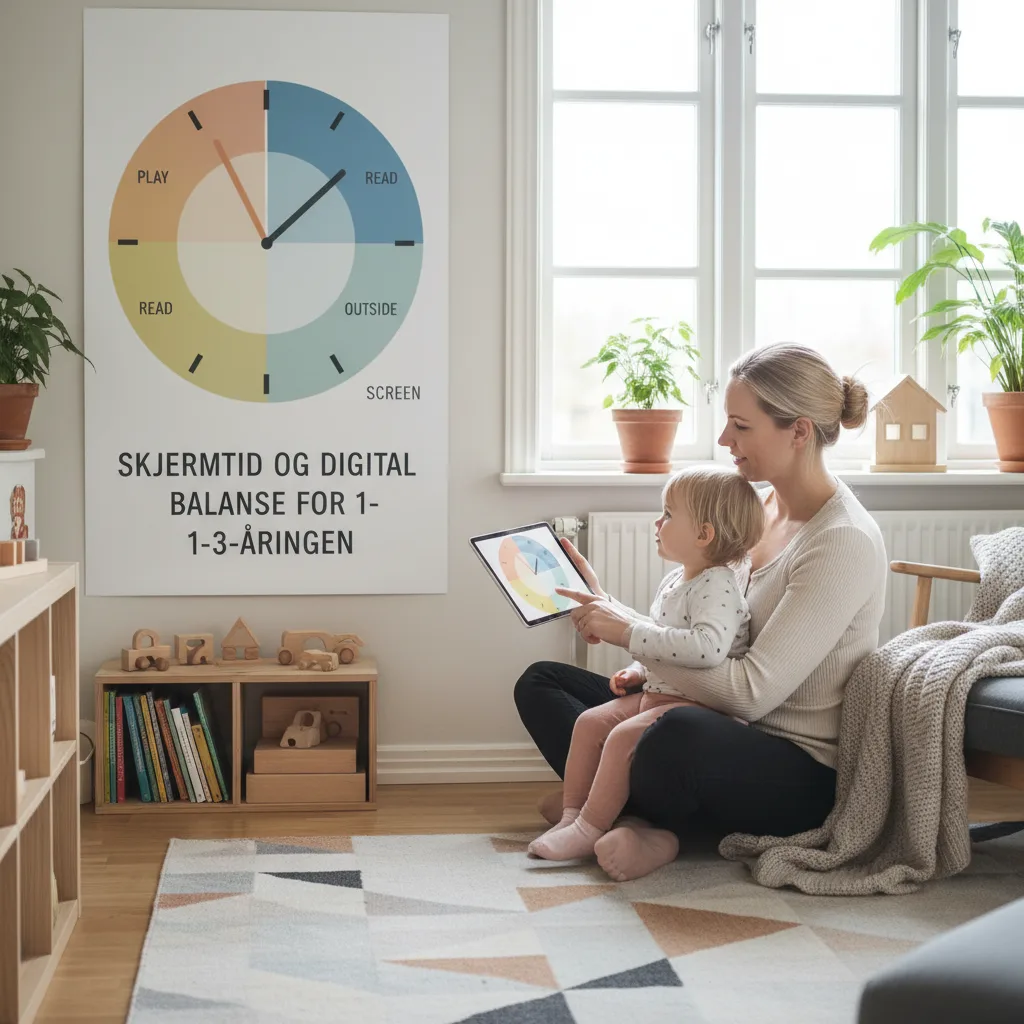
Co-viewing, watch together
When you watch screens together with your child, you can:
- Point and name things: "Look, there's a red ball! What is Bluey doing now?"
- Connect content to your child's life: "We have a dog too, just like that one!"
- Ask questions: "What do you think will happen next?"
- Pause and talk about what you're watching
Research shows that children who watch TV with an adult who comments and asks questions learn more than children who watch alone. The screen becomes a starting point for conversation, not a replacement for it.
Apps designed for learning
Some apps are genuinely good for toddler development:
- Drawing apps where the child creates something
- Puzzle apps with age-appropriate difficulty
- Music apps where the child can play instruments
- Books with audio that the child can browse independently
Avoid apps with advertising, in-app purchases, or endless scrolling.
PBS Kids is free, ad-free, and produced for young children. The content is carefully curated and age-appropriate, one of the safest options for toddlers.
Practical strategies for digital balance
1. Set clear rules, and stick to them
Decide on a framework that works for your family:
- "We watch the tablet after dinner, before bath time"
- "Screens only in the living room, never at the table"
- "You can choose one episode, and then we're done"
When the rules are predictable, there's less fighting over the screen.
2. Use a timer
Set a timer the child can see. When it goes off, screen time is over. Give a warning two minutes before: "Screen time is almost done. After this episode."
3. Have alternatives ready
It's easier to turn off the screen when something else exciting is waiting:
- "Now we're going to play in the bathtub!"
- "Shall we sing your favorite song?"
- "Do you want to help me with dinner?"
4. Avoid using screens as reward or punishment
When screens are used as a reward ("If you finish your food, you can watch the tablet"), the screen's perceived value increases in the child's eyes. This makes it harder to regulate use.
5. Be a good role model
Children copy what adults do. If you're on your phone all evening, it's hard to explain to your child that screen time should be limited.
- Put your phone away during meals
- Take a "phone break" during playtime with your child
- Show that you read books, go outside, and do other things
Screens on trips and during illness
Let's be honest: some situations call for pragmatic solutions.
Long trips
- Download episodes and apps in advance (no internet needed)
- Also pack books, drawing supplies, and small toys
- Alternate between screens and other activities
- Use headphones (with volume limits for children)
When the child is sick
A sick child lying on the sofa with a fever may benefit from extra screen time. It's an exceptional situation, and you don't need to feel guilty about it.
Car trips: Keep a "car bag" with small items that are only used in the car. A magnetic doodle board, picture books, and snacks can provide just as much entertainment as a tablet. Save the screen for the final stretch.
What research says about consequences
Let's look at what we actually know, and what we don't.
What we know
- Too much passive screen time can displace time the child would otherwise spend on active play, reading, and social interaction
- Screen use right before bedtime can interfere with falling asleep (blue light suppresses melatonin)
- Rapid editing and high-tempo videos can make it harder for the child to concentrate afterward
- Background TV (TV on with no one actively watching) can disrupt a child's play and concentration
What we don't know
- Whether moderate screen time (within guidelines) has any long-term negative effects
- Whether the difference between types of content (educational vs. entertainment) has lasting significance
- Whether children who use screens together with adults have any negative effect at all
Perspective: Television has been in family homes since the 1950s. The children who grew up watching Saturday morning cartoons turned out just fine. Screens are new, but concern about new media is old. The key is balance and presence.
Sleep and screens
One of the most concrete recommendations concerns screens and sleep:
- No screens in the last hour before bedtime. Blue light from screens suppresses melatonin production
- No screens in the bedroom. No TV, tablet, or phone
- Calming activities instead. Reading, singing, cuddling, and quiet play help the child wind down
For more tips on sleep routines, use the Sleep Tracker to follow your child's sleep patterns.
Frequently asked questions
Does a video call with grandparents count as screen time?
No, most experts exempt family video calls from screen time recommendations. Video calls are interactive and social, which distinguishes them from passive screen use.
My child has a meltdown every time I turn off the screen. What do I do?
Give advance warnings: "Two more minutes, then we're done." Have a fun activity ready immediately afterward. Stay consistent, if you give in sometimes, the child learns that screaming works. Read more in setting limits for toddlers.
Is YouTube Kids bad?
YouTube Kids has better filtering than regular YouTube, but content quality varies. The autoplay and recommendation system can lead the child to content that isn't ideal. Prefer downloaded episodes or curated apps.
What about e-books, is that screen time?
E-books with audio that you read together are closer to book reading than passive screen time. But physical books provide a richer sensory experience (turning pages, pointing, touching). Use both.
Can screen time delay language development?
Research suggests that passive screen use (child watching alone, without dialogue) can displace time that would otherwise be spent in conversation. But active, conversational screen use (co-viewing) can stimulate language. The key is interaction.
Read more
- Play and development for toddlers
- Sleep tracker. Follow your child's sleep patterns
Sources
- WHO, guidelines on physical activity and sedentary behaviour for children under 5
- American Academy of Pediatrics, screen time guidelines
- Common Sense Media, screen time research
🔧 Helpful Tools
- Baby Milestones Tracker. Track your baby's developmental milestones
- All Baby Tools. Browse all free tools for pregnancy and baby care
📖 Related Articles
- Quality Screen Time: How to Choose Good Content for Toddlers. Guide to quality-checked screen content for young children. Age ratings, interactive vs passive screen time, and what the research says.
- ADHD Signs in Toddlers: What Parents Should Look For. Learn about ADHD signs in toddlers. What's normal active behavior, when should you seek help, and how does evaluation work? A guide for parents.
- ADHD Signs in Toddlers: What Should Parents Look For?. Learn about ADHD signs in toddlers. What is normal active behavior, when should you seek help, and how does assessment work in Norway? Guide for parents.