It's half past four. Dinner isn't ready, you have a hungry toddler at your feet, and the remote control is the only thing that can buy you twenty minutes. Welcome to reality. The question is not whether your child will ever watch something on a screen, but what they watch.
Not all screen time is equal. A calm program with recognizable situations and clear language is something entirely different from fast-paced YouTube clips with constant stimulation. Here is how to choose good screen content for toddlers, without the guilt.
What Do Researchers and Health Organizations Say?
The World Health Organization (WHO) and the American Academy of Pediatrics (AAP) recommend avoiding screen time for children under 18-24 months, with the exception of video calls. For children over 2, it's less about how long and more about what they watch. Experts consistently point out that the quality of the content matters far more than the number of minutes.
💡 Tip: Use our Milestones tracker to follow your baby's developmental goals.
For toddlers over 2, research increasingly shows that the quality of content is far more important than duration.
Passive vs Active Screen Time
Not all screen time works the same way in a young brain:
- Passive screen time: The child sits and watches without participating. Fast cuts, constant scene changes, loud sound. Little learning benefit.
- Active screen time: The child answers questions, sings along, points, talks. The program invites participation.
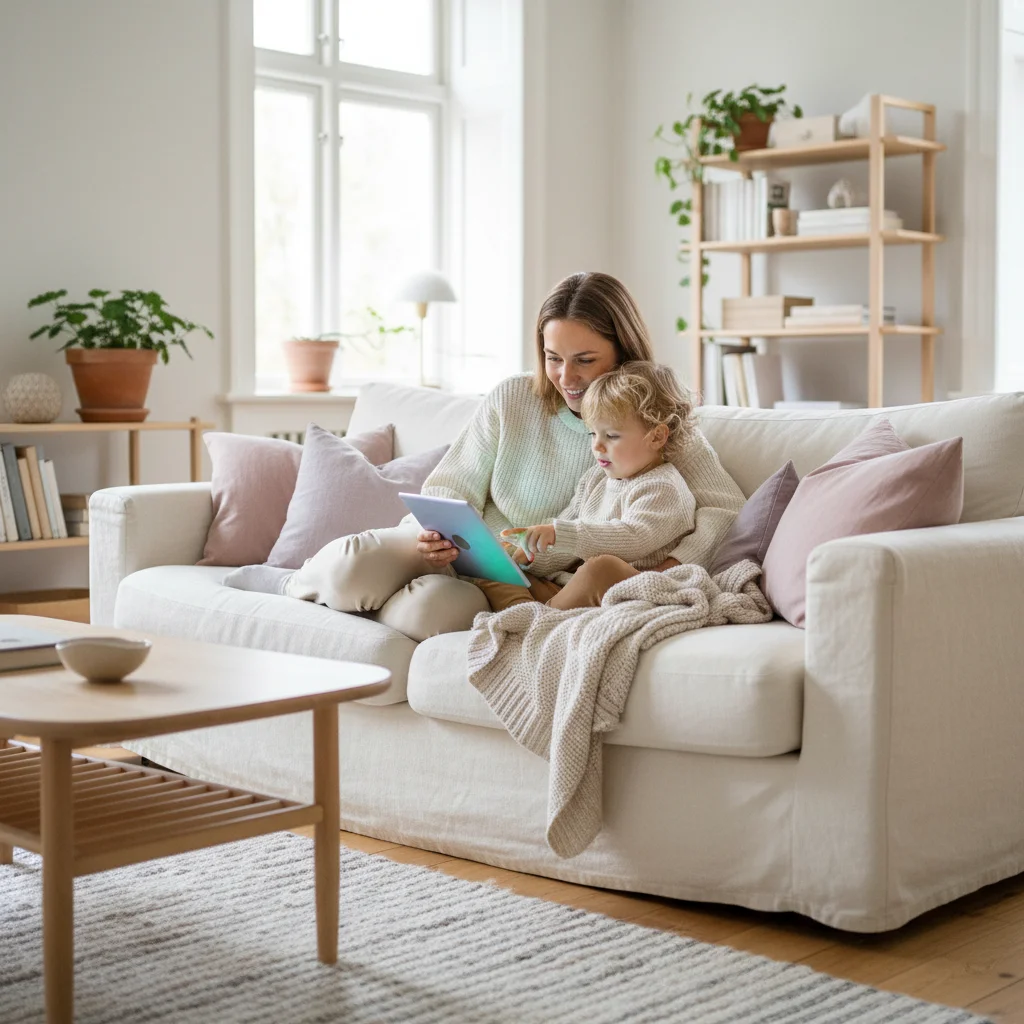
- Co-viewing with adults: You watch together, comment, and talk about what you see. This consistently shows the best learning effects.
Research from the AAP shows that children learn more from screen content when an adult is present and talks about what they see. Make it a shared activity whenever possible.
What Makes a Good Children's Program?
When assessing whether a program is good for your child, look for these qualities:
Calm Pace and Clear Storytelling
Good children's programs have slow scene changes, clear voices, and simple storylines. The child should have time to understand what's happening before the next scene starts. Programs with constant effects and fast cuts overstimulate without teaching.
Recognizable Situations
The best programs show situations the child recognizes: going to bed, eating, playing with friends, feeling afraid, getting angry. This helps the child understand their own feelings and experiences.
Language Stimulation
Good children's programs use clear language, repeat words, ask questions, and allow pauses where the child can respond. Programs in your child's home language are particularly valuable for language development.
Values You Agree With
Pay attention to what values the program conveys. Kindness, cooperation, curiosity, and empathy are good signs. Programs where conflicts are resolved through dialogue rather than aggression build social skills.
Watch the first episodes yourself before showing them to your child. Ten minutes gives you a good sense of pace, language, and content. If you're completely bored, it's probably too simple. If you think it moves too fast, your child definitely will too.
Highly Recommended Programs for Toddlers
Bluey (Disney+/ABC Kids)
An Australian animated series about family life, recommended by educators worldwide. Calm pace, rich language, relatable family situations. Suitable from about age 2.
Daniel Tiger's Neighborhood (PBS Kids)
Based on the Mister Rogers' Neighborhood universe. Explicitly designed around emotional learning. Each episode focuses on a specific feeling or social situation.
Sesame Street (PBS Kids/HBO Max)
A classic with strong educational foundations. Clear language, diverse characters, and a healthy mix of entertainment and learning.
Other Strong Choices
- Peppa Pig, short episodes, simple language, everyday situations
- Tumble Leaf (Amazon), calm nature exploration with a gentle pace
- Hey Duggee, simple stories, excellent humor, strong emotional content
Use caution with YouTube for the youngest children. The recommendation algorithm can lead to content that looks child-friendly but has inappropriate elements. If you use YouTube, choose YouTube Kids with parent-controlled content, and ideally watch together with your child.
Practical Rules for Screen Time in Daily Life
Rules make screen time easier for the whole family. Here are some that work:
- Set specific times. Let screen time become a routine rather than something the child asks about all day. For example, 20 minutes while dinner is being prepared.
- Choose in advance. Have two or three programs ready that you know are good. Avoid "browse mode" where the child scrolls through options.
- Natural ending. Choose programs with clear episode endings. Give notice in advance: "We're watching two episodes, then that's it."
- Talk about it afterward. "What did the characters do today?" A short conversation afterward reinforces what the child has seen.
- Never as a sleep aid. Screens before bedtime disrupt sleep quality. Switch off at least 30 minutes before bedtime.
Read more about screen time for children for a thorough overview of recommendations and boundaries, and see the latest guidance on screen time for updated research.
When Screens Are Perfectly Fine
Let's be honest: some days screens are a lifesaver. When you're sick, exhausted, or just need to cook in peace, 20-30 minutes of good content is absolutely fine. No child is harmed by this.
Guilt and shame around screen time help no one. What matters is the overall shape of everyday life: that your child plays freely, spends time outside, reads books, and is with adults who talk with them. Screens are one small part of a much bigger picture.
Frequently Asked Questions
From what age can my child watch children's TV?
The WHO and AAP recommend avoiding screens for children under 18-24 months, with the exception of video calls. From age 2, short sessions with quality content can work well. Start with 10-15 minutes and see how your child responds.
Is there a difference between TV and a tablet?
Content matters more than the device. But a tablet gives the child the ability to tap and switch themselves, which can lead to restless "scrolling behavior" without watching anything through. TV with one chosen episode often provides better focus for toddlers.
What do I do if my child protests strongly when I turn it off?
Prepare the child: "After this episode, we're done." Give a brief transition: "Now we're switching off, and then we can read a book / build with blocks." Consistent follow-through over time makes the transition easier. The protest will decrease after a few days with a regular routine.
Are there good apps for toddlers?
Yes. PBS Kids, Sesame Street Go, and Khan Academy Kids are ad-free and age-appropriate. Look for apps with clear educational content and no in-app purchases. Avoid apps with advertising or reward systems.
Read More
Sources: WHO. Screen Time for Children, AAP. Screen Time Guidelines, PBS Kids Research
Last updated: March 2026
Sources
- AAP. Developmental milestones for children
- CDC. Learn the Signs. Act Early., milestone tracking
- WHO. Child health and development
🔧 Helpful Tools
- Baby Milestones Tracker. Track your baby's developmental milestones
- Development Leaps. Understand your baby's developmental leaps
- All Baby Tools. Browse all free tools for pregnancy and baby care
📖 Related Articles
- Screen Time and Digital Balance for Toddlers (1–3 Years). How much screen time is appropriate for toddlers? Updated guidelines and practical tips for digital balance in everyday family life.
- ADHD Signs in Toddlers: What Parents Should Look For. Learn about ADHD signs in toddlers. What's normal active behavior, when should you seek help, and how does evaluation work? A guide for parents.
- ADHD Signs in Toddlers: What Should Parents Look For?. Learn about ADHD signs in toddlers. What is normal active behavior, when should you seek help, and how does assessment work in Norway? Guide for parents.